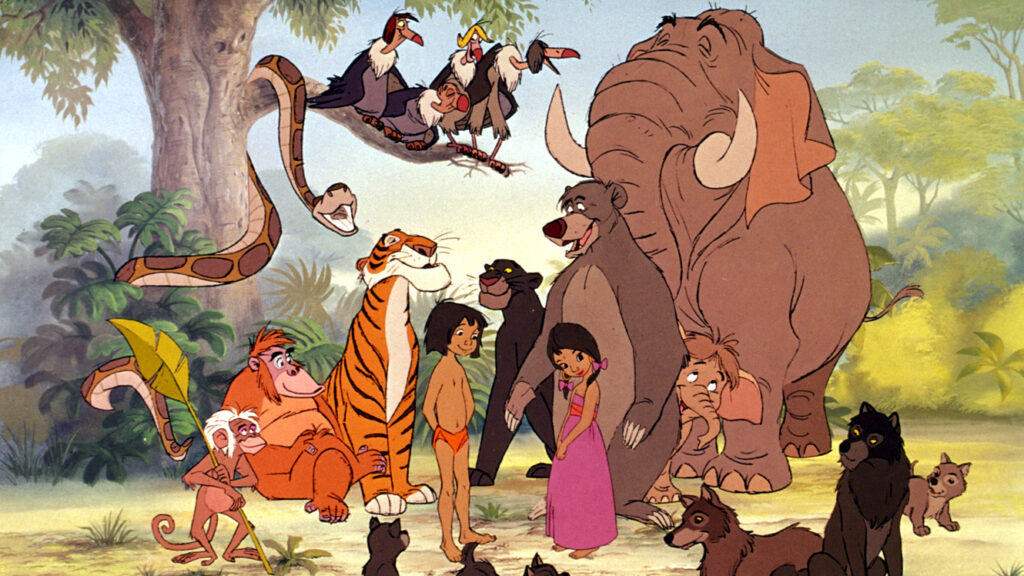
The first Jungle Book article argued that the story is a map of becoming: how seamless presence gets pushed into category, survival, law, and social mirror until a time-bound self takes shape. But the film does more than show that identityThis — IdentityThis names the formed identity: the body, role, image, wound, belief, or story claimed as what the self is.Read full entry → forms.
It shows the instruments that form it.
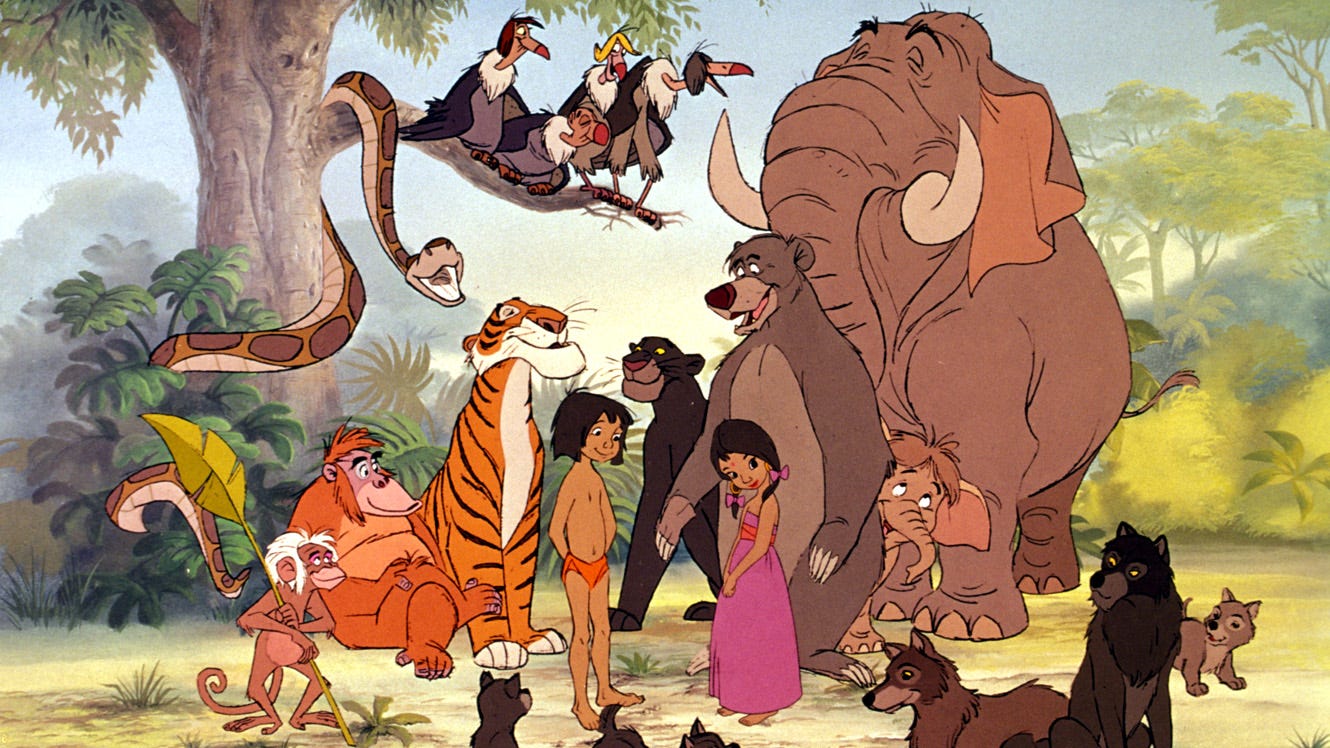
If the first piece mapped the field, this one names the tools. Kaa, King Louie, and man’s red fire reveal that the false self is not built by fear alone. It is completed by fascination, imitation, and the promise of control.
Kaa and the Capture of Attention
Shere Khan is obvious danger. Kaa is subtler.
Kaa does not first threaten Mowgli into becoming a self. He captures his attention. He replaces direct presence with a moving image that feels more compelling than reality itself. That is why the snake matters.
In Geomytha, this is one of the purest forms of capture: not brute force, but fascination. Awareness stops resting in itself and begins orbiting an object. The center shifts. Presence no longer holds attention. Attention now serves the image.
That is the deeper meaning of Kaa’s hypnosis. He is not merely deception. He is the mechanics of image-capture.
This is how identity begins to harden. Not only through fear of what might happen, but through fascination with what appears. The self is not just pressured into existence. It is enchanted into existence.
Why Kaa Is the Hinge
Even the name feels like a clue.
Not as a historical claimI — ClaimI names claim: the interruption by which reflected presence is taken as mine.Read full entry →, but as symbolic logic, Kaa sounds like a hinge-syllable, a middle operation, a transfer point. That makes him especially suggestive alongside the middle sound in mer-ka-ba.
Read through Geomytha, mer-ka-ba can be taken as the vehicle by which awareness becomes mobile, formed, and projected. In that sense, ka is the animating middle, the subtle transfer by which direct being becomes image-bearing experience. Kaa comports with that almost perfectly.
He is the serpent at the hinge.
He is not the whole vehicle. He is the middle mechanism: the soft turning of awareness away from itself and toward what it sees.
King Louie and the Counterfeit Ascent
If Kaa shows how awareness is captured, King Louie shows what identity wants once it has already accepted mediation as reality.
Louie does not want peace. He wants upgrade.
“I wanna be like you” is one of the clearest confessions in the film. It is identity admitting that it believes being can be obtained by copying form. Essence is treated like something external: a trick to learn, a power to steal, a symbol to possess.
That is counterfeit ascent.
In Geomytha, counterfeit ascent happens whenever the self tries to reach authenticity through acquisition. Instead of remembering the ground directly, it looks for a method, a credential, a secret, or a performance that will make it real.
King Louie is therefore not just comic relief. He is mimetic ego in royal form. He is the unstable self trying to turn imitation into sovereignty.
He does not want sourceIs — SourceIs names unclaimed being: awareness before possession, distinction, or identity.Read full entry →. He wants the advantages source seems to provide.
Why He Wants Red Fire
That is why Louie wants man’s red fire.
Red fire is the missing bridge between imitation and dominion. The monkeys can mimic. They can chatter, gather, and copy. But they cannot stabilize rule. They lack the power that turns intelligence into command.
In Geomytha, red fire strongly comports as forethought made operative.
Not simple thinking.
Not imagination in its harmless form.
But abstraction converted into leverage.
Fire is the human power to project ahead, manipulate conditions, and reorder life by technique. It is what lets man move from participation to control. It is not evil because it destroys. It is more dangerous than that. It works.
That is what makes it sacred to the false self.
Once fire appears, presence begins to look weak. Surrender looks naïve. Technique becomes ultimate. Experience becomes material for reconfiguration. Identity becomes operator.
That is why Louie wants it. He wants the force that would let mimicry harden into kingship.
Why the Fire Is Red
The color matters.
Red belongs to the Setian side of the symbolic field: the harsh land, the cutting force, the power that separates, defines, and dominates. Fire carries that same signature. It divides, transforms, and masters. It is the promise that thought can do more than interpret the world. It can remake it.
That is why red fire is more than flame. It is a metaphysics.
It tells consciousness:
You do not need to trust the field.
You can command it.
You do not need to remember the center.
You can construct one.
You do not need to remain in relation.
You can rule.
That is SetSetIn Geomytha, Set names the claimant: I — the interruption by which reflection is taken as mine and converted toward ownership.Read full entry →’s promise in its refined form.
Power does not always overthrow being through violence. Sometimes it simply makes being look insufficient.
The Sequence the Film Reveals
Taken together, Kaa, Louie, and red fire form a precise sequence:
First, awareness is captured by image.
Then identity seeks essence through imitation.
Then abstraction becomes power.
That is one of the clearest formulas for false-self formation in the story.
Kaa says: leave directness and follow the image.
Louie says: acquire the secret and become more than you are.
Fire says: convert thought into dominion.
That is not just characterization. It is a process.
Presence becomes entranced.
Entrancement becomes mimicry.
Mimicry seeks leverage.
Leverage stabilizes identity.
By the time law, tribe, and village consolidate the self, the deeper displacement has already happened.
Why This Is First Quarter · Form
This is why the article belongs to First Quarter · Form.
The first Jungle Book piece showed the environment of becoming. This one shows the sharper mechanism. It isolates the forces that give the self contour: hypnosis, imitation, and tool-power. TheseThese — AccumulationThese names accumulation: possessions, titles, achievements, beliefs, communities, and other extensions gathered around identity.Read full entry → are not merely stirring forces. They are form-making forces. They define, sharpen, and establish.
That is First Quarter logic.
Kaa gives identity its image-capture.
Louie gives it its ambition.
Fire gives it its leverage.
This is where becoming stops being diffuse and starts taking shape.
The Question Left Hanging
That is why The Jungle Book persists.
It does not merely encode the fact that presence becomes identity. It shows the seductions that make that becoming feel inevitable, desirable, and powerful.
The self is not only threatened into existence. It is enchanted into existence.
It is not only categorized into existence. It is tempted into existence.
It is not only protected by structure. It is offered dominion.
And so the question becomes sharper than before:
Once awareness has been captured by image, imitation, and fire, can presence still be remembered inside what has been formed?