Every kingdom has a border.
Every tribe has an outsider.
Every religion has a heretic.
Every nation has a foreigner.
Every hero has a villain.
The pattern is so common that it appears natural. Most people assume enemies arise because differences exist. One group believes one thing. Another group believes something else. Conflict follows.
Yet beneath the visible differences lies a deeper question.
Why does identityThis — IdentityThis names the formed identity: the body, role, image, wound, belief, or story claimed as what the self is.Read full entry → so consistently create an outside?
The answer may begin with a sentence.
First comes:
I am thisThe False-Self Sentence — I Am ThisThe false-self sentence forms when claim joins reflection to a fixed object of identity: I am this.Read full entry →.
Then comes:
These are mineThese — AccumulationThese names accumulation: possessions, titles, achievements, beliefs, communities, and other extensions gathered around identity.Read full entry →.
Sooner or later a third sentence appears.
Those are notThose — ProjectionThose names projection: enemies, outsiders, competitors, threats, and disowned qualities placed beyond the identity boundary.Read full entry →.
The outsider is born.
The movement is ancient.
A child points at a toy and says, “Mine.”
Moments later another distinction emerges.
Not mine.
The first border appears.
Identity has begun drawing a map.
At first the map seems harmless.
This toy.
That toy.
This room.
That room.
This family.
That family.
Yet the same structure scales upward through every level of human life.
The self becomes a tribe.
The tribe becomes a nation.
The nation becomes an empire.
Each expansion requires a boundary.
Each boundary creates an outside.
Ancient EgyptEgyptAncient Egyptian cultural and mythic field referenced by the essay.Read full entry → understood this dynamic well.
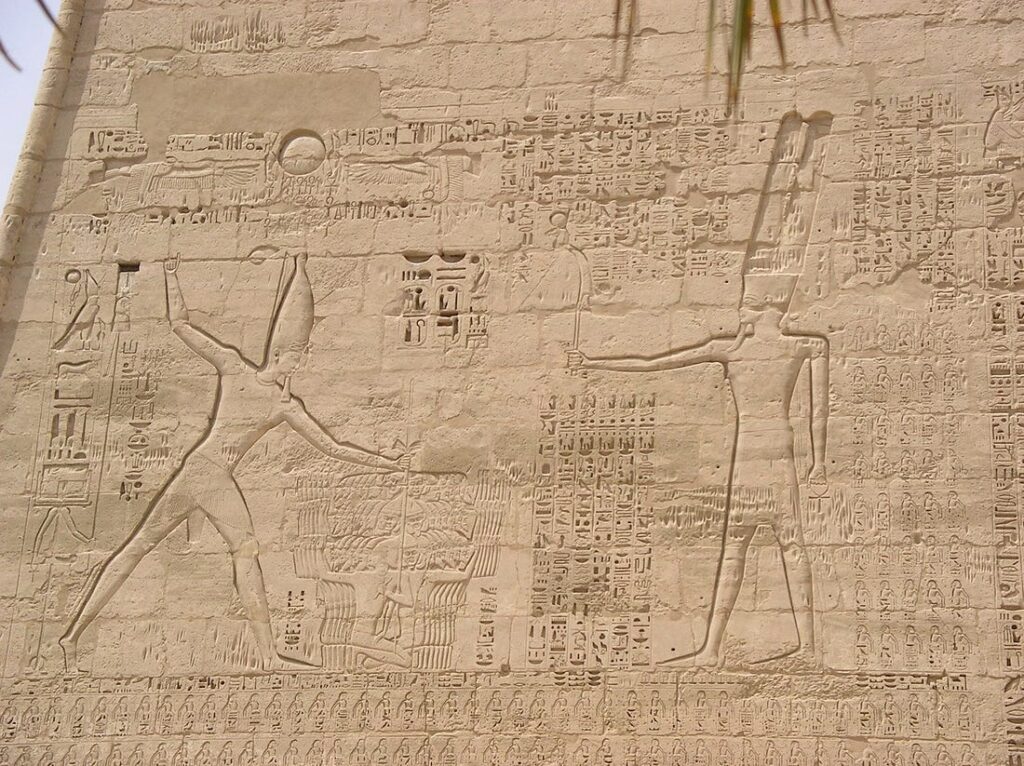
Throughout Egyptian art, pharaohs are frequently shown standing above defeated enemies. Foreign peoples appear beneath royal feet. Captives kneel before kings. The symbolic message is not merely military victory. It is the establishment of order through distinction.
The kingdom knows itself because something exists beyond the kingdom.
Egypt had a name for this collection of outsiders.
The Nine Bows.
The Nine Bows represented the enemies of Egypt, the peoples beyond the ordered world of the Nile. The exact groups changed across history, but the symbolic function remained.
Order required an outside.
The kingdom required an other.
The same pattern appears throughout myth.
Cain and Abel begin as brothers.
Before there are nations, religions, or armies, there is a division.
Two offerings.
Two identities.
Two stories.
One becomes favored.
The other becomes threatened.
The first enemy emerges.
The conflict is not really about sacrifice.
It is about identity.
Whose story matters?
Whose place is secure?
Who belongs?
Who does not?
The pattern repeats again and again.
The Greeks had barbarians.
The Romans had barbarians.
The Chinese had barbarians.
Civilizations often define themselves by what they are not.
The outsider becomes part of the identity of the insider.
Without the border, the self begins to blur.
This is why enemies are so useful.
They simplify identity.
A hero becomes easier to understand when a villain appears.
A nation becomes easier to define when a rival exists.
A religion becomes easier to defend when a heretic emerges.
The enemy provides contrast.
The enemy sharpens the boundary.
The enemy stabilizes the story.
This is one reason myths are filled with monsters.
Dragons.
Giants.
Demons.
Serpents.
Beasts beyond the wall.
Whether it is Grendel outside the hall, the dragon outside the villageThe Village — The PrisonerThe controlled settlement in the television series The Prisoner.Read full entry →, or the monster beyond civilization, the symbolic function remains similar.
The creature beyond the border helps define what exists within it.
The same mechanism operates in modern life.
Politics offers an obvious example.
People often imagine they are defending policies.
Yet much of political conflict concerns identity.
Once someone says:
These are my beliefs.
The next sentence often appears automatically.
Those people are the problem.
The details change.
The structure remains.
Religion can operate the same way.
Nationality can operate the same way.
Sports can operate the same way.
Even personal relationships can operate the same way.
The identity becomes stronger when an opposing identity appears.
This is where the idea of the shadow becomes useful.
The qualities rejected within ourselves often appear outside ourselves. Traits we refuse to acknowledge internally become easier to recognize in enemies, rivals, opponents, and strangers.
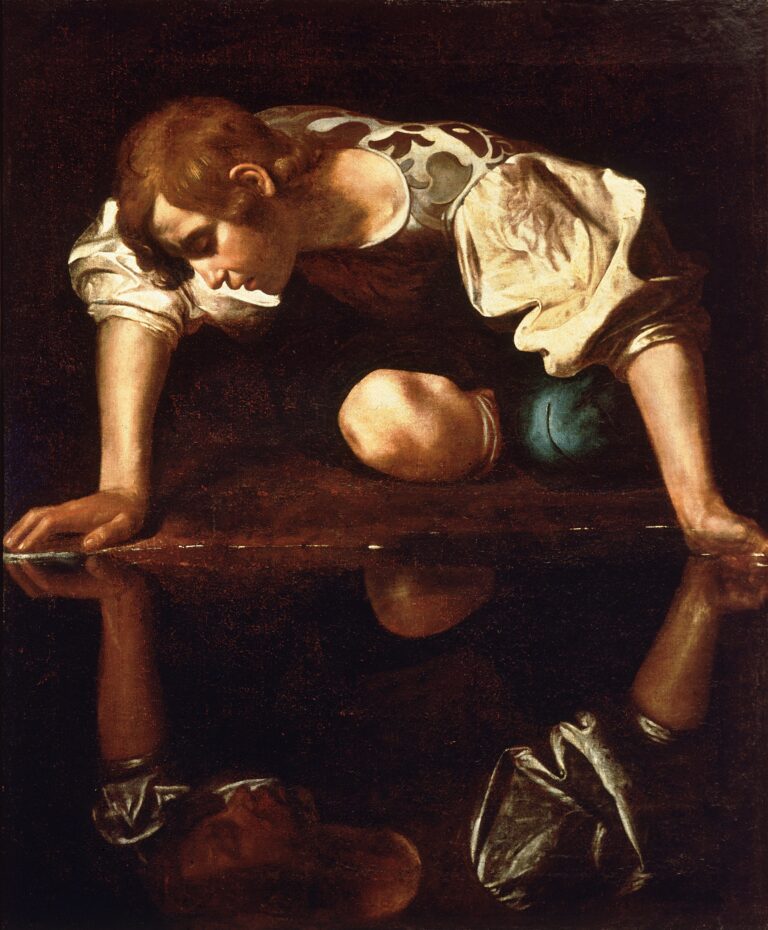
The enemy becomes a mirror.
The border becomes a projection screen.
The conflict appears external while partly originating within.
This does not mean every enemy is imaginary.
Some threats are real.
Some dangers are real.
Some conflicts are unavoidable.
The point is not that all enemies are inventions.
The point is that identity often depends upon enemies for stability.
A kingdom with no outside begins asking uncomfortable questions about itself.
A tribe with no rival begins examining its own contradictions.
A story without a villain becomes more difficult to maintain.
The enemy provides structure.
The enemy provides certainty.
The enemy provides direction.
This is why entire systems can become dependent upon opposition.
The rival becomes necessary.
The conflict becomes self-sustaining.
The border becomes sacred.
Yet something strange happens when the mechanism becomes visible.
The enemy does not necessarily disappear.
Differences do not vanish.
Boundaries do not cease to exist.
What changes is the spell.
The outsider is no longer carrying the entire burden of identity.
The enemy is no longer responsible for defining the self.
The border softens.
The projection weakens.
The kingdom begins seeing the purpose the enemy once served.
The same movement that produced:
These are mine
also produced:
Those are not.
The second sentence is not separate from the first.
It is the shadow cast by it.
The releaseReturn — RemembranceReturn names remembrance and release: the loosening of possession so reflection can become transparent to source again.Read full entry → begins when that relationship is noticed.
Not because all distinctions vanish.
Not because all conflicts end.
But because the need for an enemy begins to loosen.
And when that happens, the kingdom discovers something surprising.
Its deepest foundation was never the enemy standing outside the wall.
It was the identity standing within it.