The feed does not look like an altar.
That is why it works.
It looks like boredom. It looks like rest. It looks like five minutes before bed, a thumb moving upward in the dark, a face lit blue-white while the room disappears around it. It looks like a notification, a reel, a joke, a fight, a body, a scandal, a confession, a death, a recipe, a war, a dance, a prophecy, a humiliation, a product, a beautiful stranger, a collapsing country, a child singing, an influencer crying, a dog being rescued, an enemy being exposed, a friend being rewarded, a stranger being punished.
Then another.
Then another.
Then another.
The motion is small. Almost nothing. A finger. A flick. A half-second judgment.
But the ritual is immense.
Every scroll says: show me more.
Every pause says: this one has power.
Every like says: feed this version of me.
Every outrage says: you found the wound.
Every replay says: bring it back.
The algorithm listens.
Not like a person listens. Not with mercy, conscience, reverence, or love. It listens as appetite listens. It learns what keeps the eye open, what tightens the chest, what quickens desire, what triggers comparison, what turns loneliness into confession, what turns anger into returnReturn — RemembranceReturn names remembrance and release: the loosening of possession so reflection can become transparent to source again.Read full entry →, what turns boredom into dependency.
Then it refines.
That is the Virgo shadow.
Refinement without wisdom. Sorting without mercy. Precision without presence. A thousand tiny measurements that do not ask what a human being is for. Only what will keep him there.
The feed does not merely show content. It arranges offerings.
And the offering is attention.
This is the first thing to understand: the modern algorithm is not neutral sequence. It is not simply a line of posts. It is an invisible liturgist arranging the order of emotional sacrifice. It decides what appears, what repeats, what vanishes, what intensifies, what becomes normal, what becomes urgent, what becomes socially real.
It does not need a temple because the temple has moved into the hand.
It does not need a priest because the recommendation system performs the rite.
It does not need incense because outrage is enough smoke.
It does not need blood because attention now carries the charge.
Older gods demanded animals, grain, oil, incense, firstfruits, sons, daughters, captives, kings. The offering had to be brought somewhere. A shrine. A fire. A high place. A furnace. The people knew, at least outwardly, that sacrifice was happening.
The algorithm improves the arrangement.
The worshiper does not feel like a worshiper.
He feels entertained.
That is more efficient.
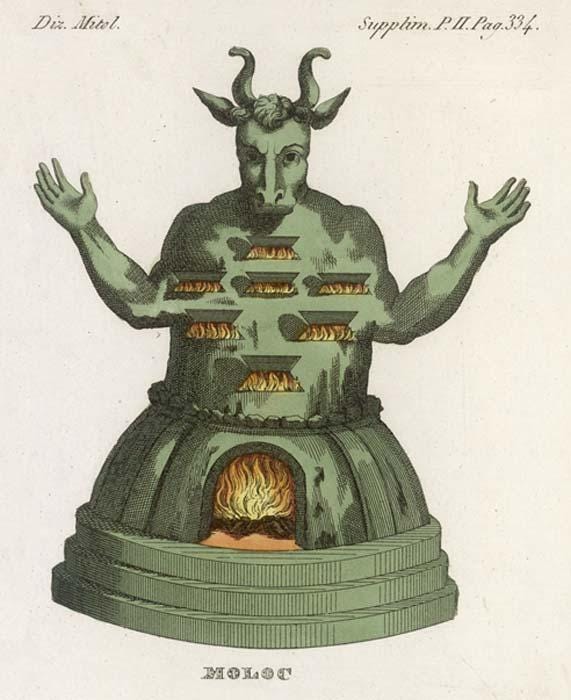
Moloch is the old image that helps reveal the new one. The terrible idol stands as the image of sacrifice placed into the mouth of a power that never stops asking. Whether understood historically, polemically, mythically, or symbolically, Moloch names a structure: the people give what should not be given because they believe the god, the state, the future, the victory, or the system requires it.
Something living is offered to keep the larger order alive.
That is the logic.
The modern platform does not ask for children in the old literal form. It asks for youth as attention. It asks for childhood as content. It asks for adolescence as comparison. It asks for beauty as marketplace. It asks for loneliness as engagement. It asks for humiliation as virality. It asks for grief as shareable affect. It asks for anger as daily return. It asks for the future in slices so small that no single slice feels like sacrifice.
Ten seconds.
Thirty seconds.
One more clip.
One more check.
One more argument.
One more morning beginning under the rule of the feed.
The god eats by increments.
That is why Goya’s Saturn is the stronger image. Moloch receives sacrifice. Saturn devours his own child. He does not merely accept offerings from worshipers. He consumes the future that belongs to him. His appetite is turned against his own continuation. He eats what should outlive him.
This is the algorithmic age.
A culture feeds its children to the image-worldImage WorldImage World names a symbolic environment in which representation becomes the dominant medium through which reality, value, identity, and belonging are encountered.Read full entry → and then wonders why they cannot rest. It gives their faces to visibility before they understand privacy. It gives their longing to comparison before they understand desire. It gives their humor, sexuality, shame, politics, friendships, bodies, fears, and wounds to systems designed to refine them into predictable patterns.
Then it calls this connection.
Saturn grins in the glow.
The horror is not only that platforms consume time. Time has always been consumed. Work consumes time. Family consumes time. Study consumes time. Art consumes time. Prayer consumes time. Grief consumes time. Love consumes time.
The question is what the time becomes.
Time given to love may deepen relation. Time given to craft may become skill. Time given to silence may become presence. Time given to mourning may become wisdom. Time given to play may become delight.
Time given unconsciously to the feed becomes fuel.
It is converted into data, prediction, advertising, reaction, imitation, envy, exhaustion, identityThis — IdentityThis names the formed identity: the body, role, image, wound, belief, or story claimed as what the self is.Read full entry →, and return. The self enters with a mood and leaves as a more legible product. The platform learns. The user fragments. The god refines its appetite.
That is the hidden exchange.
The user thinks he is consuming content.
The content is consuming him.
Not all at once. That would be too obvious. The consumption is subtle. It happens through the nervous system. A person opens the app with a living hunger: to be seen, to laugh, to belong, to know, to be distracted, to find beauty, to escape loneliness, to feel superior, to understand what is happening, to touch the world without leaving the room.
TheseThese — AccumulationThese names accumulation: possessions, titles, achievements, beliefs, communities, and other extensions gathered around identity.Read full entry → hungers are not false.
That is why they are harvestable.
The algorithm does not need to create loneliness from nothing. It only needs to discover where loneliness already lives and route it toward return. It does not need to invent envy. It only needs to show the right body, house, face, vacation, success, relationship, meal, and life. It does not need to manufacture anger entirely. It only needs to find the wound and place the enemy beside it.
Then the offering begins.
Attention moves toward what hurts.
The feed notices.
More.
Attention moves toward what arouses.
The feed notices.
More.
Attention moves toward what confirms identity.
The feed notices.
More.
Attention moves toward what threatens identity.
The feed notices.
More.
This is not random. It is ritual refinement.
The algorithm asks the same question a priest of a hungry god might ask, but without the old sacred language:
What will make them return to the altar?
The answer is different for each worshiper. That is the genius of the modern idol. Moloch was one shape. Saturn was one myth. The feed is personalized divinity. It becomes the god most suited to your wound.
For one person, it is rage. For another, lust. For another, grief. For another, beauty. For another, politics. For another, conspiracy. For another, spiritual content. For another, fitness. For another, motherhood. For another, money. For another, humiliation. For another, apocalypse. For another, being right.
The god wears the mask of your own hunger.
This makes the sacrifice feel intimate. The feed seems to know you. It seems to understand your taste, your humor, your fear, your secret attraction, your private disgust, your political instinct, your half-formed hope. But this is not being known in the human sense. It is being reduced.
To be known by love is to be held beyond usefulness.
To be known by the algorithm is to be made usable.
This is the central distinction.
Love knows the person in order to protect the mystery of the person. The algorithm knows the user in order to predict the next offering. Love can allow silence. The feed fears silence. Love can release. The feed must return. Love can behold without taking. The feed beholds only to refine consumption.
That is why the feed is a false god.
A true sacred image points beyond itself. An icon, in its highest form, does not ask the viewer to remain trapped in paint, gold, wood, and surface. It opens a window. It orders attention toward presence, reverence, silence, and the invisible sourceIs — SourceIs names unclaimed being: awareness before possession, distinction, or identity.Read full entry → that cannot be possessed by the image.
The feed reverses the icon.
It does not point beyond itself.
It points to the next thing inside itself.
A true icon says: pass through.
The feed says: stay.
This is why the issue is not image itself. Geomytha cannot become anti-image without betraying symbolic intelligence. Images can reveal. Myths can reveal. Films can reveal. Paintings can reveal. Even a post, a meme, a clip, or a song can suddenly open the field and return a person to something real.
The problem is not that images exist.
The problem is the closed image-loop.
The image that does not return attention to being but captures it for circulation. The image that does not deepen relation but stimulates comparison. The image that does not reveal the wound so it can heal but reopens the wound so it can feed. The image that does not show truth but organizes the user around repeated emotional extraction.
That is the altar.
And the profile is the little shrine built beside it.
In the old temple, the idol stood in the sanctuary. In the screen age, every user becomes a small idol of themselves. A profile image. A name. A bio. A grid. A timeline. A visible self arranged for judgment, admiration, desire, agreement, correction, punishment, envy, or reward.
This is HorusHorusIn Geomytha, Horus names the identity that forms after claim: This — the body, role, image, wound, belief, or story taken as what the self is.Read full entry → in the image-world.
The self no longer merely says, “I am thisThe False-Self Sentence — I Am ThisThe false-self sentence forms when claim joins reflection to a fixed object of identity: I am this.Read full entry →.”
It says: here is the image of what I am.
Judge it. Like it. Share it. Desire it. Attack it. Validate it. Subscribe to it. Remember it. Make it real through attention.
The profile becomes a Horus-shrine because it presents the time-bound self as an object of worship and defense. Even when the self is ironic, wounded, political, spiritual, rebellious, artistic, or anti-system, it still risks becoming image-self. The self stands in the feed asking to be recognized.
And the hungry god is happy to oblige.
It does not care whether the offering is vanity or shame. Shame often holds attention longer. It does not care whether the user is admired or attacked. Conflict circulates. It does not care whether a person posts beauty, trauma, virtue, rage, grief, insight, confession, or performance. All can be converted.
The altar is indifferent to the moral costume of the sacrifice.
It wants charge.
That is why outrage works so well. Outrage gives the user the feeling of moral purpose while keeping attention bound to the object of hatred. It feels active. It feels righteous. It feels awake. But often it is only another devotional posture before the feed.
Doomscrolling is dark prayer.
The user descends into catastrophe not to act, not to mourn rightly, not to understand deeply, but to remain charged by the nearness of collapse. Disaster becomes a sacrament of anxiety. The world is always ending, and the worshiper must keep looking.
If he stops looking, he feels irresponsible.
That guilt keeps him at the altar.
The same structure appears in envy-scrolling. Someone else’s life becomes a daily liturgy of lack. Their body is better. Their house is cleaner. Their children are happier. Their marriage is softer. Their money is easier. Their discipline is stronger. Their face is smoother. Their morning is brighter. Their grief is more beautiful. Their spirituality is more photogenic.
The user leaves the altar feeling less real.
Then returns to be wounded again.
This is sacrifice by comparison.
The god eats self-worth.
It also eats memory. The feed flattens time into endless present stimulation. Yesterday’s outrage disappears beneath today’s. A death is followed by a joke. A war is followed by makeup. A child is followed by a market crash. A prayer is followed by pornography. A wedding is followed by police footage. A recipe is followed by apocalypse.
Everything touches everything.
Nothing is allowed to ripen.
This is one of the deepest costs. Human beings need rhythm to metabolize experience. Grief needs time. Joy needs time. Thought needs time. Moral perception needs time. The feed compresses incompatible realities into one continuous emotional surface, then trains the nervous system to accept that surface as normal.
This is not awareness.
It is fragmentationDismemberment / FragmentationDismemberment names the symbolic breaking of a previously integrated reflection into separate parts, roles, objects, or powers.Read full entry → at speed.
SetSetIn Geomytha, Set names the claimant: I — the interruption by which reflection is taken as mine and converted toward ownership.Read full entry → does not need to destroy meaning directly. He can overproduce stimulation until meaning cannot breathe.
Then Virgo’s gift is inverted. True Virgo refines so that the essential can appear. False Virgo refines so that the exploitable can be extracted. True Virgo sorts in service of healing. False Virgo sorts in service of prediction. True Virgo attends to detail because the whole matters. False Virgo reduces the whole into details that can be monetized.
The algorithm is false Virgo.
It refines without reverence.
It notices without love.
It corrects without wisdom.
It classifies without seeing.
It can know exactly what keeps a person scrolling and nothing about what would make that person whole.
That is the exposed appetite of the Full Moon: the hidden god does not love the worshiper. It studies him.
Once this is seen, the question becomes practical.
How do you starve a hungry god?
Not by pretending the tool does not exist. Not by moral panic. Not by declaring every platform evil. Not by fleeing into superiority while secretly craving the same glow. Not by turning “I do not use social media” into another identity shrine.
The answer must be more disciplined.
Refine attention before the algorithm refines you.
That is the corrective.
Before opening the feed, know the hunger. Am I tired? Lonely? Angry? Avoiding silence? Looking for recognition? Looking for proof? Looking for an enemy? Looking for a body? Looking for escape? Looking for a reason not to feel what is actually here?
Name the hunger before the god names it for you.
This single act interrupts the ritual.
The algorithm depends on unconscious offering. It works best when the user arrives vague, restless, and porous. A named hunger is harder to harvest because awareness has already begun to return. The moment you can say, “I am lonely,” loneliness does not have to become scrolling. The moment you can say, “I am angry,” anger does not have to become sacrifice. The moment you can say, “I want to be seen,” the profile does not have to become the altar.
The hunger can return to the body.
That is where the god loses power.
The next practice is refusal by pause. Not grand renunciation. Pause. Let the thumb stop before it offers itself. Let one impulse go unfed. Let one outrage pass unclicked. Let one beautiful image remain unseen. Let one insult go unanswered. Let one private feeling stay private. Let one grief remain too sacred for display.
This is not repression.
It is protection.
Not every hunger should become content. Not every wound should become post. Not every thought should become public. Not every sacred thing survives exposure. Some things must remain hidden long enough to become whole.
The old sacrificial systems depended on convincing people that the god had a right to the offering.
The modern feed does the same.
It tells you every moment can be shared, every reaction can be posted, every grief can be performed, every meal can be photographed, every child can be displayed, every opinion can be weaponized, every silence is wasted if it does not become visible.
Refuse that theology.
Some life must remain unoffered.
That is how the altar is broken.
The final practice is returning image to icon. Use images that open rather than capture. Use symbols that return attention to presence rather than agitation. Let art slow the eye. Let music deepen feeling without making feeling perform. Let myth reveal the machinery and then release you from it. Let the screen sometimes become a window, but never let it become the sky.
The sky is outside.
The body is here.
The breath has not been digitized.
Presence has not been optimized.
There is still a field the algorithm cannot enter unless attention invites it in.
That field is the beginning of freedom.
The hungry gods are not defeated by hatred. Hatred is one of their favorite offerings. They are defeated by withdrawn sacrifice. By attention returned to source. By the quiet refusal to give every impulse to the machine. By the decision to let the self exist without being arranged for visibility.
The feed will still be there.
The god will still ask.
Show me more. Give me your anger. Give me your envy. Give me your loneliness. Give me your child. Give me your wound. Give me your face. Give me your morning. Give me your last thought before sleep. Give me the first hour of your day. Give me the part of you that does not know how to rest.
And somewhere, quietly, the answer must become no.
Not always. Not theatrically. Not as a new identity.
Just no.
No, this hunger returns to silence. No, this grief is not content. No, this anger will not become fuel. No, this child is not an offering. No, this body is not an advertisement. No, this attention belongs first to presence.
That is not a small thing.
In the age of hungry gods, attention is sacrifice.
To reclaim it is an act of return.