Eat an apple and something outside your body becomes part of your body.
Eating is incorporation in its most literal form. That makes food law a powerful place to ask a second question about consciousness—but only after we begin with the law itself.
Leviticus 11 does not present a hidden psychological code. It gives concrete distinctions among animals that may or may not be eaten. Land animals must both have a split hoof and chew the cud. Aquatic creatures must have fins and scales. Certain birds and winged creatures are prohibited. Contact with some carcasses produces ritual impurity.
Those rules belong first to the religious and legal life of Israel and, through later interpretation, to the continuing Jewish practice of kashrut. GEOMYTHA does not replace that history. It asks a second question:
What happens if incorporation itself becomes the symbolic mechanism?
The text begins with distinction
Leviticus repeatedly teaches distinction.
This may be eaten.
This may not.
This animal is clean.
This one is not.
This carcass may transmit impurity.
This blood may not be eaten.
Jewish interpreters have long asked why these distinctions exist, and their answers are not uniform. Some emphasize obedience even when the rationale is opaque; others connect the laws with holiness, separation, purity, or symbolic conduct. Modern scholarship likewise offers competing explanations rather than one universally accepted key.
That uncertainty matters. GEOMYTHA should not pretend that the Torah secretly encoded a modern theory of consciousness.
But the repeated act of distinguishing still gives us a legitimate comparative question:
What do you allow to become part of you?
Eating as incorporation
Food crosses a boundary.
Before eating, the thing is outside.
After eating, it is metabolized into the living body.
That is why food becomes such a useful image for mental and cultural intake.
A thought can be encountered without being swallowed.
An image can be seen without being adopted.
A slogan can be heard without becoming identity.
A crowd can move without carrying you with it.
The GEOMYTHA reading begins here: not every encounter requires incorporation.
This is not an argument that Leviticus secretly uses “unclean food” to mean “bad thoughts.” The text does not say that. GEOMYTHA is making a modern symbolic analogy from the action of eating.
The pig: one sign is not enough
Leviticus treats the pig as prohibited because it has a split hoof but does not chew the cud.
The historical rule is concrete.
GEOMYTHA can use the structure as a metaphor: one visible sign of fitness is not sufficient when the second criterion is missing.
Something can look sorted on the outside and still fail the deeper test.
A claim can have the right language but no reflection.
An identity can display the right badge but never reconsider what it consumes.
That is the useful symbolic move—not “the pig means greed,” and not a claim that ancient Israel encoded psychology into porcine anatomy.
The mechanism is simpler:
one criterion does not complete discernment.
Fins and scales: movement and boundary
Leviticus permits aquatic creatures with fins and scales.
Again, the law comes first.
GEOMYTHA then notices two visible functions.
Fins help movement through water.
Scales form a living surface.
That gives us a useful pair: direction and boundary.
In a symbolic reading, an emotional or social field can be thought of as water. The question then becomes:
Can you move through the field?
Can you remain bounded while moving through it?
The point is not that fish biology was secretly designed to teach psychology. The point is that the visible structure makes a strong analogy available.
Shellfish and the limit of wordplay
Leviticus prohibits aquatic creatures without fins and scales. The English resemblance between shell and self is only a modern pun—not Hebrew, etymology, or historical interpretation.
At most, the shell offers a secondary image: a boundary can protect life, or it can harden into enclosure. The useful contrast is boundary versus self-sealing, not “shellfish bad.”
The carcass: form after life has left
Leviticus also treats carcasses as a source of impurity in specific contexts. Even the carcass of an animal that may normally be eaten can transmit impurity when the animal dies on its own.
That gives GEOMYTHA one of its clearest symbolic images.
A carcass still has form.
It still looks like the body.
But the life that animated the form is gone.
The modern analogy is dead identity: a role, belief, institution, image, or habit whose living relation has departed while the shell remains.
We can keep consuming the old form because it is familiar.
We can keep defending it because it once carried life.
We can confuse preservation of the shape with preservation of what made the shape meaningful.
The question becomes:
Am I receiving something living, or eating the remains of an identity that has already died?
Blood: life is not simply ours to consume
Leviticus 17 gives blood a special status because the life of the flesh is identified with the blood, and the blood is assigned a role in atonement at the altar.
Jewish commentators developed that point in different ways, but the text itself gives blood a meaning larger than ordinary food.
GEOMYTHA can draw a restrained symbolic lesson from that boundary:
Not everything that can be taken should be possessed.
Some things participate in life without becoming private property.
That does not turn the biblical blood prohibition into a modern theory of ownership. It simply gives us another image of incorporation meeting a limit.
The danger of making symbolism replace Judaism
This article would fail if it treated the dietary laws as obsolete rules whose “real meaning” is psychological.
Symbolic interpretation itself is not new. The second-century BCE Letter of Aristeas, for example, gives moral allegories for dietary distinctions while still defending literal observance. That precedent shows that a symbolic reading can coexist with practice—but a later allegory is still a later interpretation, not proof of the law’s original intent.
Kashrut remains a living Jewish practice.
Jewish law and interpretation developed these biblical passages through centuries of halakhic reasoning far beyond the short list in Leviticus 11.
GEOMYTHA is not correcting that tradition.
It is using a second-order comparative method: first preserve the religious text and practice as themselves, then ask whether the underlying human action—eating, separating, incorporating, refusing—illuminates another domain.
That order matters.
The stress test: exclusion can become its own identity
Discernment has a shadow.
A system built around distinguishing what comes in can become obsessed with keeping things out.
A person can turn healthy boundaries into purity theater.
A community can turn discipline into superiority.
A mind can reject unfamiliar information simply because it is unfamiliar.
So the GEOMYTHA lesson cannot be “be more restrictive.”
The deeper question is:
Does the boundary protect living relation, or has the boundary become the identity?
That is the same test we found with the shell.
Do not eat the thought
You do not have to ingest everything you encounter.
You can hear an accusation without building a self from it.
You can see an image without wanting what it sells.
You can enter a crowd without surrendering discernment.
You can receive an idea without immediately making it doctrine.
You can also reject something without turning rejection into holiness.
The practical movement is:
Receive. Examine. Distinguish. Incorporate only what can remain alive in relation.
Food law gives the body a discipline of intake.
GEOMYTHA asks what a comparable discipline would look like for consciousness.
Sources and further reading
- Leviticus 11–18, Sefaria — primary biblical text for clean and unclean animals, carcass impurity, blood, and related purity laws.
- My Jewish Learning, “Food Laws in the Bible” — overview of biblical food restrictions and their place in later Jewish dietary practice.
- Eve Levavi Feinstein, “The Animal Laws before Kashrut: A System of Purity,” TheTorah.com — scholarly discussion of purity categories in Leviticus 11.
- David M. Freidenreich, “Are Biblical Dietary Laws Meant to Keep Israelites Separate?” TheTorah.com — scholarly discussion of holiness, distinction, and competing explanations of the laws.
- Ramban on Leviticus 17:11, Sefaria — traditional Jewish commentary on the prohibition of consuming blood and its sacrificial role.
- Joshua Garroway, “The Earliest Explanation for Kosher,” TheTorah.com — discussion of ancient Jewish allegorical readings of dietary law and their relationship to literal observance.
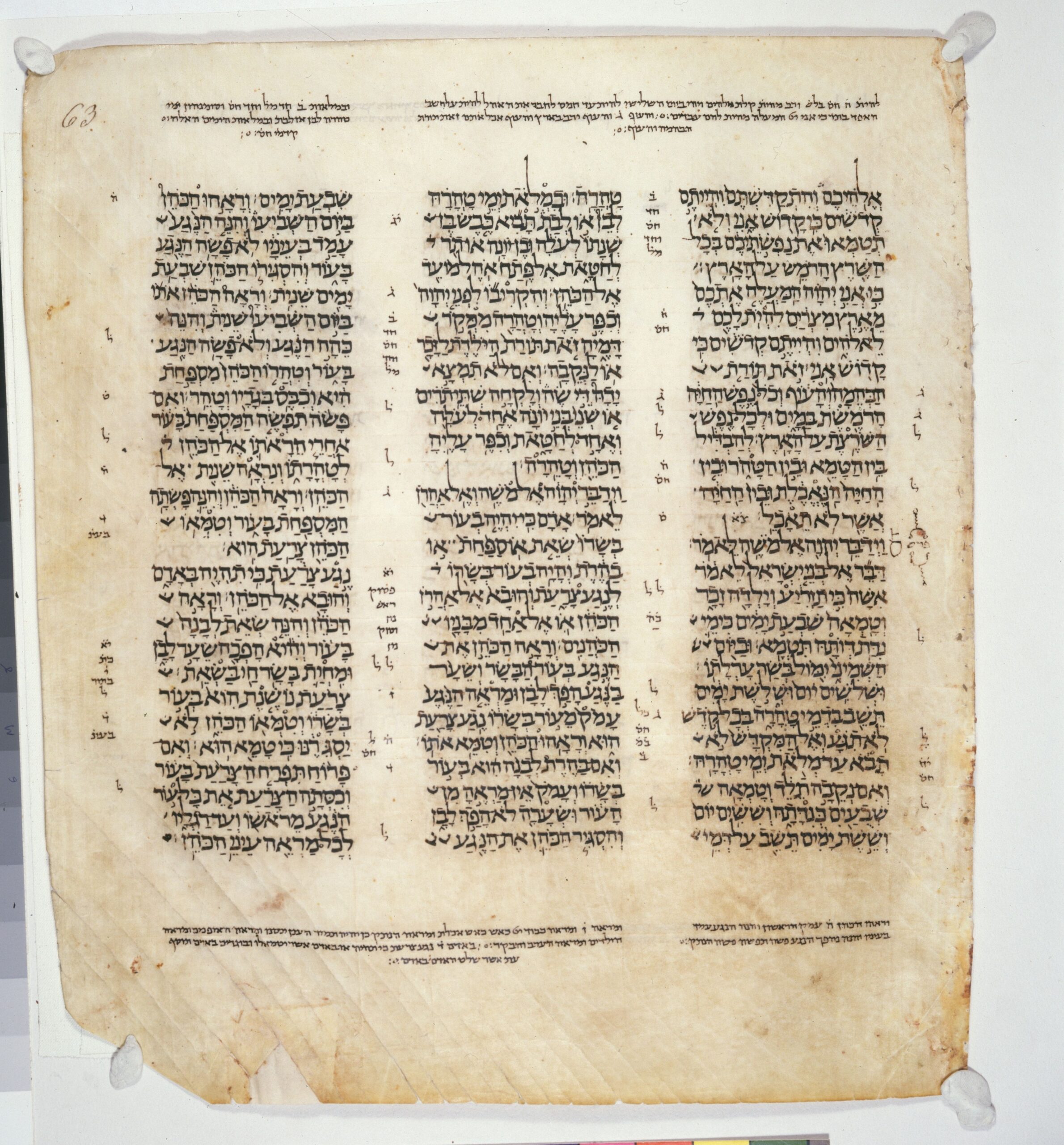
- Leningrad Codex, folio 63r, Wikimedia Commons — public-domain Hebrew manuscript image containing Leviticus 11:44–13:12, used in this article.
GEOMYTHA interpretation is comparative and symbolic. The biblical, Jewish, and scholarly sources above establish the underlying laws, interpretive traditions, and historical context. They do not establish GEOMYTHA’s psychological reading as the original meaning of Leviticus.