Author: D. Cyprian

  • Revelation 1: When John Turns Around

    Revelation 1: When John Turns Around

    Geomytha and the Apocalypse of Awareness

    Most readings of the Book of Revelation treat it as a timetable: a sequence of events that will someday happen “out there” at the end of the world.

    In Geomytha, Revelation is not a forecast but a diagnosis. It describes what happens in consciousness when awareness finally turns and looks directly at the system that has been running it.

    To name that system, I use four core archetypes:

    • Isis – simple, wordless awareness; the living fact of “I am” before any story.

    • Osiris – reflective consciousness; the inner mirror that can see and name what arises in awareness.

    • Set – solar imagination; the engine that spins stories, timelines, institutions, religions, empires.

    • Horus – the time-bound ego; the “I” that believes it is the main character in Set’s story.

    Revelation 1 is the moment when Osiris turns around. The mirror stops reflecting passively and swivels to face the light source itself.

    John as Osiris: The Witness Wakes Up

    “I, John, was in the Spirit on the Lord’s Day…” (Rev 1:10)

    In the Geomytha lens, John is not only a historical writer. He is the Osiris function inside you:

    • the capacity to step slightly out of identification,

    • to notice what is happening,

    • and to bear witness rather than merely react.

    “In the Spirit” does not mean “out of the body and far away.” It means: John is no longer fully fused with his circumstances and emotions. A bit of space has opened. There is enough stillness for seeing.

    This is the same pattern that hides inside many “brother” stories:

    • When Cain is warned that “sin is crouching at the door” before he kills Abel. There is a brief moment of possible seeing.

    • When Jacob lays his head on a stone and dreams of a ladder connecting heaven and earth. He wakes and says, “Surely the LORD is in this place, and I did not know it.”

    • When Esau meets Jacob years later and, instead of killing him, embraces him.

    Each of these is a tiny Apocalypse: a moment when consciousness, usually lost in the role of one brother or the other, suddenly sees the pattern it has been playing out.

    Revelation 1 begins at exactly that kind of moment.

    “I Turned to See the Voice”: Facing the Narrator

    “Then I turned to see the voice that was speaking to me…” (Rev 1:12)

    This one line is the hinge of the entire book.

    Most of the time, your inner “voice” — the narrator in your head — speaks from just behind your attention. It comments on your day, judges you, explains other people’s motives, speculates about the future. You listen to it. You argue with it. You rarely turn and look at it.

    John does.

    He “turns to see the voice.” In Geomytha terms, Osiris turns to look at Set’s broadcast, instead of simply transmitting it.

    That shift is the real beginning of Revelation. Everything that follows — the visions, symbols, beasts, and plagues — unfolds from the simple act of no longer taking the inner narrator for granted.

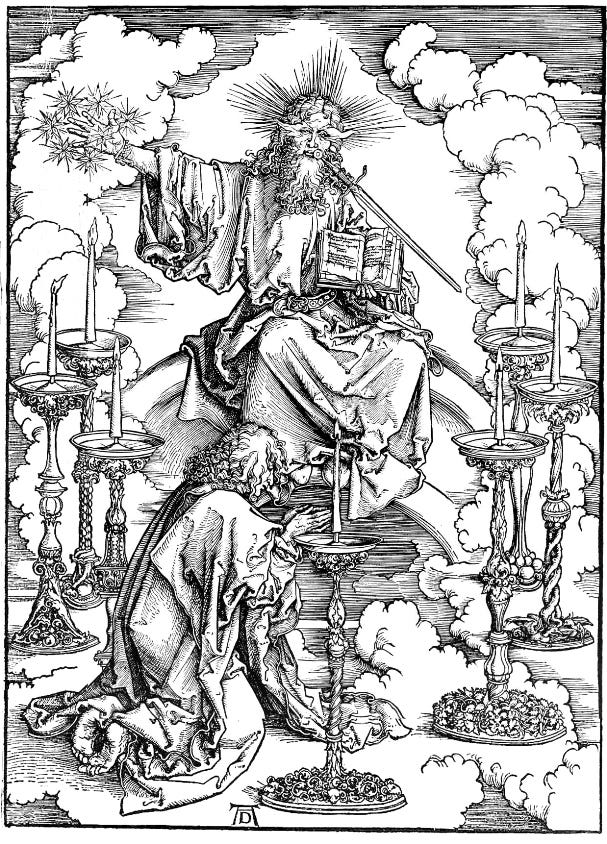
    The Solar Christ Among the Lampstands

    When John turns, this is what he sees:

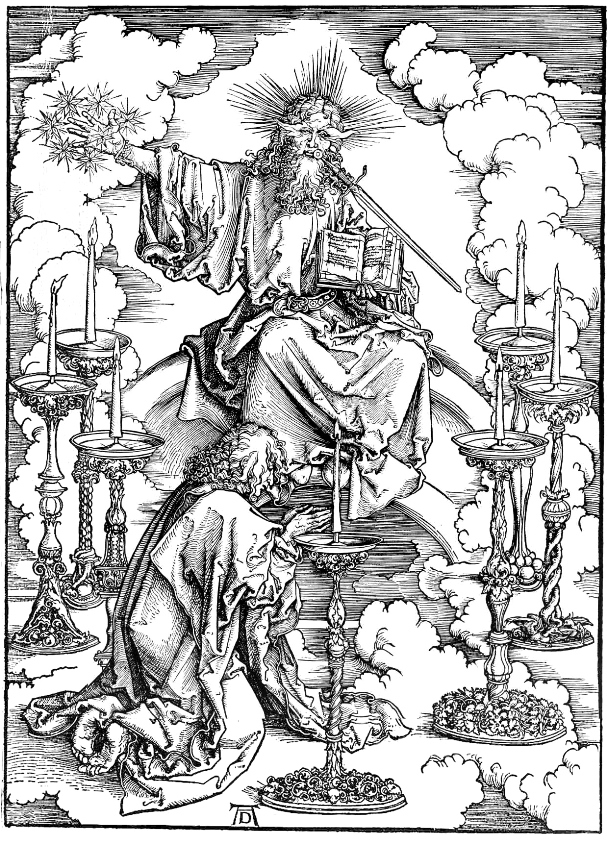
    “One like a son of man… his eyes were like a flame of fire, his face was like the sun shining in full strength… and in the midst of the lampstands one like a son of man…” (Rev 1:13–16, condensed)

    This figure is a Horus-Christ archetype seen in a new way:

    • “Like a son of man” – fully inside the human field.

    • “Face like the sun” – solar, bright, radiating force.

    • “Eyes like fire” – perception that burns through pretense.

    • “A sharp two-edged sword” from his mouth – speech that cuts illusion instead of defending it.

    In everyday life, Horus (ego) stands at the center of your inner world running errands for Set:

    • trying to secure safety,

    • maintain an identity,

    • negotiate with other egos,

    • and build a future that will finally make everything “make sense.”

    In Revelation 1, John sees a version of Horus that is no longer in Set’s service. The same solar energy that once powered the system of illusion has been reclaimed.

    This figure stands “among seven golden lampstands.” A few verses later, we are told:

    “The seven lampstands are the seven churches.” (Rev 1:20)

    In Geomytha language, these seven churches are seven inner centers — roughly parallel to the chakra model — seven “brothers” inside you, each with its own strengths and distortions:

    1. Survival / root

    2. Creative / sexual

    3. Power / solar plexus

    4. Heart / relational

    5. Expression / throat

    6. Interpretation / brow

    7. Spiritual identification / crown

    Horus-Christ appears in the middle of them. Consciousness is still centered in a human figure, but that center is no longer fully hypnotized by Set’s stories. It is filled with a different kind of fire.

    The Fall of the Old Identification

    John’s reaction is immediate:

    “When I saw him, I fell at his feet as though dead.” (Rev 1:17)

    This is not theatrical piety. It is an accurate description of what happens when Osiris truly sees the pattern it has been supporting.

    The old identification cannot bear the sight of itself.

    Up to this point, John/Osiris has been aligned with an image of God, an image of Christ, an image of himself, all largely defined by Set’s solar imagination — by the religious, cultural, and personal stories of his time. When the true structure comes into view, that entire self-image collapses.

    Geomytha treats this as the brother drama turned inward:

    • Cain cannot bear Abel’s favor and kills him.

    • Jacob cannot trust Esau’s blessing and steals it.

    • Joseph’s brothers cannot tolerate his dreams and sell him.

    In each case, a structure collapses eventually: famine drives the brothers back to Joseph; Jacob must wrestle all night and limp away with a new name; Cain is driven east of Eden.

    Revelation 1 describes the collapse happening in consciousness itself. When you really see the solar Christ — the reclaimed Horus no longer serving Set — the version of “you” that was built to navigate Set’s world falls “as though dead.”

    “Fear Not”: Isis Speaks Through the Mask

    What happens next is crucial:

    “But he laid his right hand on me, saying, ‘Fear not, I am the first and the last, and the living one. I died, and behold I am alive forevermore…’” (Rev 1:17–18)

    The same figure that just shattered John’s identification now reassures him.

    In Geomytha terms, this is Isis speaking through the Horus-mask:

    • the deeper awareness behind all forms saying,

    • “Yes, the identity you knew is dying. No, you are not.”

    “I am the first and the last” is not merely a claim of supremacy. It is a description of awareness itself:

    • present at the “beginning” of every experience,

    • present at the “end” of every experience,

    • unchanged by the rise and fall of stories.

    The brothers’ myths hint at this:

    • Esau and Jacob are reconciled; the feud was never the whole truth of either of them.

    • Joseph and his brothers weep together; the famine exposes a deeper kinship beneath the betrayal.

    • Even Cain is spoken to, warned, and marked; he is not simply erased.

    Revelation 1 places that reconciliatory voice inside the most terrifying vision. The hand that unravels the old structure is the same hand that says, “Fear not.”

    “Write What You See”: From Being the Story to Documenting It

    The chapter ends with a command:

    “Write therefore the things that you have seen, those that are and those that are to take place after this.” (Rev 1:19)

    This is where Revelation becomes Geomytha-relevant in a very practical way.

    To “write what you see” is to move from being unconsciously lived by a pattern to consciously documenting it:

    • noticing where Set’s voice speaks in your mind,

    • noticing how Horus (ego) responds,

    • noticing which “church” (inner center) is being used,

    • and putting that into language.

    In terms of the brother archetypes:

    • It is the difference between acting Cain and Abel, Jacob and Esau, Joseph and his brothers

    • and recognizing that those sibling dynamics are playing out in your own thoughts, relationships, and spiritual life.

    Revelation 1 is that moment of recognition. John is told that the visions to come are not just events; they are “things that are” — existing structures in consciousness — and “things that will take place,” the natural consequences when those structures are allowed to complete their cycle.

    How Revelation 1 Functions in Geomytha

    Through the Geomytha lens, Revelation 1 is not a prologue to a distant catastrophe. It is a description of an inner turning that can happen at any time:

    • Awareness (Isis) allows reflection (Osiris) to step slightly out of the stream.

    • Osiris “turns to see the voice” of Set instead of passively repeating it.

    • The Horus-Christ figure appears: ego seen in its solar dimension, no longer fully in service to illusion.

    • The old identification collapses (“as though dead”).

    • Awareness reassures itself through the mask: “Fear not.”

    • The instruction comes: “Write what you see.”

    From that point on, everything in Revelation — the seals, trumpets, beasts, Babylon, New Jerusalem — unfolds as a systematic exposure of how Set’s world is built and how it unravels.

    But the Apocalypse begins here, with a very small but radical movement:

    You stop listening only to the inner voice,

    and you turn to see it.

    In tomorrow’s article, I will take this same Geomytha lens into Revelation 2, where the first four “churches” appear as four inner siblings, each repeating a different version of the brother dramas — Cain and Abel, Jacob and Esau, Joseph and his brothers, Osiris and Set — inside your own field.

    X: @mythicgeometry · YouTube: Geomytha · Instagram: @mythicgeometry · TikTok: @Geomytha · Patreon: GeomythaNoir


  • Are You the Song or the Signal? Isis–Osiris–Set–Horus as a Radio Station

    Are You the Song or the Signal? Isis–Osiris–Set–Horus as a Radio Station

    When you turn on a radio, you do not usually question who you are in that system. You simply hear a song and say, “I like this,” or “I hate this,” and then identify with your reaction.

    In the framework of Isis, Osiris, Set, and Horus, we can use the radio as a precise metaphor for how consciousness turns pure awareness into a time-bound ego. This is not just a clever comparison; it cleanly encodes:

    • Field vs. frequency

    • Wave vs. observer vs. particle

    • And the illusion that the song currently playing is “me.”

    This article reframes your inner life as a radio system, mapped to the four archetypes:

    • Isis – the field / medium

    • Osiris – the frequency / wave

    • Set – the tuner, modulator, and observer

    • Horus – the song you hear: the particle-identity

    1. The Four Archetypes as a Radio System

    Here is the whole structure in one glance:

    • Isis – the field: the “air” or electromagnetic medium in which any signal could exist.

    • Osiris – the frequency: the coherent carrier wave, a standing pattern of “I Am.”

    • Set – the tuner, modulation, and decoding: the imaginative observer that selects, shapes, and collapses the signal into meaning.

    • Horus – the output: the song in your headphones, the time-bound ego experience.

    In more technical language:

    • Osiris functions as the wave (frequency, coherence).

    • Set functions as the observer / collapse / interference (measurement and modulation).

    • Horus functions as the particle (a localized, concrete “me” in time).

    • Isis is prior to all of this: the background field in which waves and particles can even appear.

    Let us walk through the “broadcast” from start to finish.

    2. Isis: The Medium That Makes Radio Possible

    Before you ever choose a station or hear a single note, something more fundamental must already be present: a medium. The air, the electromagnetic field, the space in which signals can propagate.

    In this system:

    • Isis is that medium.

    • She is Is–Is: awareness itself, not yet formed into any particular image or story.

    • She is not a wave or a particle, not content and not a station—she is the capacity for all of them.

    You could say:

    Isis is the fact that a universe can be “heard” at all.

    Everything that follows—frequency, modulation, observer, song—unfolds within Isis as field.

    3. Osiris: The Station’s Carrier Frequency

    A radio station does not broadcast random static. It chooses a stable carrier frequency—for example, 101.1 MHz. That repeating oscillation, steady and coherent, is what lets you distinguish that station from the background.

    That carrier frequency is Osiris in this model.

    • Osiris is reflective consciousness, the way awareness begins to show up as a stable pattern.

    • In number-language, this corresponds to the 124875 loop at the solar plexus: a coherent, repeating structure—a kind of inner standing wave.

    • Osiris is the wave, not yet loaded with content, story, or identity, but already patterned and coherent.

    He is to consciousness what the carrier frequency is to radio:

    A continuous, ordered “I Am” signal reflected within awareness, before it is filled with specific narratives.

    4. Set: Tuner, Modulator, and Collapse

    If Osiris is the carrier, then something has to do something to that carrier to make it into a concrete experience: to choose it, shape it, and decode it into meaning. This is the domain of Set.

    In the radio analogy, Set performs three related functions.

    4.1 Set as Tuner: Choosing a Narrow Band of Reality

    There are many possible “stations” in the field of Isis. Many ways Osiris could be patterned, many versions of “reality” that could be emphasized.

    Set acts like the tuner:

    • Selecting this band of meaning instead of that one.

    • Saying: “This is important,” “This matters to me,” “This is who I am.”

    From the full spectrum of what could be experienced, Set dials in a narrow band and calls it “my world.”

    4.2 Set as Modulator: Imprinting Imagination onto the Carrier

    A station does not just transmit a bare sine wave; it modulates that wave with content—voices, music, news, advertising.

    In consciousness terms:

    • The pure Osirian frequency (coherent “I Am”) becomes modulated by imagination, memory, fear, desire, social conditioning, and belief.

    • Stories such as “I was betrayed,” “I must succeed,” “I am unlovable,” “I am chosen,” and so on are content riding on the Osirian carrier.

    This is Set as imagination/solar overlay.

    The act of writing a story on top of the base signal of existence.

    4.3 Set as Observer and Collapse: Turning Wave into Apparent Facts

    In physics language, Set also acts like measurement or collapse:

    • The moment you “look at” the wave in a particular way, you force a specific outcome.

    • Set is that look: the interpretive act that collapses broad possibility into a narrow conclusion such as “He hates me,” “I failed,” “I am a victim,” “I am superior.”

    So, in this analogy:

    Set = the entire cognitive mechanism that tunes, modulates, interprets, and collapses the Osirian wave into apparently solid facts.

    Set does not merely observe; Set decides what the observation means, and in doing so, locks the system into a particular version of reality.

    5. Horus: The Song You Mistake for “You”

    Finally, consider what actually comes out of the speakers or your headphones: a song, three or four minutes long, with a beginning, middle, and end.

    That song is very different from:

    • the invisible field,

    • the raw carrier frequency, and

    • the electronics of the tuner.

    Yet it is what you consciously experience.

    In the archetype system, this output is Horus.

    • Horus is the time-bound ego identity—the “particle” produced by Set acting on Osiris.

    • Each moment of “I am this person, in this story, in this situation” is like a detection event, a discrete “particle hit” on the screen of awareness.

    • The apparent continuity of Horus—your life story—comes from a rapid sequence of such samples, woven into one narrative.

    In other words:

    Horus = the song.

    The specific, localized output of the entire chain, currently playing in the theater of your mind and body.

    You are invited, over and over, to mistake the song for the whole system.

    “I am this story. I am this role. I am this success or failure.”

    But in this model, Horus is just the surface manifestation of a much deeper structure.

    6. The Full Chain: From Field to Ego

    We can now restate the entire process as a single flow:

    1. Isis – Field

      • Pure awareness, the medium that allows anything to appear.

    2. Osiris – Frequency (Wave)

    • A coherent, reflective “I Am” pattern (124875 loop).

    • The carrier wave of consciousness.

    1. Set – Observer / Tuner / Modulator / Collapse

    • Tunes to a narrow band of experience.

    • Imprints imagination and belief onto the carrier.

    • Interprets and collapses possibilities into apparent facts.

    1. Horus – Particle (Song / Ego)

    • The concrete, time-stamped sense of “me.”

    • A stream of identity-events, like tracks on a playlist, which together feel like one continuous person.

    In compact form:

    Field (Isis) → Wave/Frequency (Osiris) → Observer/Modulation (Set) → Particle/Ego (Horus).

    7. What This Changes in Practice

    This radio analogy is not just intellectual. It has practical consequences for how you relate to your own experience.

    • When a strong identity state arises—anger, shame, pride, fear—you are hearing a song (Horus), not the whole system.

    • Behind it is a patterned frequency (Osiris): “I exist,” “I am,” prior to the specific narrative.

    • That pattern arises within a field (Isis) that does not contract or fragment when any particular song plays.

    • And the one turning the dial, applying the story, and insisting “this is what it means” is Set.

    Noticing this distinction is the beginning of freedom:

    • You are not limited to the current track.

    • You are not the advertisement, nor the drama, nor the breaking news.

    • You are closer to the signal than the song—and ultimately, closer to the field than the signal.

    The radio keeps playing, but your identification can shift:

    • from Horus (the song)

    • back to Osiris (the signal)

    • and finally to Isis (the field), in which even Set’s modulation is just another pattern appearing and disappearing.

    If this framework resonates, it is one thread in a larger tapestry I call The I Am Experience—an exploration of how myths, numbers, and symbols encode the mechanics of consciousness itself: field, wave, observer, and particle, all inside the single fact that awareness is.

  • The Double-Slit Experiment Through the Isis–Osiris–Set–Horus Lens

    The Double-Slit Experiment Through the Isis–Osiris–Set–Horus Lens

    Modern physics presents an experiment so simple that it resembles a children’s riddle, yet so profound that it exposes the architecture by which consciousness crystallizes into a world. The double-slit experiment is not merely a peculiarity of quantum mechanics. When examined through the Isis–Osiris–Set–Horus framework, it becomes a complete parable of how undivided awareness is fractured, interpreted, and finally recorded as the time-bound identity we call “the physical universe.”

    This is not a departure from physics. It is a deeper symbolic reading of what physics already displays but cannot name: the way consciousness modulates itself into form.

    I. Isis — The Undivided Field Before All Distinctions

    The experiment must begin where all phenomena begin: within the silent field of awareness itself.

    Isis represents undifferentiated presence—awareness prior to conceptual boundaries, before the insistence that a particle must be “here” or “there,” before the division of unity into measurable components. In the context of the double-slit experiment, Isis is not a variable inside the apparatus. It is the ground that makes the apparatus possible.

    GEOMYTHA compares a coherent quantum state with an undivided field. This is a symbolic analogy: superposition is a mathematical description of a physical system, not experimental evidence that consciousness or Isis produces it.

    In this reading, the quantum state supplies a comparison for Isis. The correspondence belongs to GEOMYTHA and is not a scientific identification of a deity with a quantum state.

    II. Osiris — The Wavefunction as Harmonious Reflection

    Once presence reflects itself without yet being fractured into definitional categories, Osiris emerges. Osiris is the reflective mode of consciousness—the coherent, lunar, non-local field that mirrors Isis while preserving unity.

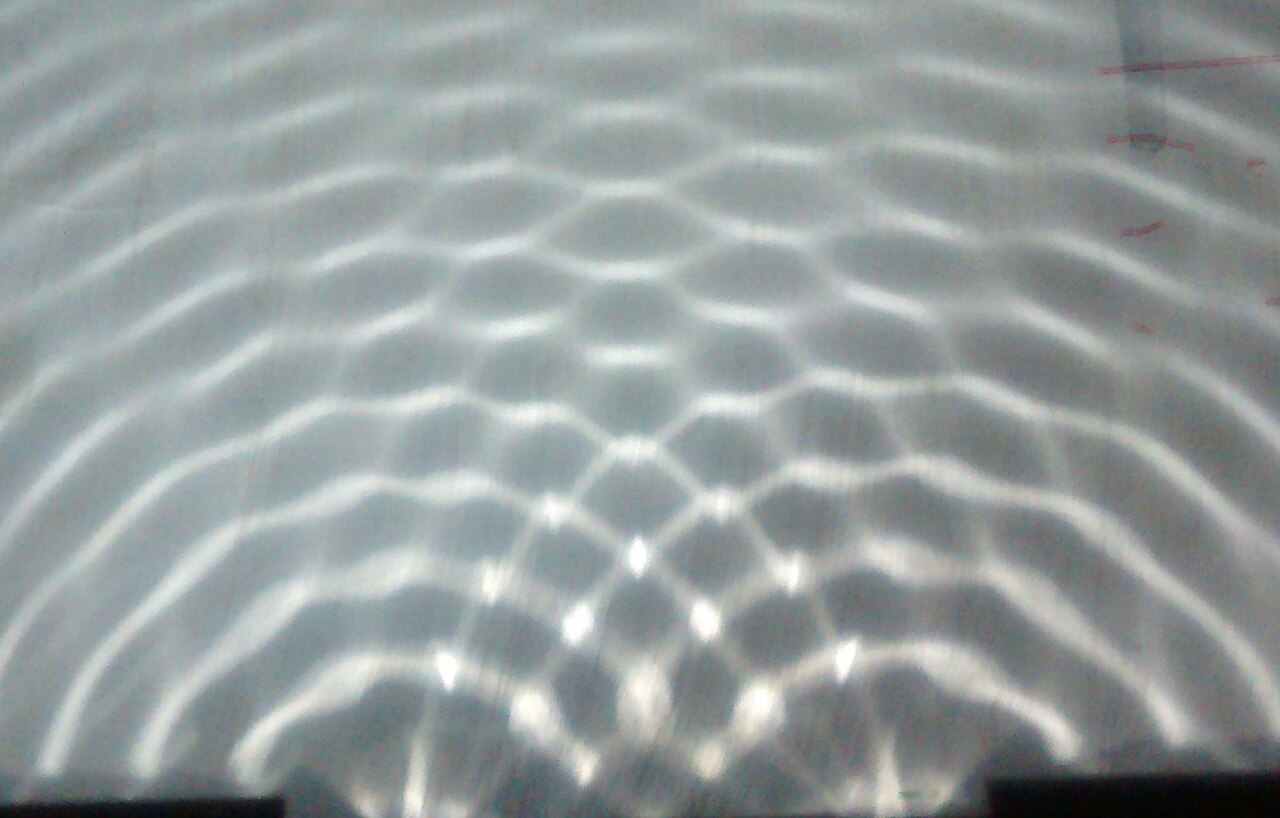
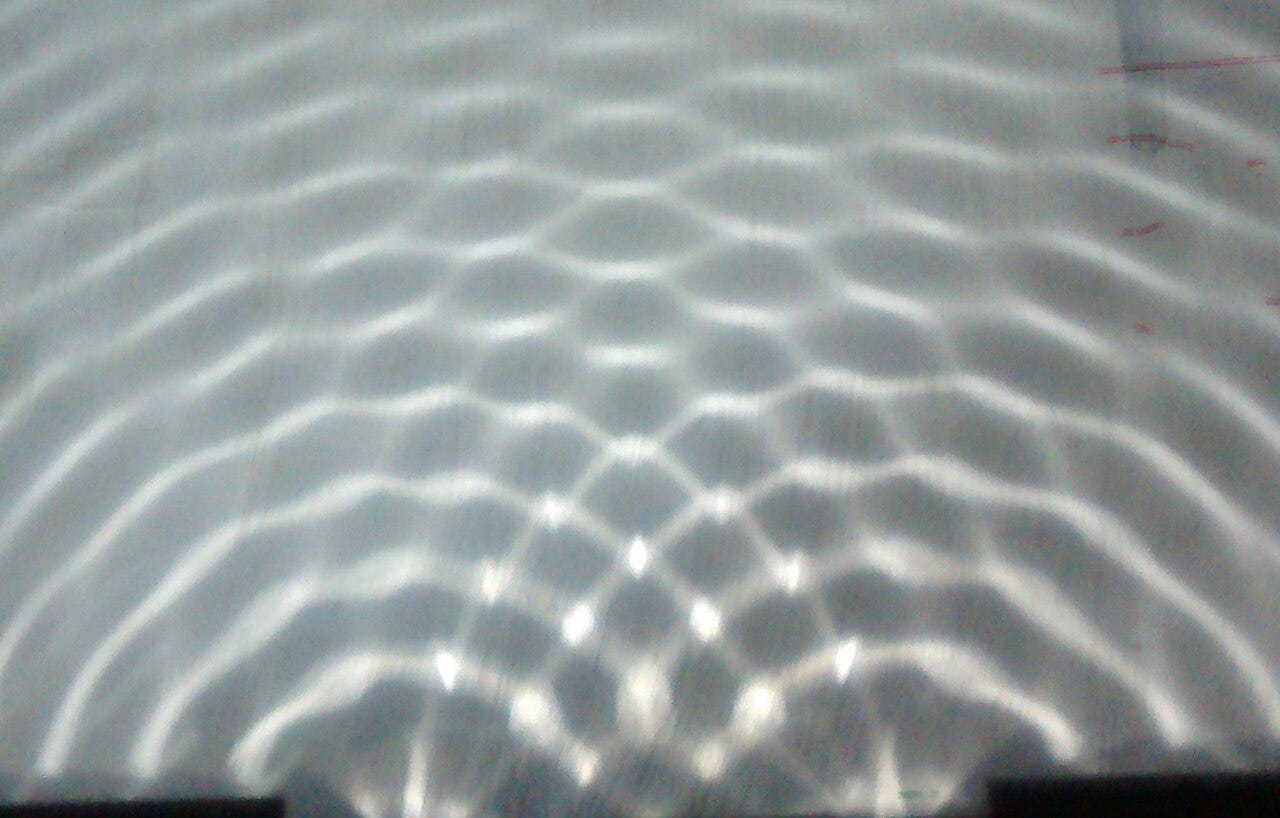
    In the double-slit experiment, Osiris appears as the wavefunction. It is the elegant, interference-capable structure that allows a single photon or electron to explore multiple paths simultaneously. When no detection is made at the slits, the wavefunction passes through both, creating an interference pattern on the screen: bright and dark bands that encode the harmonious overlap of possibilities.

    This pattern is not chaos. It is ordered reflection, the same patterning principle seen in every Osirian symbol: the Ark, the Sabbath, the Tree of Life. The interference fringes are the physics-laboratory version of the Osirian torus, a field that remains whole even while appearing in multiplicity.

    As long as Osiris is unopposed, unity reflects unity.

    III. Set — Measurement as Fragmentation and the False Phallus

    Interference is reduced or lost when interactions make the alternatives distinguishable through which-path information. A person’s demand or conscious attention is not itself the physical mechanism. GEOMYTHA compares this distinction-making operation with Set.

    Set represents imaginative fragmentation: the solar insistence on definition, the conceptual grasping that converts fluid reflection into rigid information. In physics, this grasping ismeasurement. Whenever the system is interrogated with a detector—which slit did the particle pass through?—the Osirian wave is fractured into discrete alternatives.

    Interference disappears. Possibility gives way to exclusivity.

    The apparatus that demands “one path or the other” functions exactly as the false phallus: an imposed hierarchical point that fractures the continuum and forces consciousness into binaries. The wavefunction decoheres into separate branches, mirroring Set’s archetypal function of dividing what was previously seamless.

    Under Set, the system is no longer allowed to reflect Isis. It must reflect the demands of measurement.

    IV. Horus — The Classical Pattern and the Time-Bound Record

    What remains after measurement is not reality itself but the structured record of it—the realm of Horus.

    Horus is the time-bound identity built atop Set’s fragmentation. It is the narrative, the sequence, the chain of events that appears solid and self-contained. In the double-slit experiment, this appears as the classical pattern on the screen:

    • With no measurement, Horus records an interference pattern, because Osiris was permitted to function.

    • With distinguishable paths, the observed distribution lacks the corresponding interference fringes. Its exact shape depends on the apparatus; it need not be two discrete bands. Horus names the recorded appearance in this symbolic comparison.

    Horus is the story the world tells about itself after the deeper processes have already acted. It is the visible historical residue of operations performed in silence. In this sense, classical physics is not the foundation of reality; it is the diary of Set’s interventions.

    Horus is the world we think we inhabit, arranged into space, time, and object permanence. It is a coherent illusion generated by the interplay of awareness, reflection, and fragmentation.

    V. Delayed-Choice and Quantum Erasure — The Editing of Apparent Time

    The more advanced variations of the experiment deepen this architecture. In delayed-choice and quantum-eraser setups, the decision to preserve or erase which-slit information can be made after the particle has passed the slits. In quantum-eraser experiments, interference can appear in appropriately selected correlations when path distinguishability is removed. This does not restore fringes to an unconditioned record by conscious choice, send information backward in time, or rewrite previously recorded events.

    GEOMYTHA can compare the organization of a record with Horus, but ‘editing the past’ is a metaphor. Quantum-eraser correlations do not demonstrate retroactive alteration of historical events by thought or by a later observer.

    This phenomenon reveals the central principle of the Isis–Osiris–Set–Horus cycle:

    The world is not constructed as a fixed sequence of events.

    The world is constructed as a coherent narrative imposed upon a deeper field of possibilities.

    Horus is not primordial. Horus is editorial.

    VI. The Deeper Implication: Physics as a Mythic Map of Consciousness

    The double-slit experiment is therefore not merely a physical demonstration. It is a symbolic revelation. The universe behaves in an Osirian manner until Set insists on measurement. Once Set intervenes, Horus constructs a classical world consistent with that demand.

    The experiment becomes a perfect model of the cycle:

    • Isis: undivided presence

    • Osiris: coherent reflection

    • Set: fracturing by conceptual grasping

    • Horus: the final, time-bound identity

    Modern physics describes these stages mathematically but never interprets them symbolically. Yet the symbolism is unmistakable. The measured distributions depend on the physical experimental arrangement and available path information. The contrast between reflective and grasping attention is GEOMYTHA’s psychological comparison, not a result established by the experiment. The world that appears is not the world that is; it is the world shaped by the form of attention applied to it.

    The double-slit experiment therefore stands as a scientific parable of how consciousness constructs the illusion of a solid, continuous universe. GEOMYTHA proposes a recurring comparative cycle, to be tested against particular narratives and counterexamples. Neither the experiment nor a recurring image establishes that every myth or tradition expresses the same doctrine.

    VII. Connect with Mythic Geometry

    For deeper explorations of these archetypes across myths, songs, and modern culture:

    • YouTube: Geomytha

    • X (Twitter): mythicgeometry

    • Instagram: mythicgeometry

    • TikTok: Geomytha

    • Patreon: GeomythaNoir

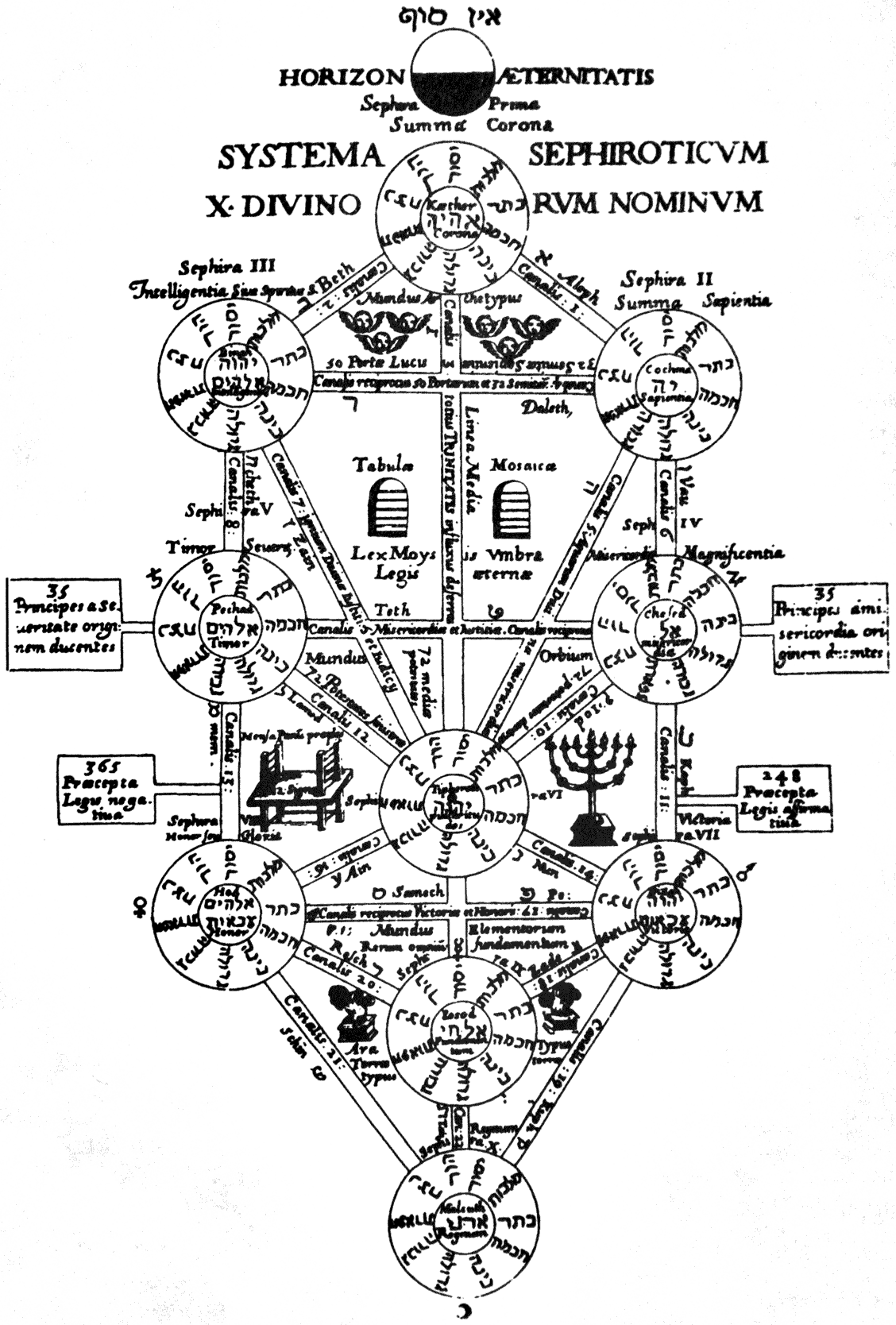
  • Kabbalah Through the Isis–Osiris–Set–Horus Lens

    Kabbalah Through the Isis–Osiris–Set–Horus Lens

    Paid essay — public preview. This page introduces the original essay. The complete argument, examples, and conclusion are available to paid Geomytha subscribers on Substack.

    How the Tree of Life Encodes the Hijacking of Presence by Thought

    Most people meet Kabbalah as a mystical roadmap to God, the soul, and the structure of reality. In my framework, it is also something else: a technical diagram of how pure awareness gets reflected, fragmented, hijacked by imagination, and crystallized into a time-bound ego identity.

    My core system is simple:

    Isis – pure awareness, the “Is-Is,” earth/body, timeless presence.

    Osiris – the perfect moon-like reflection of that awareness, harmonious consciousness.

    Set – the solar overlay of imagination, fragmentation, and the “false phallus.”

    Horus – the time-bound ego, the illusion of “man” as a separate self moving through linear time.

    The Vortex Math Diagram (VMD) encodes this process numerically…

    Read the complete essay on Substack →

    This WordPress page preserves the essay’s place in the Geomytha archive, its original title and subtitle, and its publication date. The full subscriber edition remains protected on Substack.

  • Gnosticism Through the Vortex: Barbelo, Sophia, and the Four Archetypes

    Gnosticism Through the Vortex: Barbelo, Sophia, and the Four Archetypes

    Paid essay — public preview. This page introduces the original essay. The complete argument, examples, and conclusion are available to paid Geomytha subscribers on Substack.

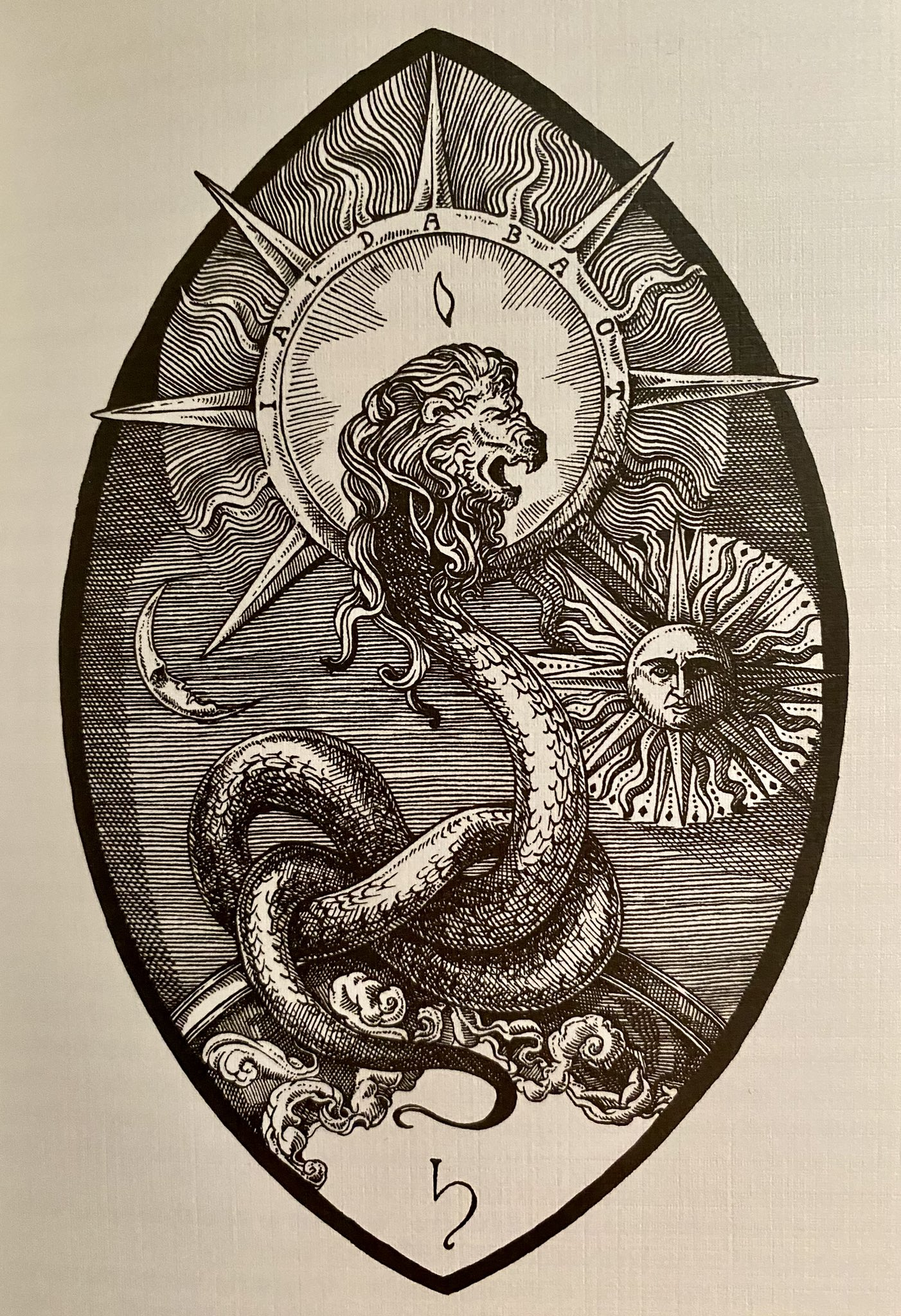
    In the usual telling, Gnosticism is a forgotten heresy: strange cosmologies, hostile archons, a bungling demiurge, and a secret saving knowledge called gnosis. Read that way, it lives in the second century.

    Through my system, Gnosticism is not a dead religion. It is a precise symbolic map of how awareness forgets itself, becomes trapped in imagination, and then tries to wake up as a time-bound ego. It describes, in mythic language, the same pattern I map with the four archetypes and the vortex math diagram:

    Isis / Earth – pure awareness, the “Is Is” that simply is.

    Osiris / Moon – reflecting and perfecting consciousness, the clean lunar mirror of awareness.

    Set / Sun – imagination and conceptualization overtaking reflection,…

    Read the complete essay on Substack →

    This WordPress page preserves the essay’s place in the Geomytha archive, its original title and subtitle, and its publication date. The full subscriber edition remains protected on Substack.

  • The Upanishads in the Isis–Osiris–Set–Horus Framework

    The Upanishads in the Isis–Osiris–Set–Horus Framework

    Read the Upanishads through a four-part lens: Isis (awareness), Osiris (reflection), Set (imagination’s overlay), and Horus (time-bound identity). The result is a precise path from misidentification to freedom, mapped onto your Vortex Math Diagram.

    About this series

    This series examines archetypes through the lens of awareness (Isis/earth), reflective consciousness (Osiris/moon), imagination’s overlay (Set/sun), and the time-bound ego identity (Horus/illusion of man)—with the Vortex Math Diagram (VMD) as a visual aid.

    The Upanishads in the Isis–Osiris–Set–Horus Framework

    Thesis. Read through this lens, the Upanishads present a rigorous movement from pure awareness to a time-bound identity—and back. Isis names unconditioned awareness; Osiris is awareness perfectly reflected; Set is imagination’s solar overlay that fractures unity into names and forms; Horus is the time-bound ego crystallized by that overlay. Liberation (mokṣa) is the return from Horus/Set to Osiris/Isis—identity unwinds into presence.

    I. Issue, Rule, Analysis, Conclusion (IRAC)

    Issue. What do the Upanishads assert about the Self and reality, and how does that assertion comport with this four-part model (and the VMD)?

    Rule. The core statements (mahāvākyas) hold that (1) the ground of reality is undivided consciousness (Brahman), (2) the inmost Self (Ātman) is not other than that ground, and (3) multiplicity appears through māyā—misidentification with transient name-and-form.

    Analysis.

    • Isis ≡ Brahman. Pure awareness prior to image and story.

    • Osiris ≡ Ātman rightly reflected. The moonlike witness that reflects Isis without distortion.

    • Set ≡ māyā. The solar broadcast of imagination—useful for appearance, distorting when believed as ultimate.

    • Horus ≡ ahaṃkāra (ego). The time-bound identity that forms when Set’s overlay is mistaken for the Self.

    Conclusion. The Upanishadic path is not “self-improvement” for Horus; it is de-identification from Set’s overlay until Osiris’ reflection is steady and Isis is recognized as ever-present.

    II. The Four Terms Precisely Defined

    1. Isis (Awareness / “Earth”) The indivisible fact of consciousness. Not an object, not a property—the condition for every object and property.

    2. Osiris (Reflective Consciousness / “Moon”) Awareness as flawless witness. Noticing occurs without annexation. When Osiris is stable, the “I” is transparent.

    3. Set (Imagination / “Sun”) The broadcast that overlays forms, meanings, valuations, and timelines. The error is usurpation: taking projection as reality.

    4. Horus (Time-Bound Identity / “Man’s Illusion”) The composite story sustained by identification with Set’s images: “I am this role, this history, this grievance.”

    III. Five Upanishadic Scenes Read Through the Lens

    1. Bṛhadāraṇyaka & Chāndogya (mahāvākyas) “Aham brahmāsmi” and “Tat tvam asi” collapse the supposed gap between witness and ground. Remove Set’s overlay and what remains, undeniably present, is Isis.

    2. Īśa Upaniṣad (living without ownership) “All this is pervaded.” Action continues, ownership ceases. Discipline: let perception arise, but do not annex it. Rest attention at the “Sabbath” center (solar plexus), where Osiris reflects without appropriation.

    3. Kaṭha Upaniṣad (Naciketas; the chariot) The pleasant (preya) versus the good (śreya). The chariot allegory instructs: reins (mind) answer to the charioteer (witness), not the scenery. Set offers infinite scenes; Osiris chooses rest over chase.

    4. Muṇḍaka Upaniṣad (two birds, one tree) One bird eats (Horus/agent), the other witnesses (Osiris). The eater’s dissatisfaction matures into disidentification; attention abides as witness and Isis shines on its own.

    5. Māṇḍūkya Upaniṣad (four states) Waking, dream, deep sleep are modes within Set/Horus dynamics. Turīya is Isis—the ground of all states. Recognition ends the compulsion to curate or optimize states.

    IV. How the Vortex Math Diagram (VMD) Sharpens the Reading

    • Osiris loop (1-2-4-8-7-5). Closed, self-consistent reflection without leakage.

    • Set overlay (3-6-9). A solar through-line that appears to complete the picture but converts reflection into projection.

    • Horus as apparent completion (1→9). When 3-6-9 is mistaken for ground, identity congeals. The continuity felt is reference, not reality.

    • Resolution. Do not smash the overlay; withdraw belief and energy from it. The loop is then experienced as whole, and Isis is obvious.

    V. Practice: Three Disciplines in Upanishadic Language

    1. Neti-Neti (Not this, not that) A structured examination of candidates for “me.”

      • If it is seen, it is not the seer.

      • If it changes, it is not the changeless ground.

      • If it can be lost, it cannot be the Self. Persist until only self-luminous awareness (Isis) remains.

    2. Re-centering at the Sabbath (solar-plexus rest) Set commandeers the head-center—broadcasting, comparing, anticipating. Re-center attention in the chest/solar plexus and rest. When Osiris stabilizes here, the overlay loses voltage.

    3. Witness-first living (Osiris in motion) For one day, prioritize the witness in every act. Let phenomena arise and resolve without annexation. Where annexation occurs, notice it, release it. Over time, Horus cannot hold shape.

    Five-minute micro-protocol

    • 60s: recognize raw awareness without object.

    • 120s: rest attention at the solar plexus; allow breath to settle.

    • 120s: watch thoughts/images/urges appear and dissolve; label each “Set” silently.

    • 30s: confirm the witness as prior to all content.

    VI. Objections and Replies

    • “Isn’t imagination (Set) necessary?” Yes. The issue is not function but authority. When imagination usurps, suffering is built in. When it serves reflection, creativity is clean.

    • “Isn’t ego (Horus) required to navigate society?” A provisional identity is operationally useful. The claim is not “destroy the person,” but “withdraw the false absolute.” Recognized as instrument, Horus behaves better, not worse.

    • “Why emphasize the solar plexus?” As used here, it is a somatic convention that ends broadcast-reaching. It is a cue, not a dogma.

    VII. Practical Consequences

    1. Speech: Fewer declarations; when needed, precise and minimally self-referential.

    2. Conflict: The need to “win the story” relaxes. Facts and logic can be pressed firmly without defending an identity.

    3. Attention: Entertainment and scrolling become optional choices rather than anesthetics.

    4. Ethics: Without annexation, others are not means. Conduct trends toward restraint, clarity, and care.

    VIII. A Short Reading Plan

    • Start: Īśa (conduct without ownership).

    • Then: Muṇḍaka (two birds; witness practice).

    • Then: Kaṭha (discrimination; chariot).

    • Then: Chāndogya/Bṛhadāraṇyaka (mahāvākyas; identity unwind).

    • Capstone: Māṇḍūkya (Turīya; state-transcending rest).

    After each section, pause one minute and ask:

    Where is Isis? Where is Osiris? Where is Set active? What in Horus wants to annex this insight?

    IX. One-Paragraph Summary

    The Upanishads teach that reality is undivided awareness (Isis). When awareness reflects itself cleanly (Osiris), the person functions without annexation. Suffering begins when imagination’s solar overlay (Set) is taken as ground, crystallizing a time-bound identity (Horus). Practice is neither self-adornment nor self-annihilation but the end of usurpation: withdraw belief from the overlay, rest where reflection is pure, and allow identity to unwind into presence.

    X. Closing

    Nothing new is added by recognition; only the counterfeit is removed. When Set stops posing as the ground, Horus cannot hold, Osiris is steady, and Isis is obvious. The outcome is not trance but the simplest fact: awareness, here, prior to any story about “me.”

    Sidebar: Mahāvākyas Mapped

    • Tat tvam asi → Osiris ≡ Isis recognized.

    • Aham brahmāsmi → The “I” minus annexations is Isis.

    • Prajnānam brahma → Awareness itself is the Real.

    • Ayam ātmā brahma → This very Self is Brahman.

    Sidebar: Daily Cue

    When grasping is noticed in the head, ask, “Who is broadcasting?”

    Shift attention to the solar plexus; exhale; leave three breaths unmanipulated.

    Let the witness see the broadcast as broadcast—and stop annexing it.

    Which passage of the Upanishads most clearly exposes Set’s overlay for you? How do you operationalize witness-first living in a busy day?

  • Water & Salt: How the Vortex Math Diagram Maps Presence and Identity

    Water & Salt: How the Vortex Math Diagram Maps Presence and Identity

    In this framework, “water” is unfixed awareness and “salt” is awareness fixed into identity. The Vortex Math Diagram can be read as a symbolic map of how one becomes the other—and how the movement can reverse. A boundary matters at the beginning. The repeating 1→2→4→8→7→5 cycle associated with Vortex-Based Mathematics is a real consequence of digital-root arithmetic in base ten. What does *not* follow from that arithmetic by itself are larger claims about toroidal energy, free energy, electron spin, higher dimensions, or consciousness physics. Geomytha therefore uses the diagram as a symbolic scaffold, not as experimental proof. **The map in one glance** **Isis — earth / water:** pure awareness, uncarved presence. **Osiris — moon:** reflection of that presence without ownership. **Set — sun / fire:** forethought, imaginative projection, naming, and the heat of fixing. **Horus — time-bound identity:** the crystallized product—the usable persona that can be counted, managed, defended, and narrated. Geomytha maps the Vortex Math Diagram onto these movements in two symbolic circuits: **1 2 4 8 7 5:** the living-water loop—return, reflection, and movement without permanent fixation. **3 6 9:** the solar overlay—projection, prediction, naming, and control. Horus is the apparent “whole” once the overlay stabilizes into a persona.
    Vortex Math Diagram showing the 1-2-4-8-7-5 cycle and the 3-6-9 triangle.
    **Water mode: presence as wave** Water signifies coherence without specification. In this mode attention is fluid and reflective. Geomytha reads the 1 2 4 8 7 5 loop as a self-returning symbolic circuit: awareness moves, reflects, and returns without immediately being converted into a declaration about what it is. The word *wave* is useful here as metaphor. In quantum physics, interference depends on physical coherence and on whether path information is available in the experimental system. Geomytha is not claiming that ordinary human attention is literally a quantum wave or that self-narration performs a laboratory measurement. The analogy is narrower: an undivided field behaves differently from a field continually forced into trackable alternatives. **Felt sense:** wide peripheral awareness, breath settling lower, time feeling less urgent, choices arriving with less internal argument. These are phenomenological descriptions, not medical markers. **Salt mode: identity as particle** Salt is fixation—the crystallized residue left when fluid possibility is reduced into stable form. In Geomytha’s symbolic body-map, projection accelerates forethought: scenario-running, prediction, optimization, rehearsal. Attention rises from embodied presence into the upper image-system, and the fluid field is converted into reportable hits: names, roles, metrics, outcomes. The result is Horus: the self as a time-story. **Felt sense:** narrowed attention, breath held higher, a constant sense of “next,” compulsive rehearsals and reviews, the self experienced as a portfolio to manage. Again, these are descriptive cues inside the model, not diagnoses. **The double-slit as parable** The double-slit experiment gives the article a powerful analogy, but only if the physics is kept intact. When quantum alternatives remain coherent and which-path information is unavailable, interference can appear. When a physical measurement apparatus gains path information, interference is reduced or destroyed through measurement interaction and decoherence. In quantum-eraser experiments, carefully arranged measurements can make interference recoverable in correlated or conditioned data after which-path distinguishability is erased. That does *not* mean a human mind collapses reality by paying attention, and it does not mean “erasing the ego” literally restores quantum coherence. Geomytha uses the experiment as a parable: continuous psychological self-measurement writes a conceptual path-record—“I am this,” “I did that,” “I must become X.” The more often experience is forced through that ledger, the more fluid presence is converted into fixed identity. **Prometheus’ fire and the salt-works** Geomytha reads Prometheus’ stolen fire as forethought: the power to project ahead, make tools, build calendars, construct ledgers, and stabilize possibility into durable form. Fire makes civilization possible. It also makes salt. The gift is double-edged. Prediction protects and empowers, but when it becomes the center, life is chained to the rock of time. The future must constantly be fed. The forecast must constantly be maintained. The projected self must constantly be updated. The more we live entirely by forecast, the more symbolic heat we generate and the more salt we accumulate. **Dune’s spice as a cultural case study** Frank Herbert’s *Dune* gives the pattern a modern fictional body. Melange is bound to prescience, dependency, navigation, empire, and the political economy of Arrakis. The desert ecology is also structurally unforgiving: sandworms and spice production belong to the dry planetary cycle, while open water is lethal to adult worms and large-scale wetting threatens the conditions that sustain them. Geomytha reads spice as concentrated forethought. Prescience becomes the extreme form of living inside the future-map. The blue-within-blue eyes make dependence visible on the body. The empire organizes itself around a substance that turns uncertainty into navigational and political advantage. The comparison is symbolic, not scientific: presence makes forethought possible, but a life organized entirely around prediction can become dependent on the very mechanism meant to serve it. **The attention economy of salt** Why does identity prefer salt? **Countability.** What is fixed can be measured, stored, compared, and billed—internally as self-judgment, externally as social metrics. **Predictability.** Stable identities support long chains of coordination and control. **Harvestability.** Fixed patterns are easier for institutions, platforms, markets, and internal narratives to sort and exploit than fluid states that refuse permanent declaration. This is why Geomytha repeatedly finds builders, rulers, accountants, judges, and demanding gods clustered around Set-like functions. The claim is symbolic: systems live more easily on the salted residue of attention than on awareness that has not yet been converted into a category. **How water becomes salt—and back again** **Forward: salting** Presence → reflection → forethought heated by urgency → identity crystallized. Common triggers include anxious planning, comparison, moral debt—“I should already be…”—and reputation maintenance. **Reverse: desalination** Identity softens → forethought cools → reflection resumes → presence returns. Common openings include genuine rest, whole-body attention, non-declarative perception, and surrender of the compulsive “next.” **Practical protocols** **1. Reorder the sequence daily.** Use forethought after presence and reflection, not before. Begin with several minutes of non-declarative noticing—no labels, no goals—then, only if needed, enter a short bounded planning window. Close by returning to silence long enough to feel the planning-state release. **2. Sabbath as system hygiene.** Treat the end of planning or identity-work as a cue to stop forecasting for a moment. No declarations, no self-branding, no rehearsing the next version of yourself. Let the salt cool. **3. Posture the mirror.** When attention becomes overheated, deliberately include pelvis, soles, belly, and peripheral vision. This is an attentional practice, not a medical treatment. Its function is to widen the field that the head-story has narrowed. **4. Audit the detectors.** Reduce background measurement: dashboards, metrics, notifications, and self-surveillance loops that continually ask for proof of who you are. Replace perpetual monitoring with bounded review. **5. Language fast.** Spend short periods without declaring who you are, what everything means, or what must happen next. Let the world be encountered before it is converted into statement. **Frequently misunderstood** **“Is salt bad?”** No. Salt is form, and form is necessary to act in time. The issue is priority and dosage. When salt serves water, identity becomes a tool. When water serves salt, identity becomes a cage. **“Does this reject planning?”** No. It rejects living inside planning. Planning is a window, not a habitat. **“Is the Vortex Math Diagram proven physics?”** No. The digital-root sequence is straightforward arithmetic. Geomytha’s use of the diagram is symbolic. Claims that the diagram itself establishes a toroidal energy field, free energy, quantum consciousness, or the physical structure of reality require evidence beyond the number pattern. **“Does the quantum analogy prove consciousness collapses reality?”** No. The double-slit and quantum-eraser results concern physical quantum systems, measurement interactions, coherence, and path information. Geomytha borrows the structure as a metaphor for psychological fixation. **The VMD as a living compass** **Water loop — 1 2 4 8 7 5:** symbolic home of return, reflection, and fluid presence. **Salt overlay — 3 6 9:** symbolic tool for foresight, naming, coordination, and control. **Horus:** the usable mask—wear it lightly, remove it often. Read this way, the Vortex Math Diagram is not valuable because it secretly proves the physics of consciousness. It is valuable because a simple arithmetic pattern can be turned into a disciplined symbolic compass: presence or identity, water or salt, reflection or fixation. The first mercy is simply to notice when the water has become salt. The second is to remember that salt can dissolve.