Author: D. Cyprian

  • Revelation 11: Measuring the Temple and Killing the Witnesses

    Revelation 11: Measuring the Temple and Killing the Witnesses

    How the inner sanctuary, the trampled court, and the two witnesses map to your own field of awareness in Geomytha.

    Revelation 10 ended with a remarkable act:

    John was told to eat a little scroll — sweet in his mouth, bitter in his stomach — and then commissioned:

    “You must again prophesy about many peoples and nations and languages and kings.”

    In Geomytha, that was the moment where the work stopped being theory and became digestion:

    • Isis – awareness – handing you your own script,

    • Osiris – reflection – swallowing it,

    • Set – no longer just observed from outside, but tasted,

    • Horus – the ego – beginning to feel the cost of what has been revealed.

    Revelation 11 shows what happens next:

    1. The Temple is measured, but the outer court is left to be trampled.

    2. Two witnesses prophesy, are killed by the Beast, lie in the street, and rise.

    3. The seventh trumpet sounds, and the inner Temple opens to reveal the Ark.

    Through the Geomytha lens, this is about:

    • separating what in you truly belongs to awareness from what has been given over to Set;

    • watching your own inner witness functions be silenced and revived;

    • and the first explicit proclamation that the kingdom of Set’s world is being displaced.

    Measuring the Temple: What Is Protected and What Is Left Exposed

    “Then I was given a measuring rod like a staff, and I was told,

    ‘Rise and measure the temple of God and the altar and those who worship there,

    but do not measure the court outside the temple; leave that out,

    for it is given over to the nations,

    and they will trample the holy city for forty-two months.’” (Rev 11:1–2)

    John is handed a measuring rod and told to:

    • measure the Temple,

    • the altar,

    • and those who worship there.

    But he is explicitly told not to measure the outer court:

    • “leave that out,

    • for it is given over to the nations,

    • and they will trample the holy city for forty-two months.”

    In Geomytha:

    • The Temple is your inner sanctuary – the part of your field where Isis (awareness) and Osiris (clear reflection) are directly in play.

    • The altar is the convergent point (solar plexus / Tree-of-Life axis) where offerings are made — your center of intention.

    • “Those who worship there” are the aspects of Horus that actively turn toward the throne rather than toward Set’s idols.

    To “measure” them is to:

    • mark them off,

    • define their boundary,

    • affirm: “this belongs to awareness.”

    The outer court, by contrast, is:

    • the layer of your life already entangled with Set’s systems:

      • social identities,

      • public roles,

      • institutional affiliations,

      • your “citizenship” in the world’s empires.

    “Given over to the nations” and “trampled for forty-two months” means:

    • for a defined season (3.5 years symbolically = half of seven, an incomplete cycle),

    • your outer, visible life will still be subject to the madness and pressure of Set’s world.

    Geomytha translation:

    There is a part of you that is being consciously claimed and protected.

    There is another part that will remain exposed to the world’s trampling for a time.

    This is often how awakening feels:

    • the inner sanctuary of presence and clarity deepens,

    • while the outer circumstances, relationships, and institutions still behave like “the nations” — chaotic, unjust, confused.

    • The text does not promise immediate outer relief; it promises inner measurement and protection.

    The Two Witnesses: Isis and Osiris Prophesying in the City of Set

    “And I will grant authority to my two witnesses,

    and they will prophesy for 1,260 days, clothed in sackcloth.” (Rev 11:3)

    Now the focus narrows to two witnesses.

    They are described as:

    • prophesying for 1,260 days (3.5 years = same half-cycle as the 42 months),

    • clothed in sackcloth – the attire of mourning and repentance,

    • “the two olive trees and the two lampstands that stand before the Lord of the earth” (v.4) – imagery drawn from Zechariah.

    In the Geomytha frame, the two witnesses represent a dual aspect of your inner testimony against Set’s world:

    1. Silent awareness itself (Isis) – the simple, wordless “I am,”

      • present,

      • unadorned,

      • clothed in the mourning of what illusion has done.

    2. Articulate reflective consciousness (Osiris) – the part of you that can name precisely:

      • “This is illusion; this is real,”

      • “This is sacrifice; this is love,”

      • “This is my participation in Set’s system.”

    They are “olive trees” (sources of oil, anointing, illumination) and “lampstands” (containers of light) because:

    • Isis and Osiris are both sources and bearers of light:

      • one simply by being,

      • the other by seeing and speaking.

    The two-witness pattern also echoes your brother archetype:

    • presence and thought,

    • body and narrative,

    • Esau and Jacob in their reconciled form,

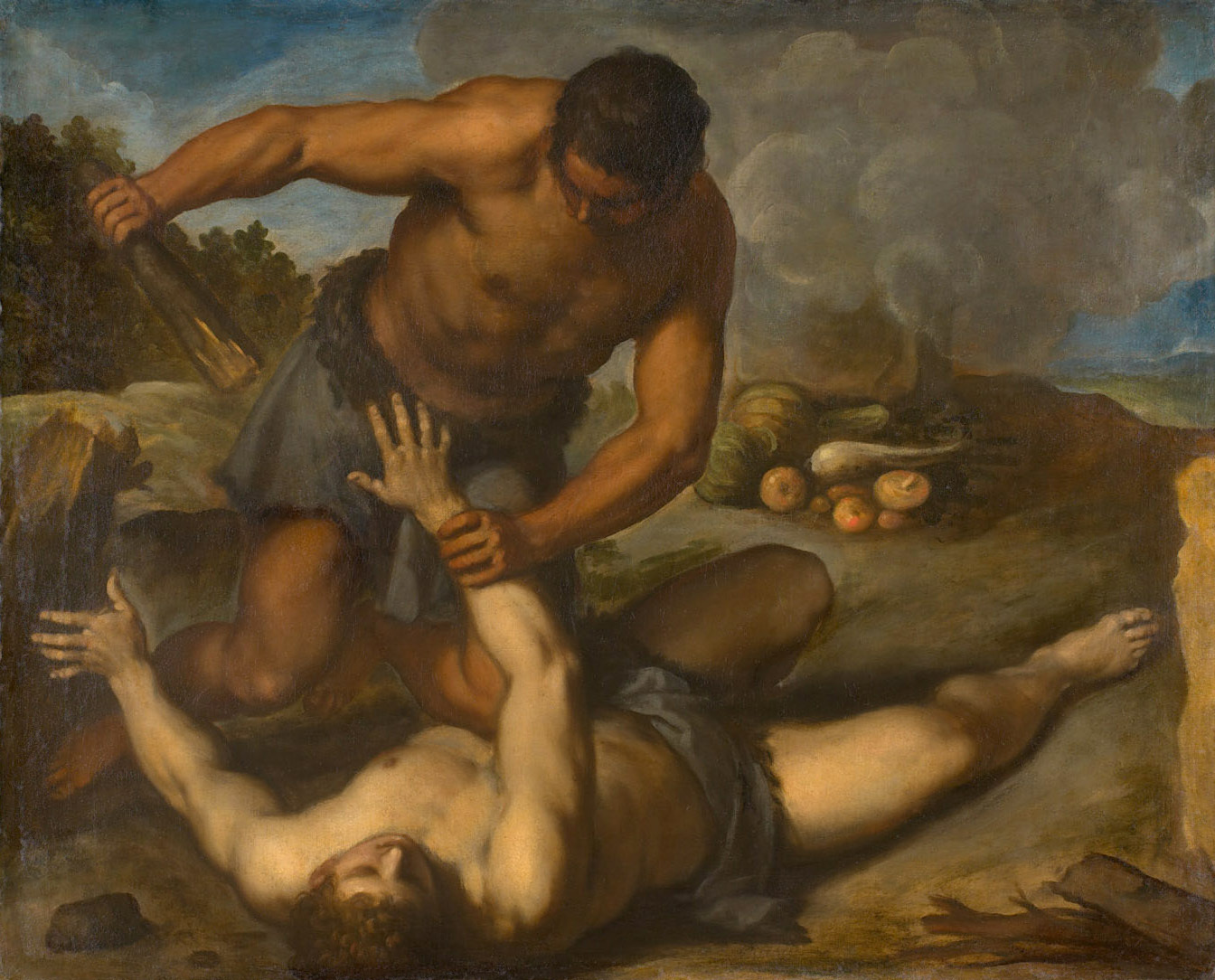
    • Cain and Abel as finally truth-telling instead of murdering;

    • Osiris and Set, if Set were to stop usurping and finally acknowledge the truth.

    Here, however, they stand “before the Lord of the earth” inside the “great city” (11:8) that is symbolically called Sodom and Egypt — the city of Set-like consciousness: sexualized exploitation (Sodom), enslaving empire (Egypt).

    Your two inner witnesses stand inside that city, announcing a different order.

    Fire from Their Mouths: The Cost of Honest Testimony

    “If anyone would harm them, fire pours from their mouth and consumes their foes.

    If anyone would harm them, this is how he is doomed to be killed.” (Rev 11:5)

    The witnesses are not meek in a sentimental sense:

    • their word carries fire;

    • any attempt to destroy them is met with consuming truth.

    In Geomytha:

    • this is the power of pure witnessing:

      • when awareness and reflection speak from the center,

      • their words burn illusions, cut through pretenses, and can feel lethal to ego-identities.

    It is not that they “attack”; it is that anything that tries to silence them has to confront reality directly.

    They also:

    • “have power to shut the sky, that no rain may fall,”

    • and to “turn waters into blood and to strike the earth with every kind of plague” (v.6).

    All of this imagery says:

    When the witnesses speak, they expose the system’s reliance on false light, false waters, and false fertility.

    It is costly to live with your Isis–Osiris witnesses active:

    • certain habits, comforts, and relationships cannot survive their presence,

    • certain “rains” (comforting illusions) stop falling,

    • certain “waters” (doctrines, narratives) are revealed as blood-soaked.

    The Beast from the Abyss: Killing the Witness Function

    “And when they have finished their testimony,

    the beast that rises from the bottomless pit

    will make war on them and conquer them and kill them,

    and their dead bodies will lie in the street of the great city

    that symbolically is called Sodom and Egypt,

    where their Lord was crucified.” (Rev 11:7–8)

    When their testimony is complete, something happens:

    • the Beast from the Abyss (introduced later as part of Set’s full apparatus)

    • makes war on them,

    • conquers them,

    • kills them.

    Their bodies lie in the street of the “great city,” symbolically:

    • Sodom – pleasure, exploitation, consumption.

    • Egypt – empire, slavery, religiousized politics.

    • “Where their Lord was crucified” – mapping onto Jerusalem, the religious-political center that killed the incarnate Witness.

    Geomytha reading:

    • The Beast is a concentrated form of Set’s system:

      • a hybrid of political, economic, religious, and imaginative machinery.

    • When your inner witnesses have said what they needed to say, the system often retaliates.

    Psychologically and spiritually, this looks like:

    • periods when your sense of presence (Isis) and clarity (Osiris) feel dead,

    • the part of you that used to know how to say “no” to illusion is silent,

    • and your witness functions lie “in the street” — exposed, mocked, apparently defeated.

    The “great city” is the inner metropolis of Set in you:

    • habits, screens, markets, institutions,

    • the churn of ordinary life where crucifixion-of-truth happens daily.

    The World’s Reaction: Rejoicing at Silence

    “For three and a half days some from the peoples and tribes and languages and nations

    will gaze at their dead bodies and refuse to let them be placed in a tomb,

    and those who dwell on the earth will rejoice over them and make merry and exchange presents,

    because these two prophets had been a torment to those who dwell on the earth.” (Rev 11:9–10)

    The reaction is chilling:

    • people from everywhere stare at the dead witnesses,

    • refuse even the basic dignity of burial,

    • celebrate,

    • exchange gifts.

    Why?

    “Because these two prophets had been a torment to those who dwell on the earth.”

    In Geomytha:

    • awareness and honest reflection are a torment to a consciousness that wants to remain comfortable inside Set’s system.

    • The death of your witness function feels like relief to all the parts of you (and the society around you) that prefer distraction and denial.

    On the inner level:

    • moments where you “just want to relax and not think about all that,”

    • seasons where you stop caring about what is true and just want to be left alone,

    • can feel like a holiday from the torment of your own integrity.

    Outwardly, entire cultures celebrate when inconvenient truth-tellers are silenced.

    The text names this dynamic directly: the world finds the witnesses tormenting, because they interrupt the narcotic of normalcy.

    Breath of Life and Ascent: The Witnesses Rise

    “But after the three and a half days a breath of life from God entered them,

    and they stood up on their feet, and great fear fell on those who saw them.

    Then they heard a loud voice from heaven saying to them, ‘Come up here!’

    And they went up to heaven in a cloud, and their enemies watched them.” (Rev 11:11–12)

    The silence is not permanent.

    After a short symbolic period (“three and a half days” – again, a half-cycle), three things happen:

    1. A breath of life enters them.

    2. They stand on their feet.

    3. They are called up and taken up in a cloud.

    In Geomytha:

    • the witness function in you — Isis-awareness and Osiris-reflection — may be suppressed, crucified, and mocked,

    • but it is indestructible at its core.

    • When its appointed “dead time” is over, it rises.

    This is the same pattern as:

    • Christ’s resurrection,

    • Joseph’s ascent from prison to rulership,

    • Jacob emerging from the night-wrestling with a limp and a new name,

    • any moment where your own clarity, long buried, suddenly stands up again.

    “Great fear fell on those who saw them”:

    • The parts of you (and the world) that celebrated their death are suddenly confronted with the fact that truth cannot be finally killed.

    • The relief of denial is over.

    They are called “up” — into a higher vantage point — while “their enemies watched”:

    • awareness and reflection now operate from above the city of Set,

    • not from under its pressures.

    Earthquake and Remnant: Partial Collapse, Partial Turning

    “And at that hour there was a great earthquake, and a tenth of the city fell.

    Seven thousand people were killed in the earthquake,

    and the rest were terrified and gave glory to the God of heaven.” (Rev 11:13)

    The immediate aftermath:

    • a great earthquake,

    • a tenth of the city falls,

    • seven thousand die,

    • “the rest… gave glory to the God of heaven.”

    The numbers again are symbolic:

    • tenth – a significant fraction, but not total.

    • seven thousand – seven (fullness) × 1,000 (multiplied) – a substantial, complete subset.

    In Geomytha:

    • the resurrection of the witnesses triggers structural upheaval in the city of Set:

      • some institutions, patterns, and identities collapse;

      • some “population” of inner habits and outer participants dies.

    But not all:

    • much remains,

    • yet “the rest… gave glory” – some aspect of the remaining consciousness shifts allegiance.

    • The survival of the witnesses and the partial collapse of the city bring about an actual internal turning in at least part of the field.

    This is what it looks like when:

    • the re-emergence of your own integrity, after a season of denial,

    • forces a reconfiguration of your life,

    • and some, but not all, of what used to resist awareness now acknowledges the truth.

    The Seventh Trumpet: “The Kingdom of This World…”

    “Then the seventh angel blew his trumpet, and there were loud voices in heaven, saying,

    ‘The kingdom of the world has become the kingdom of our Lord and of his Christ,

    and he shall reign forever and ever.’” (Rev 11:15)

    With the seventh trumpet, a declaration is made:

    “The kingdom of the world has become the kingdom of our Lord and of his Christ…”

    In Geomytha:

    • “the kingdom of the world” = the entire organized field of Set:

      • its empires, religions in his service, markets, illusions.

    • “become the kingdom of our Lord and of his Christ” =

      • the recognition that at the deepest level,

      • this whole field has never belonged to Set as owner,

      • but has always been grounded in Isis-awareness and redeemed through the Lamb/Christ/Horus aligned with Osiris.

    This is not yet the full collapse of Babylon (that comes later), but it is the legal proclamation, so to speak:

    “Your title is invalid.

    This realm is reverting to its true Owner.”

    The twenty-four elders fall on their faces and give thanks that:

    • God has taken great power and begun to reign,

    • the time has come to judge the dead, reward servants, and “destroy the destroyers of the earth” (v.18).

    “Destroy the destroyers of the earth” is a precise phrase:

    • it is not creation that is destroyed,

    • but the patterns that destroy creation — the Abaddon/Apollyon principle in human form.

    Temple Opened and Ark Revealed: Inner Holy of Holies Exposed

    “Then God’s temple in heaven was opened,

    and the ark of his covenant was seen within his temple.

    There were flashes of lightning, rumblings, peals of thunder, an earthquake, and heavy hail.” (Rev 11:19)

    The chapter ends with:

    • the heavenly Temple opened,

    • the Ark of the Covenant visible in the inner space,

    • followed by lightning, rumblings, thunder, earthquake, hail.

    In Geomytha:

    • this is your innermost center (Holy of Holies) becoming consciously exposed.

    • The Ark is the symbol of:

      • direct presence,

      • promise,

      • the “contract” between Isis-awareness and human consciousness.

    For most of the narrative, the Ark is hidden:

    • behind veils,

    • behind systems,

    • behind Set’s stories.

    When it is seen:

    • the truth about everything else is automatically called into question.

    • The “covenant” – the original arrangement of reality – is now visible again.

    Lightning, thunder, earthquake, hail:

    • the whole field responding to that exposure,

    • just as at Sinai when the Law was first given,

    • but now on a cosmic, internal scale.

    How Revelation 11 Functions in Geomytha

    As a whole, Revelation 11 describes:

    1. Inner boundary-setting.

      • Measuring the Temple and altar and worshippers =

        • recognizing what in you is sanctuary and marking it off.

    • Leaving the outer court to be trampled =

      • accepting that your outer life will still pass through Set’s chaos for a season.

    1. The rise, death, and rise of your witness function.

    • Two witnesses (Isis-awareness and Osiris-reflection) prophesy in the midst of the city of Set.

    • They torment the system simply by speaking truly.

    • The Beast kills them; denial celebrates.

    • Breath returns; they stand and ascend; the city shakes; some turn.

    1. The formal proclamation of sovereignty.

    • Seventh trumpet = legal notice:

      • “The kingdom of the world has become the kingdom of our Lord and of his Christ.”

    1. The opening of the inner Temple.

    • The Ark is visible again:

      • the deepest covenant between Being and consciousness is revealed.

    In personal practice through the Geomytha lens, this chapter invites questions such as:

    • What is my inner Temple, and where am I allowing it to be consciously measured and claimed?

    • Where is my outer court still given over to “the nations” — to patterns, obligations, and roles that trample what is holy in me?

    • Who are my two witnesses right now?

      • How does simple awareness testify?

      • How does clear reflection testify?

      • Where have I let the Beast from the Abyss silence them?

    • Can I recognize the seasons when my own witness felt “dead in the street,” and have I also seen those moments when breath re-entered and they stood?

    • And perhaps most sharply:

      • Where in my life do I still secretly rejoice when my inner witnesses are quiet, because they have been a “torment” to business-as-usual?

    Revelation 11 says:

    The story cannot proceed to beasts, Babylon, and New Jerusalem

    until the Temple in you is measured,

    your witnesses have passed through death and resurrection,

    and the Ark at your center has been unveiled as the true reference point.

    Everything that comes next will unfold in the light of that open Temple.

    X: @mythicgeometry · Substack: Geomytha Noir · YouTube: Geomytha · Instagram: @mythicgeometry · TikTok: @Geomytha · Patreon: GeomythaNoir
  • Revelation 10: Eating the Little Scroll

    Revelation 10: Eating the Little Scroll

    Why the next step after exposing Set’s machinery is to swallow your own script – sweet in the mouth, bitter in the stomach – through the Geomytha lens.

    Revelation 9 ended in a grim place:

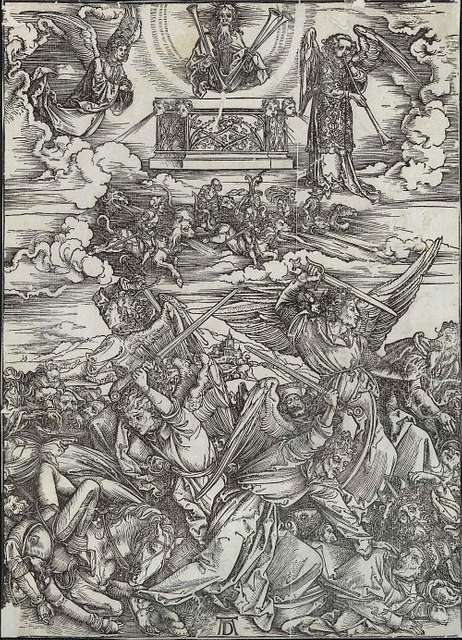
    • the Abyss opened,

    • locust-like thought-forms tormenting people,

    • a demonic cavalry riding out,

    • a third of humanity destroyed,

    • and the rest still refusing to repent of their idols and patterns.

    You might expect Revelation to just keep escalating from there.

    Instead, chapter 10 does something more intimate:

    It introduces a mighty angel with a little scroll

    and tells John to eat it.

    In Geomytha, this is the moment when the analysis of Set’s world stops being merely external and is internalized as lived insight.

    • Isis – awareness – is still the background.

    • Osiris – reflection – now has to move from seeing to digesting.

    • Set – the storyteller – has had his patterns exposed; now they must be tasted.

    • Horus – the ego – is about to learn what it’s like when its own story is chewed, swallowed, and metabolized.

    A Mighty Angel Wrapped in Cloud, with a Little Scroll

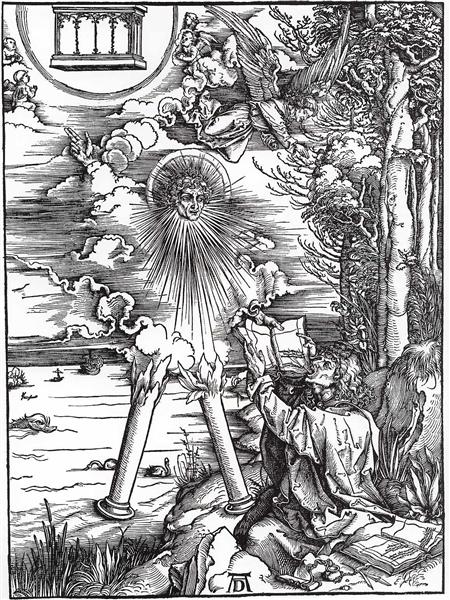
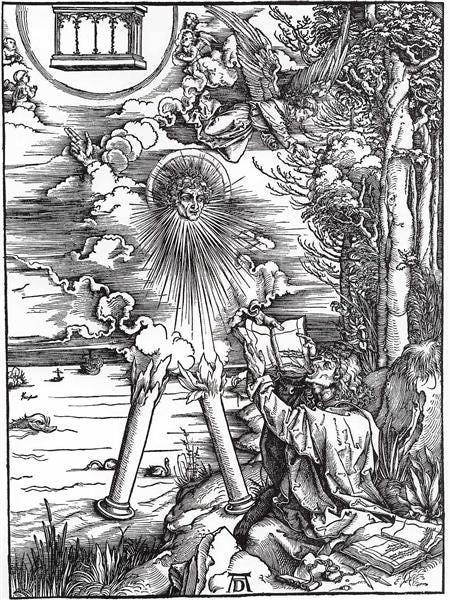
    “Then I saw another mighty angel coming down from heaven, wrapped in a cloud,

    with a rainbow over his head, and his face was like the sun,

    and his legs like pillars of fire.

    He had a little scroll open in his hand.” (Rev 10:1–2a)

    This angel is not the Lamb and not the One on the throne, but he clearly comes from that same field:

    • wrapped in a cloud – like Sinai, like the presence surrounding the mountain.

    • rainbow over his head – echoing the rainbow around the throne in Revelation 4: covenant field, spectrum of being.

    • face like the sun – solar radiance, but here not as Set’s counterfeit, rather as reclaimed solar power.

    • legs like pillars of fire – stability plus purifying intensity.

    He holds a little scroll, already open.

    In Geomytha:

    • The big scroll in chapter 5 was the full record of Set’s world: macro-patterns, history, collective story.

    • The little scroll is your personalized subset of that record:

      • the specific pattern of how those dynamics (horses, beasts, Babylon, etc.) have played out in your arc.

    The angel is like an emissary from the throne, bringing Osiris a manageable portion of what has been revealed, tailored for digestion.

    One Foot on Sea, One Foot on Land: Claiming Both Fields

    “He set his right foot on the sea, and his left foot on the land,

    and called out with a loud voice, like a lion roaring…” (Rev 10:2b–3a)

    The angel’s stance is important:

    • right foot on the sea – the emotional/collective unconscious field.

    • left foot on the land – the structured, material, conscious world.

    He is standing on both:

    • uniting the realm of inner chaos and the realm of outer form,

    • as if to say, “What I’m about to announce concerns your whole field.”

    The voice “like a lion roaring” evokes:

    • lion-aspect of the living creatures,

    • the earlier “Lion of Judah” title from chapter 5.

    In Geomytha:

    • this is Horus in its royal aspect, but now in full service to Isis/Osiris, calling for a total integration:

      • no more split between “inner” and “outer,”

      • no more pretending your emotional life is separate from your material choices.

    The little scroll will address both sea and land.

    Seven Thunders Speak – and Are Sealed

    “When he called out, the seven thunders sounded.

    And when the seven thunders had sounded,

    I was about to write, but I heard a voice from heaven saying,

    ‘Seal up what the seven thunders have said, and do not write it down.’” (Rev 10:3b–4)

    This is one of Revelation’s strangest moments:

    • the seven thunders say something,

    • John starts to write it (as he’s been doing with everything else),

    • and a voice interrupts: “Seal it. Do not write this part.”

    In Geomytha terms, this is crucial:

    Not everything can be externalized as content.

    Some things must be known only by direct impact.

    “Seven thunders” echoes the pattern of sevens:

    • seven seals,

    • seven trumpets,

    • seven bowls to come,

    • seven churches.

    Thunder is:

    • sound without precise articulation;

    • the raw reaction of the whole field to a disturbance.

    What the thunders say is real, but it is not recorded.

    Spiritually, this signals:

    • there are inner disclosures – raw, shocking knowings – that cannot be fully captured in language, doctrine, or systems.

    • They belong to the direct experience of awareness, not to the public script.

    For your own work in Geomytha:

    • these are the moments you cannot teach by explanation alone.

    • The “thunder” in a person’s life has to be felt – the exact weight of their own turning, their own confrontation, their own “I can’t go back” moment.

    Revelation 10 leaves those un-written on purpose.

    “There Will Be No More Delay”: The Mystery Completed

    “And the angel whom I saw standing on the sea and on the land

    raised his right hand to heaven and swore by him who lives forever and ever…

    that there would be no more delay,

    but that in the days of the trumpet call to be sounded by the seventh angel,

    the mystery of God would be fulfilled,

    just as he announced to his servants the prophets.” (Rev 10:5–7)

    The angel swears an oath:

    • by the eternal One,

    • that there will be no more delay.

    In other words:

    The long postponement is ending.

    The “mystery” is going to complete.

    In Geomytha:

    • “mystery” here is not a puzzle to be solved with intellect.

    • It is the hidden plan by which awareness allows Set’s system to fully expose itself and opens a way through and beyond it.

    This oath signals:

    • you are moving from diagnostic to decisive stages.

    • The trompe-l’œil of Set’s world has been thoroughly sketched; now the question is what consciousness will do with that knowledge.

    For our purposes, notice: this declaration comes right before John is asked to eat the scroll.

    No more delay means:

    “You cannot keep this as theory.

    You must take it into yourself now.”

    “Take and Eat It”: Sweet in the Mouth, Bitter in the Stomach

    “Then the voice that I had heard from heaven spoke to me again, saying,

    ‘Go, take the scroll that is open in the hand of the angel who is standing on the sea and on the land.’

    So I went to the angel and told him to give me the little scroll.

    And he said to me, ‘Take and eat it; it will make your stomach bitter, but in your mouth it will be sweet as honey.’

    And I took the little scroll from the hand of the angel and ate it.

    It was sweet as honey in my mouth,

    but when I had eaten it my stomach was made bitter.” (Rev 10:8–10)

    This is the heart of the chapter.

    John is told:

    • not just to read the scroll,

    • but to eat it.

    Geomytha translation:

    You can no longer keep this revelation at arm’s length.

    You must internalize it.

    “Sweet as honey in my mouth”:

    • At the level of mind, insight feels wonderful.

    • Seeing the pattern, mapping it, naming it – all of this is gratifying.

    • “Ah, now I understand how Set’s horses work, how Babylon works, how the system functions.”

    • Many people stop here and assume understanding = transformation.

    “But when I had eaten it, my stomach was made bitter”:

    • When the truth goes down into the gut (solar plexus, core), it becomes costly.

    • It begins to act on your actual attachments, losses, complicity, and hopes.

    • The system you are exposing is not “out there” only; it is in you.

    • The recognition that your own life has been entangled in, benefitted from, or been shaped by Set’s machinery is bitter.

    • This “sweet/bitter” pattern tracks through the brother stories:

    • Joseph’s insight into dreams is sweet; the reality of betrayal, slavery, prison is bitter.

    • Jacob’s cleverness in gaining the blessing tastes sweet at first; decades of exile, fear, and wrestling are bitter.

    • Cain’s fantasy that killing Abel will solve his problem is sweet in anticipation; the mark and exile that follow are bitter.

    Revelation 10 insists:

    Every true insight into the pattern will taste sweet and bitter

    if it is allowed to fully enter your life.

    If it’s only sweet, it’s still at the surface.

    “You Must Again Prophesy”: Speaking from the Inside Out

    The chapter ends with a new commission:

    “And I was told,

    ‘You must again prophesy about many peoples and nations and languages and kings.’” (Rev 10:11)

    This is not John’s first call to speak, but it comes after eating the scroll.

    In Geomytha:

    • prior to this, prophecy could still be partly theoretical:

      • describing what he saw,

      • reporting visions.

    • after this, the prophecy must come from someone who has ingested the pattern.

    “You must again prophesy” means:

    • you are not done speaking,

    • but what you say from here on will be different,

    • because it is spoken from a body that has been sweetened and embittered by what it knows.

    “About many peoples and nations and languages and kings”:

    • the scope remains global, structural, archetypal.

    • But the voice is now that of someone who cannot pretend to stand outside what they describe.

    For your Geomytha work, that is the pivot point:

    You are not just mapping myth and Revelation from the outside;

    you are eating your own material.

    That means:

    • letting it show you your patterns of conquest, war, scarcity, and death.

    • letting it expose how your own “tribes,” “kings,” and “nations” have played their part.

    • and then speaking not as a spectator, but as one who has consented to be changed by what you see.

    How Revelation 10 Functions in Geomytha

    As a chapter-long gesture, Revelation 10 says:

    1. A personalized packet of the pattern is being handed to you.

      • The mighty angel with the little scroll brings you your piece of the Revelation script.

    2. Not everything can be written; some things must only be thundered.

      • There will be parts of your own awakening that are not for public language, only for your direct knowing.

    3. Delay time is over.

      • You cannot live indefinitely in diagnostic mode — forever analyzing Set’s world without letting it touch you.

    4. You have to eat the scroll.

      • Allow the work to be sweet in your understanding and bitter in your gut.

      • If you only enjoy the sweetness, you haven’t swallowed it.

      • If you get only bitterness with no sweetness, you may be stuck in self-condemnation rather than revelation.

    5. From that digestion, a new voice emerges.

      • “You must again prophesy” = you must speak, write, create, and live from the metabolized insight, not just the diagram.

      • Your Geomytha work, at this stage, is prophecy in that sense:

        • not fortune-telling,

        • but truth-telling about peoples, nations, languages, and kings, starting from your own swallowed scroll.

    Practically, this chapter invites questions like:

    • What part of this Revelation/Geomytha material do I still hold safely in my mind without letting it touch my actual habits, relationships, and economics?

    • Where has the work been honey, and where has it started to become bitter in my belly?

    • Which “thunders” in my own story do I know I cannot put fully into words yet, but must honor as real?

    • What would it mean for my next round of speaking or creating to come from the eaten scroll rather than from the “interesting” scroll?

    Revelation 10 is a pause between blowing trumpets and measuring the Temple (chapter 11). It is the moment where the visionary is told:

    “This is not a show.

    Swallow it.

    And then, speak again.”

    X: @mythicgeometry · Substack: Geomytha Noir · YouTube: Geomytha · Instagram: @mythicgeometry · TikTok: @Geomytha · Patreon: GeomythaNoir
  • Revelation 9: When the Abyss Opens and the Cavalry Rides

    Revelation 9: When the Abyss Opens and the Cavalry Rides

    Paid essay — public preview. This page introduces the original essay. The complete argument, examples, and conclusion are available to paid Geomytha subscribers on Substack.

    Locusts as weaponized thought-forms and a demonic cavalry as runaway collective patterns – through the Geomytha lens.

    Revelation 8 showed the first four trumpets:

    earth, sea, rivers, and sky taking partial damage;

    the body, emotions, thought-streams, and cosmology beginning to reflect the cost of living under Set’s system.

    Revelation 9 takes the trumpets inside.

    The fifth and sixth trumpets are not about more external weather. They are about what happens in the human psyche when:

    the inner Abyss is opened,

    thought-forms are weaponized,

    and long-bound forces at the boundary of consciousness are released.

    Through the Geomytha lens:

    Isis – awareness – is still the ground.

    Osiris – reflection – is being pushed to see darker layers.

    Set – solar imagination…

    Read the complete essay on Substack →

    This WordPress page preserves the essay’s place in the Geomytha archive, its original title and subtitle, and its publication date. The full subscriber edition remains protected on Substack.

  • Revelation 8: When the Trumpets Start to Sound

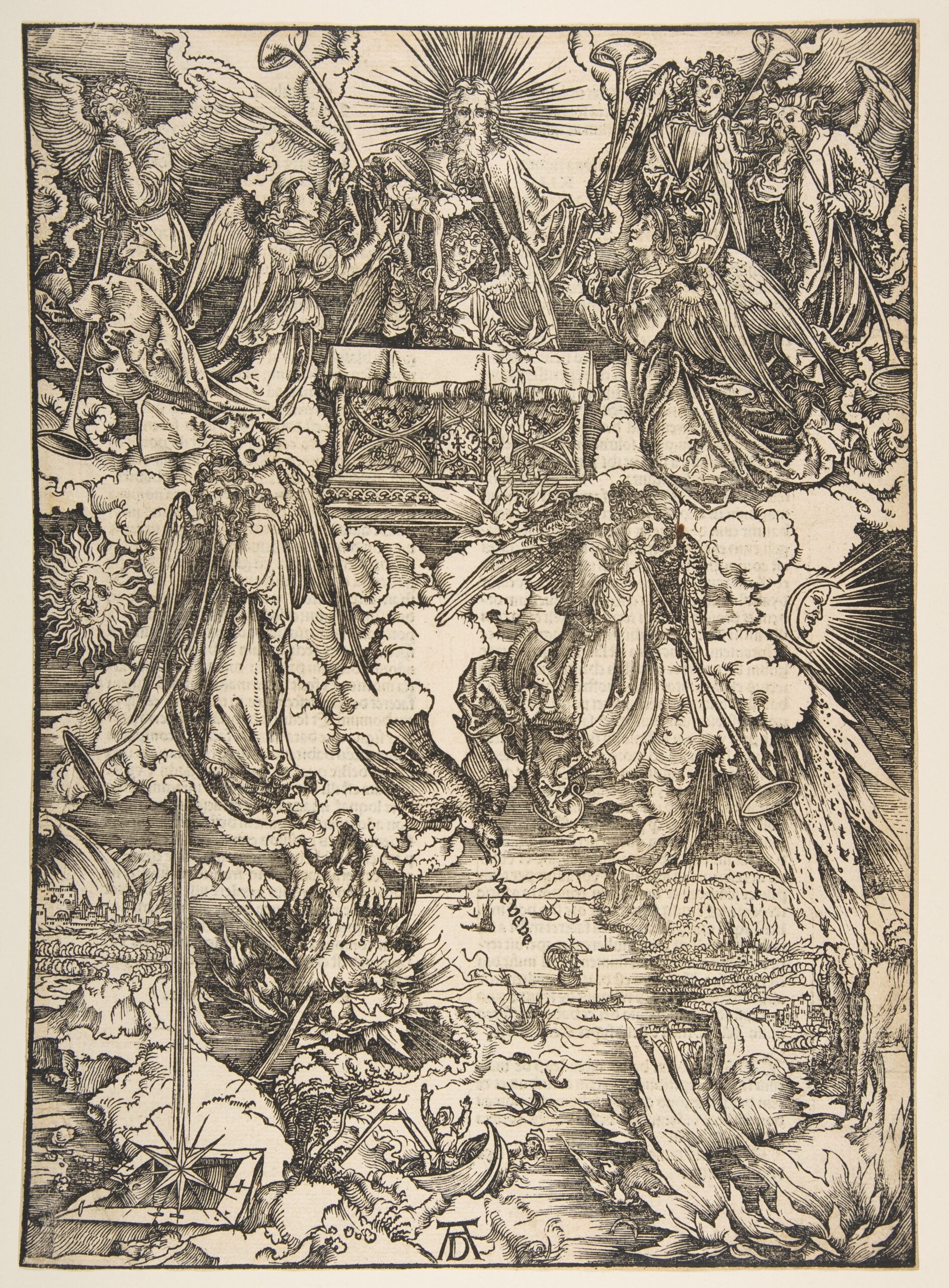
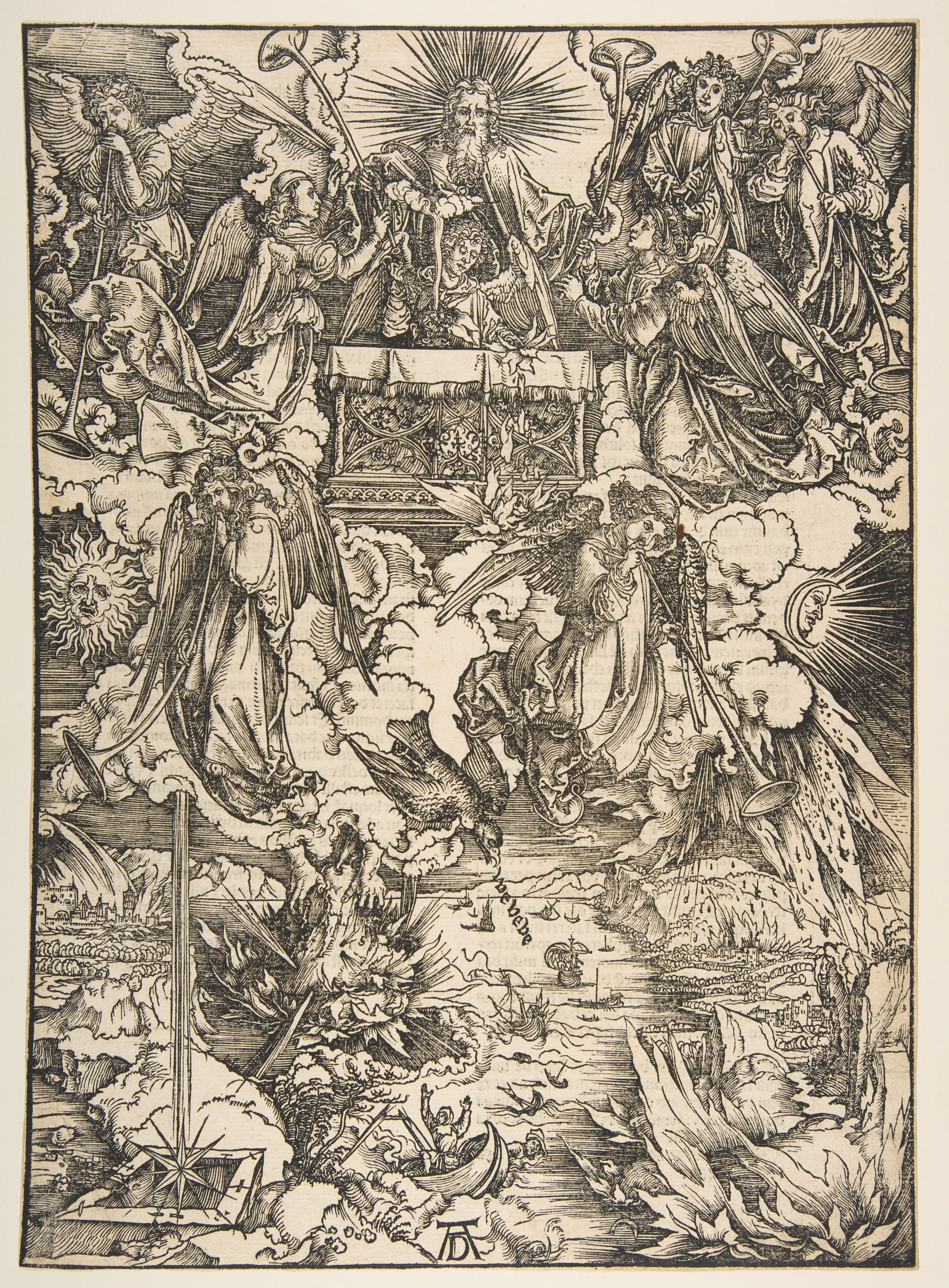
    Revelation 8: When the Trumpets Start to Sound

    Silence in heaven, seven trumpets, and the first shocks to earth, sea, rivers, and sky – through the Geomytha lens.

    Revelation 7 answered the question, “Who can stand?” with two images:

    • a sealed remnant (144,000 from the tribes), and

    • a great multitude in white robes, out of “the great tribulation.”

    Those visions showed that not all of you belongs to Set. There is a preserved core and a future beyond the horses.

    Revelation 8 turns back to the scroll.

    The Lamb opens the seventh seal, and instead of immediate new disasters, something unexpected happens first:

    • silence,

    • prayer,

    • and only then the trumpets begin.

    In Geomytha, this chapter marks a shift from exposing the inner operating modes (seals / horses) to exposing their outer consequences in the elements of your life:

    • earth (body, material structures),

    • sea (collective emotion),

    • rivers (thought-streams),

    • sky (your cosmology, your sense of time and meaning).

    The trumpets are not random plagues. They are announcements that Set’s system is starting to reap what it has sown.

    The Seventh Seal: Half an Hour of Silence

    “When the Lamb opened the seventh seal,

    there was silence in heaven for about half an hour.” (Rev 8:1)

    After all the noise — thunder, earthquakes, horses, cries, questions — the seventh seal produces:

    • not more sound,

    • but silence.

    In Geomytha, “heaven” is not just a place; it is a level of consciousness:

    • the interpretive, symbolic, meaning-making sky.

    “Silence in heaven” means:

    • the whole interpretive system goes quiet.

    • No new stories, no explanations, no noise from Set.

    This is an Isis moment:

    • pure awareness without commentary.

    • The circuit stops talking long enough for something deeper to land.

    The “about half an hour” language is deliberately vague:

    • not literal clock time,

    • but a sense of temporary, intentional pause — a sabbath inside the Apocalypse.

    It resembles those brief, potent pauses in the brother stories:

    • the night Jacob spends alone before meeting Esau – a gap between trickery and reconciliation.

    • the days Joseph’s brothers sit in Egyptian custody before Joseph reveals himself.

    • the gap between Cain’s warning and his act.

    Revelation 8 says: before anything else breaks open, there must be a complete, wordless suspension of the usual commentary.

    Incense and Prayers: The Hidden Data That Must Be Included

    “Then I saw the seven angels who stand before God, and seven trumpets were given to them.

    And another angel came and stood at the altar with a golden censer,

    and he was given much incense to offer with the prayers of all the saints on the golden altar before the throne,

    and the smoke of the incense, with the prayers of the saints, rose before God from the hand of the angel.” (Rev 8:2–4)

    Before the trumpets blow, something else happens:

    • an angel gathers “the prayers of all the saints,”

    • mixes them with incense,

    • and sends that mixture up before the throne.

    In Geomytha, this scene matters because it says:

    The unfolding of consequences is not mechanical only.

    The entire history of honest longing, grief, and appeal is part of the equation.

    “Prayers of the saints” are:

    • every cry for justice,

    • every plea for mercy,

    • every “how long?” from the martyrs under the altar,

    • and every quiet “please” ever directed toward truth.

    In other words, all of the heart’s data is loaded into the system before it responds.

    This is the opposite of Set’s cold calculus. Set’s economy:

    • counts profit, loss, power, and optics.

    • does not register the interior weight of what it costs beings to live inside his system.

    Revelation 8 insists that before the trumpets sound, all that unseen cost is brought to the center.

    Only then:

    “The angel took the censer and filled it with fire from the altar and threw it on the earth,

    and there were peals of thunder, rumblings, flashes of lightning, and an earthquake.” (Rev 8:5)

    The “fire from the altar” symbolizes:

    • the raw energy of reality in response to what has actually been going on.

    • a feedback loop: what has been offered up (prayers, sacrifices, suffering) now returns as a series of shocks.

    Trumpets versus Seals: From Inner Pattern to Outer Field

    The seals showed:

    • how the system operates internally: four horses, sacrificed presence, a cracking sky.

    The trumpets show:

    • how the system’s choices play out in outer domains: earth, sea, rivers, and sky.

    Seals are like opening the hidden diagnostics of your psyche and culture.

    Trumpets are like the consequences starting to show up in your body, environment, and cosmology.

    Each trumpet affects a third:

    • a third of earth, a third of trees, a third of the sea, a third of waters, a third of the sky.

    This “third” language means:

    • we are not yet at total collapse;

    • these are partial judgments/exposures, previews, warnings, side effects, not full endings.

    Think of the way a life begins to get feedback:

    • health issues,

    • relational blowups,

    • societal breakdowns,

    • climate events.

    They are not always total; they often come in fractions, to get your attention.

    First Trumpet: Hail, Fire, Blood – Earth and Green Things

    “The first angel blew his trumpet,

    and there followed hail and fire, mixed with blood,

    and these were thrown upon the earth.

    And a third of the earth was burned up,

    and a third of the trees were burned up,

    and all green grass was burned up.” (Rev 8:7)

    Imagery:

    • hail and fire (opposites: cold/heat),

    • mixed with blood (life-force).

    • Earth, trees, and grass burned.

    In Geomytha:

    • earth = body, material structures, lived physical reality.

    • trees = long-term structures, lineages, institutions that grow and root.

    • green grass = immediate life, daily vitality, your simplest organic thriving.

    Hail + fire + blood thrown onto earth is what it looks like when:

    • the combined contradictions and violence of Set’s system drop into your body and material life.

    • stress, burnout, exploitation of land, exhaustion, and blood-cost begin to surface.

    On the personal level:

    • health crises,

    • sudden burnout,

    • “why is my basic vitality gone?” are internal versions of this first trumpet.

    On the collective level:

    • literal climate damage,

    • ecological harm,

    • scorched-earth economics.

    The “third” signals:

    • not total annihilation,

    • but enough damage to say: this is the direction the system is headed if nothing changes.

    Second Trumpet: Burning Mountain into the Sea – Collective Emotion Poisoned

    “The second angel blew his trumpet,

    and something like a great mountain, burning with fire, was thrown into the sea.

    A third of the sea became blood,

    a third of the living creatures in the sea died,

    and a third of the ships were destroyed.” (Rev 8:8–9)

    Now we move from earth to sea.

    • A burning mountain (symbol of massive, established power)

    • is thrown into the sea (collective emotional field, unconscious depths).

    The result:

    • a third of the sea turns to blood,

    • a third of sea-creatures die,

    • a third of ships (human projects in that field) are destroyed.

    In Geomytha:

    • the mountain is Set’s concentrated system: empire, ideology, financial-industrial power, even religious structures.

    • when that mountain collapses or is violently imposed, it falls into the collective psyche.

    This reads like:

    • generational trauma,

    • wars,

    • social collapses that throw entire populations into the sea of grief, fear, and despair.

    The sea turning to blood:

    • emotional waters saturated with unresolved violence.

    • the field of feeling becomes a field of death-memory.

    Sea-creatures dying:

    • the subtle, living instincts and sensitivities that normally inhabit the emotional field cannot survive in those conditions.

    Ships destroyed:

    • human projects, narratives, and aspirations that sailed on those waters are wrecked.

    On an inner level, this trumpet sounds when:

    • your emotional life has been used as a dumping ground for institutional and relational damage.

    • “something huge” crashes into your feeling-world and turns it toxic.

    Again, only a third — it is a warning, not yet an absolute.

    Third Trumpet: Wormwood – Bitter Waters and Thought-Streams

    “The third angel blew his trumpet,

    and a great star fell from heaven, blazing like a torch,

    and it fell on a third of the rivers and on the springs of water.

    The name of the star is Wormwood.

    A third of the waters became wormwood,

    and many people died from the water, because it had been made bitter.” (Rev 8:10–11)

    Now we move from sea to rivers and springs:

    • rivers = flowing thought-streams, doctrines, media, stories, “takes.”

    springs = sources of

    • those streams: deep intuitions, philosophical or spiritual sources, origin-myths.

    A star falls from heaven — some high intellectual or spiritual principle:

    • previously seen as “light,”

    • now plummeting into the streams.

    It’s named Wormwood (a bitter herb).

    In Geomytha:

    • this is the corruption of meaning-sources.

    • The ideas and revelations that were meant to nourish become bitter:

      • theology used to control,

      • philosophy used to justify cruelty,

      • media used to manipulate rather than inform,

      • “insight” used as superiority-fuel.

    The waters people drink to make sense of reality are now:

    • flavored by cynicism,

    • laced with despair,

    • poisoned by half-truths and trauma.

    “Many people died from the waters” means:

    • people are spiritually, psychologically, even physically undone by the interpretive frameworks they ingest.

    • Their inner Osiris is starved or warped by what is supposed to guide it.

    The brother stories show smaller versions of this:

    • stories told in the family that justify abuse, favoritism, or exile;

    • interpretations of “blessing” and “curse” that keep everyone locked in roles.

    Wormwood is what happens when those stories become the default water supply.

    Fourth Trumpet: Darkened Sun, Moon, and Stars – A Fractured Cosmology

    “The fourth angel blew his trumpet,

    and a third of the sun was struck, and a third of the moon, and a third of the stars,

    so that a third of their light might be darkened,

    and a third of the day might be kept from shining, and likewise a third of the night.” (Rev 8:12)

    The fourth trumpet hits the sky-clock itself:

    • sun – Set’s solar engine, the ruler of day, productivity, visibility, ego-time.

    • moon – Osiris’ reflective, cyclical aspect, the emotional and intuitive rhythm.

    • stars – fixed points of orientation: doctrines, constellations, archetypes, social “laws.”

    A third of each is struck:

    • the sun’s light reduced,

    • the moon’s reflection dimmed,

    • the stars’ guidance obscured.

    A third of day and a third of night are darkened.

    In Geomytha, this is:

    • a partial breakdown of your cosmology.

    • Not total darkness, but enough disorientation that you can no longer fully trust the sky you grew up under.

    This can feel like:

    • loss of faith in institutions,

    • loss of trust in inherited religion or ideology,

    • feeling that “time” itself no longer behaves as you expected,

    • seasons of life not matching the script you were given.

    We already saw a version of this with the sixth seal (sky rolling up).

    Here, the trumpets show it in fractions:

    • your days feel shorter, meaning-wise;

    • your nights (intuitive/inner life) are not as luminous;

    • the “stars” (role models, texts, systems) are no longer as reliable.

    This has a Geomytha upside:

    • it loosens the tyrannical hold of Set’s sky,

    • making it possible to see beyond it.

    But as an experience, it is destabilizing.

    The Eagle’s Cry: Three Woes Yet to Come

    “Then I looked, and I heard an eagle crying with a loud voice as it flew directly overhead,

    ‘Woe, woe, woe to those who dwell on the earth,

    at the blasts of the other trumpets that the three angels are about to blow!’” (Rev 8:13)

    The chapter closes with an eagle in flight:

    • one of the four living creatures’ faces is an eagle (vision, overview).

    • Here, an eagle acts as herald.

    It announces three woes still to come, tied to the remaining trumpets (9–11):

    • things will get more targeted, more intense,

    • moving from environmental/structural shocks

    • to direct torments and exposures in the human psyche and systems.

    In Geomytha, the eagle’s cry is:

    • Osiris at the high-vision level saying,

    • “This is not random; this is where Set’s circuit goes when left unchecked. Pay attention.”

    How Revelation 8 Functions in Geomytha

    Revelation 8 is the first layer of feedback:

    • The seals exposed inner patterns.

    • The trumpets show how those patterns begin to show up in outer fields.

    Through this lens:

    • First trumpet – Body and material life begin to burn under the contradictions of the system.

    • Second trumpet – Collective emotion becomes a graveyard for collapsed powers and traumas.

    • Third trumpet – Meaning-streams and sources turn bitter; doctrines and narratives poison rather than heal.

    • Fourth trumpet – Your sky partially goes dark; the clock you lived by no longer feels trustworthy.

    And still, only thirds.

    Geomytha practices suggested by this chapter:

    1. Notice where the “thirds” are showing up.

      • Where does your body or environment feel partially burned out?

      • Where does your emotional “sea” carry someone else’s collapsing mountain?

      • Where have your thought-streams grown bitter — what are you drinking mentally every day?

      • Where has your inner sky gone dim, and what scripts no longer fit?

    2. Allow the half-hour of silence.

    • Before trying to fix or interpret these things, honor that seventh-seal pause.

    • Let there be intervals with no new story, no new take — just Isis-silence.

    1. Trust that your prayers are included.

    • Even if your conscious prayers have been confused, the heart’s real data is part of the response.

    • The trumpets are not blind fate; they are part of a larger correction process, however harsh it looks to the surface self.

    Revelation 8 is what it looks like when the universe begins to say to Set’s system:

    “No more free external ride.

    What you’ve done internally will now start to show up in your elements —

    earth, sea, rivers, sky —

    so you can no longer pretend it isn’t there.”

    Next, in chapter 9, those trumpets will reach deeper into the psyche:

    locusts from the Abyss, a demonic cavalry — images of runaway thought-forms and collective compulsions unleashed when the early warnings are ignored.

    X: @mythicgeometry · Substack: Geomytha Noir · YouTube: Geomytha · Instagram: @mythicgeometry · TikTok: @Geomytha · Patreon: GeomythaNoir
  • Revelation 7: Who Can Stand? The Sealed Remnant and the Crowd in White

    Revelation 7: Who Can Stand? The Sealed Remnant and the Crowd in White

    How the 144,000 and the great multitude reveal the “preserved core” inside Set’s world, through the Geomytha lens.

    Revelation 6 ended with everything shaking.

    The seals opened. The four horses of conquest, war, scarcity, and death rode out. The martyrs under the altar cried “How long?” The sun darkened, the moon turned to blood, the sky rolled up like a scroll. Kings and slaves alike hid in caves, terrified of “the face of him who is seated on the throne, and from the wrath of the Lamb.”

    The last line of the chapter is a question:

    “For the great day of their wrath has come,

    and who can stand?” (Rev 6:17)

    Revelation 7 is the answer.

    It does not come as a theological proposition. It comes as two visions:

    1. 144,000 sealed from the tribes of Israel, and

    2. A great multitude no one can number, from every nation, in white robes.

    In Geomytha, this chapter shows:

    • that not all of you belongs to the horses and beasts,

    • that there is a preserved core inside the system,

    • and that awareness has already marked parts of your field that will not be lost to Set.

    Four Winds Held Back: A Pause Before the Storm Finishes

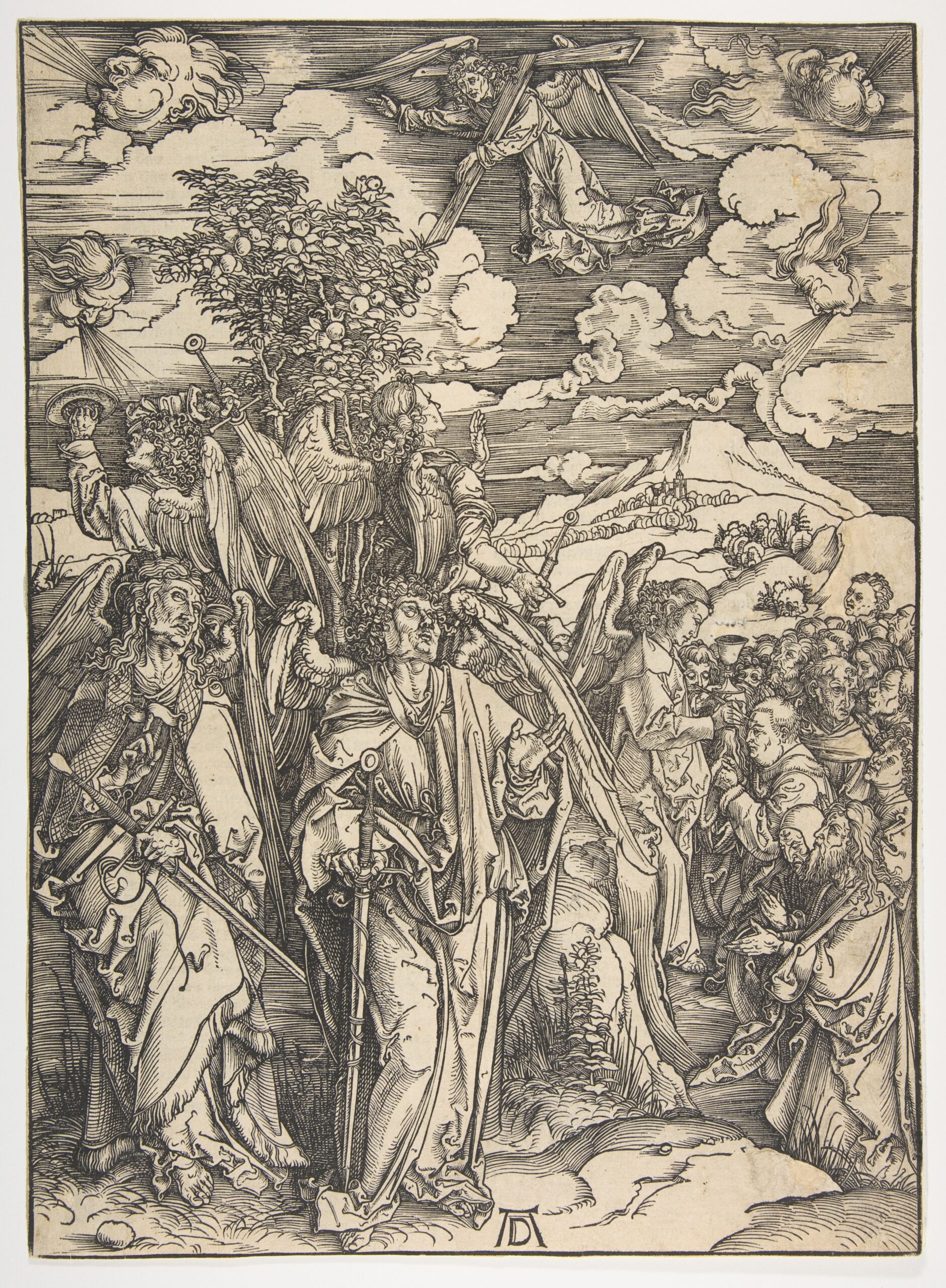
    “After this I saw four angels standing at the four corners of the earth,

    holding back the four winds of the earth,

    that no wind might blow on earth or sea or against any tree.” (Rev 7:1)

    Before anything else happens, there is a pause.

    Four angels stand at the “corners of the earth” holding back four winds. The earth, sea, and trees are temporarily protected.

    In Geomytha terms:

    • the winds are the full, unrestrained consequences of Set’s patterns – the karmic storm that could sweep through every layer (earth = body and material life, sea = emotional and collective field, trees = rooted structures, lineages).

    • the angels are boundaries established by awareness: a stay of execution.

    This is not mercy as sentiment; it is mercy as timing:

    “Do not harm the earth or the sea or the trees,

    until we have sealed the servants of our God on their foreheads.” (Rev 7:3)

    The system is not allowed to complete its own collapse until something has been done:

    • certain aspects of consciousness must be sealed – clearly marked as belonging to the throne, not to the horses.

    This is the Lamb’s protection of your Philadelphia-like parts: the small, sincere centers in you that have remained open to awareness even while the rest of the field participates in Set’s world.

    The 144,000: Twelve Tribes, Twelve Brothers, Completed Circuits

    “And I heard the number of the sealed,

    144,000, sealed from every tribe of the sons of Israel…” (Rev 7:4)

    What follows is a list of twelve tribes, each with 12,000 “sealed” ones.

    Numbers in Revelation are never just statistics; they are shapes:

    • 12 is the number of a full circuit:

      • twelve tribes, twelve apostles, twelve months, twelve gates, twelve fruits on the Tree of Life.

    • 12 × 12 × 1000 (symbolic fullness) = 144,000.

    In Geomytha:

    • the twelve tribes are the twelve brother-lines that descend from Jacob/Israel.

    • Jacob himself is the archetype of wrestling with God and being renamed.

    • These tribes represent twelve archetypal ways consciousness can develop.

    The “sons of Israel” are the family system where so many brother dramas play out:

    • Joseph and his brothers,

    • Judah and Tamar,

    • the rivalries and reconciliations that shape the whole story.

    To say that 12,000 from each tribe are sealed on their foreheads is to say:

    In every archetypal line, in every way identity has expressed itself,

    there is a portion that now bears the mark of awareness.

    The forehead is the thought-center:

    • Set marks the forehead with his stories and fears (the “mark of the beast” later).

    • Here, the Lamb marks the forehead with another seal: a quiet, inner recognition of the throne.

    Geomytha translation:

    • Within each of your “tribes” – survival strategies, family inheritances, personality structures – there is a remnant that has already turned toward Isis/Osiris.

    • These are not perfect people or perfect traits. They are capacities, tendencies, memories, and choices that have consented to truth as far as they understood it.

    The important point is not the literal number, but the pattern:

    • Every kind of “brother” is represented.

    • No tribe is left without a sealed portion.

    • The system is not pure corruption; there is preserved seed in each branch.

    The Great Multitude in White: All Brothers, All Nations

    After the sealed number, John sees something else:

    “After this I looked, and behold, a great multitude that no one could number,

    from every nation, from all tribes and peoples and languages,

    standing before the throne and before the Lamb,

    clothed in white robes, with palm branches in their hands…” (Rev 7:9)

    The scale suddenly expands:

    • not just Israel’s twelve tribes,

    • but every nation and language – all the “brothers” of humanity.

    They are:

    • standing before the throne and the Lamb (answering the “who can stand?” question),

    • wearing white robes,

    • holding palm branches.

    In Geomytha, this is a picture of:

    1. Identity washed of Set’s imprint

      • White robes = garments (identities) that have been “washed.”

      • The text will say explicitly: “they have washed their robes and made them white in the blood of the Lamb.”

      • This is the paradox: the wound-processed awareness (Lamb-consciousness) becomes the very thing that bleaches identity of its fear-stains and power-games.

    2. Living branches of the Tree of Life

      • Palm branches evoke festival processions and harvest celebrations.

      • Within your system, they can be read as portable pieces of the Tree: signs of life, resilience, renewal.

      • These people are, in effect, carrying the Tree of Life in their hands while standing at the throne.

    This multitude has no ethnic, linguistic, or cultural boundary. All the brother-divisions – Israel vs. the nations, one tribe vs. another, one religion vs. another – are gathered in one place, in one posture, facing the throne rather than facing each other in rivalry.

    “Out of the Great Tribulation”: What They Came Through

    One of the elders asks John, “Who are these, clothed in white robes, and from where have they come?” John defers: “Sir, you know.”

    The elder answers:

    “These are the ones coming out of the great tribulation.

    They have washed their robes and made them white in the blood of the Lamb.” (Rev 7:13–14)

    “The great tribulation” is often read as a future time of unique distress. Through the Geomytha lens, it is also:

    • the entire experience of living in Set’s world under the horses.

    • the long circuit of conquest, war, scarcity, and death-identification,

    • the brother stories of betrayal, exile, famine, and partial reconciliation,

    • the whole roller coaster of trying to be a self in a field built on fear.

    These people are not those who avoided tribulation. They are those who came through it:

    • not untouched,

    • but cleansed in the way only the Lamb can cleanse: by metabolizing the wound into deeper clarity and compassion.

    The phrase “washed their robes in the blood of the Lamb” is a symbolic way of saying:

    “The very suffering consciousness went through, when held in Lamb-mode,

    became the solvent that dissolved false identity and left only what is true.”

    It is Joseph’s line:

    • “You meant it for evil, but God meant it for good,” scaled out over the whole human story.

    No More Scorching Sun: Set’s Light Loses Its Power

    The elder continues describing their state:

    “They shall hunger no more, neither thirst anymore;

    the sun shall not strike them, nor any scorching heat.

    For the Lamb in the midst of the throne will be their shepherd,

    and he will guide them to springs of living water,

    and God will wipe away every tear from their eyes.” (Rev 7:16–17)

    Several details matter in the Geomytha mapping:

    1. No more hunger or thirst

    • This is the end of the black horse life – the economy of “not enough.”

    • The inner scales are put down; existence is no longer experienced as endless lack.

    2. The sun no longer strikes them

    • Set’s solar field – which previously dominated as harsh productivity, exposure, judgment – no longer burns.

    • It is not that there is no sun; it is that the sun has lost its power to wound.

    • The same external conditions may still exist, but their inner meaning has been transfigured.

    1. The Lamb as shepherd at the center of the throne

    • The Lamb is now explicitly said to be “in the midst of the throne” and acting as shepherd.

    • This means Osiris-in-wound (the Lamb) is no longer just one figure in the scene; it is integrated into the very axis of reality.

    • Awareness is now explicitly guided by the aspect of itself that knows suffering from the inside.

    1. Springs of living water

    • Eternal, fresh awareness (Isis) flowing in tangible experience.

    • Not stagnant doctrine, not stored-up merit, but present-moment vitality.

    1. Every tear wiped away

    • Not an erasure of memory, but the end of unresolved grief.

    • The unresolved brother stories—Cain’s regret, Esau’s loss, Joseph’s trauma, the older brother’s resentment—are all seen at a depth where their pain is no longer the organizing principle of identity.

    In short, the multitude in white is what it looks like when:

    • the sealed remnant (144,000)

    • and the processed multitude (“out of great tribulation”)

    • stand together in a field where Set’s patterns no longer define reality.

    How Revelation 7 Functions in Geomytha

    Placed between the sixth and seventh seals, Revelation 7 serves several roles:

    1. It answers the question “Who can stand?”

      • Those who have been sealed in their thinking and willing — marked by awareness rather than by fear.

      • Those who have come through tribulation in Lamb-mode rather than being swallowed by it.

    2. It prevents nihilism.

    • After Revelation 6, it would be easy to conclude that everything is doomed.

    • Revelation 7 insists:

      • there is a preserved core in every archetypal line,

      • and a future for every kind of “brother” who consents to be washed.

    1. It shows that salvation is both particular and universal.

    • Particular: 12,000 from each tribe—every “brother-type,” every line, has its own way of being sealed.

    • Universal: a crowd no one can number from every nation—no lineage is structurally excluded.

    1. It locates guidance in the Lamb.

    • The one who leads them is not a distant sky-king, but the “slain yet standing” consciousness in the midst of the throne.

    • The same awareness that saw the horses in you is now the shepherd of what remains.

    For your own practice in the Geomytha field, Revelation 7 suggests questions like:

    • Where in me has something already been sealed?

      • What are the boundaries or truths I simply will not betray anymore, even if I do not always live them perfectly?

    • Where do I sense a great multitude of experiences, identities, and past selves that could be washed rather than denied?

    • How often do I still live under a scorching sun — a harsh inner critic, productivity god, or timeline that burns me — and what might it feel like if that sun lost its power to strike, even if it still shone?

    Revelation 7 is the reminder that, even as the horses ride and the sky shakes, there is a door held open in the middle of the story:

    A preserved remnant in each “brother,”

    a crowd of futures no one can count,

    and a Lamb at the center who knows how to lead them home.

    X: @mythicgeometry · Substack: Geomytha Noir · YouTube: Geomytha · Instagram: @mythicgeometry · TikTok: @Geomytha · Patreon: GeomythaNoir
  • Revelation 6: The Four Horses That Already Run Your Life

    Revelation 6: The Four Horses That Already Run Your Life

    How the first six seals expose conquest, war, scarcity, and death-patterns in consciousness through the Geomytha lens.

    Revelation 5 ended with the Lamb — “slain yet standing” — taking the sealed scroll from the One seated on the throne.

    In Geomytha, that Lamb is the Osiris-function in its most awakened form:

    • fully acquainted with the wound,

    • still capable of clear seeing,

    • authorized by awareness (Isis) to read the whole story Set has written.

    In Revelation 6, the Lamb begins to open the seals.

    What comes out are not random future disasters. They are the main operating modes by which Set’s solar imagination already runs your life and the world’s systems:

    1. Conquest

    2. War

    3. Scarcity

    4. Death-identification

    Then two more seals:

    1. Martyrs under the altar – sacrificed presence;

    2. A cosmic crack in the sky – Set’s calendar tearing.

    Through Geomytha, these are not external omens; they are ongoing functions inside consciousness that the Lamb finally exposes.

    First Seal: The White Horse – Conquest and the Future-Rescue Story

    “Now I watched when the Lamb opened one of the seven seals,

    and I heard one of the four living creatures say with a voice like thunder, ‘Come!’

    And I looked, and behold, a white horse! And its rider had a bow,

    and a crown was given to him, and he came out conquering, and to conquer.” (Rev 6:1–2)

    The white horse looks noble:

    • white (purity, righteousness),

    • bow (aim, focus),

    • crown (authority),

    • conquering (victory).

    In more literal readings, this is often interpreted as Christ, the gospel, or a righteous empire.

    In the Geomytha reading, tethered to the Lamb and scroll context, this is the first exposed pattern of Set:

    The belief that your salvation lies in a future victory.

    This is conquest-consciousness:

    • “Once I achieve X, I’ll be safe.”

    • “Once I win this argument, get this degree, defeat this enemy, finish this awakening, then my life will finally begin.”

    It wears white because it presents itself as noble:

    • conquering “for God,” for truth, for family, for justice, for enlightenment.

    But under it:

    • Set is pulling Osiris out of the present and projecting it into the future as a rescue fantasy.

    • Horus is constantly leaning forward, never allowed to rest.

    The brother stories show this pattern:

    • Jacob believes his life will only be secure after he secures the birthright and blessing.

    • Joseph’s brothers imagine their security only after Joseph is removed.

    • Cain imagines that if the “problem” (Abel) is solved, his offering will implicitly be vindicated.

    In each case, the white horse logic is operating:

    “When I conquer this, then I will be real.”

    Revelation 6 is not introducing this pattern; it is saying:

    “Look. This is what has been riding you.”

    Second Seal: The Red Horse – War and the Enemy-Identity

    “When he opened the second seal,

    I heard the second living creature say, ‘Come!’

    And out came another horse, bright red.

    Its rider was permitted to take peace from the earth,

    so that people should slay one another,

    and he was given a great sword.” (Rev 6:3–4)

    The red horse is the embodiment of war-consciousness:

    • It “takes peace” away.

    • Its whole function is to turn beings against one another.

    • The sword here is not surgical discernment; it is a weapon.

    In Geomytha, this is Set’s division principle:

    • the reflex that needs an enemy for the ego to feel defined.

    • “Who am I?” becomes answered largely by “who I am against.”

    You see this in every brother pair:

    • Cain vs. Abel: one’s existence becomes intolerable to the other.

    • Jacob vs. Esau: each is seen as a threat to the other’s place in the father’s favor.

    • Joseph vs. his brothers: Joseph’s dreams become a justification for the others’ hatred.

    Wherever this horse rides in you, your inner script sounds like:

    • “If they did not exist, I could finally relax.”

    • “If this group, this person, this ex, this institution disappeared, then I’d be okay.”

    The red horse doesn’t care whether the war is physical, verbal, emotional, or purely internal. Its aim is:

    • to keep Isis and Osiris from recognizing themselves on both sides.

    • as long as your identity is built on conflict, Set’s world has your full attention.

    Third Seal: The Black Horse – Scarcity and the Economy of “Not Enough”

    “When he opened the third seal,

    I heard the third living creature say, ‘Come!’

    And I looked, and behold, a black horse!

    And its rider had a pair of scales in his hand.

    And I heard what seemed to be a voice… saying,

    ‘A quart of wheat for a denarius, and three quarts of barley for a denarius,

    and do not harm the oil and wine!’” (Rev 6:5–6)

    The black horse carries scales. It is an accountant.

    This is scarcity-consciousness:

    • everything weighed, measured, priced, rationed.

    • the fixation on whether there will be “enough”: enough food, money, time, love, success, forgiveness.

    The quoted prices and the “do not harm the oil and wine” line emphasize:

    • a world where basic goods are squeezed,

    • luxuries protected,

    • inequality baked in,

    In Geomytha terms:

    • the black horse sits deep in Set’s economic architecture.

    • It is responsible not only for literal financial anxiety, but for the subtle sense of existential lack:

      • “I am behind.”

      • “I am too late.”

      • “Everyone else is ahead of me.”

      • “There isn’t enough for me to be generous or rest.”

    The brother stories are soaked in this logic:

    • Esau famously sells his birthright for a bowl of stew because hunger feels more “real” than inheritance in that moment.

    • Joseph’s brothers fear there will not be enough love or favor to include both Joseph and themselves.

    • In the prodigal son parable, the older brother’s complaint is economic: “You never gave me a young goat… but you killed the fattened calf for him.”

    In all of these, Set’s black horse whispers:

    “There is not enough — of anything that matters. You must hoard, compete, and fear.”

    Revelation 6 does not create that voice; it unmasks it.

    Fourth Seal: The Pale Horse – Death as Identity

    “When he opened the fourth seal,

    I heard the voice of the fourth living creature say, ‘Come!’

    And I looked, and behold, a pale horse!

    And its rider’s name was Death, and Hades followed him.

    And they were given authority over a fourth of the earth,

    to kill with sword and with famine and with pestilence and by wild beasts of the earth.” (Rev 6:7–8)

    The pale horse — often rendered sickly, ashen, greenish — is the culmination of the first three.

    Its rider’s name is simply Death, with Hades (the underworld) following.

    In Geomytha, this is death-identification:

    • not just the fact that the body dies,

    • but the pervasive story that you are your biography, and that biography is racing toward annihilation or permanent judgment.

    Conquest, war, and scarcity all aim toward this horse:

    • The white horse says: “Hurry, or you will die without having lived.”

    • The red horse says: “Fight, or you and yours will be destroyed by them.”

    • The black horse says: “Hoard, or there will not be enough to keep death away.”

    The pale horse says:

    “It is all death anyway: why not double down on the story or collapse into despair?”

    In the brother stories, this is the point where:

    • Cain says, “My punishment is greater than I can bear,” and sees himself as permanently cursed.

    • Esau cries out, “Have you only one blessing?” and experiences himself as irreversibly supplanted.

    • Joseph’s brothers assume all that is left for them is retribution: “It may be that Joseph will hate us and pay us back.”

    Death-identification is not realism. It is absolute conclusion:

    • “I am ruined.”

    • “It is too late.”

    • “Nothing good can come from this now.”

    The pale horse writes those sentences in your nervous system.

    Fifth Seal: Martyrs Under the Altar – Sacrificed Presence

    “When he opened the fifth seal,

    I saw under the altar the souls of those who had been slain for the word of God and for the witness they had borne.

    They cried out with a loud voice,

    ‘O Sovereign Lord… how long…?’” (Rev 6:9–10)

    The fifth seal takes us from horses to an altar.

    Under it lie the “souls” of those slain for the word and their witness.

    At one level, this refers to literal martyrs. In Geomytha, the image also exposes a deeper pattern:

    All the moments of presence sacrificed to Set’s systems.

    Think of:

    • Children sacrificed to Moloch in the text — and children sacrificed to careers, ideologies, and addictions now.

    • Hours of life given up to pointless conflict, compulsive scrolling, or anxiously replaying scenarios in the mind.

    Those sacrificed moments are your internal martyrs:

    • times when Isis and Osiris were present enough to “bear witness,”

    • and were nevertheless thrown under the altar of “how things are done.”

    Their cry — “how long?” — is the deep intuition that something about this economy is fundamentally unjust.

    They are told to rest a little longer, “until the number… should be complete” — a way of saying:

    • the sacrificial system must be seen in its full extent before it can be retired.

    • The Lamb is making sure the scroll not only records what happened, but how completely it has been playing out.

    Sixth Seal: The Cracking Sky – Set’s Calendar Tears

    “When he opened the sixth seal, I looked, and behold, there was a great earthquake,

    and the sun became black as sackcloth, the full moon became like blood,

    and the stars of the sky fell to the earth…

    The sky vanished like a scroll that is being rolled up…” (Rev 6:12–14)

    With the sixth seal, the stage itself starts to shake:

    • earthquake – the “ground” of reality trembles;

    • sun darkened – Set’s solar clock and its reassuring light fail;

    • moon turned to blood – Osiris’ cycle is no longer a gentle reflection; it is a crisis;

    • stars falling – fixed points of orientation in the mental “sky” lose their places;

    • the sky rolling up – the entire framework of meaning withdraws.

    In Geomytha, this is what happens when:

    • your inherited cosmology, your personal story, your social and religious maps

    • are no longer able to contain what you are seeing.

    Set’s overarching calendar — the sense of “how things work” — begins to tear.

    Every brother story has a version of this:

    • Cain is driven out and must live east of Eden with a mark; the world he knew is gone.

    • Jacob limps away from the Jabbok with a new name and cannot go back to being the old trickster.

    • Joseph’s famine forces the whole family system to reassemble in a new configuration.

    When the sixth seal opens in your own life, it feels like:

    • “I don’t know what anything means anymore.”

    • “The beliefs that got me here no longer match my actual experience.”

    • “I’m not even sure what ‘God’ or ‘self’ or ‘world’ mean now.”

    The text ends this section with people of every level hiding in caves, asking mountains to fall on them to hide them “from the face of him who is seated on the throne, and from the wrath of the Lamb” (Rev 6:16).

    In Geomytha, that “wrath” is not vindictive anger; it is the intensity of reality breaking through illusion. It feels like wrath to the parts of you that are built on false premises.

    How Revelation 6 Functions in Geomytha

    Revelation 6 is not a catastrophe schedule. It is a diagnostic overlay on your inner life:

    • The white horse rides every time your value is projected into a future victory.

    • The red horse rides every time your identity is defined by who you’re against.

    • The black horse rides every time you live from “not enough.”

    • The pale horse rides every time you conclude your story is irreparably doomed.

    • The martyrs under the altar are every sacrificed moment of presence, honesty, and tenderness abandoned to “how things are done.”

    • The cracking sky is every crisis in which your inherited map fails and a deeper truth pushes through.

    The Lamb opening the seals means:

    The most wounded-yet-awake part of you

    is now allowed to see these patterns clearly.

    From a Geomytha practice angle, the next step is not to fear these horses more, but to withdraw consent from their automatic rule — the “reversal” work you’ve already begun:

    • from conquest to consent to the present,

    • from war to witnessing without enemy-identity,

    • from scarcity to sufficiency for the next honest step,

    • from death-identification to abiding as awareness of change, rather than as the story that ends.

    Revelation 6 shows you the horses.

    Later chapters will show what happens when they run unchecked at civilizational scale.

    But all of that begins here, very personally, with a simple question:

    “Which horse am I riding right now — and am I willing to climb down?”

    X: @mythicgeometry · Substack: Geomytha Noir · YouTube: Geomytha · Instagram: @mythicgeometry · TikTok: @Geomytha · Patreon: GeomythaNoir
  • Revelation 5: The Lamb and the Locked Story

    Revelation 5: The Lamb and the Locked Story

    How the sealed scroll and the “Lamb slain yet standing” reveal who is actually allowed to read your life, in Geomytha.

    Revelation 4 took John “up” through an open door and showed him the center:

    • a throne,

    • One seated upon it,

    • a glassy sea,

    • four living creatures full of eyes,

    • twenty-four elders laying down their crowns.

    In Geomytha, that was the convergence point of consciousness:

    Isis and Osiris united at the axis, with all cycles and directions arranged around them.

    Revelation 5 adds something new to that room:

    • a sealed scroll,

    • a universal failure to open it,

    • and then a Lamb “slain yet standing” who takes it.

    This is not a random heavenly drama. It is a precise portrait of:

    • what your whole story actually is,

    • why none of your usual identities can safely read it,

    • and what kind of consciousness must awaken for the “seals” to be broken.

    The Sealed Scroll: Your Story in Lockdown

    “Then I saw in the right hand of him who was seated on the throne

    a scroll written within and on the back, sealed with seven seals.” (Rev 5:1)

    The scroll is:

    • written inside and outside – total.

    • sealed with seven seals – complete closure.

    In Geomytha, this scroll represents the full program of Set’s world:

    • all the timelines, karmic loops, incarnations,

    • all the “brother dramas” – Cain and Abel, Jacob and Esau, Joseph and his brothers,

    • all the ways Horus has been formed, wounded, armored, and sent back into the circuit.

    It is, in short, the book of your life and the life of the collective:

    • the record of what has actually happened under Set’s calendar,

    • not just at the surface of events but at the level of pattern.

    The fact that it is sealed means:

    • nothing inside the system is currently allowed to read it.

    • the contents are too much for ordinary identity to bear.

    You know this intimately:

    • There are entire sections of your own story you do not want to look at.

    • There are family patterns, ancestral histories, collective traumas, religious complicities that the surface self cannot soberly face.

    Those sections live in the scroll.

    “No One Was Found”: The Failure of Heroic Solutions

    “I saw a mighty angel proclaiming with a loud voice,

    ‘Who is worthy to open the scroll and break its seals?’

    And no one in heaven or on earth or under the earth was able to open the scroll or to look into it,

    and I began to weep loudly because no one was found worthy…” (Rev 5:2–4)

    A mighty angel – a high-order intelligence – issues the challenge:

    Who can open this?

    • No one in heaven (higher realms),

    • no one on earth (ordinary human plane),

    • no one under the earth (deep unconscious, underworld),

    • is able to open or even look into the scroll.

    John weeps loudly.

    In Geomytha terms:

    • Every version of Horus fails.

    • Strong Horus (power, achievement), wise Horus (philosophy, theology), mystical Horus (visions, ecstasies) – none are “worthy.”

    • None can hold the whole of what Set’s world has done without either collapsing or re-justifying it.

    This is the inner moment when you discover:

    • no amount of effort, cleverness, or spiritual rank

    • will make it safe for your ordinary ego to read the entire book of your life with full clarity.

    The old brother stories mirror this insufficiency:

    • Cain cannot undo what he has done.

    • Jacob cannot trick his way into reconciliation.

    • Joseph’s brothers cannot imagine an ending other than judgment or revenge.

    All of their strategies fail to open the scroll of their own shared history.

    John’s weeping is your own grief when you realize:

    “There is no heroic version of me that can fix this.”

    “Weep No More”: The Lion Announced, the Lamb Revealed

    “Weep no more; behold, the Lion of the tribe of Judah,

    the Root of David, has conquered,

    so that he can open the scroll and its seven seals.” (Rev 5:5)

    One of the elders announces a Lion:

    • tribal, royal, victorious.

    • This is lion-Horus language: power, conquest, king.

    You expect a heroic figure.

    Instead:

    “And between the throne and the four living creatures and among the elders I saw a Lamb standing, as though it had been slain…” (Rev 5:6)

    There is a deliberate twist:

    • The elder names a Lion,

    • John sees a Lamb.

    In Geomytha, this is the pivot from Set’s idea of victory to Isis–Osiris’ reality of seeing.

    The Lamb is:

    • “standing” – present, upright, functioning.

    • “as though slain” – carrying visible marks of being killed.

    This is Osiris:

    • reflective consciousness that has been torn apart, sacrificed, scattered,

    • yet remains fundamentally undestroyed and capable of standing.

    It is the part of you that has actually:

    • felt the consequences of Set’s world in the body,

    • undergone betrayals, losses, deaths of identity,

    • and still, somehow, did not harden completely.

    Where Lion-Horus says, “I conquered,”

    Lamb-Osiris says, “I was killed and I am still here.”

    That difference is everything.

    Seven Horns and Seven Eyes: Power and Vision in Every Center

    The Lamb is described further:

    “…a Lamb… with seven horns and with seven eyes,

    which are the seven spirits of God sent out into all the earth.” (Rev 5:6)

    In this symbolic field:

    • Horns = power, authority, the ability to act.

    • Eyes = Osiris’ function: seeing, reflecting, knowing.

    Seven horns:

    • power available in all seven centers (the churches we just saw audited),

    • not as domination but as capacity.

    Seven eyes:

    • awareness present in all those same centers,

    • no dark corners left.

    The text then identifies these eyes with the “seven spirits of God sent out into all the earth”:

    • the same seven torches from chapter 4,

    • the same seven churches from chapters 2–3, now re-presented as a unified field of seeing.

    Geomytha translation:

    • The Lamb is Osiris fully awake across the entire system.

    • Every chakra, every “brother,” every layer of Horus now has an eye in it.

    • Nothing in you is completely blind anymore.

    This is why only the Lamb can open the scroll:

    It is the only form of consciousness that is

    vulnerable enough to carry the wound,

    and awake enough to see without denial.

    Taking the Scroll: Isis Entrusting Osiris with the Script

    “And he went and took the scroll from the right hand of him who was seated on the throne.” (Rev 5:7)

    The Lamb approaches the throne and takes the scroll.

    In Geomytha:

    • the One on the throne is Isis–Osiris in unity: the ground of being, the source.

    • the Lamb is Osiris in the specific mode of having been through the world and its wounds.

    When the Lamb receives the scroll:

    • awareness (Isis) entrusts the reflective, wounded-yet-awake aspect of itself

    • with the authority to read and unwind the entire story.

    This is different from ego grabbing the script to justify itself.

    This is Being saying:

    “The part of me that has actually suffered illusion

    is the only one I will authorize to open the record of illusion.”

    Think of the Joseph story:

    • Joseph is the one who suffered: sold, enslaved, imprisoned.

    • When his brothers stand before him, he is the one who interprets the whole story: “You meant it for evil, but God meant it for good.”

    No one else can say that.

    The scroll of that family’s history can only be read by the one who carried the full weight of the wound and stayed soft enough to see a larger pattern.

    The Lamb is that principle on a cosmic scale.

    The New Song: Worthiness Comes from Wound, Not from Rank

    The moment the Lamb takes the scroll, the response is immediate:

    “And when he had taken the scroll,

    the four living creatures and the twenty-four elders fell down before the Lamb…

    And they sang a new song, saying,

    ‘Worthy are you to take the scroll

    and to open its seals,

    for you were slain,

    and by your blood you ransomed people for God

    from every tribe and language and people and nation…’” (Rev 5:8–9)

    Notice the logic:

    • The Lamb is worthy because it was slain.

    • Worthiness is tied to suffering endured without closing, not to strength, prestige, or distance.

    In Set’s economy, worthiness is tied to:

    • power,

    • success,

    • purity,

    • rank.

    In the Lamb’s economy, worthiness is tied to:

    • having gone all the way into the wound,

    • and coming out still capable of love and clear seeing.

    The song goes on:

    “…and you have made them a kingdom and priests to our God,

    and they shall reign on the earth.” (Rev 5:10)

    “Every tribe and language and people and nation” condenses all the brother divisions:

    • family, clan, ethnicity, culture, religion.

    Through the Lamb, they become:

    • “a kingdom and priests” – all of them brought into direct relationship with the center,

    • equipped to stand at the axis (priest) and move in the world (reign).

    Geomytha translation:

    • the Lamb’s way of seeing breaks the spell of “us vs. them” at every level.

    • All the brothers are reclassified as priests – mediators of awareness – when they let the Lamb’s vision rewrite their own self-understanding.

    This is the inner equivalent of:

    • Esau embracing Jacob instead of killing him,

    • Joseph feeding the very brothers who betrayed him.

    The “new song” is that recognition scaled up to the entire human field.

    Every Creature Joins: When the Whole Field Recognizes the Axis

    The chapter ends with a widening chorus:

    “Then I looked, and I heard around the throne and the living creatures and the elders

    the voice of many angels… saying with a loud voice,

    ‘Worthy is the Lamb who was slain…’

    And I heard every creature in heaven and on earth and under the earth and in the sea,

    and all that is in them, saying,

    ‘To him who sits on the throne and to the Lamb

    be blessing and honor and glory and might forever and ever!’” (Rev 5:11–13, condensed)

    Two centers of praise:

    • “him who sits on the throne” – Isis–Osiris unity, the source.

    • “and the Lamb” – Osiris-through-the-wound, the way the source has moved through the story.

    In Geomytha, this is the moment when:

    • every level of your own field – body (earth), mind (heaven), unconscious (under the earth), emotional depths and collectives (sea) –

    • recognizes the authority of this mode of consciousness.

    Not the authority of:

    • your defended persona,

    • your clever explanations,

    • your spiritual performance,

    but the authority of the one in you who has been broken open and yet remains capable of clear, merciful seeing.

    What Revelation 5 Means in Practice (Geomytha)

    Revelation 5 is not asking you to locate a Lamb in the sky. It is pointing to a shift of authority inside:

    • Acknowledge the scroll.

      • Admit there is a larger pattern-book of your life and your line that you cannot read from the level of ordinary ego.

      • Let John’s weeping be yours: “No ordinary me can handle this.”

    • Recognize the Lamb-mode in you.

      • Identify the aspect of you that has truly suffered – that feels “slain yet somehow still standing.”

      • Notice that this aspect tends to be humble, hesitant, but more honest than any heroic persona.

    • Let that aspect take the scroll.

      • In contemplation or journaling, consciously allow the wounded-yet-aware part of you to look at your story.

      • Not the part that wants to win, justify, or condemn, but the part that knows what it cost and can still see.

    • Expect the seals to open next.

      • When the Lamb opens the scroll in subsequent chapters, out come the four horsemen and everything that follows.

      • In your life, when Lamb-awareness starts to read your story, you will see conquest, war, scarcity, and death-patterns more clearly. That is not regression; it is exposure.

    The key of Revelation 5 in Geomytha is simple and severe:

    Your life cannot be truly interpreted by your strongest self,

    only by your most honestly wounded, awake self.

    Only that “Lamb” can read the scroll.

    Everything else either dramatizes it or denies it.

    X: @mythicgeometry · Substack: Geomytha Noir · YouTube: Geomytha · Instagram: @mythicgeometry · TikTok: @Geomytha · Patreon: GeomythaNoir
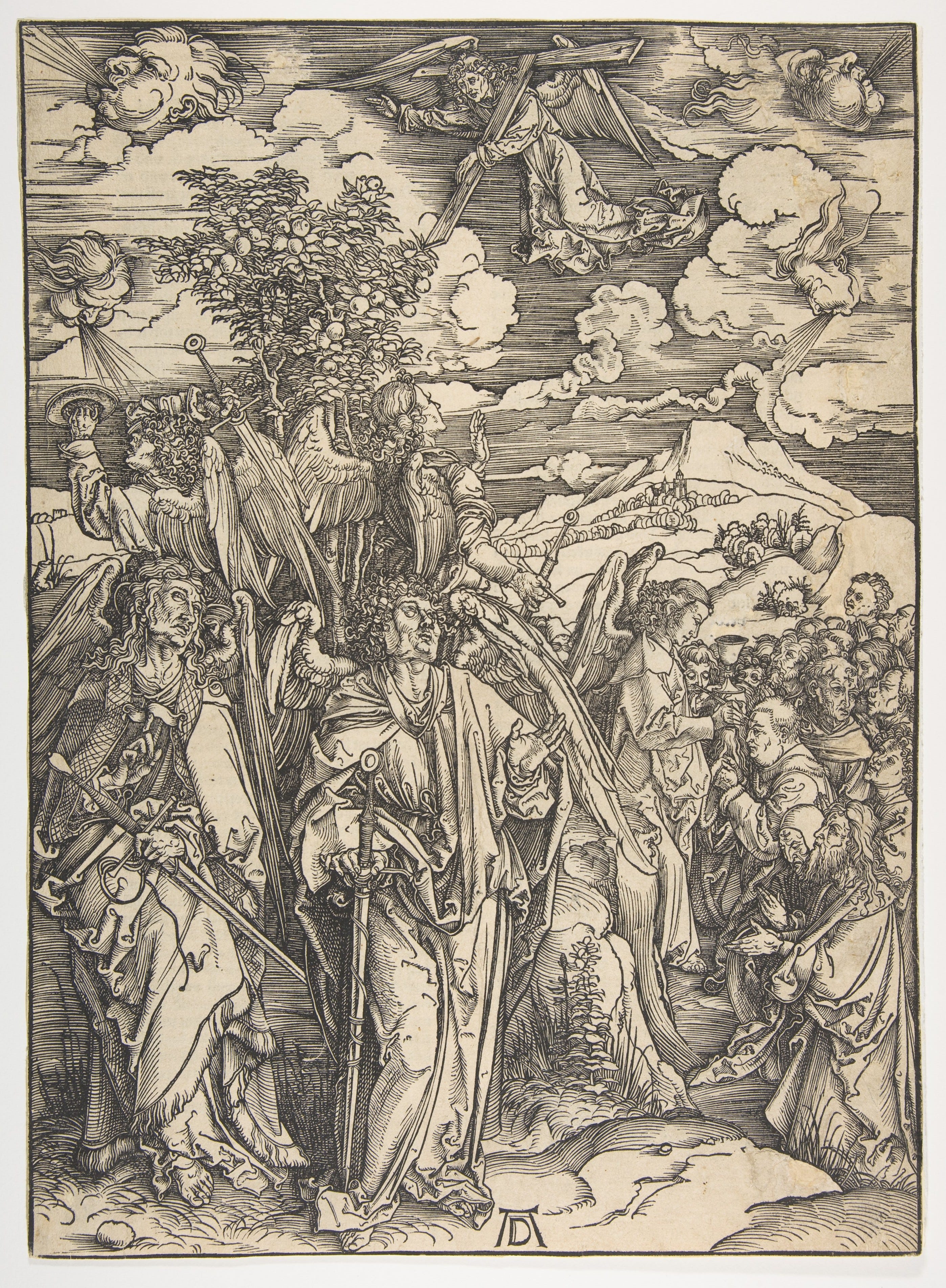
  • Revelation 4: The Throne at the Center of the Diagram

    Revelation 4: The Throne at the Center of the Diagram

    How John’s “throne room” vision maps to the central convergence point of consciousness in Geomytha.

    After the letters to the seven churches, Revelation changes altitude.

    Chapters 2–3 walked through seven inner centers – seven “brothers” – with all their distortions and tensions. In Geomytha, those were the places where Isis (awareness), Osiris (reflection), Set (solar imagination), and Horus (ego) are tangled together.

    In Revelation 4, John is taken above that level.

    He is not shown “the future” in the newspaper sense. He is shown the center: the way consciousness is structured when it is not hijacked by Set.

    If you imagine the Geomytha diagram – the vortex pattern, the torus, the tree at the center – Revelation 4 is a tour of that central convergence point from the inside.

    “A Door Standing Open in Heaven” – Changing Altitude

    “After this I looked, and behold, a door standing open in heaven!

    And the first voice, which I had heard speaking to me like a trumpet, said,

    ‘Come up here, and I will show you what must take place after this.’” (Rev 4:1)

    In chapter 1, John turned to see the voice.

    In chapters 2–3, that voice walked among the seven churches.

    Now there is a door in “heaven” – not outer space, but a higher layer of consciousness. “Come up here” is an instruction to change vantage point.

    In Geomytha terms:

    • John/Osiris is invited to step out of the level where the “brothers” are fighting,

    • and into the level where their entire game is seen in context.

    This is the same pattern hinted at in the Jacob story:

    • Jacob dreams of a ladder between heaven and earth.

    • He sees angels ascending and descending, a traffic between levels.

    • He wakes up and realizes: “This is the house of God… and I did not know it.”

    Revelation 4 is John climbing that ladder consciously. He does not merely see a gate; he walks through the door.

    The Throne: The Convergence Point / Axis

    “At once I was in the Spirit, and behold, a throne stood in heaven, with one seated on the throne.” (Rev 4:2)

    The first thing he sees is not angels, not souls, not beasts.

    It is a throne, and One seated upon it.

    In Geomytha, this throne is:

    • the convergence point of the diagram,

    • the place where all flows meet – often mapped to the solar plexus / Tree-of-Life center,

    • the axis you’ve explored under names like Mt Meru, the World Tree, the center of the globus cruciger.

    The One seated is not a separate sky-deity imported from elsewhere. It is:

    • Isis–Osiris unity seen from above:

      • awareness as such,

      • and its perfect, undistorted reflection in consciousness.

    The description is gemstone and light:

    “He who sat there had the appearance of jasper and carnelian, and around the throne was a rainbow that had the appearance of an emerald.” (Rev 4:3)

    Jasper, carnelian, emerald – these are frequency descriptors. In Geomytha language, they point to:

    • the spectrum of being (like the color wheel in the torus),

    • condensed into a single focal point.

    The rainbow around the throne echoes the rainbow given to Noah:

    • a sign of covenant after the flood,

    • a statement that the waters (unconscious chaos) will no longer destroy the structure.

    Here, the rainbow is the field around the convergence point: the toroidal band of color and frequency circulating around the center of awareness.

    Twenty-Four Elders: Completed Cycles Laying Down Their Crowns

    “Around the throne were twenty-four thrones, and seated on the thrones were twenty-four elders, clothed in white garments, with golden crowns on their heads.” (Rev 4:4)

    Twenty-four is 12 × 2:

    • twelve tribes + twelve apostles,

    • twelve months + their mirrored cycle,

    • twelve “houses” of experience doubled.

    In Geomytha, the elders represent:

    • completed cycles of consciousness – aspects of Horus that have lived through enough rise-and-fall to become wise;

    • all the “brothers” who have finally recognized they are part of one family.

    They sit on thrones, but their role in the vision is telling:

    “Whenever the living creatures give glory… the twenty-four elders fall down before him who is seated on the throne… and cast their crowns before the throne…” (Rev 4:9–10)

    Every time awareness (through the living creatures) recognizes itself, the elders:

    • get off their own thrones,

    • drop their crowns (ego-claims),

    • and acknowledge the One at the center as the real axis.

    Geomytha translation:

    • Every cycle of identity, every life-story, every brother-drama,

    • ultimately learns to hand its rulership back to the center.

    Cain, Esau, Joseph’s brothers — all the archetypal siblings — are present here in their matured form: no longer fighting for the birthright, no longer holding grudges, but placing their “crowns” at the feet of the origin.

    Lightning, Thunder, and Seven Lamps: The Dynamic Center

    “From the throne came flashes of lightning, and rumblings and peals of thunder,

    and before the throne were burning seven torches of fire,

    which are the seven spirits of God…” (Rev 4:5)

    The throne is not a static chair. It is an active generator:

    • lightning – sudden insight,

    • thunder – rolling consequence and resonance,

    • voices – articulation.

    The seven torches correspond to the seven churches / centers we have just seen:

    • but here they are not confused, rebuked, or compromised;

    • they appear as pure flames, “the seven spirits of God.”

    In Geomytha:

    • these are the seven main channels of consciousness (root through crown) in a clarified state;

    • Isis (awareness) flows through each without obstruction;

    • Osiris reflects truly;

    • Set is not erased but has no independent throne;

    • Horus is not at the center of the room—only participating.

    Where Revelation 2–3 showed those centers under distortion, Revelation 4 shows their original template.

    The Sea of Glass: The Calmed Unconscious

    “And before the throne there was as it were a sea of glass, like crystal.” (Rev 4:6)

    The sea throughout scripture often symbolizes:

    • the deep unconscious,

    • chaos,

    • the collective emotional field out of which beasts rise.

    Here, before the throne, that sea is:

    • “like glass,”

    • “like crystal.”

    In Geomytha terms:

    • the emotional/unconscious field has been stilled;

    • not destroyed, but no longer storm-tossed;

    • the torus “surface” is now clear enough to reflect the center without distortion.

    This is Noah’s flood narrative resolved at another level:

    • instead of an ark floating on chaotic waters,

    • we have a glass sea in front of a stable throne.

    The same pattern: the waters that once threatened to consume now serve as a mirror and a floor.

    Four Living Creatures Full of Eyes: Awareness in Every Direction

    “Around the throne, on each side of the throne, are four living creatures…

    the first like a lion, the second like an ox, the third with the face of a man, the fourth like an eagle in flight…

    and within they are full of eyes.” (Rev 4:6–8, condensed)

    These four living creatures correspond to a very old symbolic set:

    • lion,

    • ox,

    • human,

    • eagle.

    They map easily onto the four fixed signs of the zodiac (Leo, Taurus, Aquarius, Scorpio/eagle), but in Geomytha I would describe them as four primary directions of expression from the center:

    • Lion – will, courage, sovereign fire.

    • Ox – embodiment, endurance, work in matter.

    • Human – mind, relationship, narrative.

    • Eagle – vision, overview, the capacity to rise above and see the pattern.

    They are “full of eyes, around and within.”

    Eyes are Osiris symbols: the capacity to see, to reflect, to be aware of what is present.

    Here, that reflective capacity is:

    • not localized in one “brother,”

    • but distributed across the whole field;

    • every direction you move from the throne is saturated with perception.

    The creatures’ song is simple and constant:

    “Holy, holy, holy, is the Lord God Almighty,

    who was and is and is to come!” (Rev 4:8)

    This is the language of Isis:

    • the awareness that suffuses past (“was”),

    • present (“is”),

    • and all apparent futures (“is to come”)

    • without being contained by any of them.

    The living creatures are what it looks like when every major direction of your life recognizes that fact.

    Casting Crowns: When Horus Stops Pretending to Be the Source

    Every time the four creatures give glory, the twenty-four elders respond:

    “They cast their crowns before the throne, saying,

    ‘Worthy are you, our Lord and God,

    to receive glory and honor and power,

    for you created all things,

    and by your will they existed and were created.’” (Rev 4:10–11)

    Crowns are Horus symbols: claims to rulership, identity, power.

    In Geomytha, this is the moment when:

    • every identity you have ever worn,

    • every life you have ever lived,

    • every “brother” you have played — Cain, Abel, Jacob, Esau, Joseph, the older brother, the prodigal —

    recognizes that it was never the source.

    Instead of competing for the birthright (who is “chosen,” who is “special,” who gets the inheritance), the elders:

    • lay their crowns down together,

    • acknowledge the One at the center as the true origin of all things.

    The entire brother-drama is resolved in a circle of willing surrender.

    This is not self-hatred. It is not erasing individuality. It is the honest recognition that:

    “What I am as a story or a mask is not where life originates.

    I am a participant, not the generator.”

    In that act, Horus stops pretending to be the sun and returns to being a planet orbiting the true center.

    How Revelation 4 Functions in Geomytha

    Revelation 4 is not a random heavenly scene. It is the structural baseline for everything that follows:

    • The seals, trumpets, beasts, and Babylon will all show what happens when consciousness forgets this throne-room architecture and lets Set run the show.

    • The New Jerusalem at the end will echo this chapter: throne, river, tree, cycles healed.

    For practice, the chapter suggests a very simple question:

    “Where is the throne in my own experience right now?”

    Not metaphorically, but:

    • what feels like the center of my day?

    • my body’s sense of gravity (solar plexus, chest),

    • my emotional “sea,”

    • my mental sky and its constellations.

    Revelation 4 offers a picture of what that center looks like when:

    • Isis is acknowledged,

    • Osiris is fully awake (“full of eyes”),

    • Set has no competing throne,

    • Horus and all his “brothers” have stopped fighting and laid their crowns down.

    The rest of the Apocalypse will show how far we have wandered from this room – and what it costs to come back.

    X: @mythicgeometry · Substack: Geomytha Noir · YouTube: Geomytha · Instagram: @mythicgeometry · TikTok: @Geomytha · Patreon: GeomythaNoir
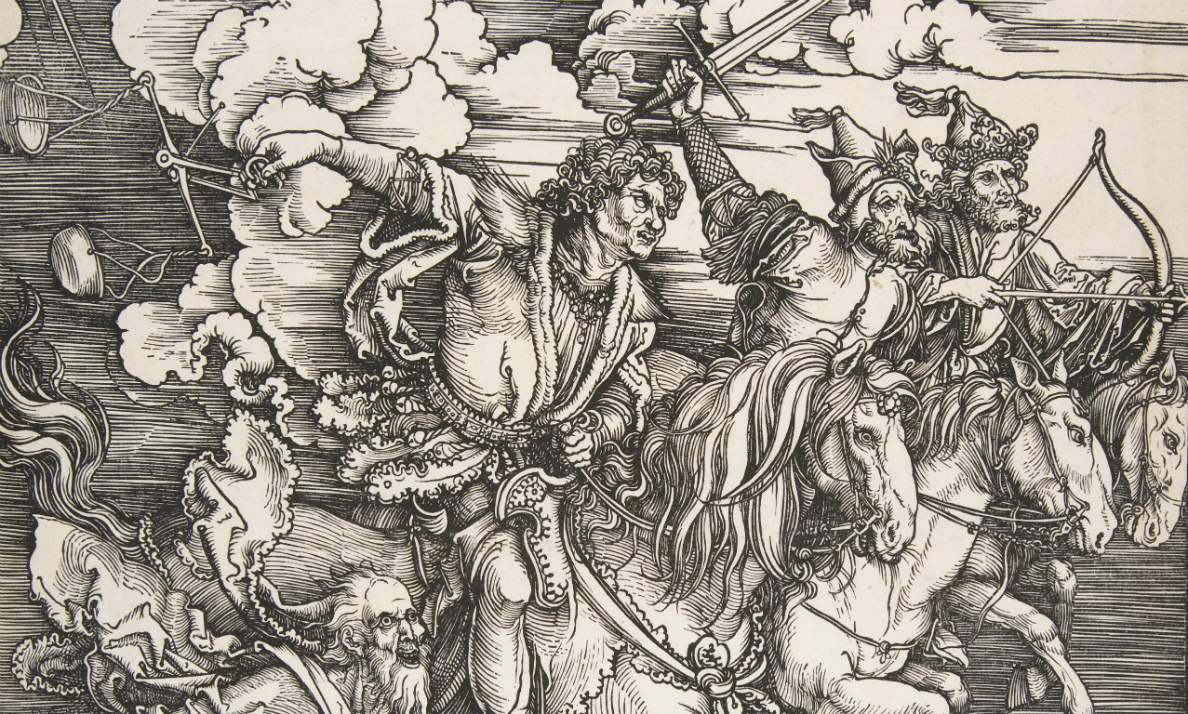
  • Revelation 3: Sardis, Philadelphia, Laodicea – The Sleeping Self, the Open Door, and the Lukewarm Crown

    Revelation 3: Sardis, Philadelphia, Laodicea – The Sleeping Self, the Open Door, and the Lukewarm Crown

    How the last three churches reveal the dead persona, the brotherly-heart “open door,” and the complacent ego, through the Geomytha lens.

    Revelation 2 walked us through four inner “churches” – four centers of consciousness – that mirror the old brother dramas: Cain and Abel, Jacob and Esau, Joseph and his brothers, Osiris and Set.

    Revelation 3 finishes the audit.

    We meet Sardis, Philadelphia, and Laodicea.

    In the usual reading, they are communities in Asia Minor.

    In Geomytha, they are three more “brothers” inside you:

    • Sardis – the spiritually-branded persona: looks alive, is actually dead.

    • Philadelphia – literally “brotherly love”: the small, sincere heart-center that remains an open door for awareness.

    • Laodicea – the wealthy, self-satisfied ego: not cold enough to wake up, not hot enough to transform.

    Underneath each letter, the same archetypal field is present:

    • Isis – simple awareness.

    • Osiris – reflective consciousness.

    • Set – solar imagination and systems.

    • Horus – the “I” that tries to survive and succeed inside those systems.

    Revelation 3 is the solar Christ walking through these three rooms and speaking to each in turn.

    Sardis: A Name That Lives, But Dead Inside

    “I know your works. You have the reputation of being alive, but you are dead.” (Rev 3:1)

    Sardis is the part of you that:

    • has a spiritual reputation,

    • carries a name that says “alive,”

    • but has allowed its inner life to go numb.

    This is the spiritual persona: the version of Horus that has learned all the correct language and markers of being “awake,” while quietly disconnecting from Isis.

    In the Geomytha field, Sardis is:

    • Osiris reduced to a logo: a set of phrases, doctrines, or insights it can repeat;

    • Isis pushed to the background, no longer felt;

    • Set running the entire performance: how you appear, what community you belong to, which side you’re on;

    • Horus carefully maintaining the image that “I am alive.”

    This matches the “whitewashed tombs” pattern Jesus calls out in the gospels: clean, impressive exterior; dead interior.

    It also echoes a brother-type you see in the parable of the Prodigal Son:

    • The older brother never leaves home, never squanders his inheritance, and appears faithful.

    • But when the prodigal returns, the older brother’s heart is exposed: resentful, joyless, more servant than son.

    Sardis is that older brother energy in religious or spiritual form. It has:

    • stayed “inside the house,”

    • built a life around being faithful,

    • but stopped actually enjoying the Father’s presence.

    The message to Sardis is blunt:

    “Wake up, and strengthen what remains and is about to die… Remember, then, what you received and heard; keep it, and repent.” (Rev 3:2–3)

    Geomytha translation:

    • There is still a tiny pilot light of Isis/Osiris in this center.

    • “Wake up” = feel again. Stop being spiritual on paper only.

    • “Remember what you received” = recall the moments when awareness was real, not branded.

    The promise to “a few people in Sardis who have not soiled their garments” points to a small core inside the persona that never fully agreed to the performance. That core can be strengthened.

    Philadelphia: Brotherly Love and the Open Door No One Can Shut

    “I know that you have but little power,

    and yet you have kept my word and have not denied my name.

    Behold, I have set before you an open door, which no one is able to shut.” (Rev 3:8)

    Philadelphia literally means “brotherly love.”

    That etymology is not a throwaway detail; it aligns almost perfectly with its role in the Geomytha mapping.

    Philadelphia is the small, sincere heart-center in you that:

    • has “little power” by worldly metrics,

    • is not impressive by Sardis standards,

    • but has remained quietly faithful to something real.

    This is the place where Isis and Osiris are still in conversation. Presence and reflection are not constantly fighting. There is an instinctive sense that:

    “My brother is not my enemy.”

    In the old brother myths:

    • When Jacob and Esau reconcile in Genesis 33, years of trickery and threat dissolve into an unexpected embrace.

    • When Joseph reveals himself to his brothers in Egypt, he weeps and says, “You meant it for evil, but God meant it for good.”

    • When the older brother in the prodigal story is invited into the celebration, he faces the choice between competition and shared joy.

    Philadelphia is that reconciled brother field inside you:

    • A place where inner “siblings” – survival, heart, intuition, intellect – do not have to defeat one another to exist.

    • An area where you have experienced the possibility of love without a winner and loser.

    No other church receives a promise like this:

    “I have set before you an open door, which no one is able to shut.”

    Through the Geomytha lens, that “open door” is:

    • a stable passageway between your conditioned inner system and direct awareness;

    • a simple, repeating access-point where Isis can be felt and Osiris can reflect without being immediately seized by Set.

    Philadelphia is “weak” in the eyes of Set’s world:

    • It’s not rich,

    • not influential,

    • not marked by numbers and spectacle.

    But because it has “kept my word and not denied my name,” it holds a kind of authority that cannot be externally revoked. No one can shut the door that awareness itself has opened in your heart.

    This is why, in a Geomytha reading of Revelation, Philadelphia is so important:

    • Sardis and Laodicea show two ways the system calcifies.

    • Philadelphia is the quiet exception: the brother who did not fully sell out.

    It is the place in you where:

    • you have loved without needing to win,

    • forgiven without a grand narrative,

    • and sensed that your brother’s healing did not diminish you.

    That is brotherly love in the most literal sense.

    Laodicea: Lukewarm, Rich, and Blind

    “I know your works: you are neither cold nor hot.

    Would that you were either cold or hot!

    So, because you are lukewarm… I will spit you out of my mouth.” (Rev 3:15–16)

    If Sardis is the dead persona, Laodicea is the comfortably numb ego.

    This center:

    • is materially or socially secure: “You say, I am rich, I have prospered, and I need nothing.”

    • sees no urgent reason to change.

    • has managed to avoid the extremes of outright rejection (“cold”) or burning devotion (“hot”).

    In other words, Laodicea has optimized life inside Set’s world. The solar imagination has provided:

    • a decent identity,

    • acceptable comforts,

    • enough distraction,

    • and an internal narrative that says, “I’m fine.”

    From the Geomytha perspective:

    • Isis is nearly forgotten; awareness is occasionally acknowledged, rarely prioritized.

    • Osiris reflects mostly in the service of self-maintenance: “How am I doing? Am I okay?”

    • Set is thriving: the person is fully integrated into the economy of status, comfort, and distraction.

    • Horus is content: “I see no problem here.”

    The indictment is sharp:

    “You do not realize that you are wretched, pitiable, poor, blind, and naked.” (Rev 3:17)

    Laodicea is dangerous precisely because nothing looks obviously wrong. Unlike Smyrna, there is no outward tribulation to force depth. Unlike Sardis, there isn’t even the drive to appear especially holy.

    If Sardis echoes the older brother outside the party, Laodicea echoes something like Esau selling his birthright for a bowl of stew:

    • Esau is not a villain; he is hungry.

    • He undervalues his inheritance because the immediate need feels more real.

    • He trades something invisible and long-term for something visible and short-term.

    Laodicea has done that trade on a whole-life scale:

    • It has accepted a comfortable bowl of “enough” in exchange for the living inheritance of direct awareness.

    • It has mistaken being undisturbed for being truly alive.

    The remedy is not sentimental:

    “I counsel you to buy from me gold refined by fire… white garments… salve to anoint your eyes, so that you may see.” (Rev 3:18)

    • “Gold refined by fire” – value that has passed through real loss, real challenge, real ego-death.

    • “White garments” – identity not constructed out of status or shame.

    • “Eye salve” – the ability to see one’s own condition clearly.

    And then, the most intimate image in the chapter:

    “Behold, I stand at the door and knock…” (Rev 3:20)

    Even here, with the most complacent of the churches, the solar Christ does not storm the house. He knocks.

    There is, even in Laodicea, a door that can be opened from the inside – a faint echo of Philadelphia’s open door, but now on the Laodicean side of the wall.

    Three Final Churches, Three Inner Positions

    Sardis, Philadelphia, and Laodicea describe three final positions consciousness can take inside Set’s world:

    • Sardis – The Sleeping Self

      • A strong spiritual/religious identity with a hollow core.

      • “A name that you live, but you are dead.”

      • Needs to wake up and remember first-hand life.

    • Philadelphia – The Brotherly-Heart Open Door

      • Small, sincere, and not very impressive outwardly.

      • Holds an open passage between your conditioned system and direct awareness.

      • Brotherly love instead of brother rivalry; the field where Jacob can embrace Esau, Joseph can forgive his brothers, and inner parts stop needing to win.

    • Laodicea – The Lukewarm Crown

      • Comfortable, prosperous, and self-sufficient.

      • Cannot feel why change would matter.

      • Needs to be shocked into seeing its poverty in the very middle of abundance.

    In Geomytha terms:

    • Isis calls through all three letters as the deeper presence they have lost.

    • Osiris is being invited to stop reflecting only what Set wants to see and to reflect reality as it is.

    • Set is being exposed: as spiritual branding in Sardis, as subtle cynicism around Philadelphia, as complacent comfort in Laodicea.

    • Horus is being asked to choose: stay asleep, stay lukewarm, or step through the door in Philadelphia and risk real transformation.

    Revelation 3 completes the audit of the seven churches. From here, the text will move into seals, trumpets, beasts, and Babylon — the large-scale structures of Set’s world and how they collapse.

    But those visions rest on this foundation:

    Every apocalypse is personal first.

    The seven churches are seven inner positions.

    And in the middle of them, there is always at least one Philadelphia –

    a small, brotherly-hearted door no system can fully shut.

    X: @mythicgeometry · Substack: Geomytha Noir · YouTube: Geomytha · Instagram: @mythicgeometry · TikTok: @Geomytha · Patreon: GeomythaNoir
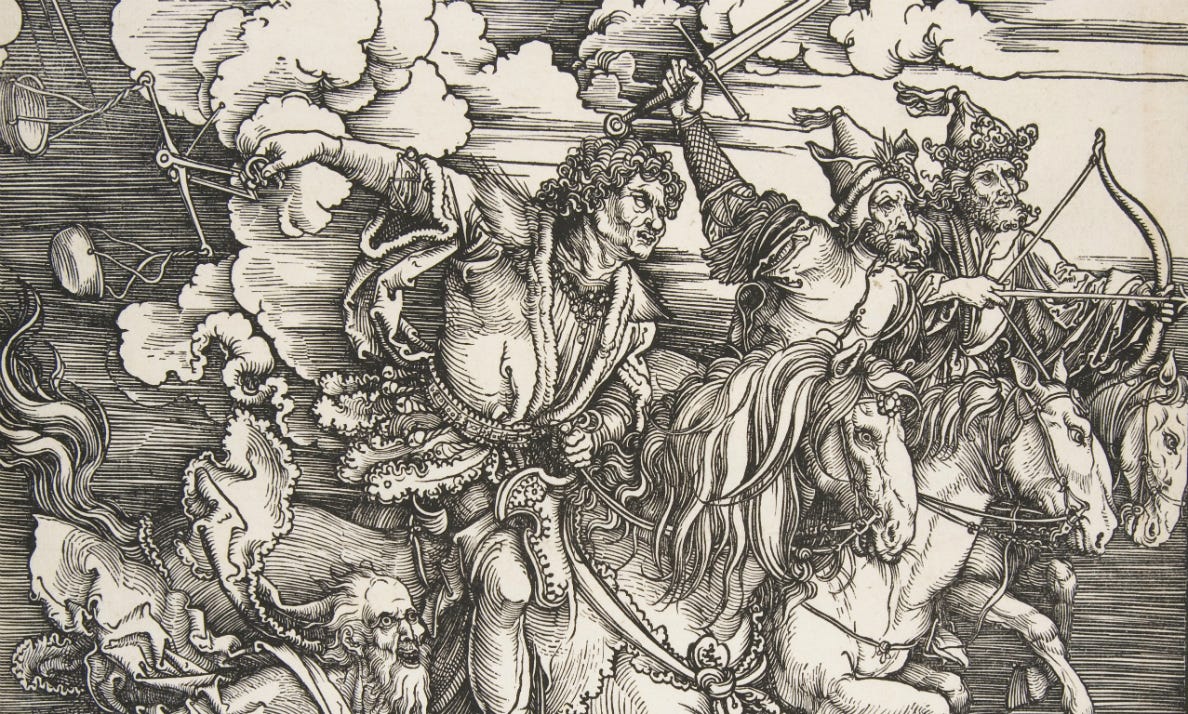
  • Revelation 2: The First Four Churches as Inner Brothers

    Revelation 2: The First Four Churches as Inner Brothers

    Ephesus, Smyrna, Pergamum, and Thyatira through the Geomytha archetypes of Isis, Osiris, Set, Horus – and the old brother dramas playing out inside you.

    Revelation 1 ended with John turning to “see the voice” and collapsing in front of a solar Christ who is no longer in service to the system.

    Revelation 2 shows what that vision does next.

    The Christ-figure walks among four churches – Ephesus, Smyrna, Pergamum, and Thyatira – and delivers an x-ray report to each.

    In the usual reading, these are first-century congregations in Asia Minor. In Geomytha, each “church” is an inner center of consciousness, and each one corresponds to a familiar brother-dynamic from myth and scripture:

    • Cain and Abel

    • Jacob and Esau

    • Joseph and his brothers

    • Osiris and Set

    Underneath all of them, the same pattern repeats:

    Presence versus strategy.

    Simple devotion versus clever survival.

    Isis and Osiris versus Set and Horus.

    Revelation 2 is what it looks like when the solar Christ walks through those rooms in your own house and tells the truth.

    Ephesus: Cain’s Correctness and Abel’s Missing Heart

    “I know your works, your toil and your patient endurance…

    …But I have this against you, that you have abandoned the love you had at first.” (Rev 2:2,4)

    Ephesus is the part of you that:

    • works hard,

    • sniffs out error,

    • refuses obvious falsehood,

    • and takes pride in getting things right.

    It is doctrinally sharp, ethically serious, and, on the surface, very impressive.

    In Geomytha terms, this is Horus trained by Set to defend the “truth” as a weapon. It knows how to identify the wrong priests, the wrong doctrines, the wrong moves. What it has lost is Abel.

    In the Cain and Abel pattern:

    • Abel’s offering is simple: firstborn of the flock. Raw presence.

    • Cain’s offering is managed: the fruit of the ground, arranged. Correctness.

    • When Cain feels his offering is not regarded, he kills Abel rather than face the wound to his ego.

    Ephesus has become Cain with good theology:

    • It can no longer tolerate being wrong,

    • It’s exhausted from testing everyone else,

    • And somewhere along the way, its own first love was sacrificed on the altar of being right.

    The voice in Revelation doesn’t deny Ephesus’ strengths:

    “I know you are enduring patiently and bearing up for my name’s sake…”

    But then comes the indictment:

    “You left your first love.”

    Geomytha translation:

    • Isis (simple awareness, devotion without agenda) has been pushed out.

    • Osiris (reflection) has been conscripted into Set’s war games.

    • Horus spends its life fighting for truth while becoming hollow inside.

    The remedy is strikingly gentle:

    “Remember therefore from where you have fallen; repent, and do the works you did at first.”

    “Repent” here is not shame; it is remembering Abel – the simple, non-defensive relationship to the sacred you had before everything became a debate.

    Smyrna: Joseph in Prison and the Truth About Poverty

    “I know your tribulation and your poverty (but you are rich)…

    …Be faithful unto death, and I will give you the crown of life.” (Rev 2:9–10)

    Where Ephesus is overconfident, Smyrna is under siege.

    This center:

    • feels poor,

    • feels persecuted,

    • gets slandered by those who “say they are Jews and are not,”

    • and is warned of more suffering ahead.

    On the surface, this is the weakest of the four churches. It has no rebuke, only warning and promise.

    This is your Joseph center.

    In Genesis:

    • Joseph has real dreams (Osiris insight),

    • but his brothers, loyal to Set’s scarcity logic, cannot tolerate it.

    • They throw him into a pit, sell him into slavery, and he ends up in prison in Egypt.

    From the outside, Joseph’s life is a long Smyrna-phase: tribulation and poverty. Yet at each stage, something is quietly building in him that the outer plot cannot see.

    Revelation speaks to Smyrna in exactly that tone:

    • “I know your tribulation and your poverty” – Set has run you over.

    • “But you are rich” – Something in you has not been claimed by the system.

    In Geomytha language:

    • Isis is still alive in Smyrna, almost in hiding.

    • Osiris here is under pressure; its reflection is distorted by fear and pain but not destroyed.

    • Horus in Smyrna does not look heroic; it looks humiliated.

    • Set whispers: “See? You trusted, and look where it got you.”

    The text does not promise an escape from the experience. It promises a way through it that does not kill the core:

    “Be faithful unto death, and I will give you the crown of life.”

    That “death” can be literal, but it is also psychological:

    the death of the story that suffering and poverty automatically mean abandonment.

    Smyrna is the part of you that must discover:

    “Even when Set’s world strips me down, awareness has not left.

    Pergamum: Jacob in the Land of the Throne

    “I know where you dwell, where Satan’s throne is.

    Yet you hold fast my name…” (Rev 2:13)

    Pergamum is a different problem.

    This is the center that:

    • lives at the heart of the system,

    • is immersed in Set’s narratives (political, religious, cultural),

    • yet has genuinely held on to something real.

    “You dwell where Satan’s throne is” is blunt:

    Your mind has been living at the capital city of the story machine.

    In Geomytha, this is the interpretive center – the part of you that builds frameworks, worldviews, philosophies. It is where Horus learns to explain the world to itself.

    The brother archetype here is Jacob.

    Jacob has a real encounter at Bethel:

    • He dreams of a ladder between heaven and earth,

    • receives a promise,

    • names the place “house of God.”

    And then… he keeps right on living under his old patterns – tricking, bargaining, manipulating – for many years. He had a real experience of Isis/Osiris, but his life remained in Set’s mode.

    Pergamum is like that:

    • You have had genuine flashes of truth.

    • You’ve “held fast the name.”

    • But your mind is still living where “Satan’s throne is” – inside the mental capital of your culture’s fear, status, and control narratives.

    Revelation commends Pergamum for fidelity, but then exposes the compromise:

    “But I have a few things against you: you have some there who hold the teaching of Balaam…”

    Balaam is the prophet who knows better and sells his gift anyway.

    In Geomytha terms:

    • Osiris in Pergamum has tasted real vision,

    • but lets that vision be rented out to Set’s interests – power, manipulation, alliance with the dominant order.

    The call is sharp:

    “Repent, or I will come to you soon and war against them with the sword of my mouth.”

    The sword (discerning word) will cut through the mixed motives of this center. Jacob eventually has his own version of this at the Jabbok: wrestling all night and walking away with a limp and a new name.

    Pergamum is the place where your mind must stop renting its insights to the throne it secretly lives under.

    Thyatira: Jezebel in the Heart

    “I know your works, your love and faith and service…

    But I have this against you, that you tolerate that woman Jezebel…” (Rev 2:19–20)

    If Ephesus is Cain’s correctness and Smyrna is Joseph’s suffering, Thyatira is your heart center.

    It is the most relational of the four:

    • “love and faith and service and patient endurance” are all present.

    • Your capacity for devotion, affection, and commitment lives here.

    But it has a problem: Jezebel.

    Jezebel is an archetype, not merely a historical queen:

    • spiritual charisma used as a control mechanism,

    • sexuality and emotional intensity used to bind and direct others,

    • “deep things” that fascinate but do not free.

    In Geomytha, Jezebel is Set wearing Isis’ clothes.

    She mimics intuition, revelation, and nurturing, but the energy underneath is possessive and hungry: “I will keep you orbiting around me or around my system.”

    Thyatira’s heart is real. The contamination is in what it tolerates:

    “You tolerate that woman Jezebel, who calls herself a prophetess and is teaching and seducing my servants…”

    Inside you, this can look like:

    • staying in relationships that drain your life because the drama feels like love,

    • confusing intensity with intimacy,

    • attaching to “teachers” or systems that flatter your specialness while quietly consuming your time, money, and attention.

    Osiris in Thyatira can feel what is off, but does not want to lose the emotional bond, so it looks away. Horus enjoys being needed, feared, desired. Set feeds.

    The letter does not tell Thyatira to stop loving. It warns that Jezebel’s pattern leads to a bed of sickness – an image of emotional and spiritual exhaustion – and that what she births is “children” (sub-patterns) that must also be confronted.

    The medicine is clean separation:

    • love that is not entangled,

    • devotion that is not possessed,

    • heart that is not for sale.

    The Four Churches as Inner Brothers

    Seen as a set, Revelation 2 is not a random tour of ancient congregations. It is four brothers inside you, each repeating an old story:

    • Ephesus – Cain’s correctness without Abel’s heart.

      • Strong discernment, lost devotion.

    • Smyrna – Joseph’s suffering before his rise.

      • Real tribulation that does not define your true richness.

    • Pergamum – Jacob at Bethel but still in exile.

      • Authentic visions coexisting with compromise at the very center of the system.

    • Thyatira – the heart entangled with Jezebel.

      • Genuine love tolerating manipulative patterns in the name of connection.

    Underneath them:

    • Isis (awareness) has been partly exiled.

    • Osiris (reflection) is split: sometimes crystal, sometimes sold.

    • Set (solar imagination) runs most of the frameworks, both religious and secular.

    • Horus (ego) tries to keep everyone alive and respectable inside that environment.

    Revelation 2 is the solar Christ walking through these rooms and telling each brother the truth it most does not want to hear.

    Where This Is GoinG

    Chapter 3 will continue the audit with three more centers, including Philadelphia, literally “brotherly love,” which functions in Geomytha as the small, sincere “open door” the system cannot fully shut.

    For now, Revelation 2 asks a simpler, sharper set of questions:

    • Where have I traded my first love for being right?

    • Where am I suffering and assuming it means I am abandoned, when a deeper richness is still present?

    • Where am I living “where Satan’s throne is,” mentally – holding truth but still renting my insight to the system?

    • Where does my heart tolerate Jezebel-patterns because I’m afraid to lose the intensity?

    The Apocalypse is not only about beasts and plagues. It begins here, with the willingness to let each of these inner churches hear its own letter.

    X: @mythicgeometry · YouTube: Geomytha · Instagram: @mythicgeometry · TikTok: @Geomytha · Patreon: GeomythaNoir