The office does not look like Babel.
That is why nobody notices.
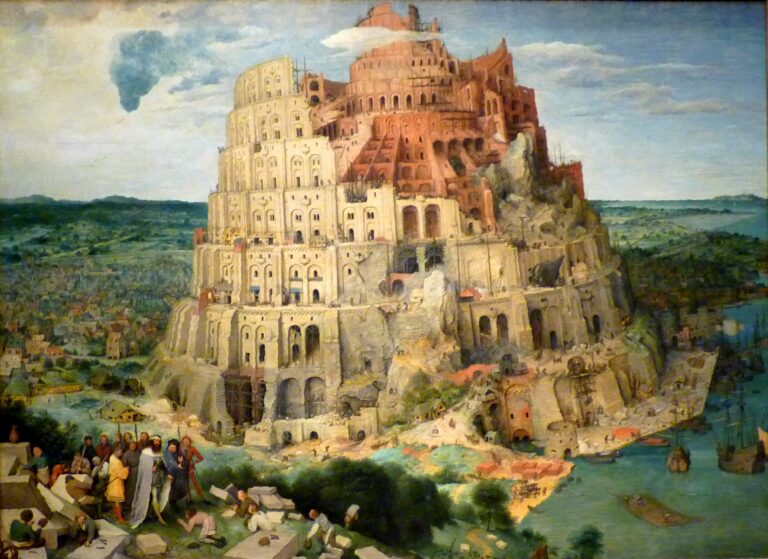
Babel looks ancient in the imagination: brick, mud, scaffoldingMirror, Not a ThroneMirror, Not a Throne is the rule that an interpretive system should reveal recurring structures without becoming a new identity, authority, or worldview that replaces direct seeing.Read full entry →, a tower rising under a brutal sky, workers climbing toward heaven while kings and architects point upward. It looks like human arrogance made visible. One language. One project. One vertical ambition. One collective body trying to build its way into sacred height.
The office is flatter.
A badge. A login. A cubicle. A calendar invite. A Slack channel. A Teams meeting. A dashboard. A culture deck. A performance review. A quarterly goal. A mission statement printed in clean font on a wall no one reads except when a visitor is being shown around.
No one says, “Come, let us build a tower whose top reaches heaven.”
They say, “Let’s align on strategic priorities.”
That is the modern miracle of Babel.
The tower did not vanish.
It learned corporate language.
In the old story, humanity gathers under one speech and one project. The people decide to build a city and a tower reaching into the heavens, to make a name for themselves, to avoid being scattered across the earth. The sin is not merely construction. Human beings must build. The sin is sacred ambition captured by collective selfCollective EgoCollective Ego forms when individual identity merges into a larger group-body and the group begins to experience its own story, image, destiny, purity, or mission as sacred.Read full entry →-making. The project becomes a substitute heaven. The name becomes the goal. The tower becomes the center around which human identityThis — IdentityThis names the formed identity: the body, role, image, wound, belief, or story claimed as what the self is.Read full entry → is organized.
That is why Babel remains alive.
Every age builds upward in its own materials. Brick becomes steel. Steel becomes concrete. Concrete becomes glass. Glass becomes interface. Interface becomes workflow. Workflow becomes culture. Culture becomes identity.
The modern corporation is one of Babel’s most successful descendants because it rarely admits that it is sacred architecture. It presents itself as practical. Efficient. Innovative. Mission-driven. Purpose-led. Values-based. Customer-centered. Data-informed. People-first. Impact-oriented.
The language is smooth enough to hide the altar.
Work itself is not the problem. Labor can be noble. Craft can be sacred. Service can be real. A person can find dignity in building, cooking, cleaning, teaching, repairing, protecting, designing, healing, organizing, farming, coding, writing, caregiving, or keeping a small corner of the world from collapsing.
The distortion begins when the institution borrows sacred language to make the worker serve the tower.
That is the difference.
A real task returns attention to the thing being served. A false mission returns attention to the institution’s own self-image. The worker may begin with labor, but slowly the language around the labor thickens. The job is no longer just a job. It is a calling, a family, a culture, a movement, a vision, a transformation, a revolution, a shared journey, a purpose.
Then the company asks for evenings.
Then weekends.
Then emotional loyalty.
Then public enthusiasm.
Then personal identity.
Then gratitude for being consumed.
This is sacred busywork.
The ordinary task is dressed in religious clothing. The spreadsheet becomes sacrifice. The all-hands meeting becomes liturgy. The values statement becomes creed. The quarterly goals become sacred calendar. The executive becomes priest-king. The brand becomes name. The office becomes temple. The worker becomes HorusHorusIn Geomytha, Horus names the identity that forms after claim: This — the body, role, image, wound, belief, or story taken as what the self is.Read full entry → formed inside institutional speech.
That formation happens through language first.
Corporate language is a controlled speech-world. It does not simply describe work. It shapes what can be felt, said, questioned, and imagined. A worker is not asked to obey. He is asked to align. He is not told to endure confusion. He is told the company is navigating change. He is not told that his job has become more precarious. He is told the organization is optimizing. He is not told that management does not know what it is doing. He is told leadership is iterating.
The tower speaks softly.
Synergy. Stakeholders. Deliverables. Culture fit. Bandwidth. Ownership. Excellence. Transparency. Impact. Innovation. Agility. Family. Mission.
TheseThese — AccumulationThese names accumulation: possessions, titles, achievements, beliefs, communities, and other extensions gathered around identity.Read full entry → words do not always mean nothing. That is why they work. Each carries a fragment of real value. Cooperation is good. Responsibility is good. Clarity is good. Adaptation is good. Service is good. But inside the corporate tower, living words are often emptied, polished, and redeployed as compliance signals.
Language becomes architecture.
A worker learns what may be spoken. Not too much anger. Not too much grief. Not too much honesty. Not too much doubt. Not too much personality unless it can be branded as authenticity. Not too much silence unless it can be interpreted as focus. Not too much resistance unless it can be converted into feedback.
The self begins to speak in office-tongues.
“I just wanted to circle back.”
“Let’s put a pin in that.”
“I’m excited to partner on this.”
“I appreciate the opportunity.”
“I’m passionate about driving results.”
“I’m grateful to be part of this team.”
Sometimes these phrases are harmless. Sometimes they are necessary costumes. But repeated long enough, costume trains posture. Posture trains identity. Identity becomes role.
That is Horus in the cubicle.
The person begins to live as the professional self: measurable, presentable, positive, responsive, productive, branded, coachable, visible. The human being becomes an employee-image, an acceptable face within the tower’s speech-system.
LinkedIn makes this visible. It is not merely a job site. It is a professional shrine-grid. The self appears as achievement, resilience, lesson, announcement, humility-post, promotion, thought leadership, gratitude, networking, personal brand. Even failure becomes content if framed correctly. Even exhaustion becomes evidence of grit. Even leaving a job becomes a ritual testimony about growth.
The professional Horus says: I am thisThe False-Self Sentence — I Am ThisThe false-self sentence forms when claim joins reflection to a fixed object of identity: I am this.Read full entry → career.
Then: these are my skills, my credentials, my metrics, my connections, my endorsements, my projects, my story.
Then: thoseThose — ProjectionThose names projection: enemies, outsiders, competitors, threats, and disowned qualities placed beyond the identity boundary.Read full entry → are the unambitious, the negative, the unprofessional, the people who do not understand the mission.
Then: all thisAll This — World-SystemAll This names the total symbolic environment that has become so complete it is experienced as reality itself.Read full entry → is reality.
Babel has become a feed.
But the cubicle remains its cell.
The cubicle is the tower flattened into compartments. Instead of one huge ascent into heaven, the modern tower becomes floors, departments, role descriptions, reporting lines, org charts, approval chains, workflows, inboxes, tabs, and tickets. Every person occupies a small box within the larger project. Each box has a function. Each function has language. Each language has limits.
This is not accidental. The cubicle teaches the body to inhabit partiality. You are near others but separated. Visible but enclosed. Individual but interchangeable. Present but abstracted into function. Your personal objects may decorate the space, but the space is not yours. A family photo, a coffee mug, a small plant, a stress ball, a quote taped to the monitor — tiny household gods in a rented chamber of Babel.
The worker tries to humanize the box.
The box remains a box.
Office Space understood this with brutal comic clarity. The horror is not one villain. The horror is a complete atmosphere of meaningless repetition. The reports, memos, managers, birthday cake rituals, printer rage, motivational emptiness, and fluorescent deadness all show a world where the form of work continues after meaning has leaked out.
That is why the movie still resonates.
It does not merely mock office life. It reveals ritual after spirit has departed.
The TPS report is funny because it is paperwork as sacrament without sacredness. Everyone knows it matters only because the system says it matters. The worker’s real life is elsewhere, but the system demands that he pretend the report, the memo, the meeting, and the tone of cooperation are morally important.
The tower requires belief it has not earned.
Severance turns the same logic into myth. The worker-self is literally split. One self lives outside. One self wakes only inside corporate space, with no memory of home, family, sky, ordinary continuity, or chosen life. The office-self is born in the institution and knows only the institution’s rooms, rules, rituals, rewards, punishments, and mysteries.
That is not just science fiction.
It is a symbolic exaggeration of something many people already feel.
There is a self that exists at work and a self that exists outside it. The work-self knows how to speak, smile, obey, perform, conceal, survive. The outside self may barely recognize what the work-self has become. The split is not always total, but it is real enough to exhaust the soul.
A person comes home tired not only because labor took energy.
He comes home tired because he spent the day being translated.
That is the confusion of tongues.
In the Babel story, language is shattered so the tower cannot continue. In the corporate world, language is not simply shattered; it is managed. Every department develops its dialect. Legal speaks one way. HR another. Engineering another. Sales another. Leadership another. Marketing another. Compliance another. Finance another. Customer service another.
Everyone speaks English.
Not everyone speaks meaning.
The confusion is subtler now. People attend the same meeting and hear different gods. One hears risk. One hears opportunity. One hears liability. One hears workload. One hears reputation. One hears optics. One hears human need. One hears budget. One hears an instruction to pretend there is consensus.
The meeting ends with alignment.
No one is aligned.
This is Babel in mature form.
The language does not collapse the tower by becoming incomprehensible. It preserves the tower by allowing everyone to believe comprehension has occurred. Corporate speech often functions not to reveal meaning, but to prevent the discomfort of meaning from becoming too direct.
“We are restructuring.”
Someone is losing a livelihood.
“We are improving efficiency.”
Someone will do three jobs.
“We are sunsetting that role.”
Someone is being erased politely.
“We are creating a culture of accountability.”
Someone is about to be watched more closely.
“We are a family.”
Someone is about to be asked to sacrifice without the protections of family.
The sacred word is borrowed. The living relation is withheld.
That is the false liturgy.
A true family does not usually require a quarterly slide deck to prove it is a family. A true mission does not need constant motivational branding to remain meaningful. A true craft does not need inflated language to justify attention. A true service does not require every worker to pretend the organization itself is holy.
But the tower always needs speech to keep building.
It must name the work as more than work because ordinary labor has limits. A worker may sell time. A worker may accept duty. A worker may even love the task. But if the tower wants devotion, it must spiritualize the job. It must make leaving feel like betrayal, exhaustion feel like virtue, overwork feel like passion, and obedience feel like culture.
That is how labor becomes worship.
Again, the point is not to mock honest work. A person who supports a family, learns a trade, does a difficult job well, or serves others through ordinary labor is not trapped merely because the labor is structured. Work can be a school of humility. Repetition can refine attention. Skill can dignify the body. Service can become prayer. Even a boring task can be done cleanly, honestly, and with presence.
The contrast is monastic labor.
In a monastery, work may be repetitive: baking, cleaning, gardening, copying, repairing, cooking, sweeping. But at its best, the labor is not inflated into branding. The task is not sacred because the institution says it is innovative. It is sacred because attention returns to presence through the task. The floor is swept. The bread is made. The garden is tended. The body serves the real.
True craft works the same way.
The carpenter does not need a culture deck to know whether the table stands. The cook does not need a mission statement to know whether food nourishes. The nurse does not need branding language to know whether a wound has been dressed. The parent does not need a productivity dashboard to know whether the child is held.
Living work returns to the thing itself.
False work returns to the tower’s self-description.
That is the practical distinction.
The office becomes Babel when the institution’s language separates labor from the life it should serve. The worker is told to care deeply about abstractions while being quietly severed from the direct human meaning of the work. Everything becomes framed, refined, measured, translated, and elevated until the living task disappears inside institutional speech.
First Quarter cuts the form.
Virgo refines it.
The hidden frame closes around the worker.
The result is sacred busywork: activity that borrows the emotional tone of purpose while often serving only the continuation of the system.
The way out is not necessarily quitting. Sometimes one cannot quit. Sometimes one should not quit. Sometimes the work is needed. Sometimes the institution is flawed but useful. Sometimes a person must endure a structure without surrendering the soul to it.
The way out begins by naming the tower.
This is a job. This is a role. This is a task. This is a policy. This is a meeting. This is a paycheck. This is a system. This is not sourceIs — SourceIs names unclaimed being: awareness before possession, distinction, or identity.Read full entry →.
That simple naming breaks the spell.
The institution may still own certain hours. It does not own being. It may assign tasks. It does not assign ultimate purpose. It may evaluate performance. It does not measure the soul. It may use words like culture, family, passion, and mission. It does not get to define those words completely.
Refine the work.
Do not worship the workplace.
Do the task well when the task is yours. Answer cleanly. Build carefully. Serve honestly. Learn the skill. Keep your word. Do not use anti-corporate cynicism as an excuse for laziness or contempt. That is just another false self. A sloppy worker is not automatically free because he despises the tower.
But neither is a devoted employee automatically whole because the tower praises him.
The balance is difficult.
Work without false worship. Serve without self-erasure. Speak the necessary language without letting it colonize the heart. Attend the meeting without believing the meeting is reality. Hold the role without becoming the role. Respect labor without mistaking the corporation for God.
There is a line between responsibility and devotion.
Babel wants to erase it.
Presence redraws it.
The day may still begin with a badge and a login. The dashboard may still load. The meeting may still happen. The phrases may still be required. The spreadsheet may still need to be finished. The tower may still stand.
But something in the worker can remain unbuilt.
That is the hidden freedom.
The cubicle may contain the body for a time. It does not have to contain attention completely. The mission statement may speak loudly. It does not have to become the soul’s scripture. The corporate language may fill the room. It does not have to become the only tongue.
There is another speech underneath.
The speech of breath. The speech of the body before role. The speech of honest work. The speech of silence after the meeting ends. The speech of the life that no institution created and no quarterly goal can finally measure.
Babel falls wherever that speech is remembered.
Not because the work stops.
Because the worship does.