Collective Ego
Public references and limits:
The Robbers Cave report gives a bounded group study, not a universal group essence. Its cooperative phase challenges a reading in which a collective must always sustain itself through an enemy.
Geomytha uses Collective Ego for group identity that ceases to remain relational and begins treating itself as self-grounding, uniquely righteous, or ultimate.
It scales the Horus mechanism from person to institution, nation, movement, community, or civilization without changing the underlying structure of claim.
I → This becomes We → This; identity enlarges into a collective body and may extend through These, Those, and All This.
Collective identity can support mutual aid and accountability. Look for the group story becoming sacred, immune to criticism and more important than its members. Shared commitment without that closure is a counterexample.
This entry’s name and mechanism belong to GEOMYTHA’s framework. The linked primary works are independent comparison witnesses, not evidence that the GEOMYTHA term originated in their cultures. Specific comparison references: Sherif et al. — Robbers Cave experiment, original report. The original work, a later translation, a catalogue record and an extant manuscript are different kinds of evidence. The oldest surviving witnesses of the comparison traditions are not established by this entry.
Collective identity, solidarity, belonging, and shared purpose are not inherently egoic or false.
Do not use the term to dismiss communities merely because they have strong identity or cohesion; the diagnostic issue is absolutization.
Where this mechanism appears
Explore the essays and Index entries linked to this mechanism.
 Babel and the Office CubicleThe office does not look like Babel. That is why nobody notices. Babel looks ancient in the imagination: brick, mud, scaffolding, a tower rising…
 The Turning CrossA symbol must be read by function. Not only by shape. Not only by age. Not only by what it once meant. Not only…
 The Day Fear Became FuelThe first thing crisis steals is not safety. It steals ordinary time. A morning becomes a before-and-after. A broadcast becomes a wound. A skyline…
 The Enemy Is a MirrorEvery kingdom eventually discovers an enemy. The enemy may appear as a rival. A monster. A foreign nation. A political opponent. A dangerous idea.…
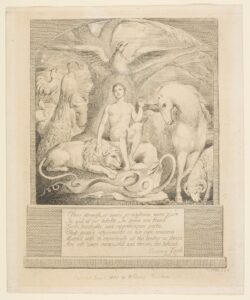 Borrowed NamesBefore a child learns who they are, they learn what they are called. A name arrives first. The child hears it spoken by parents,…
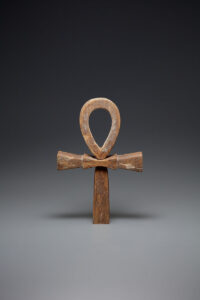 The Cross Before ChristianityThe cross is older than Christianity because the mechanism is older than Christianity. Before it is a Roman instrument, before it is a church…
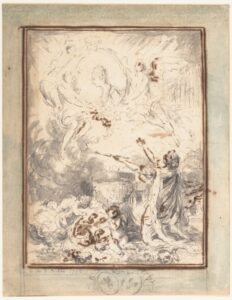 The Ritual of the False OneThe oldest ritual is not sacrifice. It is fusion. Again and again, civilization stages the same drama: two separate things are brought together, named…
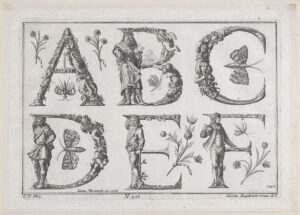 The Septenary AlphabetThe alphabet looks like one system because it is taught as one system. A, B, C, D, all the way to Z. One row.One…
Showing 8 most recent linked essays.
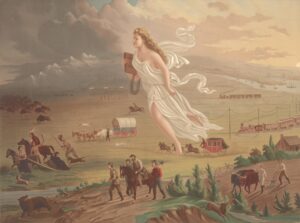 Manifest Destiny / American ProgressManifest Destiny was a nineteenth-century U.S. ideology used to justify and promote territorial expansion. John Gast’s American Progress visually allegorizes westward movement through a radiant female figure carrying signs of communication, settlement, and technological…
 The Arnolfini Portrait — Jan van EyckJan van Eyck's 1434 double portrait shows a wealthy man and woman in a domestic reception room, with joined hands, a convex mirror, furnishings, and the artist's signature. The painting has a long history…
Follow the mechanism
Moves from

Moves into
 Enemy ConstructionEnemy Construction occurs when a self or group stabilizes its own identity by projecting danger, impurity, blame, or negation onto an outside figure or category.
 Counterfeit KingshipCounterfeit kingship appears when a role, ruler, institution, or self treats the throne, office, authority, or form it occupies as the source of legitimacy rather than as a vessel answerable to something prior.
See also
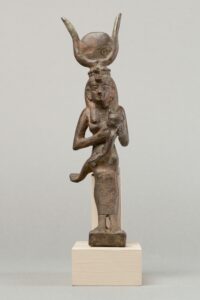 HorusIn GEOMYTHA, Horus the Son names the identity that forms after claim: This — the body, role, image, wound, belief, or story taken as what the self is.
 Mine → Not-Mine → WorldMine → Not-Mine → World tracks the expansion of identity from accumulation into projection and then into a total symbolic environment.