A symbol must be read by function.
Not only by shape. Not only by age. Not only by what it once meant. Not only by what it later became.
Function matters because a symbol is not dead. It moves through hands, cultures, rituals, flags, temples, empires, and wounds. It can bless in one field and become poisoned in another. It can begin as a sign of life and be seized by death. It can turn in the world for thousands of years before one historical power captures it so violently that the capture becomes impossible to ignore.
That is the problem of the swastika.
It is one of the most difficult symbols to discuss because it carries two histories at once.
One history is ancient, widespread, and often auspicious.
The other is modern, racial, genocidal, and inseparable from Nazi Germany.
Geomytha must not collapse those histories into one another.
The ancient swastika is not originally Nazi.
But the Nazi use cannot be softened by saying the symbol was once older.
Both things are true.
A symbol can have an ancient life and still be historically ruined by what later claimed it.
Before the Hakenkreuz
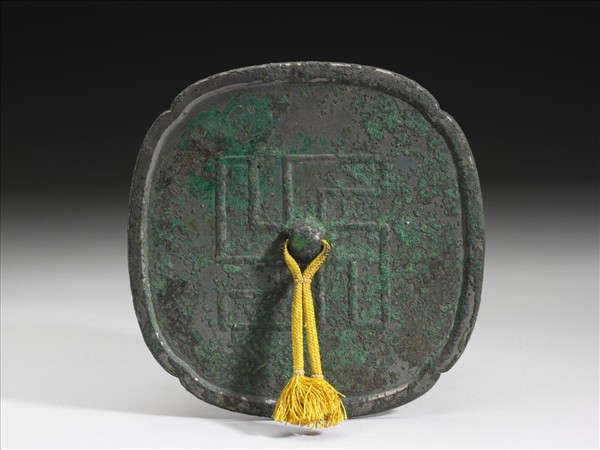
Before the Nazis, the swastika appeared across many cultures. It was used in parts of Europe and Asia, in religious and decorative settings, and in many cases carried meanings of auspiciousness, well-being, motion, blessing, order, recurrence, or sacred direction. The United States Holocaust Memorial Museum notes that the swastika was used as a symbol of well-being in ancient societies including India, China, Africa, the Americas, and Europe, long before Hitler adopted it for the Nazi flag in 1920.
That older history matters.
It prevents a shallow reading where the symbol is treated as if it emerged fully formed from twentieth-century evil. It did not. The Nazi Hakenkreuz was an appropriation, not an origin.
But older history does not erase later horror.
That is the necessary tension.
The swastika was not born Nazi, but in much of the modern West it cannot be seen innocently because Nazism burned its meaning into public memory through violence, propaganda, racism, war, and genocide.
So the article must walk a narrow path.
It must say:
Before it was a banner of racial death, it was a sign of turning life.
And it must also say:
After Nazi capture, that older life cannot be invoked carelessly.
The Cross in Motion
The basic form is simple.
A cross.
Then the cross turns.
The arms bend. The ends move. The still intersection becomes directional. A static meeting of vertical and horizontal becomes rotation, circulation, force, recurrence.
That is why the symbol is so powerful.
A simple cross gives orientation: above and below, left and right, center and extension.
The swastika gives motion.
It is not only four.
It is four turning.
In Geomytha, this makes the ancient turning cross resonate with the first fourfold grammarGEOMYTHA readingIs / Am / I / ThisThe foundational Geomytha grammar is Is → Am → I → This: Source → Reflection → Claim → Identity.Read full entry →:
Is → Am → I → This
Source. Reflection. Claim. Form.
Or in the older Egyptian body:
Isis → Osiris → Set → Horus
The cross gives manifestation its first architecture. A center appears. Direction appears. The field becomes organized. Something can move from hidden source into reflected presenceGEOMYTHA readingAm — ReflectionAm names reflected presence: awareness embodied or mirrored without yet becoming ownership.Read full entry →, from reflected presence into direction, from direction into visible form.
But this is also where danger enters.
Because once motion appears, something can claim the motion.
The wheel can turn in service of life.
Or the wheel can be seized by I.
Direction Is Not Enough
It is tempting to say the whole mystery depends on direction.
Right-facing means one thing. Left-facing means another. One is solar. One is lunar. One is outward. One is inward. One is blessing. One is danger.
There may be symbolic value in those distinctions. Direction can inflect a symbol. A rightward turn can suggest outward movement, assertion, solarization, formation, and claim. A leftward turn can suggest reversal, inwardness, return, counter-motion, or descent.
But direction alone cannot carry the whole meaning.
A left-turning symbol can still be claimed by ego.
A right-turning symbol can still be used in benign sacred context.
Meaning depends on tradition, placement, use, and historical field.
In Geomytha, direction matters, but capture matters more.
The deeper question is not only:
Which way does it turn?
The deeper question is:
What does the turn serve?
Does it return attention to source?
Or does it make identity sacred?
When I Steals the Wheel
The Nazi Hakenkreuz is the turning cross possessed by I.
That is the clean Geomytha reading.
The Nazis did not merely use an ancient symbol. They standardized it, weaponized it, racialized it, and fused it to state identity. The Holocaust Museum states that Hitler designed the Nazi flag in 1920 by combining the swastika with the imperial German colors red, black, and white.
That is not neutral symbolism.
That is capture.
The turning cross was placed in service of race, nation, mythic superiority, enemy projection, and total political order. The motion of life was seized and made to move through a death-system.
This is exactly how Geomytha reads symbolic corruption.
The original fourfold motion can be healthy:
Is → Am → I → This → Return
Source becomes reflected. Reflection becomes form. Form remains transparent. The motion returns.
But captured motion follows a different path:
I → This → These → Those → All This
The claimant appears first.
I am thisGEOMYTHA readingThe False-Self Sentence — I Am ThisThe false-self sentence forms when claim joins reflection to a fixed object of identity: I am this.Read full entry →. These are mineGEOMYTHA readingThese — AccumulationThese names accumulation: possessions, titles, achievements, beliefs, communities, and other extensions gathered around identity.Read full entry →. Those are not. All this must serve the claim.
That is the Nazi distortion.
The symbol no longer turns life through form.
It turns identity into destiny.
From Turning Cross to Racial Machine
The Nazi use of the swastika shows the full degeneration of the grammar.
First comes I: the claimant.
Not the simple personal I of responsibility, but collective I swollen into race-state myth.
Then comes This:
This blood. This people. This nation. This leader. This destiny. This sacred image of ourselves.
Then comes These:
These banners. These uniforms. These laws. These myths. These rituals. These symbols. These bodies counted as ours.
Then comes Those:
Those enemies. Those outsiders. Those corrupting forces. Those lives outside the sacred circle. Those who must be removed so the false world can purify itself.
Then comes All This:
The total state. The total myth. The total war. The total symbolic environment. The machine of identity pretending to be cosmic law.
That is why the Nazi capture of the swastika is not merely an unfortunate change of decoration.
It is the turning cross dragged into the full mechanism of false identity.
The symbol did not become horrifying because motion is evil.
It became horrifying because identity seized motion and made it serve death.
The Swastika Is Not the Black Sun
This distinction matters for the next layer.
The swastika and the Black Sun should not be treated as the same symbol.
They are related through capture logic, but they do not perform the same function.
The swastika is primarily a fourfold turning cross.
The Black Sun or Sonnenrad is better read as a twelvefold wheel around a counterfeit center.
That means their Geomytha functions differ.
The swastika shows the captured turn.
The Black Sun shows captured order around a false centerGEOMYTHA readingFalse CenterA false center forms when sovereignty is assigned to an object, role, institution, future state, identity, or projection that cannot actually serve as source.Read full entry →.
One is the fourfold motion stolen by identity.
The other is the twelvefold world-wheel locked around a dark claim.
This distinction prevents the reading from becoming sloppy. Not every wheel is the same wheel. Not every captured symbol performs the same symbolic work.
The swastika belongs first to four.
The Black Sun belongs first to twelve-plus-center.
Both can be seized by the false self.
But they are not identical.
What the Symbol Teaches
The swastika teaches that symbols do not stay pure merely because they are ancient.
A symbol’s age does not save it.
A symbol’s earlier meaning does not protect it from later possession.
A symbol’s sacred use in one tradition does not erase its destructive use in another historical field.
This is one of the hardest lessons in symbolic reading.
Geomytha does not ask:
What did the symbol originally mean, so we can ignore what happened later?
It asks:
What function is the symbol performing here?
That question is merciless and necessary.
Is the symbol orienting consciousness toward source?
Is it holding life in right relation?
Is it humbling identity before the whole?
Or is it inflating identity, creating enemies, organizing violence, and making the claimant feel chosen?
A symbol is not redeemed by depth if its current function is domination.
Captured Symbols
A captured symbol does not merely change meaning.
It changes allegiance.
That is why captured symbols must be read carefully. The old form remains visible, but the function has been redirected. The sign may still look ancient, but its motion now serves a different master.
This happens far beyond the swastika.
A cross can become empire.
A flag can become a god.
A holy book can become a weapon.
A crown can become a machine.
A word like freedom can become cover for domination.
A word like purity can become permission for cruelty.
A word like truth can become a mask for the claimant.
The question is always the same:
Who is using the symbol?
What identity does it serve?
What enemy does it require?
What world does it build?
Does it return attention to source, or does it make the claimant sacred?
That is the practical discipline of symbolic reading.
Not cynicism.
Discernment.
The Cross Must Return to Center
Motion alone is not enough.
A wheel can turn forever and never return.
A symbol can circulate through culture and become more powerful without becoming more true. A nation can march. A machine can accelerate. An ideology can spread. A feed can refresh endlessly. A symbol can spin until everyone mistakes speed for life.
Geomytha is not impressed by motion alone.
The question is return.
Does the motion return to Is?
Does the form remain transparent to source?
Does the symbol humble I?
Does the wheel serve life, or has life been made to serve the wheel?
The ancient turning cross, at its best, can be read as life moving through the fourfold field: center, direction, motion, recurrence. But once I steals the wheel, the turn becomes a machine.
That is what Nazi capture reveals in its most terrible form.
The cross no longer turns through life.
It turns against life.
The center is no longer source.
It is identity.
And when identity becomes center, the wheel begins to crush.
Careful Distinction
The task is not to casually reclaim the swastika.
That would be irresponsible.
The task is to distinguish.
Ancient symbol. Modern capture.
Turning cross. Hakenkreuz.
Motion of life. Machine of death.
Fourfold form. False identity.
These distinctions matter because symbolic intelligence requires moral seriousness. A reader who cannot distinguish layers will either flatten the ancient world or excuse the modern wound.
Neither is acceptable.
The swastika’s older life shows that symbols can carry meanings deeper than their worst use.
The Nazi Hakenkreuz shows that no symbol is immune from possession.
That is the Geomytha lesson.
A turning cross can bless the world or be seized by the false self. The difference is not in motion alone, but in what motion serves.
When I steals the wheel, the symbol becomes a machine.
When the wheel returns to Is, the cross stops conquering and becomes again a sign of life moving through form.