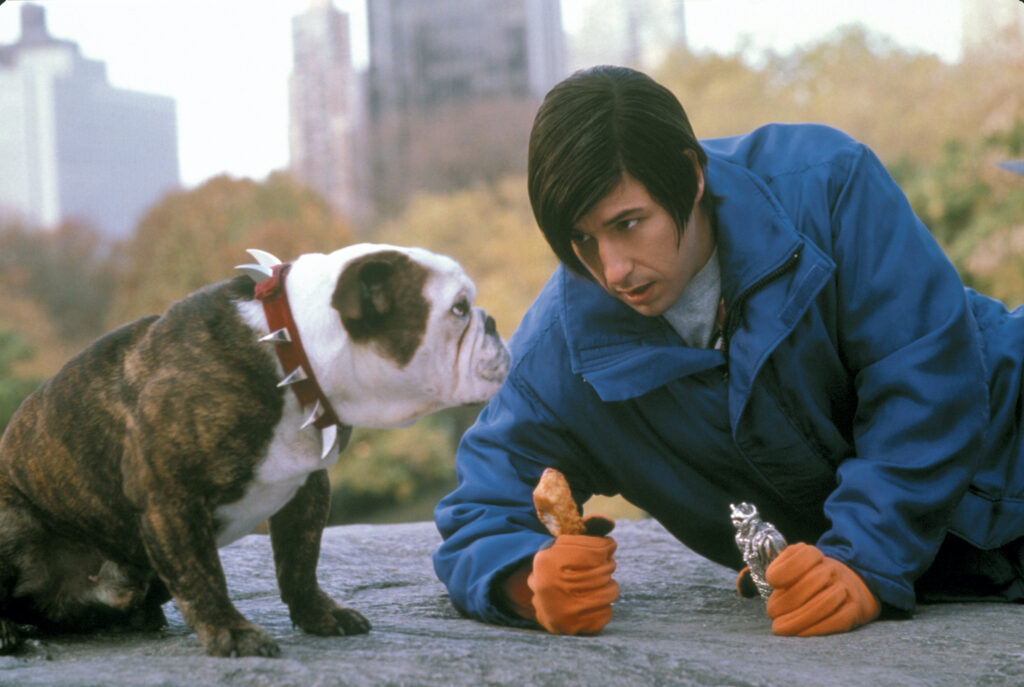
Most people remember Little Nicky as a stupid devil comedy.
That is exactly why it works.
The movie hides its myth inside ridicule. It arrives as gross-out slapstick, bad accents, fast food, and a hero who seems too weak and too ridiculous to carry any real symbolic weight. But that surface is not separate from the meaning. It is part of the meaning. The film imagines a world so spiritually degraded that even hell has become funny.
That is the first clue.
The deeper point is not simply that the son of Satan comes to Earth. It is that Earth turns out to be the more advanced version of hell. The underworld below is crude, obvious, theatrical. It still looks infernal. Earth is worse because the infernal field has been normalized into social life, appetite, commodity, charisma, and spectacle. Below, hell still burns. Above, hell has learned how to smile.
That reading gets sharper beside Dante.
Dante’s InfernoInferno — Dante’s Divine ComedyThe first canticle of Dante Alighieri’s Divine Comedy.Read full entry → is already an inversion. It is usually treated as a descent into a lower realm, but it is doing something more severe than that. It maps the moral and spiritual structure of what people already call the world. The circles of hell are not just punishments elsewhere. They are distorted ways of being made visible. Dante is not merely traveling away from ordinary life. He is revealing what ordinary life already becomes when ruled by appetite, fraud, pride, violence, and fixation.
So Inferno already says: what you call the world is hell-shaped.
Little Nicky then becomes an inversion of an inversion.
Dante reveals the infernal structure.
Little Nicky shows what happens after that structure becomes culture.
It is a comic correction. It suggests that the real inferno is not mainly below us. It is the world above once distortion has become ordinary, desirable, and ambient.
Hell below is the basement. Earth is the showroom.
This is why the firewall matters. Once hell seals up, the lower kingdom can no longer circulate itself below. It has to export itself. The two brothers are not just rebellious sons. They are portable infernal forces entering the world above as appetite, influence, personality, and domination. The lower kingdom does not really need to conquer Earth from outside. It only needs to reveal that Earth is already prepared to host it.
That is what makes the movie darker than it first appears. It is not showing hell invading innocence. It is showing hell discovering that its higher form is already in place.
The brothers matter most as functions, not as personalities. Adrian and Cassius are stronger, cleaner embodiments of infernal rule than Nicky is. They know how to dominate. They know how to spread. They know how to wear force as style. They are what hell looks like once it becomes socially adaptive.
Nicky is different.
He is still infernal. He is still a son of the broken kingdom. But he is damaged in a way that matters. He is awkward, unstable, humiliated, soft where he should be hard, and unable to reproduce infernal domination cleanly. That weakness is not a flaw in the symbolism. It is the point. The stronger sons are better at extending hell. Nicky is too cracked to do it with conviction.
That makes him the dangerous heir.
The kingdom cannot be loosened by the brother who best embodies its power. It can only begin to loosen through the son who cannot fully belong to it.
That is why he works best as a broken heir with a threshold function. He is still marked by the field he comes from, but he also moves between worlds, handles dangerous forces, and contains what has spread. He is not a pure kingly figure and not a pure healer either. He is a damaged mediator. He weakens the kingdom precisely because he cannot fully identify with its poison.
The flask becomes important here. It is not just a plot device. It is containment. If the brothers represent infernal energies spreading into the world above, the flask gathers them back into a boundary. In a world where hell has become public and normalized, containment is already a kind of correction. Before the field can breathe, what has spread everywhere has to be caught.
That same logic makes Mr. Beefy more important than he first appears.
If Earth is the real inferno in the deeper sense, then Mr. Beefy is not just a funny dog companion. He becomes a degraded Virgil figure. Dante’s Virgil guides the pilgrim through the infernal structure and teaches him how to read it. Mr. Beefy performs that function in comic, embodied form. He does not explain hell with poetry. He moves through it with instinct.
That is exactly right for this movie.
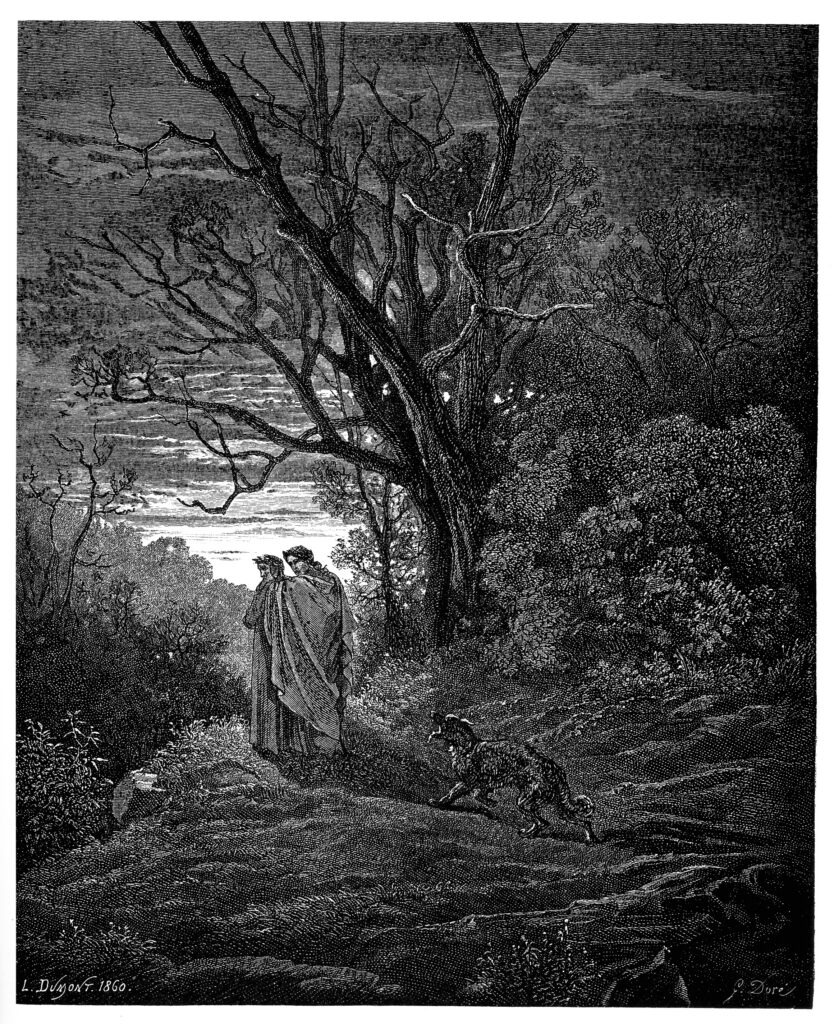
In a world where infernal structure has become social and ambient, the first guide cannot be a philosopher. He has to be an animal. Mr. Beefy is fidelity before theory. He appears before romance, before social success, before any high revelationRevelation — Book of RevelationThe final book of the Christian New Testament, also called the Apocalypse of John.Read full entry →. The first real companion Nicky receives in the upper inferno is creaturely loyalty. In a field built on performance, appetite, and spectacle, the dog stands for something Earth has not yet fully corrupted: embodied trust.
Mr. Beefy guides the damaged son through hell after hell has learned to look normal.
Valerie performs a different role. She is not just there to humanize the hero. She changes his condition inside the field.
The levitation scene works better through density and buoyancy than through gravity. Earth in this film is dense. Appetite is dense. Shame is dense. Persona is dense. The upper inferno compacts consciousness into identityThis — IdentityThis names the formed identity: the body, role, image, wound, belief, or story claimed as what the self is.Read full entry → and performance. That is what makes it hell. Not merely punishment, but density.
Valerie’s belief changes Nicky’s density within the field.
That is why he becomes buoyant.
Her recognition does not make him stronger in the infernal sense. It does not crown him or harden him into a better ruler. It makes him lighter. For a moment, he is no longer as compacted by shame and false identity as the world expects him to be. Right reflectionAm — ReflectionAm names reflected presence: awareness embodied or mirrored without yet becoming ownership.Read full entry → produces buoyancy.
That is a better miracle than triumph.
He does not conquer the inferno. He becomes less dense inside it.
This is also why the movie feels unexpectedly tender underneath the vulgarity. It is not secretly saying that hell can be defeated by a stronger son. It is saying the infernal kingdom begins to loosen only when one of its heirs becomes light enough not to fully reproduce it.
Popeye’s chicken sharpens the same reading. It is not just a recurring gag. It is degraded sacrament. Nicky is sustained not by bread from heaven, but by branded fast food. That alone would matter in a movie about Earth as upper-world inferno. But the name deepens it: Pop-eye. The outward, exaggerated eye. The pop-cultural eye. The eye of spectacle, branding, and compulsive visibility.
So the food becomes more than food. It is upper-world communion through distorted seeing. Appetite delivered through image. Fuel from a world where seeing has already been captured by branding and performance.
If hell has become ordinary life, then communion arrives in a bucket.
The city deepens the same structure. New York is not neutral background here. It is the ideal upper-infernal environment: appetite without limit, anonymity without communion, velocity without stillness, crowd life without relation, image without depth. The underworld has not been escaped. It has become urban rhythm. Earth in Little Nicky is infernal order reorganized as movement, comedy, sexuality, marketing, and spectacle.
That is why the comedy matters so much. The movie is not serious in spite of the jokes. It is serious through them. Dante reveals distortion as structured suffering. Little Nicky reveals the same structure after it has become ridiculous and marketable. Ridicule is one of the film’s main weapons. Infernal rule is shown as absurd because absurdity exposes what domination never sees about itself: it is swollen, not deep. Appetite is inflation. Hardness is overcompensation. The kingdom is already unstable. The more intensely it performs itself, the more clearly it reveals its incoherence.
This is where the movie becomes more than a devil comedy. It becomes a correction to a common mistake. The mistake is to think hell is elsewhere. Dante already resists that by making hell a truthful diagram of the world’s distortions. Little Nicky radicalizes the point by showing Earth as preferable to devils only because its infernality is smoother. Dante’s lower hell clarifies. Little Nicky’s upper hell seduces. Dante gives the map of distortion. Little Nicky shows what distortion looks like when it has gone public as culture.
That is why the film belongs to a waning phase. Its movement is not conquest, but loosening. The false kingdom cannot be healed by stronger infernal masculinity, sharper appetite, or cleaner domination. It begins to fail when one son becomes too awkward, too relational, too damaged, too buoyant under right reflection to keep its density intact. The hierarchy does not break because it is overpowered. It breaks because it cannot fully reproduce itself through the heir it has produced.
The deepest one-line reading is this:
Little Nicky is an inversion of Dante’s inversion, a comic correction that reveals Earth as the real inferno after hell has been normalized into appetite, spectacle, and smiling social life.
And that is why the movie lands where it does practically too. When a system runs on appetite, image, control, repetition, or performance, the answer is rarely stronger domination. Hardness usually feeds the field that produced it. What helps is stranger and less glamorous: faithful companionship, right reflection, containment of what has spread too far, and the kind of softening that lowers density inside the infernal machinery.
Not escape first.
Buoyancy first.
That is the secret Little Nicky hides in plain sight.



.jpg)
.jpg)