Being invited into the room is not the same as belonging to the room.
Being watched is not the same as having power.
Being famous is not the same as being free.
A person can be elevated, praised, displayed, and still remain structurally contained.
That is the mechanism behind what GEOMYTHA calls Exhibit IdentityThis — IdentityThis names the formed identity: the body, role, image, wound, belief, or story claimed as what the self is.Read full entry →: a person becomes valuable to a system because they can be shown.
The difference between visibility and agency
Visibility can feel like power because attention is real.
People know your name.
You are invited.
You are photographed.
You are placed near people with status.
You are given a microphone.
You are put on a stage.
But none of thoseThose — ProjectionThose names projection: enemies, outsiders, competitors, threats, and disowned qualities placed beyond the identity boundary.Read full entry → facts answers the deeper question:
Who controls the terms?
Who decides when you enter?
Who decides when you leave?
Who owns the image?
Who receives the money?
Who can change the rules?
Who can say no?
That is where agency begins to separate from exposure.
The star can become the exhibit
GEOMYTHA uses the word star carefully here.
A star appears elevated.
It draws attention.
It becomes a point others orient toward.
But spectacle can convert that elevation into containment.
The person is no longer simply present.
The person is presented.
The difference is small in language and enormous in structure.
To be present is to participate.
To be presented is to become part of somebody else’s arrangement.
Samson: strength converted into spectacle
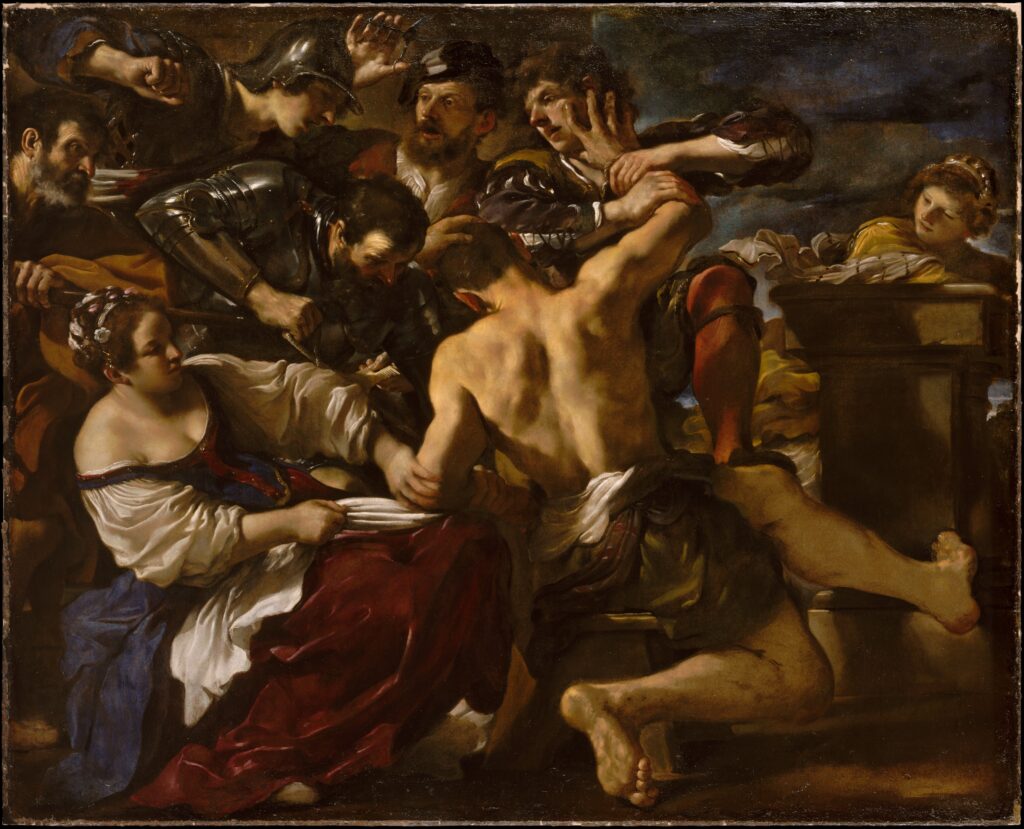
The Samson story gives us one of the oldest and clearest images of this transformation.
Samson begins as a figure of extraordinary force.
By Judges 16, that force has been captured.
His eyes are put out. He is bound. He is brought into confinement.
Then the Philistine rulers gather for celebration and call Samson out so he can perform for them.
The person who once terrified the system becomes entertainment inside it.
His power has not become theirs in any simple sense.
But his image has.
His defeat becomes part of their ceremony.
His presence confirms their story about themselves.
That is Exhibit Identity.
The dangerous person has been turned into the proof of the system’s victory.
The jester at the king’s table
The court jester gives us another version.
The jester may stand unusually close to power.
He may speak in ways other people cannot.
He may mock the court.
He may even tell truths that ordinary courtiers would be afraid to say.
The Metropolitan Museum of Art notes this tension in its discussion of eighteenth-century court fools: entertaining the ruler was their official function, while certain fools could sometimes use humor to speak truths that others could not. That latitude, however, still existed inside the court’s structure and could disappear when the ruler decided the joke had gone too far.
That is the distinction GEOMYTHA cares about.
Access is real.
Influence may be real.
But proximity is not sovereignty.
The jester is near the throne.
He does not own the throne.
Dinner for Schmucks: invitation as containment
Dinner for Schmucks makes the mechanism almost embarrassingly obvious.
The unusual guest receives an invitation that appears, on the surface, to be a form of inclusion.
But the invitation is structured around display.
The guest is not being admitted as an equal participant in the social world of the hosts.
The guest is being brought in because the host expects the guest to be entertaining.
The invitation therefore carries two meanings at once:
You have been selected.
And:
You have been selected for our use.
That second sentence is the important one.
The invitation is not the cage by itself
This is where the article needs its strongest correction.
Not every invitation is manipulation.
Not every audience is exploitative.
Not every stage turns a person into an object.
Artists choose audiences.
Performers enter contracts.
Athletes choose competition.
Writers seek publication.
People may want visibility, money, influence, collaboration, or recognition.
There is nothing inherently false about being seen.
The real issue is the structure of agency.
Five questions that matter more than fame
If we want to know whether visibility is participation or exhibition, five questions help:
Terms: Did the person understand the arrangement?
Ownership: Who owns the work, image, recording, or result?
Compensation: Who benefits materially?
Exit: Can the person leave without disproportionate punishment?
Control: Who can alter the conditions once the person is inside?
A person can be highly visible and still have meaningful agency.
A person can also be highly visible while having very little.
Visibility alone cannot answer the question.
The Truman Show: being the center without being in control
The Truman ShowThe Truman ShowThe Truman Show presents Truman Burbank living unknowingly inside a constructed television environment whose town, relationships, routines, and physical conditions are organized by a production system around him. The film repeatedly exposes…Read full entry → gives GEOMYTHA one of the cleanest modern examples.
Truman is the central figure of the entire production.
Everything is organized around him.
He is the most important person in the show.
And he has almost no authority over the show.
That is the paradox.
Centrality looks like power from the outside.
Inside the structure, it can mean dependence.
Truman is not ignored.
He is over-seen.
His problem is not invisibility.
His problem is that visibility has been separated from consent.
When the image becomes more valuable than the person
This is the critical turn.
A person becomes an exhibit when the system values the visible form more than the living subject carrying it.
The athlete becomes “the champion.”
The actor becomes “the face.”
The employee becomes “the success story.”
The dissenter becomes “the edgy one.”
The survivor becomes “the inspiring one.”
The unusual guest becomes “the funny one.”
At first the label may describe something real.
Then the label becomes useful to other people.
Then the person begins being invited primarily because the label performs.
The living person is still there.
But the system is increasingly relating to the role.
The spectacle needs a stable object
Spectacle works best when the displayed identity stays recognizable.
The audience wants the fighter to fight.
The comedian to be funny.
The rebel to rebel.
The tragic figure to remain tragic.
The genius to remain strange.
The survivor to remain inspirational.
That creates a subtle pressure.
The person may change.
The exhibit must remain legible.
This is where identity becomes a cage without any literal wall.
The role becomes the condition of continued visibility.
Network and the machinery of attention
Network pushes the mechanism into mass media.
Emotion becomes programming.
Anger becomes a format.
A human crisis becomes valuable because it can hold an audience.
The system does not need to invent the emotion for exploitation to occur.
The emotion can be completely real.
That is precisely why the mechanism is dangerous.
Something true in the person becomes useful to the machine.
The machine then has an incentive to keep the truth performing.
The stress test: sometimes the stage is liberation
There is an opposite case.
Visibility can create agency.
A platform can let someone speak who was previously unheard.
Recognition can produce bargaining power.
Money can create independence.
An audience can become a community.
A public identity can be consciously used rather than unconsciously inhabited.
That is why the GEOMYTHA mechanism cannot be “fame is a trap.”
The better distinction is:
Does visibility expand the person’s ability to act, or does the person increasingly exist to maintain the visibility?
From This to These to Those
In GEOMYTHA grammar, Exhibit Identity often begins with a stable form.
This: the recognizable person or role.
Then the form enters a larger social arrangement.
TheseThese — AccumulationThese names accumulation: possessions, titles, achievements, beliefs, communities, and other extensions gathered around identity.Read full entry →: the audience, group, network, institution, market, or community surrounding the form.
Finally, the structure may create an outside.
Those: the consumers, rivals, critics, outsiders, or others through which the exhibit gains contrast.
The danger is that the original person disappears inside the architecture built around the recognizable form.
The correction is a returnReturn — RemembranceReturn names remembrance and release: the loosening of possession so reflection can become transparent to source again.Read full entry →:
This → Am → Is.
What is the role?
Who is the person carrying it?
What remains before the display?
The practical return
When you are invited into a room, ask what the invitation is for.
When attention increases, ask what control increased with it.
When your role becomes valuable, ask whether you can still stop performing it.
When people praise the image, ask whether they remain interested in the person.
And when somebody else is on display, remember that the exhibit is never the whole human being.
Be visible if visibility serves the work. But do not confuse being seen with being sovereign.
Sources and further reading
- Judges 16, Sefaria — Samson’s capture, imprisonment, display before the Philistine gathering, and destruction of the temple.
- The Metropolitan Museum of Art, Bust of “Baron” Schmiedel — museum discussion of court fools, entertainment, privileged speech, and the limits of that privilege.
- Guercino, Samson Captured by the Philistines, 1619, The Metropolitan Museum of Art — public-domain artwork and provenance.
GEOMYTHA interpretation is comparative and symbolic. The biblical and museum sources establish the historical/textual material cited above. Film examples are used as works of criticism and comparison; they are not evidence that their creators intended the GEOMYTHA framework.