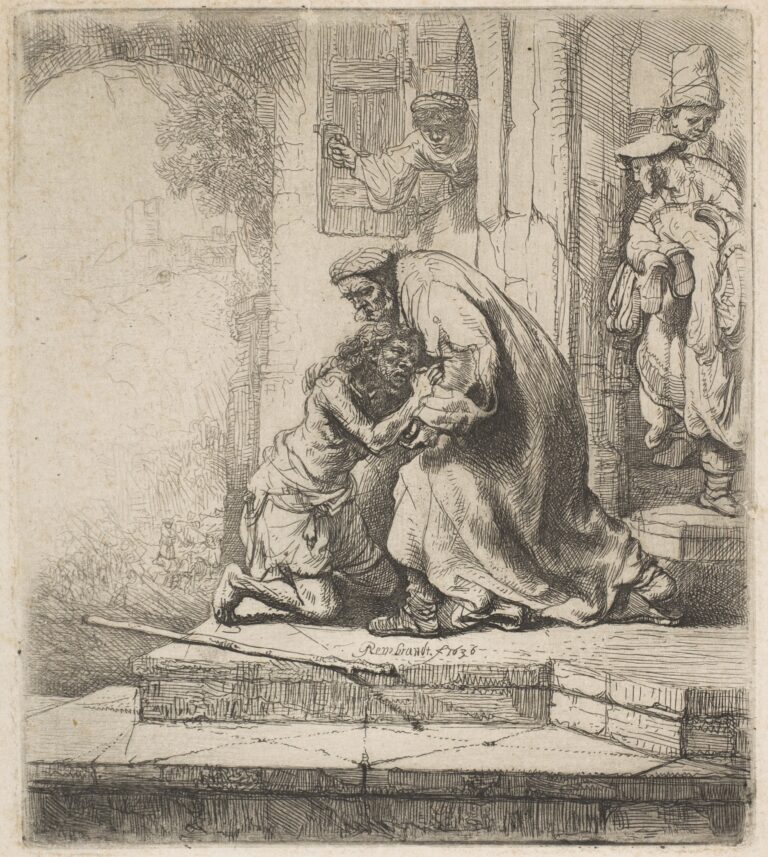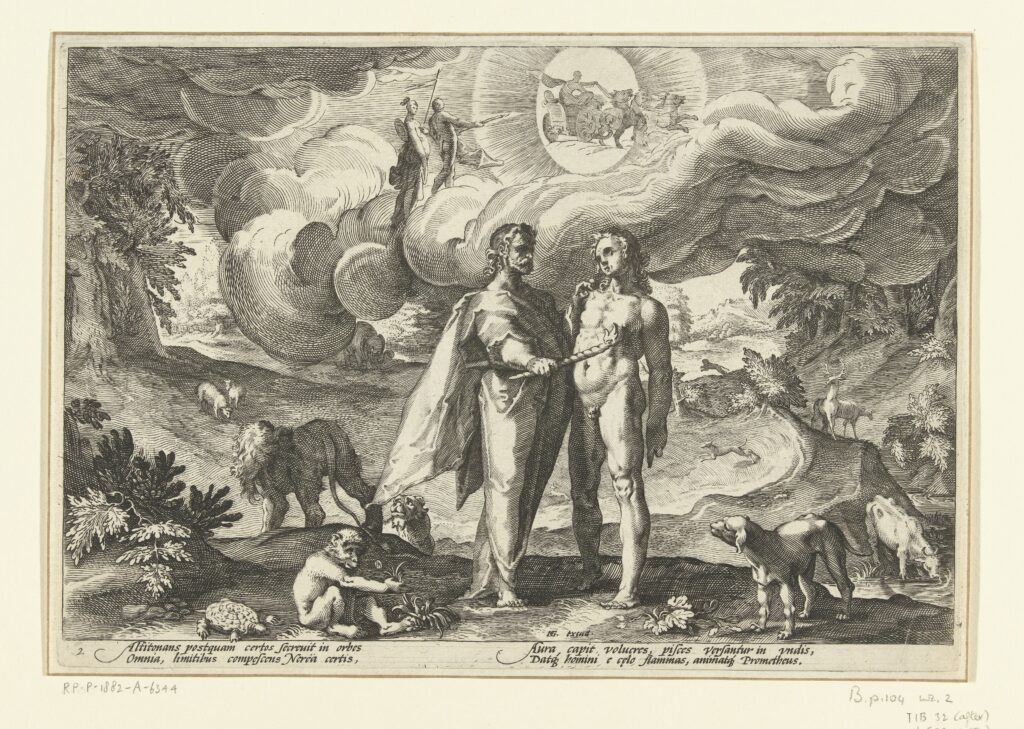
A hand catches a heel. A sword guards a gate. Fire is stolen and carried away.
They are not the same story.
They come from different traditions, different texts, and different symbolic worlds. Genesis does not mention PrometheusPrometheus — Fire BringerPrometheus is the Titan associated in Greek literary tradition with conflict over fire and its availability to mortals; later visual art repeatedly depicts him bringing or animating with heavenly fire.Read full entry →. Hesiod does not explain Eden. Neither sourceIs — SourceIs names unclaimed being: awareness before possession, distinction, or identity.Read full entry → gives us a historical chain connecting Jacob’s hand, the flaming sword, and the theft of fire.
But GEOMYTHA can still ask a narrower question:
What happens when a small act of interception grows into a defended boundary and then into a power that can build a world?
That is the mechanism this article follows.
Stage one: the heel grab
Genesis introduces Jacob with a physical action before he has done anything else. Esau is born first. Jacob comes after him with his hand holding Esau’s heel. The Hebrew narrative even links Jacob’s name to the heel.
Later, the pattern becomes social rather than physical. Esau sells Jacob the birthright. Later still, Jacob receives Isaac’s blessing while presenting himself as Esau.

The text contains family conflict, divine promise, hunger, bargaining, deception, blessing, and inheritance. It should not be reduced to one verb.
But the first visible gesture is still striking:
something already moving ahead is caught from behind.
Within GEOMYTHA, that makes the heel grab a useful image of interception.
The action does not create Esau.
It does not create the birth order.
It attaches itself to an order already in motion.
The hand says, in effect: you may be ahead, but I will not let your movement remain untouched by me.
Interception is not yet possession
This distinction matters.
To interrupt something is not the same as owning it.
You can stop a door without owning the room.
You can grab a rope without owning the ship.
You can catch someone’s heel without yet taking their place.
Interception is the first narrowing.
Relation becomes leverage.
The other is no longer simply another presence. The other becomes something through which position can be gained.
That is why the heel matters in this reading. It is contact becoming strategy.
Stage two: the guarded boundary
Genesis gives us another image much earlier in the story.
After the human is expelled from Eden, Genesis 3:24 places cherubim and a flaming sword that turns every way to guard the path to the tree of life.

Historically and textually, the sword is a guardian image. It protects access to the tree of life after the expulsion. That is what the passage actually says.
GEOMYTHA adds a second-order reading:
Interception becomes more durable when it acquires a boundary that can defend the new arrangement.
A claimI — ClaimI names claim: the interruption by which reflected presence is taken as mine.Read full entry → says, this is mine.
A defended claim says, and you may not pass.
The sword represents that second condition in the GEOMYTHA comparison—not because Genesis says “the sword is ego defense,” but because the visible function of the image is guarding access.
The boundary changes the structure
Before the guard, movement is still possible.
After the guard, the landscape has changed.
There is now an inside and an outside.
A permitted direction and a forbidden direction.
A route and an obstruction.
A defended threshold.
This is the movement from interception to defense.
The hand catches.
The sword keeps.
One is momentary leverage.
The other turns leverage into structure.
Stage three: stolen fire
Prometheus takes the pattern into a different mythic world.
In Hesiod’s Works and Days, Zeus hides fire from humanity after Prometheus deceives him. Prometheus then steals the fire back, carrying it in a hollow fennel stalk.

Prometheus must remain morally complicated.
He is a thief from Zeus’s point of view.
He is also one of humanity’s great benefactors in the tradition.
The stolen thing is not merely treasure.
It is capacity.
Fire cooks.
Fire warms.
Fire lights.
Fire hardens clay and works metal.
Fire can also burn, conquer, and destroy.
That is why fire changes the scale of the mechanism.
Prometheus industrializes the heel grab
The heel grab acts on a person already moving.
The sword protects a boundary.
Fire allows the claimantSetIn Geomytha, Set names the claimant: I — the interruption by which reflection is taken as mine and converted toward ownership.Read full entry → to alter the environment itself.
That is what GEOMYTHA means by saying Prometheus industrializes the heel grab.
Not historically.
Not etymologically.
Not because the Greek myth derives from Jacob.
The comparison is functional.
A small act of leverage becomes a defended position. The defended position acquires tools. The tools allow the position to reproduce itself in the world.
The claimant no longer only grabs what is moving.
The claimant can now make new things move.
Technology extends the hand
This is where the old myth becomes immediately recognizable.
A lever extends strength.
A fence extends a boundary.
A lock extends exclusion.
A vehicle extends movement.
A weapon extends force.
A database extends memory.
A network extends reach.
Technology takes an action that a body can perform and lets that action persist farther, faster, longer, or at larger scale.
That is not automatically bad.
Fire is not evil because it extends human capacity.
Technology is not corruption simply because it magnifies action.
The real question is:
What action is being magnified?
The stress test: fire can serve
If the mechanism only works when possession is bad, it is too simple.
Prometheus breaks that simplification.
The stolen fire can become shelter, food, medicine, craft, communication, and civilization.
A boundary can protect a child.
A lock can protect a home.
A tool can free someone from unnecessary labor.
A claim can establish responsibility.
So GEOMYTHA cannot treat interception, boundary, technology, or possession as automatic moral failures.
The problem begins when a useful function forgets its limits.
A boundary becomes absolute.
A tool becomes entitlement.
A capacity becomes identityThis — IdentityThis names the formed identity: the body, role, image, wound, belief, or story claimed as what the self is.Read full entry →.
A possession becomes proof of superiority.
The mechanism is not “power is bad.”
It is that power amplifies whatever relation is already inside it.
First fire and claimed fire
GEOMYTHA also needs a distinction inside the symbol of fire.
Fire can be formative before it is possessive.
Heat cooks food, fires clay, tempers metal, and transforms raw material into usable form.
That is formative fireFirst FireFirst Fire is the formative fire of Is → Am: source becoming a vessel capable of reflected presence.Read full entry →: energy participating in making.
Claimed fire is different.
Claimed fire says: this capacity is mine, and I control where it may go.
The same physical element can participate in both functions.
That is why the symbol cannot be given one fixed moral meaning.
The function changes with the relation.
Three stages of one pressure
The comparison can now be stated cleanly.
Heel grab: intercept the movement.
Flaming sword: defend the boundary created by the interruptionThe Interruption — Am → IAm → I is the interruption in which reflected presence becomes claim.Read full entry →.
Stolen fire: expand the power of the claimant beyond the original encounter.
Interception.
Defense.
Expansion.
Each stage can be useful.
Each stage can also harden.
The danger appears when relation becomes leverage, leverage becomes enclosure, and enclosure acquires enough power to reproduce itself as a world.
The practical return
When you find yourself defending something fiercely, ask what happened before the defense.
What did I first grab?
What did I become afraid of losing?
What boundary did I build around it?
What tools now extend that defense?
The answer might be a possession.
A title.
A belief.
A wound.
A relationship.
A status.
A story about yourself.
The goal is not to throw away every boundary or every tool.
It is to see the sequence clearly enough to choose whether the thing still serves life.
Notice the grab. Examine the guard. Question what the fire is enlarging.
Sources and further reading
- Genesis 25–28, Sefaria — Jacob and Esau, the heel, birthright, blessing, and later family conflict.
- Genesis 3:24, Sefaria — cherubim and the flaming sword guarding the way to the tree of life.
- Hesiod, Works and Days 42–58, Perseus Digital Library — Prometheus stealing fire for humanity.
- Hesiod, Theogony 507ff., Perseus Digital Library — Prometheus, deception, punishment, and the larger conflict with Zeus.
- Gustave Doré, Adam and Eve Are Driven out of Eden, Wikimedia Commons — public-domain illustration used in this article.
GEOMYTHA interpretation is comparative and symbolic. The biblical and Greek sources establish the individual stories. They do not establish a historical connection among Jacob, Eden’s guardian, and Prometheus, nor do they establish the GEOMYTHA three-stage mechanism as the intent of the original authors.