Jules Verne didn’t merely write adventure stories. He wrote maps of consciousness disguised as travelogues—and the maps recur with such consistency that they read like a single diagram rendered four different ways.
Geomytha names that diagram with four pressures that keep reappearing across myth, scripture, and pop culture:
This Substack is reader-supported. To receive new posts and support my work, consider becoming a free or paid subscriber.
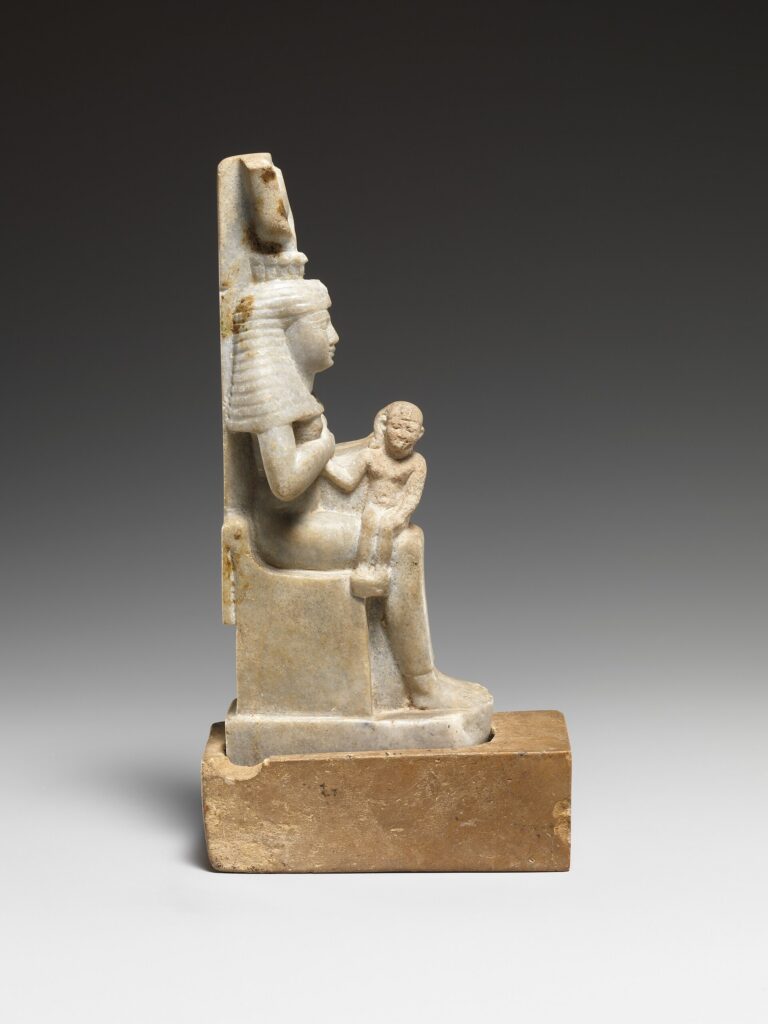
IsisIsisIn Geomytha, Isis names the unclaimed field: Is — pure being, awareness before possession, and the ground before the claimant appears.Read full entry → — undivided awareness, the living field.
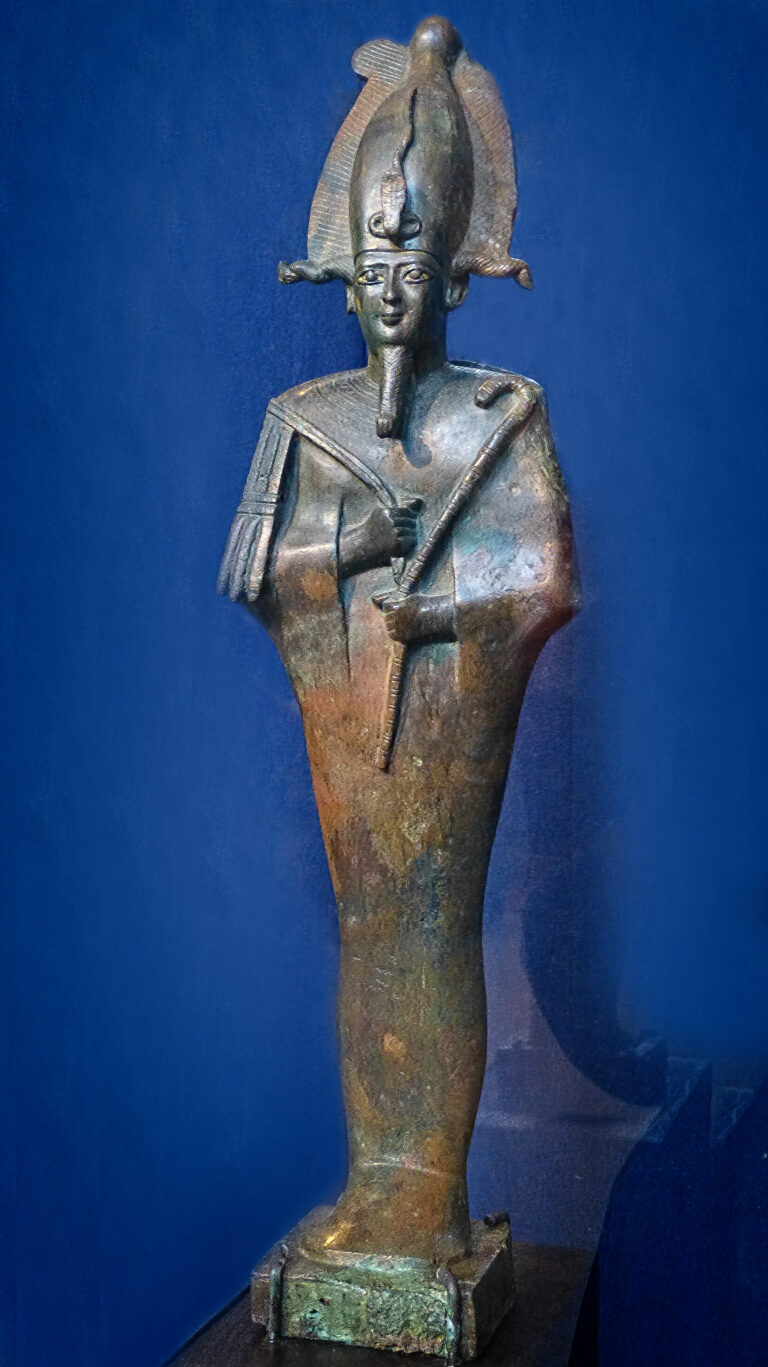
OsirisOsirisIn Geomytha, Osiris names reflected presence: Am — awareness reflected as living consciousness without yet becoming ownership.Read full entry → — reflectionAm — ReflectionAm names reflected presence: awareness embodied or mirrored without yet becoming ownership.Read full entry → that coheres, perfects, and orders.
SetSetIn Geomytha, Set names the claimant: I — the interruption by which reflection is taken as mine and converted toward ownership.Read full entry → — imagination as takeover: the perceptual overlay that hijacks the field.
HorusHorusIn Geomytha, Horus names the identity that forms after claim: This — the body, role, image, wound, belief, or story taken as what the self is.Read full entry → — the time-bound ego identityThis — IdentityThis names the formed identity: the body, role, image, wound, belief, or story claimed as what the self is.Read full entry →: the “I” forged from story, schedule, wound, and role.
Verne’s genius is that he doesn’t preach this. He stages it mechanically. The plot itself becomes the experiment.
Four novels, read together, form a complete Geomytha circuit:
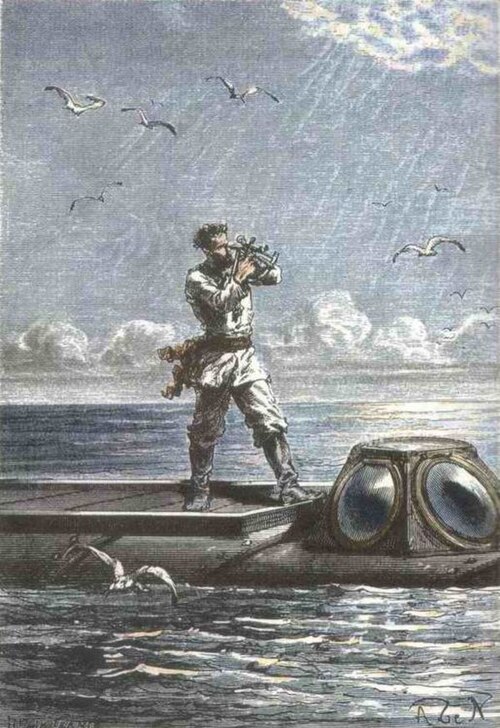
Twenty Thousand Leagues Under the Seas — the enclosure.
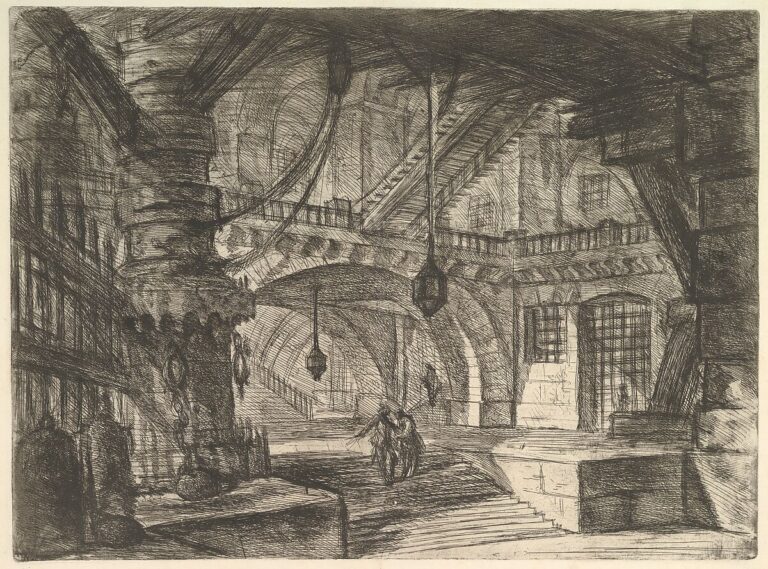
Journey to the Center of the Earth — the descent.
Around the World in Eighty Days — the clock-trance.
The Mysterious Island — the rebuild.
If you want to see how imagination colonizes reflection, and how identity hardens around time, Verne is one of the cleanest “technical writers” ever produced—because his technology is never just technology. It is always a metaphor for mediation.
1) Twenty Thousand Leagues Under the Seas — The Nautilus as Perceptual Regime
The ocean is the story’s quiet protagonist. It functions as the prior condition: vast, indifferent, inexhaustible. Not a concept. Not a narrative. A field.
That is Isis.
Then comes the Nautilus.
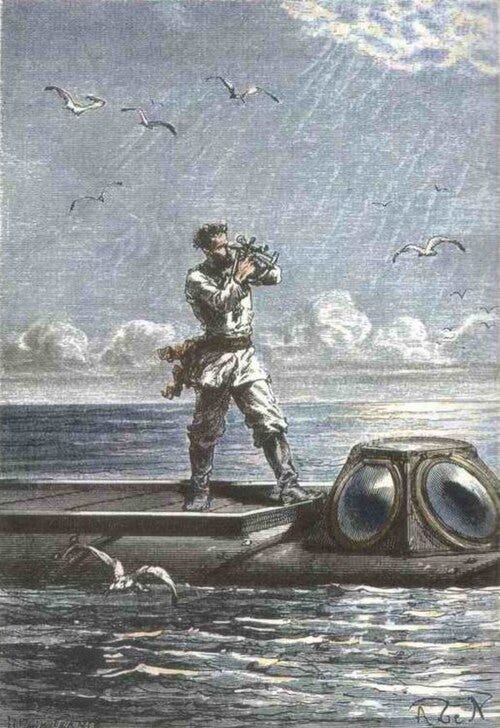
The Nautilus is not simply a submarine. It is a sealed reality-generator: a mobile world that filters what can be seen, when it can be seen, and how it will be interpreted. This is the crucial distinction Geomytha always returns to:
The field is not destroyed.
The field is curated—until the curated version becomes “more real” than what it edits out.
That is Set.
Set doesn’t conquer by brute force. Set conquers by building an environment in which the mind no longer has access to unmediated being. The Nautilus is a false centerFalse CenterA false center forms when sovereignty is assigned to an object, role, institution, future state, identity, or projection that cannot actually serve as source.Read full entry →: a false phallus of mastery, control, insulation, and selective revelationRevelation — Book of RevelationThe final book of the Christian New Testament, also called the Apocalypse of John.Read full entry →.
And then there is Nemo—the operator.
Nemo reads like Horus forged by injury: the time-bound identity built from a timeline of grievance and mission. He is not merely a man with a past; he is a man who has become his past. His “I” is the scar turned into a throne.
Meanwhile, Osiris appears in Aronnax’s best moments: the clear, contemplative seeing that wants to reflect the ocean without possessing it. Yet Osiris is under constant pressure inside the hull, because the hull is Set’s preferred architecture.
The lesson of the novel is not “technology bad.”
The lesson is: a device can become an entire cosmology. And once you live inside it, the device decides what “real” means.
2) Journey to the Center of the Earth — Descent Beneath the Surface-Mind
If Leagues is about entering the enclosure, Center of the Earth is about being stripped by the real.
The descent is the plot—but the descent is also the teaching.
On the surface, the mind believes it commands the world through concept. It believes the map is sovereign. It believes knowing a thing is the same as touching it. That is Set’s favorite trance: intellectual possession.
But the earth below does not negotiate.
The underworld in this book is Isis in a different costume: heat, darkness, pressure, scale—reality prior to interpretation. You can’t “win” against it. You can only align with it.
That alignment is what restores Osiris. Reflection becomes honest when it is forced to answer to the strata. Measurement becomes humility. Method becomes reverence. The deeper you go, the more the false phallus of conceptual mastery is exposed as fragile.
The Horus-mask—“we are explorers, we are the ones who know”—gets broken and remade over and over. Identity cannot remain rigid in a world where the earth is bigger than your story.
This is why the novel reads like a ritual.
Descent isn’t punishment. It’s correction: the mind gets pulled beneath its own propaganda, until reflection must become true again.
3) Around the World in Eighty Days — Time as Set’s Operating System
This is one of Verne’s most precise spiritual satires, even though it’s presented as a charming wager.
Because the real antagonist here is not a man. It’s not even geography.
It’s clock-time.
In Geomytha, Set doesn’t only appear as fantasy. Set appears as abstraction that colonizes the nervous system. And the most socially acceptable abstraction on earth is time-as-tyrant: timetables, minutes, deadlines, the sun turned into a measuring stick.
Phileas Fogg is the Horus archetype nearly in pure form: identity reduced to schedule. A self built from procedure. A calendar with legs. He doesn’t live time; he is owned by it.
This is the brilliant pressure Verne applies: the world keeps intruding as the unplanned. Weather. Delay. Accident. Encounter. Relationship. A human heartbeat.
That intrusion is Isis—presence refusing to be flattened into grid. And Osiris appears in the only way it can appear here: responsiveness. Intelligence serving the real rather than serving the plan.
The book’s hidden question is not “can you make it in time?” It’s:
What kind of self is produced when the future is always the court you’re trying to please?
If Horus is time-bound identity, Eighty Days shows the forging process: the ego is a contract with the future, and Set holds the pen.
4) The Mysterious Island — Rebuilding Without Creating a New Idol
After enclosure, descent, and clock-trance, Verne gives the reconstruction.
The island is pure given-ness: necessity, exposure, immediate reality. Nothing theoretical survives hunger and cold. This is Isis as ground.
From that ground, the castaways build. Here, reflection becomes sacred: Osiris as coherent order, as technique aligned with life. You could call it “civilization,” but in Geomytha terms it is simpler:
reflection serving awareness.
Yet Verne adds one more layer—the most important layer—because Set does not give up when you start doing things correctly.
Set returns as the temptation of unearned power: the hidden intervention, the miracle-tech, the god in the machine. The danger is subtle: it is not that help exists; it is that help becomes a false center.
The island tests whether the community’s identity becomes:
a tool (Horus in service), or
a crown (Horus enthroned).
Because the moment the builders begin to worship their own competence, the Osiris principle flips. Order stops protecting life and starts feeding on life. The same structure that can be shelter becomes a prison the moment the center is misplaced.
This is the book’s quiet moral: you can rebuild a world—and still rebuild the trance—if you mistake power for presence.
The Four-Novel Arc: A Single Circuit
Read as one continuous diagram, the sequence is startlingly clean:
Leagues: a perfect enclosure that turns presence into curated spectacle.
Center: a descent that strips the false phallus of mastery and forces reflection to become true.
Eighty Days: the discovery that time itself can be the enclosure—Set’s invisible empire.
Island: reconstruction, with the final test: can reflection remain aligned without becoming an idol?
This is why Verne feels modern. He is writing about the same dilemma our age lives inside:
how instruments become realities,
how abstractions become prisons,
how identity becomes a schedule,
and how rebuilding can either restore presence or merely reinvent the mask.
The adventure is the surface.
The circuit is the point.
If this resonates
X: mythicgeometry
Instagram: mythicgeometry
TikTok: Geomytha
Patreon: Geomytha Noir
Substack: Geomytha Noir
YouTube: geomytha
This Substack is reader-supported. To receive new posts and support my work, consider becoming a free or paid subscriber.