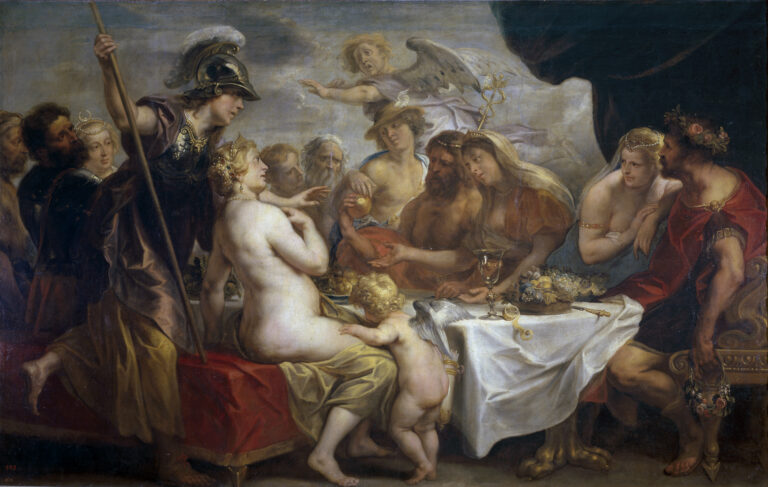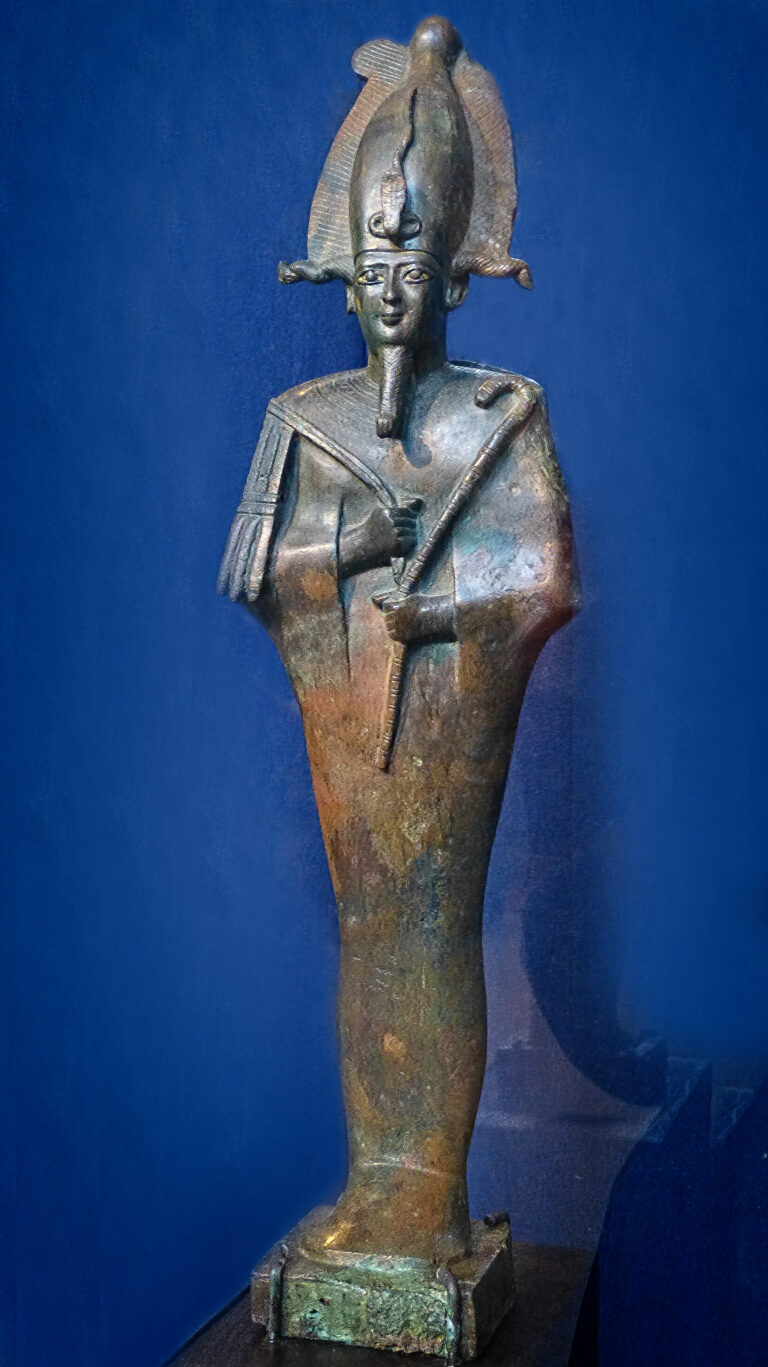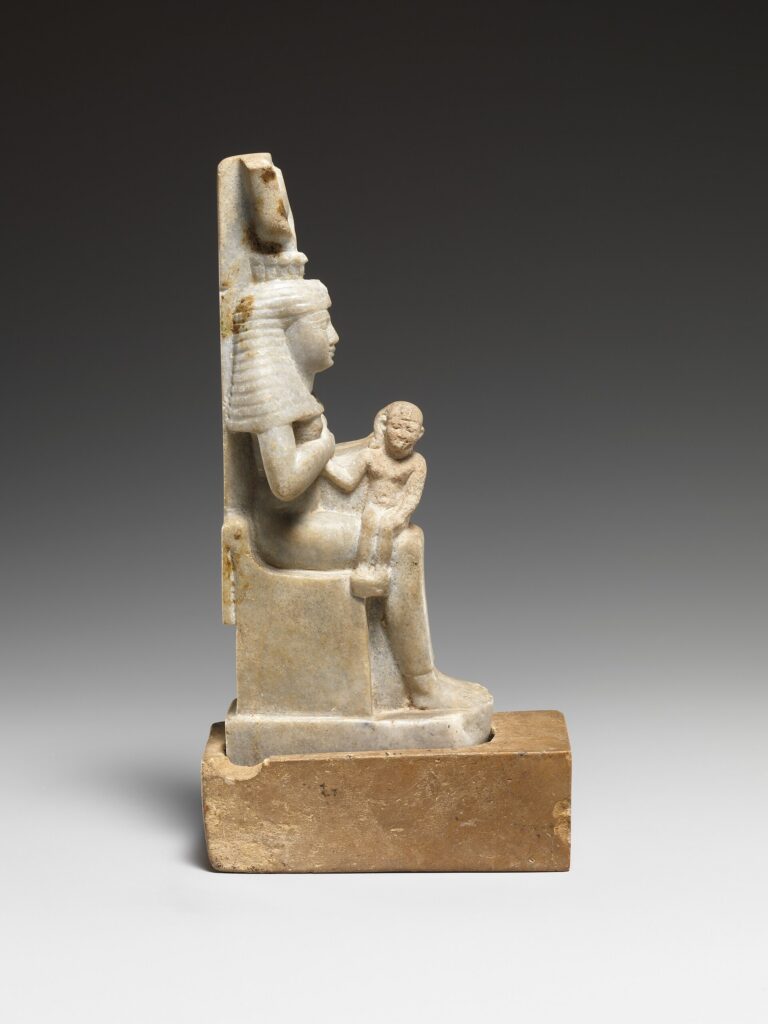
When HorusHorusIn Geomytha, Horus names the identity that forms after claim: This — the body, role, image, wound, belief, or story taken as what the self is.Read full entry → wakes up after SetSetIn Geomytha, Set names the claimant: I — the interruption by which reflection is taken as mine and converted toward ownership.Read full entry → took the wheel
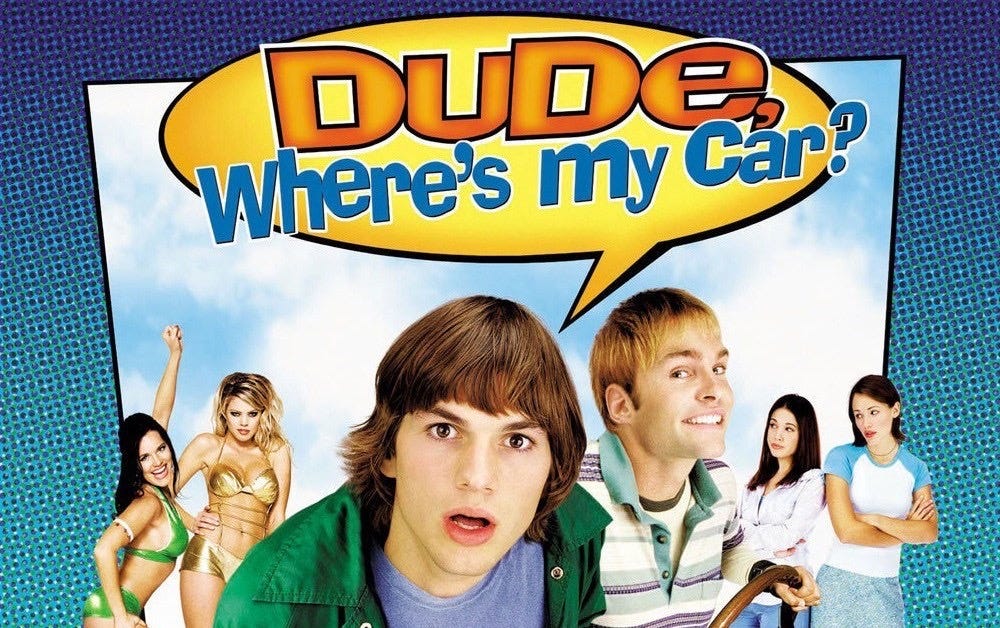
There are stupid movies, and then there are movies so stupid they accidentally confess something profound. Dude, Where’s My Car? belongs in the second category.
On the surface, it is pure chaos: two dim protagonists wake up after a blackout, cannot remember what happened, cannot find the car, and stumble through a chain of absurd clues, offended strangers, cultish weirdos, and increasingly cosmic nonsense. But through Geomytha, the title already tells you everything.
This is not really a movie about a missing car.
It is a movie about consciousness losing the vehicle, waking inside the aftermath, and trying to reconstruct itself from debris.
The title is really asking:
Dude, where did awareness lose embodiment?
Dude, where did the continuity go?
Dude, who was driving this life while I was gone?
That is not just comedy. That is the human condition.
The car as vehicle
A car is not just transportation. Symbolically, it is the moving vessel. It is the structure that carries you through the world. It is the instrument by which intention becomes trajectory.
So when the whole film begins with the vehicle missing, the first symbolic problem is already in place: consciousness has become separated from the thing that was carrying it forward.
In Geomytha, that means awareness is no longer seated in its proper relation to embodiment. The person wakes up in motion’s aftermath without memory of the movement itself. They are inside consequences they cannot connect to direct presence.
That is ego.
Ego is not merely pride or vanity. Ego is what wakes up after the fact and tries to explain the trail it did not consciously author. It inherits motion it does not truly understand. It is a latecomer to its own life.
That is why the line lands so well. “Dude, where’s my car?” is funny because it is shallow. But it is archetypally potent because it is deeper than it knows. The ego is always saying some version of that line. It is always looking around at its own life asking what happened, how it got here, and where the vehicle went.
IsisIsisIn Geomytha, Isis names the unclaimed field: Is — pure being, awareness before possession, and the ground before the claimant appears.Read full entry →: the forgotten ground
Isis, in your framework, is awareness itself, the living ground, the maternal field from which coherence arises. In this film, Isis does not appear as an obvious character because she is what has been lost sight of from the opening frame.
But her absence is precisely the point.
Nothing can be “missing” unless there was first an original wholeness. The panic over the missing car presupposes a prior order. Their confusion presupposes an underlying continuity they can no longer access directly. Isis is that continuity. She is the unbroken field beneath the fragmentationDismemberment / FragmentationDismemberment names the symbolic breaking of a previously integrated reflection into separate parts, roles, objects, or powers.Read full entry →.
The film begins after consciousness has already drifted from sourceIs — SourceIs names unclaimed being: awareness before possession, distinction, or identity.Read full entry →. That is why the whole story feels like a hangover. It is not merely a chemical hangover. It is a metaphysical one. Awareness has fallen asleep in itself and awakened in disorientation.
The comedy rests on a hidden tragedy: they no longer know how to returnReturn — RemembranceReturn names remembrance and release: the loosening of possession so reflection can become transparent to source again.Read full entry → directly to the ground of being, so they must chase signs.
OsirisOsirisIn Geomytha, Osiris names reflected presence: Am — awareness reflected as living consciousness without yet becoming ownership.Read full entry →: shattered reflectionAm — ReflectionAm names reflected presence: awareness embodied or mirrored without yet becoming ownership.Read full entry →
Osiris is reflective consciousness, the clean mirror of awareness, the power by which being knows itself without distortion. In Dude, Where’s My Car?, Osiris is not functioning properly. He has been broken into fragments.
That is exactly what the plot gives us: pieces.
There are scraps of memory, odd objects, messages, tattoos, angry reactions from others, weird clues, partial explanations, traces of actions already taken. But there is no living centerShell and CenterShell and Center distinguishes the structure built to preserve, transmit, or protect living source from the living center the structure is meant to serve.Read full entry → holding the pieces together. Reflection has become shattered into evidence.
This is textbook Osirian dismemberment.
The protagonists do not remember the night because reflective consciousness is no longer whole enough to mirror experience cleanly. Instead of direct recollection, they have a forensic trail. They have to investigate themselves like detectives investigating a crime scene.
That is a powerful image of the fallen mind. Rather than knowing itself immediately, it must infer itself from fragments. It does not inhabit continuity. It assembles continuity after the fact.
Osiris, once whole, reflects awareness. Osiris, once broken, leaves Horus to piece together a self from symbolic remains.
Set: projectionThose — ProjectionThose names projection: enemies, outsiders, competitors, threats, and disowned qualities placed beyond the identity boundary.Read full entry →, diversion, absurdity
Set is the force of projection, imaginative takeover, sensory exaggeration, and outward dispersion. He is not simply evil. He is the energy by which consciousness leaves its center and gets tangled in appearances. He is useful when employed and disastrous when enthroned.
In this film, Set is everywhere.
He is the endless chain of diversions. He is the absurd clue structure. He is the way every answer produces more confusion. He is the escalation from simple forgetfulness into a circus of external signs. He is the whole bizarre machinery that keeps the protagonists running outward instead of returning inward.
The film’s humor is fundamentally Setian. It is generated by misrecognition, excess, surface weirdness, delayed understanding, and chaotic proliferation. One missing car becomes an entire universe of complications. That is how projection works. Once awareness leaves its center, the world multiplies into problem after problem, sign after sign, false authority after false authority.
Set does not merely hide the truth. He overproduces alternatives.
That is why the movie keeps getting bigger and dumber. That inflation is not random. It mirrors the psychic structure of a consciousness that has lost its ground and become dependent on external clues. The more disconnected it is from source, the more reality becomes a scavenger hunt.
A simple return becomes impossible because every object, every stranger, every event now carries exaggerated significance. The lost center generates a swollen universe.
Horus: the self reconstructed from evidence
Horus is the resulting time-bound identityThis — IdentityThis names the formed identity: the body, role, image, wound, belief, or story claimed as what the self is.Read full entry →, the ego-self assembled after the fracture. He is the one who emerges from the battle between reflection and projection. He is not original awareness. He is the claimant to the throne after disruption.
That is exactly what Jesse and Chester are doing for the entire movie.
They are trying to rebuild a usable self.
Not a true self. A usable one.
They want enough continuity to survive social consequences, recover the vehicle, regain approval, restore order, and move forward. In other words, they are not seeking liberation. They are seeking narrative repairWorld-RepairWorld-Repair names the work of regathering relation, pattern, and presence inside a field that has been fractured rather than simply escaping the field.Read full entry →. That is Horus all day long. He does not ask, “What is awareness prior to this confusion?” He asks, “How do I put my life back together?”
And to do that, he must reconstruct identity from traces.
This is one of the movie’s most important symbolic confessions. The protagonists do not know who they were, so they infer who they must have been. They build selfhood retrospectively through signs, reactions, and residues.
That is what most people call identity.
They do not know themselves directly as awareness. They know themselves as the story pieced together from memory fragments, social response, possessions, mistakes, and unfinished consequences. The self becomes a detective theory.
That is Horus: consciousness turned into a time-bound explanation of itself.
The blackout as spiritual allegory
The blackout matters because it is more than a plot device. It is the archetypal condition of fallen consciousness.
You awaken in a life already in progress.
You do not remember how you got into this pattern.
You inherit relationships, obligations, reactions, and material consequences.
You are forced to interpret your existence through fragments.
That is not just a comedy setup. That is incarnation as experienced through ego.
People assume they are living directly, but most are living post hoc. They wake inside momentum. They awaken inside scripts. They awaken inside social entanglements and bodily trajectories they did not consciously author from present awareness. Then they spend their lives trying to explain the mess.
That is why the movie feels so strangely universal beneath its stupidity. It dramatizes the sense that life has already happened before you got there.
The ego is always late to the scene.
Why the film keeps escalating
One of the funniest things about the movie is how disproportionate everything becomes. A missing car spirals into a ridiculous cosmology. That escalation is symbolically exact.
When the center is lost, the world expands in compensation.
A missing car is no longer a missing car. It becomes evidence of conspiracy, proof of hidden forces, a portal to larger stakes, a signal that reality itself has become unstable. This is what happens when consciousness no longer rests in presence. The outer world becomes inflated because the inner axis is gone.
Without Isis grounding and Osiris reflecting, Set fills the void with spectacle. Horus then mistakes that spectacle for reality and starts running.
That is modern identity in one sentence: Set creates the maze, Horus calls it a life.
The hidden joke of the title
The word “dude” matters too.
“Dude” is already depersonalized identity. It is vague, generic, almost interchangeable. It signals a self with very little depth of inward relation. Not evil, not sinister, just unexamined and diffuse. The title does not say, “Where is the sacred vehicle of embodied awareness?” It says, “Dude, where’s my car?”
That flattening is the joke.
The sacred question has been reduced to an idiot refrain. The metaphysical crisis comes out sounding like a stoner inconvenience. But that is exactly how fallen consciousness speaks. It trivializes what is actually fundamental. It experiences dislocation as annoyance rather than revelationRevelation — Book of RevelationThe final book of the Christian New Testament, also called the Apocalypse of John.Read full entry →.
So the title is funny because it is spiritually illiterate in precisely the way the condition itself is spiritually illiterate.
The being has lost the vehicle and thinks the problem is parking.
Geomytha reading in one line
If you wanted the whole movie reduced to one Geomytha sentence, it would be this:
Dude, Where’s My Car? is the story of Horus waking in Set’s aftermath and trying to reconstruct Osiris without returning to Isis.
That is the whole machinery.
Awareness is forgotten.
Reflection is shattered.
Projection takes over.
Identity scavenges the fragments.
The result is a comedy because the ego’s reconstruction project is inherently ridiculous. It is always trying to look serious while standing in a debris field it does not understand.
Another way to say it
Or even sharper:
The ego is what wakes up in the parking lot of existence asking where the vehicle went, never realizing it was absent for the whole ride.
That is why the movie works. Beneath the slapstick, it captures something real. Most people do not drive consciously. They blackout into pattern, wake in consequence, and then narrate their way back into a sense of self.
The real missing car is embodied presence.
The real joke is that they think recovering the object will restore the self.
But Geomytha says the real recovery would not be the car. It would be awareness returning to the seat before projection takes the wheel.
Closing formulation
So through Geomytha, Dude, Where’s My Car? is not a stoner comedy. It is an accidental myth of disembodied identity.
It is what happens when:
Isis is forgotten,
Osiris is fragmented,
Set floods the field with absurd projection,
and Horus wakes up trying to manage the mess.
The question is not really where the car is.
The question is who was driving.