There is a difference between running and becoming “the runner.”
At first, the body is simply moving.
Breath finds a rhythm. Feet meet the ground. Attention narrows to pace, distance, balance, fatigue, and terrain.
Then a thought can enter:
I am running well.
Then another:
I am a runner.
The first sentence describes an action.
The second begins building an identityThis — IdentityThis names the formed identity: the body, role, image, wound, belief, or story claimed as what the self is.Read full entry →.
That difference is the center of this article.
When the verb is still alive
A verb can move.
Run.
Drive.
Serve.
Dance.
Build.
Write.
Fight.
Pray.
Each names something happening.
GEOMYTHA calls the action unclaimed when it can happen without the person needing to turn it into a permanent answer to the question “Who am I?”
That does not mean the person has no identity.
It means the action is still allowed to remain an action.
Flow is a useful comparison
Psychology gives us a familiar phenomenon that helps make this visible: flow.
Flow research commonly describes states of deep absorption in an activity, where action and awareness can seem to merge, attention concentrates on the task, self-consciousness is reduced, and time may feel altered. Clear goals, immediate feedback, and a workable balance between challenge and skill are often described as important conditions for flow.
That does not prove GEOMYTHA.
But it gives us a well-studied experience in which action can become more prominent than the story the person is telling about themselves while acting.
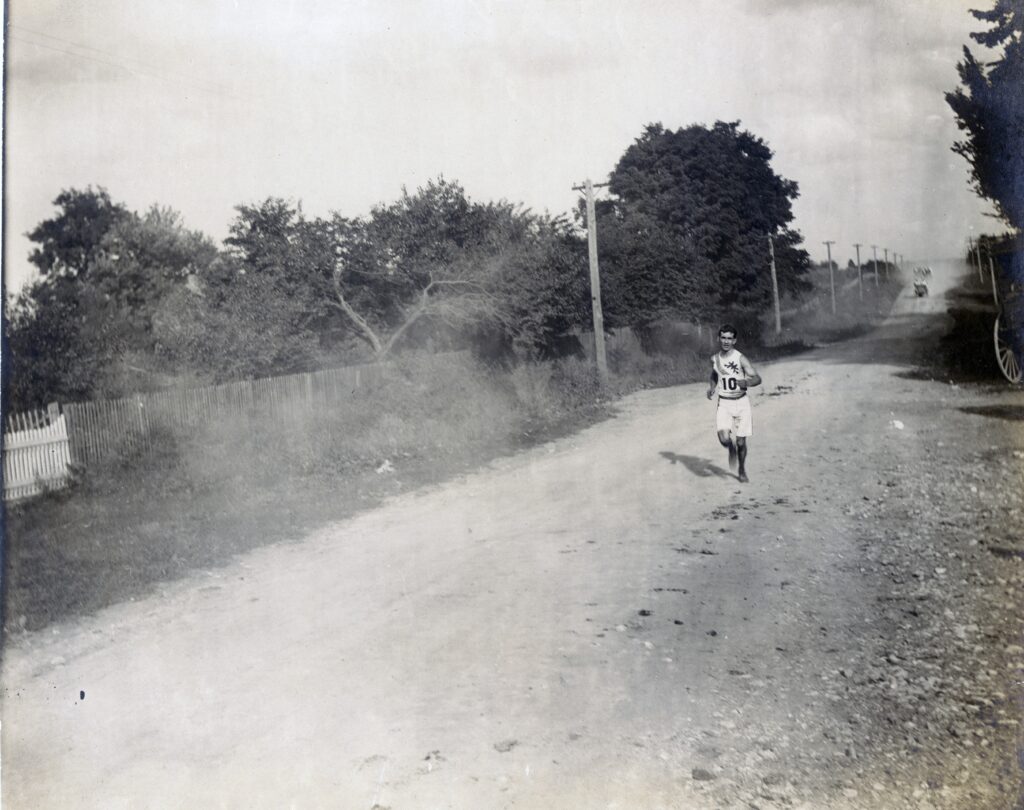
Look at Sam Mellor running the marathon at the 1904 Olympic Games.
The camera catches one step on a long dirt road.
We see the runner, but we cannot see the full run. The movement continues beyond the photograph.
The picture holds a moment. The action keeps moving.
That is the difference GEOMYTHA asks us to notice.
The dent in the verb
The distortion begins when the claimantSetIn Geomytha, Set names the claimant: I — the interruption by which reflection is taken as mine and converted toward ownership.Read full entry → enters.
The action becomes:
my running.
Then:
my ability.
Then:
my identity.
Then:
the runner.
The verb has acquired a noun.
GEOMYTHA calls that the dent in the verb: the moment a living process is interrupted long enough to become something the self can possess.
The action is still real.
The person may still be highly skilled.
The problem is not the noun itself.
The problem begins when the noun is defended as though the living action exists to support the identity.
A bartender is useful until the word becomes a prison
Take a simple work example.
Bartending is a set of actions.
Listen.
Remember.
Pour.
Move.
Clean.
Read the room.
Serve.
The noun bartender is useful. It tells people what role is being performed.
Nothing is wrong with that.
But if the role hardens into a total identity, every change begins to feel personal.
A bad shift threatens the self.
A mistake threatens the self.
A different job threatens the self.
Leaving the role can feel like losing the person.
The work has stopped being something the person does.
The work has become something the person must continue proving they are.
The same thing happens in sport
An athlete needs technique, discipline, correction, planning, memory, and self-assessment.
But highly practiced skills can sometimes suffer when a performer turns attention back onto the mechanics of an action that normally runs automatically.
Research on “choking under pressure” has found that excessive conscious monitoring of well-learned procedures can interfere with performance in some tasks. That does not mean thinking is bad or that experts should never reflect. It means there are moments when a skill works better when the performer is doing it rather than narrating every step of doing it.
That is very close to the distinction GEOMYTHA is making.
There is:
running.
And there is:
watching myself be the runner.
They are not always the same experience.
Self-awareness is not the enemy
This is where the idea needs a serious boundary.
ReflectionAm — ReflectionAm names reflected presence: awareness embodied or mirrored without yet becoming ownership.Read full entry → can improve performance.
A runner may need to notice bad form.
A musician may need to hear a timing problem.
A fighter may need to recognize a dropped hand.
A worker may need to notice a bad habit.
A writer may need to reread a sentence.
The correction itself requires awareness.
So the lesson cannot be “never observe yourself.”
The better distinction is between reflection that serves the action and reflection that turns the action into evidence for identity.
One asks:
What needs to change?
The other asks:
What does this say about me?
Flow has no owner
This is why flow is such a useful comparison.
People often describe their best performances afterward.
They say:
It just happened.
I stopped thinking about it.
Everything lined up.
I lost track of time.
The action felt effortless.
Psychology studies thoseThose — ProjectionThose names projection: enemies, outsiders, competitors, threats, and disowned qualities placed beyond the identity boundary.Read full entry → reports as features of a particular experiential state.
GEOMYTHA notices something else inside the language:
The person often speaks as though the action temporarily stopped needing an owner.
Not literally.
Not metaphysically.
The runner still ran.
The musician still played.
The worker still worked.
But the sentence “I am the one doing this” became less important than the doing itself.
From Am to I to This
In GEOMYTHA grammar, this gives us a simple movement.
Am: living activity, relation, awareness in motion.
I: the claimant that marks the action as mine.
This: the stable identity built from the claimI — ClaimI names claim: the interruption by which reflected presence is taken as mine.Read full entry →.
Running becomes:
I run.
Then:
I am a runner.
Then:
This is who I am.
That last sentence can be useful.
It can organize training, community, discipline, and responsibility.
But it can also become brittle.
What happens when the role disappears?
This is the strongest stress test.
Suppose the runner gets injured.
Suppose the bartender changes careers.
Suppose the fighter retires.
Suppose the musician loses an instrument.
If the action was a role, there is grief and adjustment.
If the action had become the whole self, the loss can feel like annihilation.
That does not prove the identity was false.
It shows how much of the person had been invested in one repeated noun.
The more tightly the verb and the self are fused, the harder it becomes to let the verb change.
Names are tools
GEOMYTHA is not asking people to stop using role words.
Names are useful.
“Runner” is useful.
“Parent” is useful.
“Doctor” is useful.
“Bartender” is useful.
“Artist” is useful.
They help coordinate responsibility and relation.
The mistake is not naming the role.
The mistake is forgetting that the role names a pattern of action rather than the whole field of the person.
The practical return
The next time you catch yourself saying:
I am the one who does this.
Try moving one step backward.
What is the verb?
What is actually happening?
Can the action remain alive without becoming a permanent identity?
Can you work without becoming the work?
Run without needing to be “the runner”?
Help without becoming “the helper”?
Fight without becoming “the fighter”?
Create without becoming “the creator”?
The point is not to erase the noun.
It is to keep the noun from owning the verb.
Do the action. Use the name when it helps. Let the verb move.
Sources and further reading
- Peifer et al., “A Scoping Review of Flow Research” — review of flow research, including challenge-skill balance, action-awareness merging, concentration, reduced self-consciousness, clear goals, feedback, control, and altered time experience.
- Sian L. Beilock and Thomas H. Carr, “On the Fragility of Skilled Performance: What Governs Choking Under Pressure?” — experimental work on skilled performance and the effects of explicit monitoring under pressure.
- Yu, “Choking under pressure: the neuropsychological mechanisms of incentive-induced performance decrements” — review of distraction and explicit-monitoring accounts of choking.
- Sam Mellor running the 1904 Olympic marathon, Missouri History Museum — historical photograph, attributed to Jessie Tarbox Beals. Public domain in the United States.
GEOMYTHA’s “Unclaimed Verb,” “dent in the verb,” and Am → I → This reading are project interpretations. Flow research and choking research establish psychological phenomena associated with absorption, self-consciousness, attention, and skilled performance; they do not establish the GEOMYTHA grammar as a scientific model.