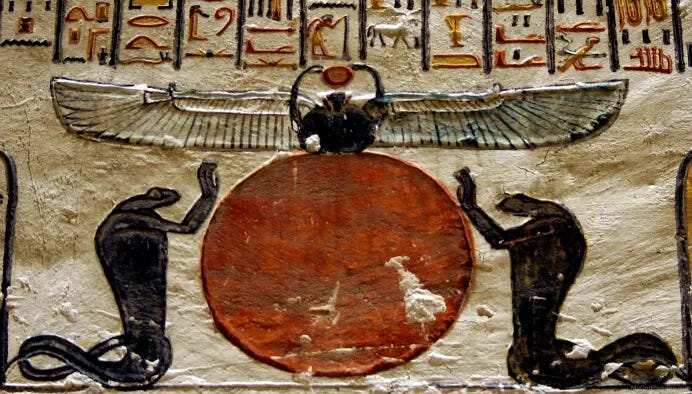
There are symbols that look low and symbols that look exalted. The dung beetle appears filthy, earthbound, humiliating. The butterfly appears luminous, delicate, transcendent. But through the Geomytha lens, appearances are exactly what must be distrusted. The question is never which image looks holier. The question is always: does this symbol point back to grounded awareness, or does it merely decorate the illusion?
That is what makes the dung beetle and butterfly such a potent pair.
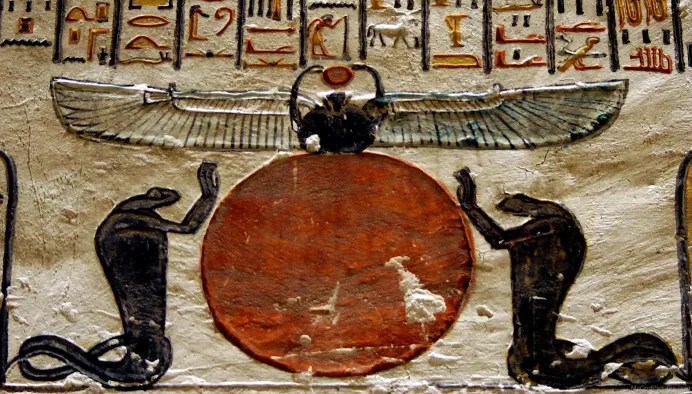
The dung beetle belongs to the realm of fallen form. It works in refuse. It gathers waste. It rolls decay into a sphere. In ordinary consciousness, this looks disgusting or absurd. In Geomytha, it looks like a perfect emblem of what happens after awareness has already been overtaken by projected perception and condensed into egoic continuity.
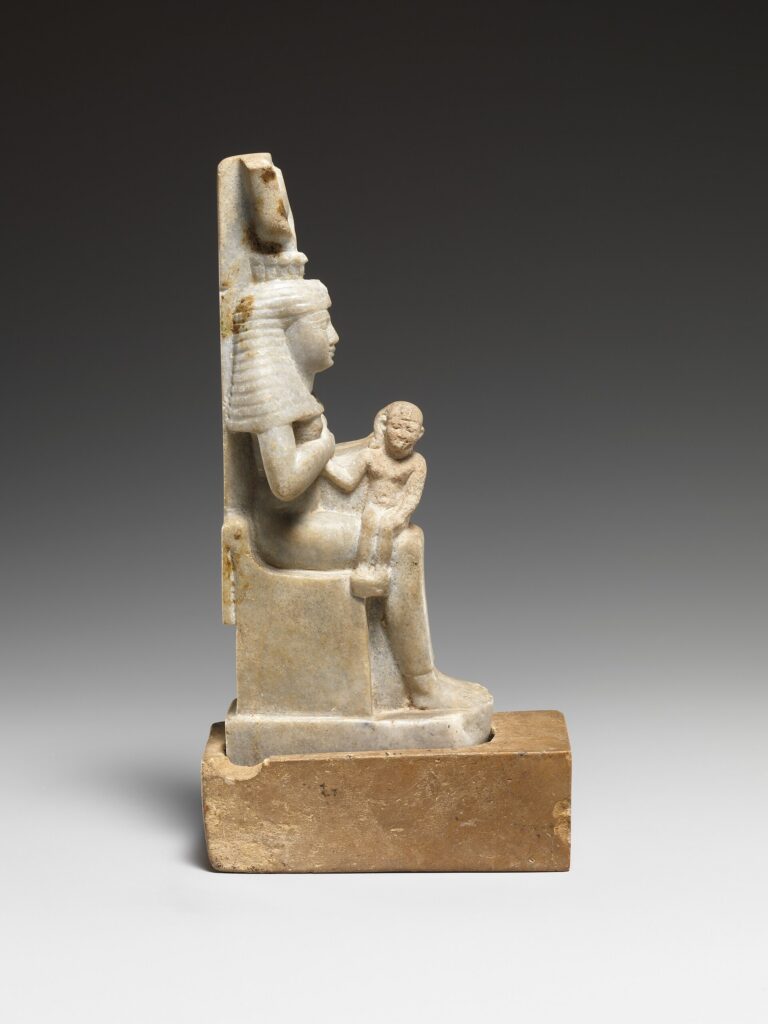
IsisIsisIn Geomytha, Isis names the unclaimed field: Is — pure being, awareness before possession, and the ground before the claimant appears.Read full entry → is the ground of aware being itself: whole, prior, unbroken.
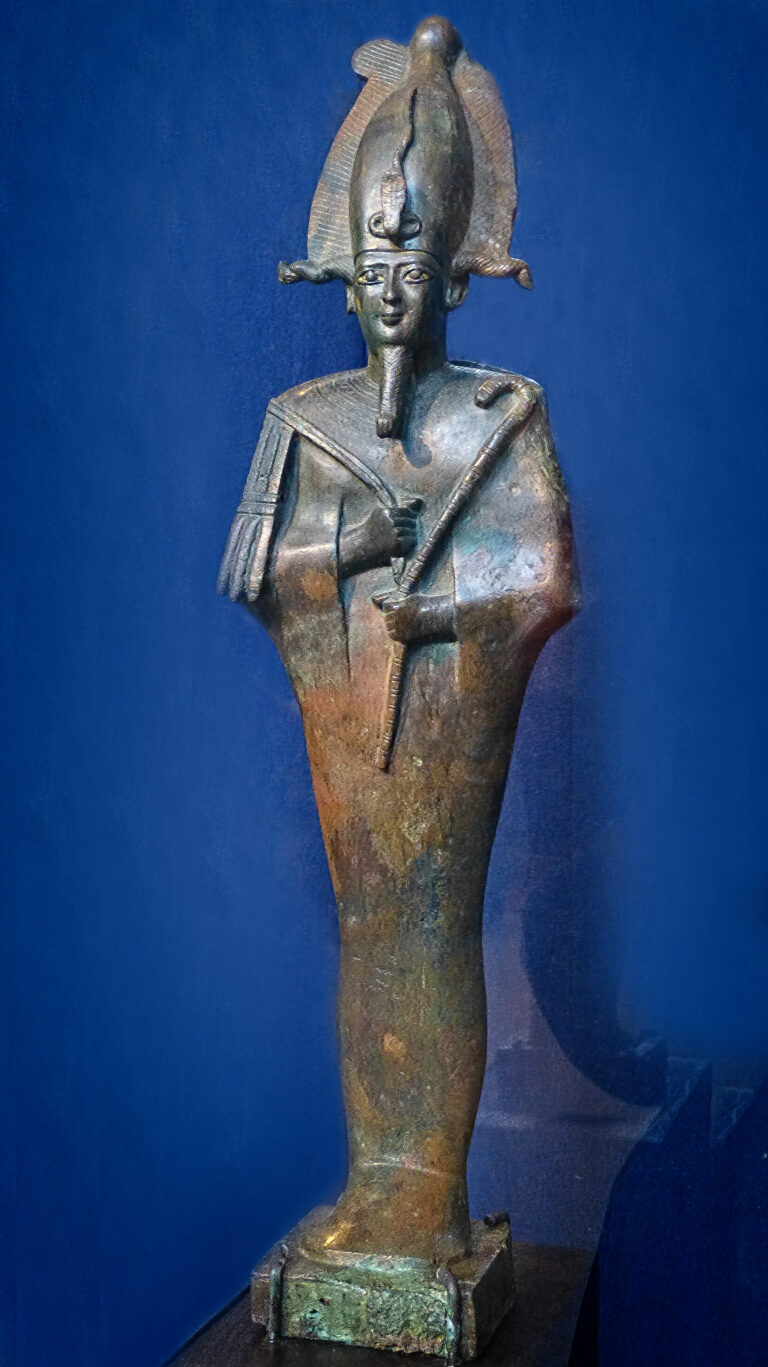
OsirisOsirisIn Geomytha, Osiris names reflected presence: Am — awareness reflected as living consciousness without yet becoming ownership.Read full entry → is that ground reflected: still, lucid, present to itself.
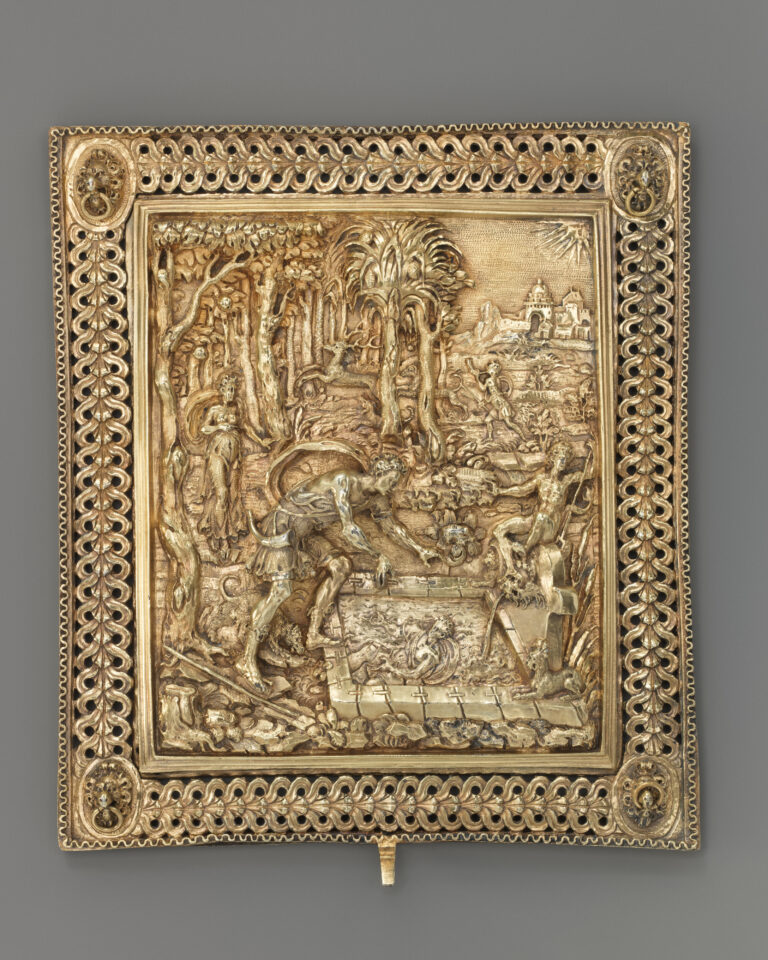
SetSetIn Geomytha, Set names the claimant: I — the interruption by which reflection is taken as mine and converted toward ownership.Read full entry → is the rupture into projectionThose — ProjectionThose names projection: enemies, outsiders, competitors, threats, and disowned qualities placed beyond the identity boundary.Read full entry →: movement, imagination, displacement, the outward spell.
HorusHorusIn Geomytha, Horus names the identity that forms after claim: This — the body, role, image, wound, belief, or story taken as what the self is.Read full entry → is the time-bound self that inherits the broken field and tries to survive inside it.
The dung beetle lives in the zone where Set and Horus dominate. It does not create from pure sourceIs — SourceIs names unclaimed being: awareness before possession, distinction, or identity.Read full entry →. It works with what has already passed through distortion. It takes what is left over and fashions it into a ball, a false wholeness, a degraded echo of the original circle.
That is why the dung beetle is such a profound symbol. The sphere it rolls is not meaningless. The circle still remembers Isis. It still remembers totality. But now totality has been reconstructed out of dung. That is the human condition in miniature: the ego endlessly rolling the remains of broken consciousness into temporary worlds and calling that life.
The dung beetle is reincarnation as labor. It is continuity without liberation. It is the self trying to build coherence out of fragments while never leaving the system that produced the fragments. It is Horus inheriting Set’s damage and mistaking management for redemption.
And yet the symbol is not merely cynical. Even here, awareness has not vanished. The attempt to shape ruin into form reveals that the memory of wholeness survives even in degradation. The sphere is fallen, but it is still a sphere. The deepest truth is not destroyed. It is obscured and repurposed.
If the dung beetle is the symbol of consciousness burdened by the cycle, the butterfly is the symbol of consciousness seduced by the beauty of change.
At first glance, the butterfly looks like one of the most spiritual symbols in existence. A caterpillar enters a chrysalis and emerges winged. It appears to enact death and resurrection, heaviness becoming lightness, crawling becoming flight. But Geomytha asks a more difficult question: has illusion ended, or has illusion simply become more elegant?
The caterpillarThe Caterpillar — Alice’s Adventures in WonderlandIn Chapter V, “Advice from a Caterpillar,” of Lewis Carroll’s Alice’s Adventures in Wonderland, the Caterpillar asks Alice who she is. Alice replies that she hardly knows at present, remembers who she…Read full entry → is easy enough to read. It crawls along surfaces, consumes constantly, and remains bound to horizontal existence. It is appetite, sequence, identification, contact with the sensory field. It is the ordinary ego moving through experience and feeding on it. In your system, that is Horus fully embedded in Set’s world.
Then comes the chrysalis, and this is where the butterfly symbol becomes truly powerful. The chrysalis is tomb-like. It is sealed. Hidden. Motion ceases. The creature disappears from ordinary visibility. This is the most Osirian moment in the entire sequence. Here, for a brief interval, the outward-moving form is suspended. The projected self is enclosed. Something deeper than motion begins its work.
The chrysalis is the closest thing in the butterfly myth to SabbathSabbathNamed weekly sacred rest pattern in Jewish tradition.Read full entry →. It is withdrawal from compulsive becoming. It is the burial chamber of the old momentum. It suggests the possibility that transformation does not come from more activity, but from a surrender into stillness.
But once the butterfly emerges, the symbol becomes dangerous again.
Flight is not automatically freedom. Color is not automatically awakening. Beauty is not automatically truth. The butterfly can just as easily signify the ego’s final refinement: no longer a gross creature of appetite, but now a spiritualized mask, a luminous self-image, a more enchanting form of entrapment.
This is one of the deepest traps in the whole symbolic field. The caterpillar becomes a butterfly, and the mind calls that liberation. But both are still forms. Both are still appearances. Both are still moving within time. The self that once crawled now flies, but it has not necessarily dissolved. It may simply have become more subtle, more aesthetic, more mystical-looking.
So the butterfly may symbolize transcendence, but it may also symbolize the final seduction: mistaking metamorphosis for awakening.
That is why the dung beetle is, in a strange way, more honest than the butterfly. The beetle does not pretend to be free. It visibly labors in decay. The butterfly is more treacherous because it appears redeemed while potentially remaining within the same dream.
One symbol says: I bear the burden of the cycle.
The other says: I have become beautiful within the cycle.
Geomytha presses further than both.
The real issue is not whether the form is filthy or radiant. The real issue is whether awareness has returned to itself. If not, then the dung beetle is still trapped in toil, and the butterfly is still trapped in enchantment.
So the sharpest reading may be this:
The dung beetle is Horus condemned to roll Set’s broken world.
The butterfly is Horus dressed in a more beautiful costume.
The chrysalis alone hints at Osiris, because it resembles sacred suspension, reflective burial, and inward stillness.
And Isis is what precedes them all: the unmoving ground no image can contain.
That is the hidden reversal. What looks low may be truer than what looks exalted. What looks transformed may only be better disguised. And what looks like death or enclosure may actually be nearest to the real.
Not every transformation is awakening.
Not every flight is freedom.
Not every radiant form has escaped the dream.
Sometimes the beetle tells the truth more plainly than the butterfly.