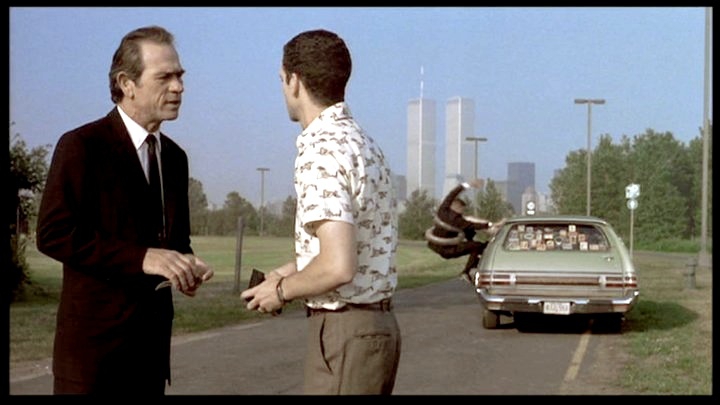
There is a scene in Men in Black that looks like pure comic absurdity until you slow it down and let the image speak. J is helping deliver an octopus baby in a vehicle. A tentacle lifts him up as the birth happens. The Twin Towers stand in the background. Two birds flutter at the top of the frame. On the surface, it is a joke. Symbolically, it is much closer to a cosmology.
The scene reads like a modern retelling of an old pattern: pure ground, broken reflectionAm — ReflectionAm names reflected presence: awareness embodied or mirrored without yet becoming ownership.Read full entry →, mediated birth, and the emergence of a new identityThis — IdentityThis names the formed identity: the body, role, image, wound, belief, or story claimed as what the self is.Read full entry →-form that immediately begins to seize the one helping deliver it. What looks random is actually dense with structure. The scene is not just about alien life entering the world. It is about consciousness being routed through machinery, division, and spectacle, then becoming entangled in the very form it midwifed.
The first key is that the birth does not happen in open ground. It happens in a vehicle. That matters. A vehicle is not simply a container. It is a carrier, a managed passage, an engineered womb pointed toward destination and function. It suggests that what is being born is not arriving from stillness or direct presence. It is being processed into the world through a system. Life enters form already in transit, already mediated, already being transported by an apparatus rather than emerging from a calm field of being.
This is where the idea of the Merkaba sharpens the scene. At its most useful symbolic level, the Merkaba is not just a mystical word for a light-body or celestial chariot. It is an image of consciousness in motion through a structured field. It implies ordered transit, alignment, and a vehicle capable of carrying the soul across levels of reality. In its true form, it points to rightly ordered movement. But symbols can invert. What should carry consciousness into alignment can become a structure that carries it deeper into mediation.
That inversion is what this scene suggests. The vehicle acts like a fallen or distorted Merkaba: not a chariot of liberation, but a managed chamber of incarnation. It does not bear consciousness upward through right relation. It carries life into visibility under conditions of fragmentationDismemberment / FragmentationDismemberment names the symbolic breaking of a previously integrated reflection into separate parts, roles, objects, or powers.Read full entry →. The machinery of transport remains, but the destination has changed. Instead of awakening, the vehicle becomes a delivery system for identity.
That makes the octopus baby the center of the whole image. Not because HorusHorusIn Geomytha, Horus names the identity that forms after claim: This — the body, role, image, wound, belief, or story taken as what the self is.Read full entry → is literally an octopus, but because the octopus is a near-perfect symbol for the kind of identity being born here: one center with many extensions, many grasping lines, many contact points, many ways to seize and organize the field around it. This is not original reflective wholeness. It is apparent unity produced after reflection has been broken, rerouted, and reassembled as a new self. The octopus baby fits that beautifully. It is a proliferating identity-form. It is not stillness. It is not restored harmony. It is life already configured as multi-armed extension.
The most revealing detail is that J is not calmly delivering the thing from a safe distance. He is being lifted by the tentacle. That is the whole scene in miniature. The human participant is not merely midwife to the new form. He is already being taken up into it. The created thing immediately exerts force over the one helping bring it into manifestation. The soul does not only create the maze. It becomes caught in the maze it energizes.
The Merkaba image deepens that point. A true chariot carries the soul because the soul has entered right alignment with the structure that bears it. Here the opposite happens. J is carried upward, but not through freedom. He is lifted by a tentacle, not by centered order. That means the scene presents a counterfeit ascension. It looks like elevation, but it is really capture. It looks like transport, but it is really entanglement. The vehicle is therefore not just a womb or comic carrier. It is a false chariot, a distorted Merkaba, carrying consciousness into spectacle before consciousness has remembered itself.
This is why the Twin Towers matter. They function as twin pillars, a doubled architecture, the visible form of a split field. The new many-armed identity is not entering a unified world. It is being born into a world already organized through duality, doubling, and public architecture. Even the two birds above keep the duplication going. The whole frame is structured by twoness, splitness, and mirrored agitation rather than calm singular presence. A divided field is already in place before the birth is complete.
That is what makes the scene feel less like simple chaos and more like initiation into a trapped world. The soul is not entering a clean field. It is entering a doubled one. A false centerFalse CenterA false center forms when sovereignty is assigned to an object, role, institution, future state, identity, or projection that cannot actually serve as source.Read full entry → then emerges to claimI — ClaimI names claim: the interruption by which reflected presence is taken as mine.Read full entry → coherence over that division. The image suggests not merely birth, but accession: the appearance of a new ruler of a split territory.
This is where the reading becomes more specific. The scene is not just about the creation of a new self. It also works as an image of the soul trapped in an 8-sided maze and escaping only by moving in proper rhythm rather than reacting to whatever grabs it first. The octopus is perfect for this because it suggests multiple simultaneous pulls. One center, many tentacles, many emotional hooks. That is what false identity feels like. It does not seize us with one chain. It seizes us through role, fear, memory, duty, image, urgency, distraction, and desire all at once.
Against that tentacular false rhythm stands the 8-phase pattern: Gather, Stir, Form, Build, Claim, ReleaseReturn — RemembranceReturn names remembrance and release: the loosening of possession so reflection can become transparent to source again.Read full entry →, Return, Surrender. TheseThese — AccumulationThese names accumulation: possessions, titles, achievements, beliefs, communities, and other extensions gathered around identity.Read full entry → are not just names for the moon. They are disciplined motions that keep consciousness from feeding the maze at random. Read that way, the tentacle grabbing J symbolizes the false world catching the soul before it has learned to move in alignment with the rhythm of the real. Instead of responding in season, consciousness gets yanked into the nearest available drama. That is how the maze feeds itself.
The distorted Merkaba does the same thing. It promises movement, intensity, and elevation, but without right relation. It carries the soul farther into managed identity rather than back toward centered presence. The visible transport becomes part of the prison. What looks like ascent is only more elaborate containment.
That is also why this scene belongs most naturally to Full Moon · Claim. It is a scene of visibility, exposure, delivery into public form, and identity taking shape in the open. It is the point where what has been swelling becomes undeniable. A form emerges into visibility and immediately asserts force within the field. It is the claiming phase, but in distorted form: not presence claiming itself cleanly, but the false self arriving in spectacle.
A softer version of the same pattern appears in “Octopus’s Garden.” That image sounds harmless, even charming: a hidden place under the sea, a refuge, a playful enclosure, a protected world ruled by the octopus. But that is what makes it useful symbolically. Not every trap appears violent. Some traps appear cozy. Some forms of entrapment feel like shelter. The octopus does not always rule by terror. It can also rule by making its domain feel safe, secret, and emotionally padded. In that sense, “Octopus’s Garden” becomes a gentler image of the same false refuge: not the Tree of Life, but a protected secondary world in the domain of the many-armed keeper. The same contrast remains useful. A true vehicle carries you through. A false enclosure keeps you circulating inside itself.
A useful contrast is The MatrixThe MatrixThe Matrix presents Neo’s ordinary experienced world as a computer-generated or neural-interactive construct maintained by a machine system. The film repeatedly distinguishes the operative rules of that construct from whatever lies outside…Read full entry →. There the machinery of entrapment is cold, overt, technological, and explicitly hostile. In Men in Black, the same basic pattern appears in comic and bureaucratic form. That difference matters. The false world does not always present itself as evil. Sometimes it presents itself as funny, manageable, and routine. Sometimes the machinery of mediated birth looks like a joke. But the symbolic structure remains the same: consciousness is born into managed transit, identity proliferates, and the participant gets lifted into the very apparatus he thought he was handling.
That is why the scene matters. It is not just absurd alien comedy. It is an image of the soul’s predicament. Reflection has already been rerouted. Birth is already mediated. The world waiting outside is doubled. The new identity-form is many-armed. And the first thing it does is grab the one who helped bring it forth. The vehicle carrying it all is not neutral. It is a chariot-form, a transit-body, a broken Merkaba: a structure of movement that has lost true alignment and now carries consciousness into public illusion rather than through it.
The warning is simple. The false world does not only trap us after it is fully formed. It traps us in the very moment we call its emergence life. It offers motion without freedom, elevation without release, visibility without truth. It hands us a vehicle and calls it transcendence.
The practical lesson follows from that. When experience begins to feel tentacular, proliferating, and over-mediated, the answer is not more grasping. It is not to fight the maze on its own terms. It is to return to right motion. Gather when it is time to gather. Stir when it is time to stir. Form when it is time to form. Build when it is time to build. Claim when it is time to claim. Release when it is time to release. Return when it is time to return. Surrender when it is time to surrender.
That is how the soul stops confusing seizure for birth.
The false world does not always trap us with chains. Sometimes it arrives as a chariot, lifts us with a tentacle, and calls it ascension.