The sentence begins simply.
A child points to a toy.
“Mine.”
No philosophy.
No politics.
No theology.
No ideology.
Just one small act of possession.
Yet hidden inside that word is one of the most powerful movements in human life.
Before there is a kingdom, there is a king.
Before there is ownership, there is identityThis — IdentityThis names the formed identity: the body, role, image, wound, belief, or story claimed as what the self is.Read full entry →.
Before there is “mine,” there is:
I am thisThe False-Self Sentence — I Am ThisThe false-self sentence forms when claim joins reflection to a fixed object of identity: I am this.Read full entry →.
The previous movement creates the self.
The next movement creates the world around the self.
Identity rarely remains content with itself. Once a reflectionAm — ReflectionAm names reflected presence: awareness embodied or mirrored without yet becoming ownership.Read full entry → has hardened into an image, the image begins extending its borders.
The self gathers territory.
The sentence changes.
First:
I am this.
Then:
These are mineThese — AccumulationThese names accumulation: possessions, titles, achievements, beliefs, communities, and other extensions gathered around identity.Read full entry →.
The transition appears everywhere.
A body becomes my body.
A house becomes my house.
A belief becomes my belief.
A nation becomes my nation.
A religion becomes my religion.
An achievement becomes my achievement.
A wound becomes my wound.
An identity becomes surrounded by possessions, symbols, and extensions of itself.
The kingdom begins to grow.
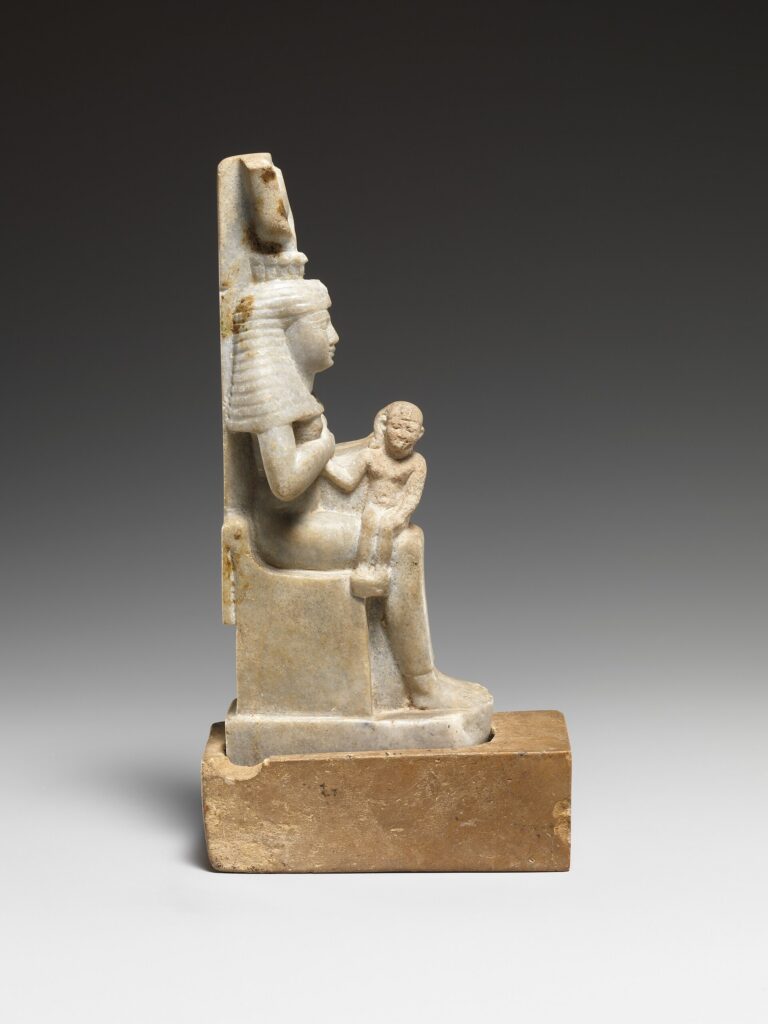
Ancient EgyptEgyptAncient Egyptian cultural and mythic field referenced by the essay.Read full entry → understood this pattern well.
HorusHorusIn Geomytha, Horus names the identity that forms after claim: This — the body, role, image, wound, belief, or story taken as what the self is.Read full entry → is not merely a ruler. He is a ruler of lands.
He wears crowns.
He possesses titles.
He governs territories.
The king does not stop with identity.
The king extends identity outward.
The crown itself becomes an extension of the self.
The throne becomes an extension of the self.
The kingdom becomes an extension of the self.
This is why rulers throughout history accumulate symbols.
Crowns.
Scepters.
Flags.
Palaces.
Regalia.
Titles.
These objects are not merely practical. They are extensions of identity.
The king says:
These are mine.
The same pattern appears in myth.
Consider King Midas.
His desire is not for food, shelter, or survival. He wants accumulation itself. Gold becomes more than wealth. It becomes identity. The treasure no longer serves the king. The king serves the treasure.
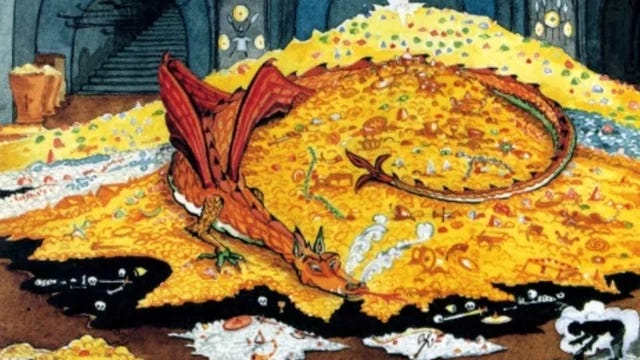
Or consider Smaug in The Hobbit.
The dragon sleeps upon a mountain of gold.
At first glance the treasure appears to be his possession.
Look more closely.
The treasure has become his identity.
Every coin reflects the same sentence:
These are mine.
The dragon guards the treasure because he is guarding himself.
The same pattern appears in modern stories.
In Citizen Kane, Charles Foster Kane spends his life accumulating newspapers, influence, wealth, estates, artworks, and status. The kingdom grows larger and larger while the center grows smaller and smaller.
Accumulation promises completion.
Completion never arrives.
The pile increases.
The hunger remains.
The same process governs modern life more often than we would like to admit.
Followers.
Subscribers.
Likes.
Collectibles.
Credentials.
Investments.
Property.
Achievements.
Even spiritual seekers are not immune.
A person may collect teachings, books, initiations, certifications, practices, symbols, or experiences with the same instinct that another person collects cars or houses.
The object changes.
The movement remains.
These are mine.
This is why accumulation is so seductive.
Possession feels like expansion.
The kingdom grows.
The self appears larger.
Yet a strange reversal quietly takes place.
The more extensions identity gathers, the more energy becomes required to protect them.
The kingdom begins owning the king.
The possessions begin possessing the possessor.
The treasure requires guarding.
The title requires defending.
The reputation requires maintaining.
The collection requires preserving.
The image requires constant repairWorld-RepairWorld-Repair names the work of regathering relation, pattern, and presence inside a field that has been fractured rather than simply escaping the field.Read full entry →.
What began as expansion becomes obligation.
What began as freedom becomes administration.
The king becomes a servant of the kingdom.
This may explain why accumulation never reaches satisfaction.
Identity seeks completion through addition.
But no addition can complete something that was never incomplete.
Every new possession produces the possibility of another possession.
Every new title suggests a higher title.
Every kingdom suggests a larger kingdom.
The horizon retreats as quickly as it is approached.
Ancient stories repeatedly warn about this pattern.
The rich fool builds larger barns.
Midas starves beneath gold.
Smaug sleeps uneasily upon treasure.
Kane dies surrounded by possessions.
The warning is not against objects.
The warning is against identification.
A house is not the problem.
A title is not the problem.
A collection is not the problem.
The problem appears when identity expands into possession and mistakes possession for self.
The kingdom is not the king.
The treasure is not the dragon.
The crown is not Horus.
The possession is not the possessor.
The extension is not the sourceIs — SourceIs names unclaimed being: awareness before possession, distinction, or identity.Read full entry →.
This is why accumulation can never provide the completion it promises.
The movement begins with a misunderstanding.
Identity believes that adding more objects will strengthen what it is.
Yet every object remains external.
The self seeks completion through accumulation because it has forgotten its origin.
The result is a kingdom built from borrowed names.
The releaseReturn — RemembranceReturn names remembrance and release: the loosening of possession so reflection can become transparent to source again.Read full entry → begins when this is noticed.
The house may remain.
The title may remain.
The family may remain.
The work may remain.
The kingdom may remain.
Only the claimI — ClaimI names claim: the interruption by which reflected presence is taken as mine.Read full entry → begins to soften.
The possessions return to being possessions.
The symbols return to being symbols.
The extensions cease pretending to be the self.
Then the kingdom can finally serve life rather than replace it.
The sentence loses its spell.
These are mine.
And what remains is not poverty.
It is relationship.
The king remains.
The kingdom remains.
But neither must be mistaken for the other.