Waxing Gibbous · Gemini — Build in Noticing — Captured Devotion: How Living Breath Hardens into Religious Shell
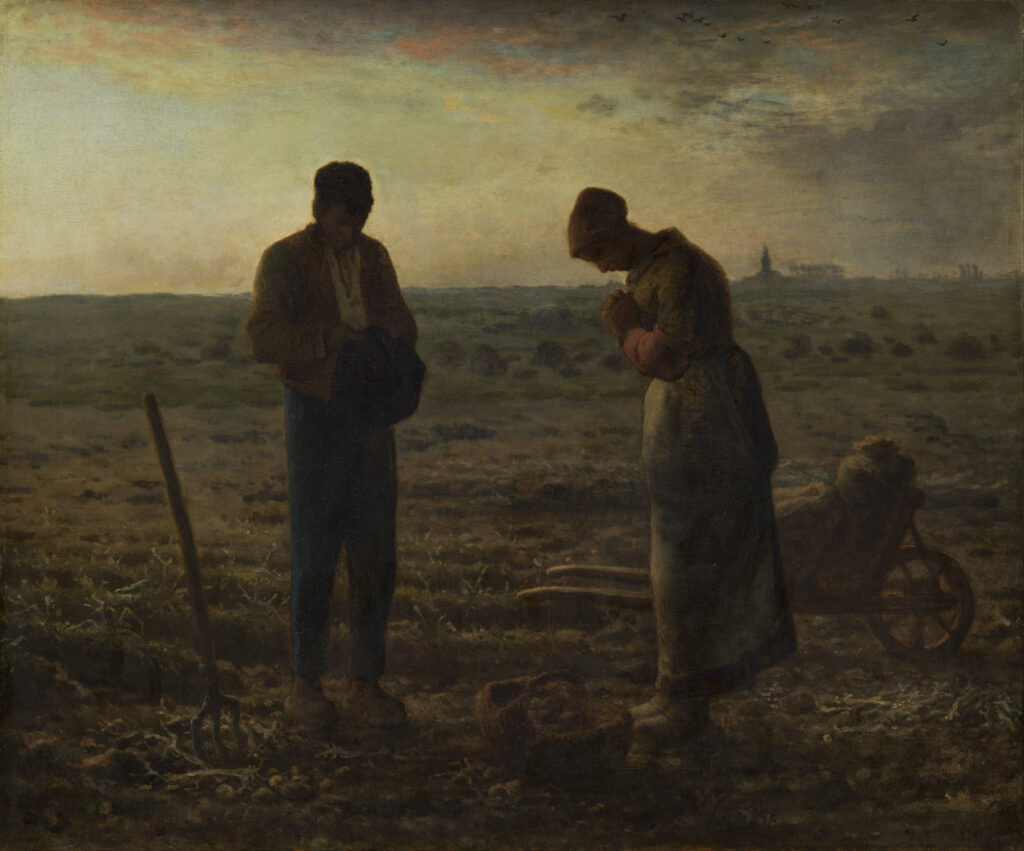
Two workers stop in a field.
The work is still there.
The tools are still there.
But for a moment, the work does not get the final word.
Jean-François Millet’s The Angelus gives us a simple image of religious form at its best: a bell marks time, bodies pause, heads bow, and ordinary labor opens into a different relation.
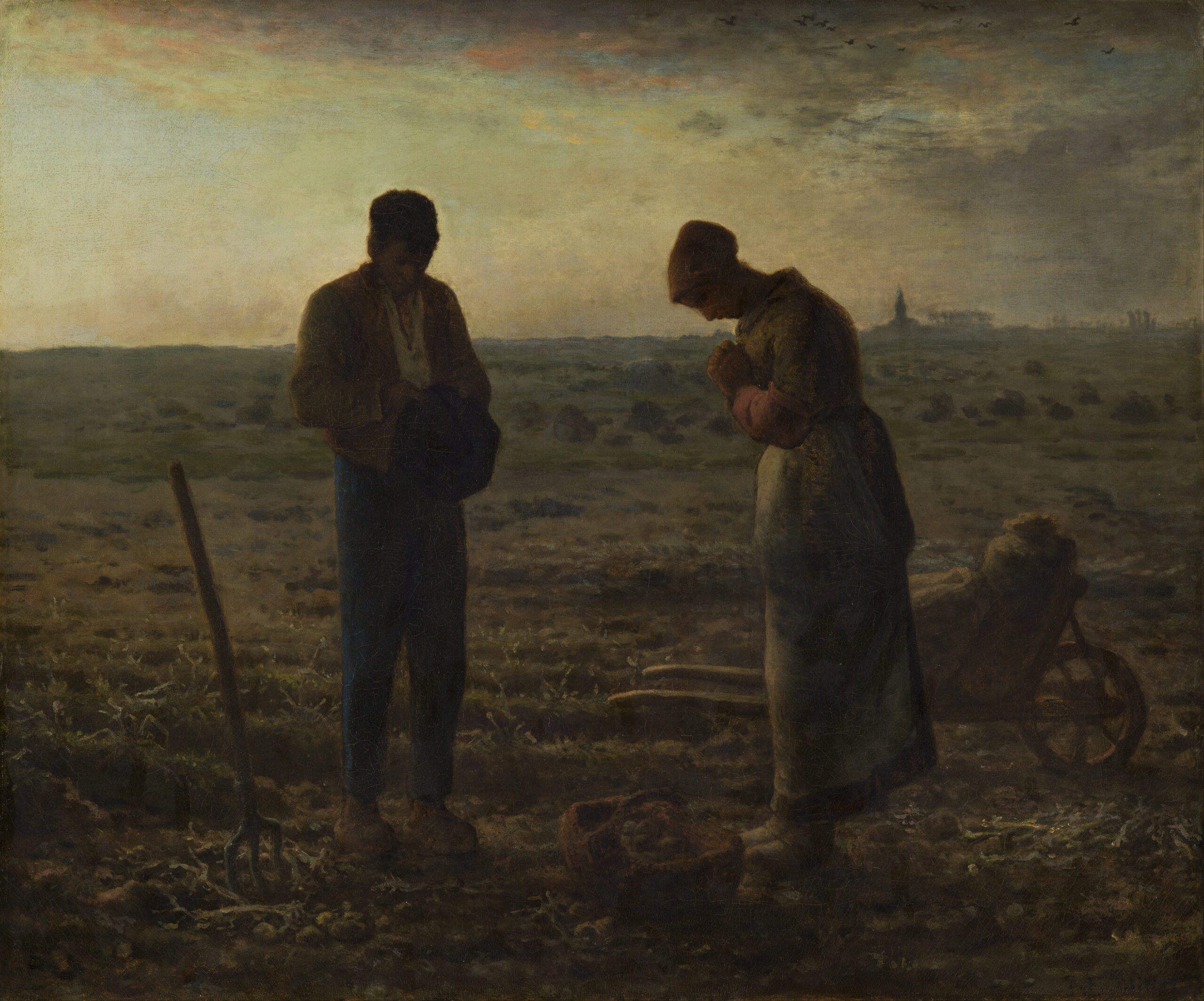
The bell is a form.
The posture is a form.
The prayer is a form.
And form is not the enemy.
The question is what the form is still serving.
Dogma Is Not Just a Bad Word
The old version of this essay used dogma too casually, almost as a synonym for dead religion.
That is not accurate.
Religious traditions use doctrine and formal statements to preserve teaching, mark boundaries, transmit memory, and give communities a common language. In Catholic ChristianityChristianity — Religious TraditionThe Christian religious tradition referenced through resurrection, baptism, and the symbolic Eighth Day.Read full entry →, for example, the Catechism describes creeds as compact, normative summaries meant to hand faith on across generations. The Nicene Creed remains important precisely because a community believed some distinctions were worth preserving.
So the problem is not that breath eventually becomes words.
Words are how insight travels.
The problem begins when the words stop pointing and start posing.
When the form no longer carries the practice.
When the form becomes evidence of who the practitioner is.
That is what this article means by breath becoming dogma.
It is a GEOMYTHA phrase, not a claimI — ClaimI names claim: the interruption by which reflected presence is taken as mine.Read full entry → that actual dogma is inherently lifeless.
The Form Can Carry the Fire
A practice needs form.
Without repetition, a prayer disappears with the mood.
Without language, teaching changes every time it passes through a new mouth.
Without calendars, bells, postures, texts, songs, meals, fasts, or gatherings, memory can become vague enough to mean anything.
A vessel can protect what it carries.
This is why mature traditions rarely oppose form and spirit as simply as modern spiritual language sometimes does.
Form can train attention.
Form can create continuity.
Form can make surrender possible on a day when feeling is absent.
The shell can protect the living thing.
Until the shell starts demanding to be mistaken for the life.
A Tradition Can Warn Against Its Own Shell
The strongest stress test comes from inside religion itself.
Christian scripture does not simply praise visible religious performance. In Matthew 6, prayer and fasting are specifically criticized when they become public displays designed to be seen by other people.
The practice remains.
The performance is questioned.
That distinction is almost exactly the one GEOMYTHA needs.
Religion does not have to be attacked from outside in order to notice that religious behavior can become self-display.
The warning already exists within the tradition.
The Rosary Knows the Difference
The rosary offers an even sharper example.
Its repetition is intentional. Beads help hold sequence. Repeated prayers create rhythm. The body and voice are given something concrete to do.
But Catholic teaching itself warns that repetition can become mechanical if contemplation disappears. John Paul II, drawing on Paul VI, described the rosary as contemplative prayer and warned against formula repeated without the inward relation the form is meant to support.
That is not GEOMYTHA criticizing Catholic prayer.
That is Catholic tradition naming the same internal danger:
a form can remain externally intact after its purpose has been lost.
When the Practice Starts Proving the Practitioner
The shift can be subtle.
Prayer becomes: I am the one who prays.
Fasting becomes: I am the disciplined one.
Doctrine becomes: I am the one who knows the correct formulation.
Humility becomes: I am the humble one.
Even surrender can become: I am the one who has surrendered.
The action may still be good.
The belief may still be true inside its own tradition.
The problem is the claimantSetIn Geomytha, Set names the claimant: I — the interruption by which reflection is taken as mine and converted toward ownership.Read full entry → taking possession of it.
GEOMYTHA’s Grammar of Capture
GEOMYTHA names the movement:
Is → Am → I → This.
Is is presence before claim.
Am is presence reflected into relation.
I is the claimant.
This is the formed identityThis — IdentityThis names the formed identity: the body, role, image, wound, belief, or story claimed as what the self is.Read full entry →.
A religious form can serve Am. It can hold a person inside relationship—with God, community, memory, body, time, obligation, gratitude, or mystery.
Then I can take the form.
Now the relation becomes possession.
The person no longer simply practices.
The practice becomes proof of This.
I am thisThe False-Self Sentence — I Am ThisThe false-self sentence forms when claim joins reflection to a fixed object of identity: I am this.Read full entry → believer.
I am this pure person.
I am this awakened person.
I am this correct person.
That is captured devotion.
Waxing Gibbous: Devotion Has a Shadow
Waxing Gibbous is Build.
Its directive is Devote.
Devotion means repetition, commitment, attention, and structure.
You keep returning when novelty is gone.
That is how a practice becomes real.
But Build can also build a prison.
Every repetition adds another brick if the practitioner is secretly building an identity out of the practice.
Gemini sharpens the danger because Gemini Notices.
Words matter.
Distinctions matter.
Definitions matter.
But the person who can distinguish correct from incorrect can begin using correctness as a mirror.
The doctrine still says one thing.
The identity built around possessing the doctrine says another.
This Is Not an Argument for Vague Spirituality
A common escape would be to say: forget doctrine, forget ritual, just have direct experience.
That does not solve the problem.
“I do not need religion” can harden into identity as easily as “I have the true religion.”
“I am spiritual” can become another costume.
“I see through dogma” can become a more flattering dogma.
The claimant does not care whether the costume is orthodox, mystical, skeptical, secular, esoteric, or anti-religious.
It only needs the sentence:
I am this.
GEOMYTHA Has to Pass Its Own Test
This is where the article has to turn on itself.
GEOMYTHA can become dogma too.
Its grammar can become a badge.
Its myths can become a private language of superiority.
Its interpretations can become proof that the reader “sees what others cannot see.”
If that happens, the system has failed by its own standard.
The map was supposed to reveal the claimant.
Now the claimant owns the map.
A Better Test for Religious Form
Do not ask only whether a form is old, strict, mystical, beautiful, rational, orthodox, or personally meaningful.
Ask what it is doing.
- Does this practice returnReturn — RemembranceReturn names remembrance and release: the loosening of possession so reflection can become transparent to source again.Read full entry → me to relation, or mainly tell me who I am?
- Does this doctrine preserve a distinction, or has possessing the distinction become a status?
- Can I perform the ritual without using it to rank myself against someone else?
- If the form stops serving its purpose, can I notice that without immediately treating the form as the enemy?
- Can I let the practice correct me instead of using the practice to certify me?
That is the difference between devotion and captured devotion.
When Breath Became Dogma
Breath needs form if it is going to become shared practice.
Form needs language if it is going to survive memory.
Language needs distinctions if it is going to mean anything.
None of that is the fall.
The fall happens when the form that carries relation becomes the identity that replaces relation.
The prayer remains.
The breath is gone.
The doctrine remains.
The listening is gone.
The posture remains.
The surrender is gone.
Then the shell is asking to be worshiped.
Build the form. Keep what carries life. Let the practice correct the claimant. Devote without turning devotion into a self.
Sources
- Catechism of the Catholic Church, “The Creeds,” §§185–197 — creeds as normative summaries and shared language of faith.
- John Paul II, Rosarium Virginis Mariae — rosary as contemplative prayer and warning against mechanical repetition without contemplation.
- Matthew 6:1–18 — public-domain KJV access to the critique of prayer and fasting performed for public recognition.
- Jean-François Millet, The Angelus, 1857–1859 — public-domain hero image.