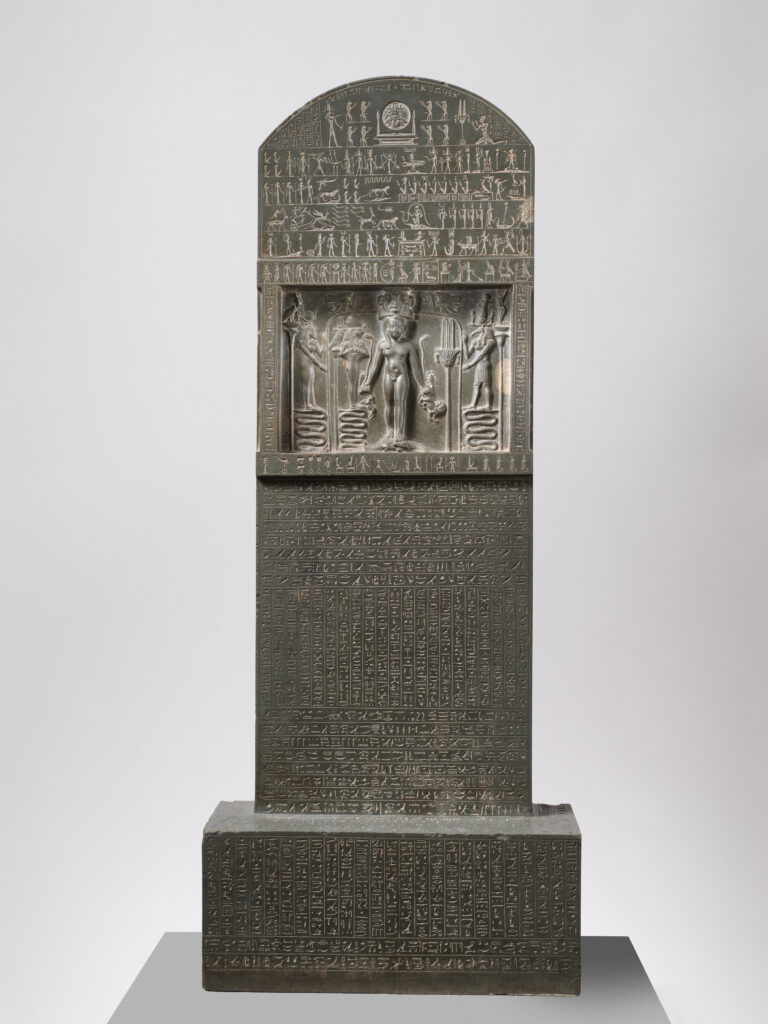
The ancient Egyptian person was not one thing.
A body mattered.
A name mattered.
Continuity mattered.
Movement mattered.
Memory mattered.
Ritual mattered.
And after death, what survived was not imagined as a single ghost simply leaving the body behind.
That alone makes Egyptian personhood useful to GEOMYTHA.
Not because Egypt secretly taught the GEOMYTHA grammar.
Because it gives us a historical system in which identity was already understood as layered, relational, and dependent on reintegration.
The first correction: Ka, Ba, Akh, and Heka are not four interchangeable soul-parts
Modern summaries often flatten Egyptian ideas into familiar English words:
Ka = soul.
Ba = spirit.
Akh = ghost.
Heka = magic.
That is convenient.
It is also too crude.
The Metropolitan Museum of Art describes the ka as life force, the ba as the individual aspect able to move between tomb and living world, and the akh as the “effective being” that results when life force and mobile personhood are successfully reunited in rebirth.
Heka is different again.
It is not simply another part of the person.
British Museum material describes heka as a powerful element woven through life, medicine, justice, religion, and the afterlife. Egyptological scholarship treats it as an operative force or efficacy available to gods and humans rather than stage magic in the modern sense.
So the first GEOMYTHA lesson is already a warning:
Do not force four Egyptian terms into four neat GEOMYTHA boxes just because there are four of them.
Ka: life received, not privately manufactured
The Met describes the ka as the life force of the individual.
At death, the ka separated from the body and returned to the creator from whom it came. The deceased required continued relation with the ka in order to live again.
That is why offerings mattered.
Food and drink sustained the ka during life, and tomb ritual continued that relation after death. Tombs could function as “ka houses,” and statues of the deceased could serve as offering foci.
Within GEOMYTHA, the comparison is immediately useful.
Life is not presented as something the claimant manufactures alone.
It is received.
Carried.
Sustained through relation.
The ka therefore works better as an image of continuity received from a larger field than as an Egyptian version of the modern private ego.
GEOMYTHA does not claim that “ka means Am.”
The narrower comparison is that both resist the fantasy of the isolated self as its own source.
Ba: the person can move without becoming a fixed object
The ba is harder to translate cleanly.
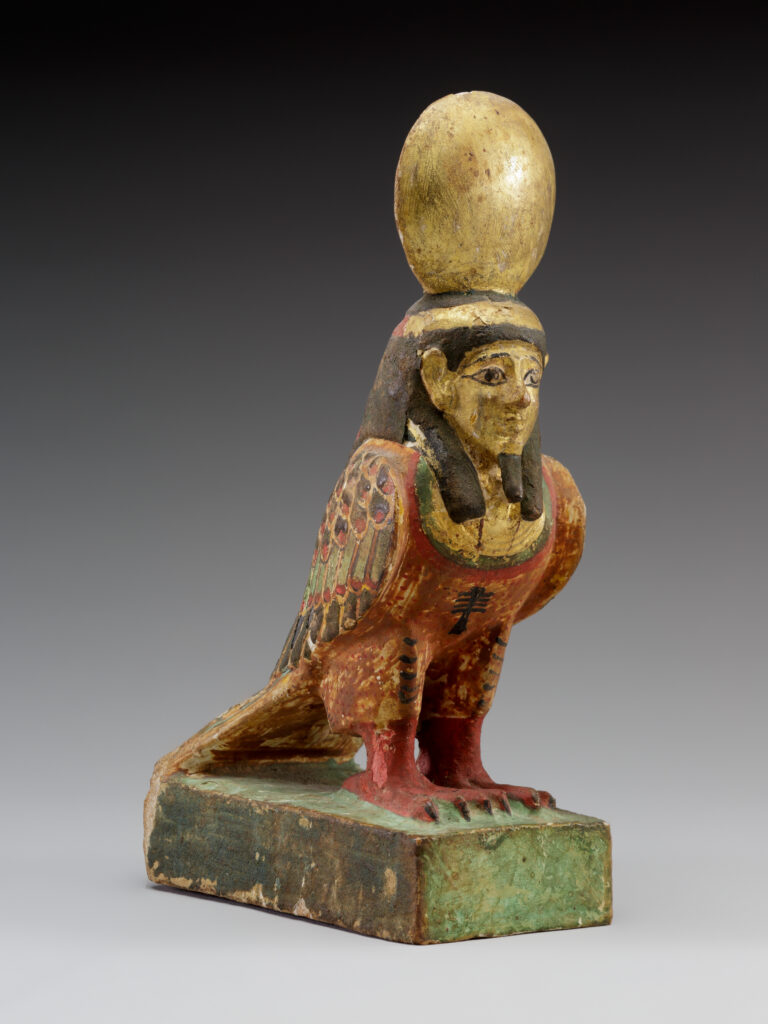
The Met’s educator material describes it as what makes the person individual apart from the body, while its collection records emphasize that the ba could move out from the tomb and periodically return to reunite with the mummy.
That mobility is why the ba was commonly represented as a bird with a human head.
The image is striking because identity is recognizable without being motionless.
The face remains.
The form moves.
The person can appear beyond the body and still remain connected to it.
This gives GEOMYTHA a more careful way to think about manifestation.
A person can have a recognizable mode of appearing without that appearance becoming the whole person.
A role can travel.
A name can travel.
An image can travel.
A reputation can travel.
But movement does not make the traveling form the source.
The ba remains relational.
It leaves.
It returns.
Akh: not escape, but effective reintegration
This is where the system becomes most interesting.
The akh is not simply “the soul after death.”
The Met describes the akh as an effective being produced through the successful reunion of ba and ka in the cycle of rebirth.
The British Museum similarly presents ka and ba as joining in the afterlife to form the perfected akh.
That makes the akh less like a component sitting beside the others and more like a transformed condition.
Something has been integrated.
The person has passed through death, ritual, judgment, reunion, and renewed effectiveness.
This is why GEOMYTHA should resist translating akh as simply “spirit.”
The stronger comparison is transfigured function after reintegration.
Not the ego surviving unchanged.
Not personality getting an eternal upgrade.
A different condition becomes possible because previously separated elements are brought back into working relation.
The tomb is not just storage
Modern eyes can mistake the Egyptian tomb for a warehouse of preserved things.
Body.
Food.
Images.
Names.
Spells.
Statues.
But the logic is more active than storage.
The tomb creates conditions for continuity.
The body remains available.
The ba can return.
The ka can be sustained through offerings.
Images and texts can act.
Ritual can keep relations functioning.
What looks static from outside is designed around recurring movement.
That matters for GEOMYTHA because preservation itself is not the goal.
Preservation serves return.
A form matters because relation still has to pass through it.
Heka: the word that acts
Heka has to be handled differently from ka, ba, and akh.
It is not another layer of personhood in the same sense.
It is closer to effective power.
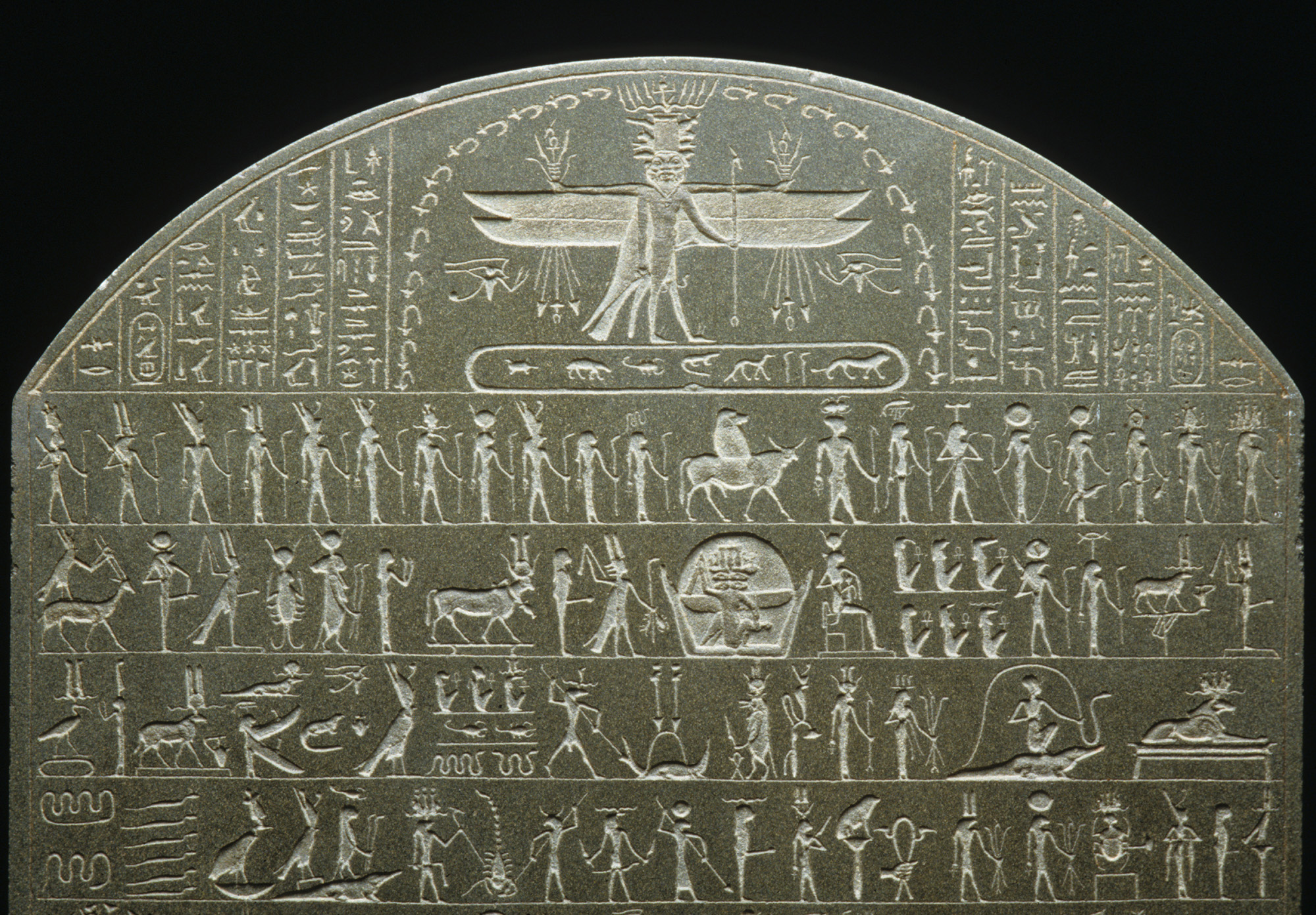
The British Museum describes heka as a magical element central to Egyptian life and afterlife, operating in areas such as childcare, medicine, justice, and religion.
The Oriental Institute’s Foy Scalf describes Heka as the personification of a creative force believed to exist in the universe and available for beings to use.
This helps explain why Egyptian ritual words, images, amulets, and healing texts were not merely symbolic decoration.
They were expected to do something.
UCL’s Digital Egypt warns against imposing a modern split between “medicine” and “magic” onto Egyptian healing practice. The categories do not divide neatly that way in the evidence.
Within GEOMYTHA, heka therefore belongs to the question:
When does a word stop merely describing a world and begin participating in one?
A blessing acts.
A curse acts.
A legal declaration acts.
A name acts.
A ritual formula acts.
A public label acts.
Language can become operative because people, institutions, memory, and behavior reorganize around it.
GEOMYTHA does not need to claim that this is identical to Egyptian heka.
It only needs to notice the shared problem of words becoming forces inside a lived world.
The person was never one thing
This is the central insight.
The Egyptian system resists the modern instinct to ask:
Which one is the real self?
Is the real self the body?
The life force?
The mobile personality?
The transfigured being?
The name?
The heart?
Egyptian mortuary thought does not solve the problem by choosing one and throwing away the others.
Continuity depends on relation among them.
That makes the system especially useful for GEOMYTHA, where distortion often begins when one temporary form claims to be the whole field.
The role says:
I am the person.
The body says:
I am the person.
The name says:
I am the person.
The memory says:
I am the person.
The image says:
I am the person.
The Egyptian model answers with multiplicity.
None of these alone is enough.
The GEOMYTHA comparison
A careful comparison can now be made without pretending to translate one system into the other.
Ka can illuminate received continuity.
Ba can illuminate mobile, recognizable manifestation.
Akh can illuminate transformed effectiveness after reintegration.
Heka can illuminate operative power—the capacity of word, image, ritual, and action to alter relation.
These are comparisons of function.
They are not dictionary definitions.
They are not historical claims that Egyptians anticipated GEOMYTHA.
And they do not map cleanly onto Is, Am, I, and This one by one.
That failure to map perfectly is useful.
It keeps the comparison honest.
The false bridge: Ka + Ba = Kaaba?
This is exactly the kind of resemblance GEOMYTHA has to discipline.
Visually and phonetically, English transliterations make Ka + Ba look tantalizingly close to Kaaba.
But resemblance is not etymology.
There is no historical evidence in the material reviewed here that the name of the Islamic sanctuary derives from the Egyptian terms ka and ba.
The Arabic name is written Kaʿbah, and scholarship discusses its derivation within Arabian linguistic and religious history. The traditional explanation connects it with Arabic kaʿb, “cube,” while recent peer-reviewed work has proposed an older South Arabian sanctuary term kʿbt.
Neither line of scholarship derives the word from Egyptian ka plus ba.
So GEOMYTHA can preserve the resemblance as a poetic prompt if useful.
It cannot present it as history.
That is a clean example of the difference between resonance and evidence.
The stress test: Egypt was not teaching modern psychology
There is another danger.
It would be easy to take these Egyptian categories and turn them into a personality system.
“Your ka is your energy.”
“Your ba is your personality.”
“Your akh is your higher self.”
“Heka is manifestation.”
That would sound neat.
It would also erase the funerary, ritual, religious, and historical contexts that make the terms what they are.
The Egyptian evidence is not a modern self-help diagram.
The categories changed across periods.
Translations remain approximate.
Ritual and afterlife context matter.
The comparison is strongest when the historical system is allowed to resist us.
The practical return
You do not need to decide which single thing is the “real you.”
Start with a smaller question.
What part of you is acting right now?
The body?
The role?
The name?
The memory?
The habit?
The relationship?
The image other people know?
Then ask whether that part has begun claiming the whole.
The ancient Egyptian person remained alive through relation among parts that had to separate, travel, return, and work together again.
GEOMYTHA takes the simpler lesson:
Do not mistake one form of yourself for the whole field that keeps making relation possible.
Sources and further reading
- The Metropolitan Museum of Art, The Art of Ancient Egypt: A Resource for Educators — overview of body, ka, ba, akh, offerings, tomb function, rebirth, and judgment.
- The Metropolitan Museum of Art, Ba-bird, object 44.4.83 — collection record on the mobility and periodic return of the ba.
- British Museum, “Journey to the afterlife” — concise institutional account of ka, ba, and akh.
- British Museum, “Heka: magic in ancient Egypt” — institutional account of heka as a force central to life and afterlife.
- Foy Scalf, “Magic,” Institute for the Study of Ancient Cultures / University of Chicago — discussion of heka as creative force and operative power.
- UCL Digital Egypt, “Healing papyri” — caution against imposing a modern medicine-versus-magic split on Egyptian healing texts.
- Mohammed A. Atbuosh, “South Arabian etymology for the Meccan Kaʿbah,” Bulletin of the School of Oriental and African Studies (2025) — recent peer-reviewed discussion of Kaʿbah etymology that does not derive the name from Egyptian ka + ba.
GEOMYTHA’s comparisons among received continuity, mobile manifestation, reintegration, operative power, and its own Is/Am/I/This grammar are modern project interpretations. The Egyptological and linguistic sources above establish the historical terms and contexts; they do not establish GEOMYTHA as an ancient Egyptian or Islamic doctrine.