A boxing ring is square.
That fact is almost too familiar to notice.
The sport calls the space a ring, but the modern fighting area is bounded by four sides and four corners. Under Association of Boxing Commissions guidelines, a professional boxing ring is a square measuring between sixteen and twenty feet inside the ropes.
A cycle inside a box.
That is already enough to make boxing useful to GEOMYTHA.
Not because boxing secretly encodes a mystical system.
Because the sport makes a familiar human problem visible: what happens to identity when action is confined, opposed, timed, watched, scored, and named?
The ring is a box
Outside the ropes, life spreads in every direction.
Inside them, movement is bounded.
You can circle.
You can advance.
You can retreat.
You can turn.
But you cannot simply walk away without changing the meaning of the event.
The boundary creates the contest.
This is the first mechanism.
A field becomes a box when movement is given an edge.
The ropes do not merely restrict the fighters. They make the fight legible.
Without a boundary there is no shared arena, no agreed distance, no center, no corner, no place from which victory or defeat can be judged.
That means the box is not automatically a prison.
It can also be a form that makes disciplined action possible.
GEOMYTHA keeps both sides.
The opponent is also a limit
Boxing is not shadowboxing.
The other person matters.
Your rhythm changes because another body is reading you.
Your distance changes because another person can enter it.
Your choices matter because they create openings for someone else.
This is where a symbolic reading can go wrong if it turns the opponent into nothing more than a projection.
The opponent is not merely “your fear,” “your shadow,” or “your ego.”
They are a real person with their own training, pain, intentions, limits, and risk.
But because each fighter must continually adjust to the other, the opponent can still become a mirror in a narrower sense.
Not because the other person is imaginary.
Because the other person reveals what your own habits look like under pressure.
Do you panic when crowded?
Do you overreach when frustrated?
Do you abandon the body when the head takes over?
Do you chase instead of position?
Do you confuse aggression with control?
The opponent does not invent those tendencies.
They expose them.
The guard is a selective boundary
A guard does not mean hiding forever.
If both hands simply cover everything and never move, the fighter cannot see, strike, or respond well.
A working guard has to protect while still allowing relation.
That makes it a useful image of boundary.
Too open, and everything enters.
Too closed, and nothing useful leaves.
The same problem appears outside sport.
A person with no boundary can be overwhelmed.
A person whose whole identity becomes defense may stop receiving anything that could change them.
The healthy boundary is selective.
It protects without becoming the entire self.
The bell cuts the story
Professional boxing rules divide a contest into rounds with rest periods between them. Under the ABC Unified Rules, a standard round is three minutes with one minute of rest between rounds.
That interruption matters.
The fight can feel continuous while it is happening.
Then the bell sounds.
The exchange stops.
The fighter returns to the corner.
The body sits.
The breath changes.
Another voice enters.
Information that could not be heard in the exchange may become available again.
The bell does something psychologically important even before GEOMYTHA adds any symbolism:
it breaks continuity.
The fight says, keep going.
The bell says, stop.
That stop creates the possibility of return.
Between rounds
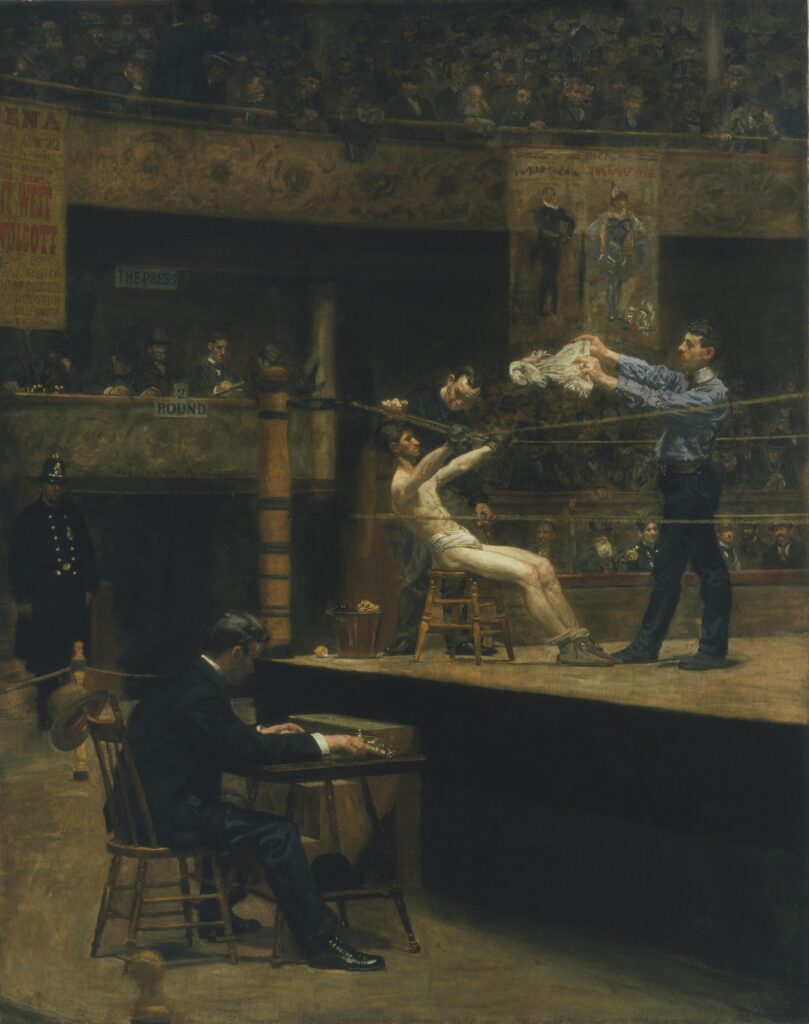
Thomas Eakins understood that the pause was worth painting.
His Between Rounds does not show the punch.
It shows the interruption.
The fighter sits while the crowd remains around him.
The ring still exists.
The contest still exists.
But for a moment, the identity of “fighter” loosens enough for care, instruction, breath, and assessment to enter.
The corner does not erase the fight.
It gives the fighter somewhere to return from it.
This is one of the strongest GEOMYTHA images in the sport.
The person leaves the exchange without leaving the structure.
They are still in the ring.
But they are no longer required to perform the exchange continuously.
The corner restores relation
Association of Boxing Commissions guidelines explicitly regulate who may enter the ring between rounds and how many seconds may assist a boxer.
That is not incidental.
Boxing is often imagined as the purest one-on-one sport.
But the fighter is never entirely alone.
There is a trainer.
A cutman.
A physician.
A referee.
Judges.
Officials.
A team.
The corner reminds us that individual performance still depends on relation.
The boxer may be the one taking the punches.
But the boxer does not create the entire world around the fight.
The corner can return memory to a person whose attention has narrowed.
Breathe.
Listen.
Stop chasing.
Move your feet.
Protect yourself.
One minute can restore proportion.
The champion can become the cage
Victory creates another danger.
A boxer can win a title.
Then the title can begin naming the boxer.
Champion.
Contender.
Prospect.
Journeyman.
Knockout artist.
Gatekeeper.
Washed.
Undefeated.
These labels are useful.
They help describe records, careers, and public standing.
But once the label becomes the whole person, the action hardens into identity.
The fighter is no longer simply fighting.
The fighter must now defend what the name means.
That is where the crown becomes a cage.
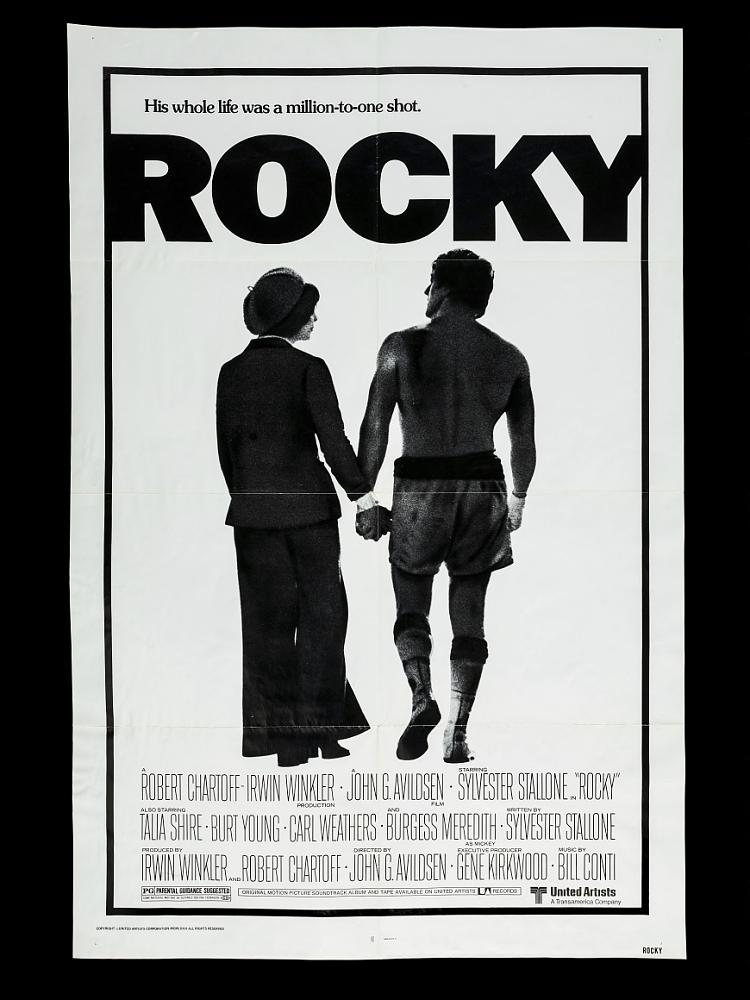
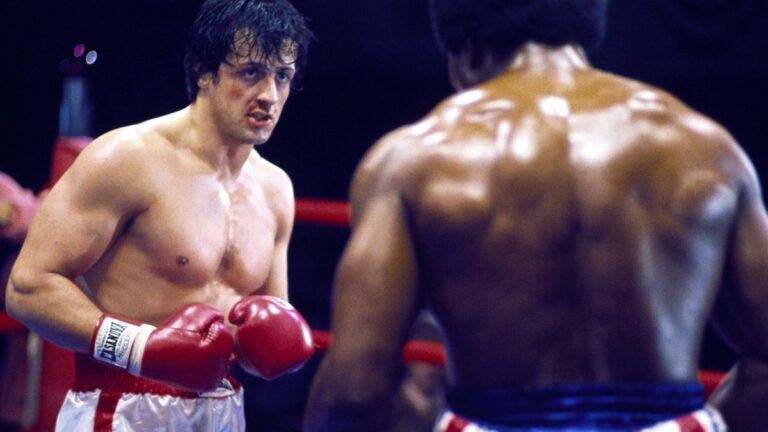
Rocky: the fight is not the title
The first Rocky gives us a clean stress test.
The American Film Institute’s synopsis describes Apollo Creed selecting Rocky Balboa as an unlikely challenger for a heavyweight championship spectacle.
Rocky enters with almost no realistic expectation of becoming champion.
His deepest goal becomes more basic:
to remain standing through the fight and prove to himself that he belongs there.
He does not win the title.
Apollo wins by split decision.
But the film does not treat Rocky as spiritually defeated.
That matters.
The external verdict and the internal transformation do not perfectly overlap.
GEOMYTHA can use that distinction without claiming the filmmakers intended its grammar.
A title belongs to the public structure.
Meaning does not always.
Rocky IV: when the fighter cannot stop being the fighter
The opposite pressure appears later in the series.
AFI’s synopsis of Rocky IV describes Apollo Creed as unable to let go of his identity as a professional boxer and celebrity. He accepts an exhibition against Ivan Drago even after warnings, and the spectacle ends in his death.
This is not a subtle example.
But it makes the mechanism visible.
The role that once gave Apollo form has become something he feels compelled to keep performing.
The fighter cannot step outside the fighter.
The identity has become stronger than the signal to stop.
That is the shadow side of the crown.
The body pays for the symbolism
This article fails if boxing becomes a clean metaphor and the damaged body disappears.
It cannot.
Boxing involves intentional blows, including blows to the head.
The medical literature has long documented concerns about acute brain injury and the long-term effects of repeated head trauma, especially in professional boxing. The precise prevalence and risk vary across eras, exposure, level of competition, safety standards, and study quality, and amateur and professional boxing should not be collapsed into one risk profile.
But the danger is real enough that commissions regulate medical examinations, suspensions, ringside physicians, rest periods, and stoppages.
GEOMYTHA should never use “the warrior,” “the fighter,” or “the sacred ring” to romanticize injury.
A body is not a disposable symbol.
The stress test: disciplined identity can be useful
There is another correction.
Being “a boxer” can be deeply constructive.
The identity can organize training.
Keep someone sober.
Create friendship.
Build confidence.
Teach patience.
Provide income.
Create belonging.
Give structure to aggression that would otherwise have nowhere disciplined to go.
So the lesson is not:
identity is bad.
It is:
a role becomes dangerous when the person can no longer hear the bell.
When rest feels like weakness.
When retirement feels like death.
When injury must be denied to preserve the name.
When the opponent must become less than human so the self can feel complete.
When winning is no longer something that happened but something the person must remain.
The GEOMYTHA movement
Inside the ring, the movement becomes unusually visible.
Am: action, rhythm, breath, trained response.
I: the claimant enters—my opening, my round, my fight.
This: the action stabilizes into role—fighter, winner, champion.
Then the bell offers a return.
This → Am.
Sit down.
Breathe.
Listen.
Remember the body.
Remember the other person.
Remember that the round ended.
The corner is not outside the fight.
It is the place inside the fight where the fighter can briefly stop being consumed by it.
Between bells
Most identities do not announce themselves as cages.
They begin as useful forms.
Worker.
Parent.
Fighter.
Expert.
Provider.
Victim.
Champion.
They give action a shape.
The question is whether the shape still allows return.
Can you hear the bell?
Can you go back to the corner?
Can you let another person tell you what you could not see while you were exchanging?
Can you protect yourself without becoming only defense?
Can you oppose someone without reducing them to “the enemy”?
Can you win without needing to remain the winner forever?
Enter the ring when the work requires it. Leave the round when the bell has already sounded.
Sources and further reading
- Association of Boxing Commissions, Regulatory Guidelines — professional ring dimensions, corner personnel, rest periods, medical safeguards, and bout administration.
- Association of Boxing Commissions, Unified Rules of Boxing — round length, one-minute rest periods, scoring, referee authority, and competition rules.
- USA Boxing, 2026 National Rule Book — current U.S. Olympic-style boxing rules and officiating framework.
- American Film Institute Catalog, Rocky (1976) — film synopsis and production history.
- American Film Institute Catalog, Rocky IV (1985) — film synopsis, including Apollo Creed’s exhibition with Ivan Drago.
- McCrory, Zazryn, and Cameron, “The evidence for chronic traumatic encephalopathy in boxing” — review of neurological risk and repeated head trauma in boxing.
- Philadelphia Museum of Art, Thomas Eakins, Between Rounds, 1898–1899 — museum record for the featured artwork.
- Wikimedia Commons, Between Rounds — public-domain reproduction used in this article.
GEOMYTHA’s ring/box, opponent-as-mirror, guard-as-boundary, crown-as-identity, and This → Am return sequence are project interpretations. The boxing, medical, film, and museum sources establish the underlying sport, risks, works, and artwork; they do not establish the GEOMYTHA reading as scientific fact or creator intent.