Category: Uncategorized

  • The Blue Bird and the Split Dragon

    The Blue Bird and the Split Dragon

    Most people remember Breath of Fire as a simple fantasy story: Light Dragons good, Dark Dragons evil, goddess bad, hero saves world.

    But the game’s symbolic structure is much stranger than that.

    The real conflict is not light versus darkness.

    It is:

    Am versus I.

    Or more precisely:

    living reflected breath
    versus
    breath claimed into identity.

    The title itself quietly tells you this.

    Breath of Fire.

    Not sword.
    Not kingdom.
    Not prophecy.

    Breath.

    Before the Dragon Clan splits into Light and Dark, dragon-force behaves like a living current moving through the world. It is powerful, dangerous, transformative, but not yet fully possessed. In Geomytha terms, this is closest to Am: reflected living presence before the claimant appears.

    Then desire enters the field.

    Myria does not first destroy the dragons.

    She offers them wishes.

    Power.
    Expansion.
    Fulfillment.
    Rule.

    That is the entrance of I.

    The movement that says:
    “I want.”
    “I deserve.”
    “I should rule.”
    “This power should belong to me.”

    The Dragon Clan does not fracture because darkness suddenly appears. It fractures because breath becomes claimable. The moment living force becomes property, duality begins.

    This is why the Light Dragons and Dark Dragons make far more symbolic sense when read as lunar and solar rather than simply moral categories.

    The Light Dragons are lunar because they reflect.

    The Dark Dragons are solar because they project.

    That distinction changes the entire game.

    The Light Dragons do not attempt to dominate the world after the split.

    They hide.
    Seal.
    Withdraw.
    Preserve.

    They contain dragon-force rather than enthroning it.

    That is lunar consciousness.

    The moon does not generate its own light.
    It reflects.

    That is Am.

    The Light Dragons preserve reflected power without claiming sourcehood. They become hidden continuity beneath the visible empire of the world. They are dragon-force under restraint, protected from becoming identity.

    Meanwhile the Dark Dragons behave exactly like solar consciousness after reflection has hardened into rulership.

    Imperial.
    Visible.
    Expanding.
    Crowned.
    Conquering.

    The hidden sentence underneath the Dark Dragon Empire is:

    I am this dragon power.

    That is the corruption.

    The Dark Dragons are not darkness itself. They are false light: dragon-force transformed into visible rulership and outward domination. Their reign behaves like the enthroned solar self, the dragon raised into the sky as the organizing principle of the world.

    This is why the Dark Dragon Empire resembles the same symbolic structure that appears elsewhere as:
    the reign of the false king,
    the thousand-year reign,
    the visible world-order,
    the kingdom of surfaces,
    the dragon enthroned above the field.

    It is the period when the sun is in the sky.

    Not sunlight as simple illumination, but sunlight as rulership.

    Projection reigning openly.

    The world organized around:
    visibility,
    identity,
    hierarchy,
    conquest,
    and claim.

    The game quietly reverses the obvious reading.

    The “Dark” Dragons are actually the solar force.

    The “Light” Dragons are lunar reflection hidden beneath the visible order.

    This inversion becomes clearest in the game’s final architecture.

    The last battle does not take place in a forest, cave, river, or hidden sanctuary.

    It takes place inside the Obelisk beneath Scande.

    That matters enormously.

    The Obelisk is not just a tower.

    It is the false phallus.

    The vertical claim.

    The illusion of separate upward identity.

    The hardened “I.”

    Rigid.
    Ascending.
    Imposing.
    Dominating.

    The Obelisk behaves exactly like the false self:
    a structure trying to reach source through force and elevation rather than reflection.

    This is why the final confrontation with Myria happens there. The battle occurs at the center of illusion itself — inside the symbolic architecture of the claimant.

    The dragon-force has become fully solarized:
    empire,
    tower,
    throne,
    identity,
    upward conquest.

    The Obelisk is the dragon transformed into ego-architecture.

    The false “I am.”

    That is why it functions as the perfect final battlefield.

    Because the game’s deepest conflict was never:
    Light versus Dark.

    It was always:
    Am versus I.

    Or:
    living reflected breath
    versus
    the claim that tries to possess it.

    The game then gives you a second upward movement entirely.

    Nina.

    Her transformation is one of the strangest symbolic moments in the game. She disappears into forgetting and returns altered:
    older,
    blue,
    and capable of becoming the Great Bird.

    Most RPGs would treat this as a simple power upgrade. Breath of Fire frames it differently. Nina’s flight only appears after memory, loss, and transformation pass through her first.

    That is the key.

    Because her ascent is not solar.

    She does not dominate the sky.

    She moves through it.

    Her blue coloration deepens the symbolism further. Blue behaves here like reflected sky, atmospheric memory, lunar water-consciousness, Osirian breath carried upward without becoming solar enthronement.

    Nina becomes remembered Am.

    Not rulership.

    Movement.

    The Great Bird is therefore the opposite of the Obelisk.

    Both rise upward.

    But only one remains alive.

    The Obelisk climbs through domination.
    The Bird rises through surrender.

    The Obelisk imposes.
    The Bird carries.

    The Obelisk seeks heaven through force.
    The Bird remembers the sky.

    That distinction quietly restructures the whole game.

    Ryu stands dangerously between these two currents.

    That is why his dragon transformations matter symbolically.

    Ryu is never simply “the good dragon.” He carries the instability of dragon-force itself. Every new transformation risks becoming:
    the heroic self,
    the conquering self,
    the solar savior,
    the dragon enthroned as identity.

    The danger is always the same:

    I am this power.

    The game repeatedly flirts with this possibility through escalating dragon forms and increasingly destructive fire.

    But Nina’s flight keeps interrupting that danger.

    Breath must remain reflected.

    Otherwise dragon-force becomes empire.

    This is why the final victory does not culminate in Ryu becoming permanent king of the world or universal ruler of dragon-force. The game corrects itself away from total solar enthronement. Myria is exposed rather than replaced.

    That is important.

    The illusion is revealed rather than perfected.

    This may also explain why so many games, movies, songs, and myths feel structurally similar beneath the surface.

    Again and again the same pattern appears:

    Am:
    reflection,
    memory,
    living presence,
    relationship,
    movement,
    breath.

    Versus:

    I:
    claim,
    projection,
    identity,
    empire,
    visibility,
    throne-consciousness.

    Most modern stories are not ultimately good versus evil.

    They are:
    I versus Am.

    The claimant versus reflection.

    The solar self versus remembered breath.

    Some stories glorify the solar empire completely. Others quietly preserve lunar memory beneath it. Some expose the illusion directly. Others accidentally reveal it through symbols they no longer consciously understand.

    Breath of Fire remains powerful because it still remembers the split clearly enough to encode both sides:
    the dragon enthroned in the sky,
    and the blue bird still capable of flight beyond it.

    The game begins with dragons.

    But underneath the fantasy, it is really asking a much older question:

    What happens when living breath forgets reflection and turns itself into a throne?

  • The Bridge Is Not the Shore

    The Bridge Is Not the Shore

    “I Am That” is a bridge.

    It is not the shore.

    That distinction matters because the false self loves to live on bridges. It loves in-between places where a phrase is strong enough to loosen ordinary identity, but not yet severe enough to dissolve the one who is using it.

    “I Am That” can help break the spell of I am this.

    That is its value.

    But if the claimant keeps the phrase, the spell does not end. It enlarges.

    The self stops saying, “I am this body, this job, this wound, this role, this fear, this story,” and begins saying, “I am That.”

    The grammar has moved upward.

    The claimant may not have moved at all.

    That is the danger of nondual language.

    It can point beyond identity, or it can become the most elegant identity the ego has ever worn.

    The previous article handled the more dangerous phrase: I am that I am. That phrase comes from fire. It is dangerous because it places divine being-language in a sentence that still begins with I. If the I dissolves, the phrase opens. If the I remains, Set steals the name and crowns himself.

    “I Am That” is slightly different.

    It is not as closed. It is more like a hand pointing away from the local self.

    Not this.

    That.

    Not this body-story.

    That field.

    Not this fear.

    That being.

    Not this biography.

    That ground.

    The phrase can be useful because it breaks the hypnotic closeness of this.

    This is immediate.
    This is graspable.
    This is the body in the mirror.
    This is the pressure in the chest.
    This is the wound being defended.
    This is the name on the form.
    This is the role being performed.
    This is the person everyone seems to be talking about.

    I am this is the ordinary sentence of Horus.

    Horus is the identity-body, the time-bound self, the apparent person formed when awareness identifies with image, memory, role, desire, fear, and narrative. Horus says:

    I am this.

    I am this face.
    I am this history.
    I am this injury.
    I am this destiny.
    I am this belief.
    I am this self.

    That is the contracted form.

    “I Am That” creates distance from this contraction.

    It says: do not stop at the local image. Do not mistake the body-story for the whole. Do not confuse the passing contents of awareness with awareness itself. There is something deeper than the visible self.

    That is why the phrase can work.

    It turns the head away from the mirror.

    But it can also create a subtler mirror.

    The ego looks into the beyond and admires itself there.

    Now it says:

    I am the absolute.
    I am the source.
    I am beyond ordinary people.
    I am the one who sees through illusion.
    I am not bound by what binds others.

    That is not liberation.

    That is Horus wearing infinity.

    The phrase did not fail because it pointed badly. It failed because the claimant survived the pointing.

    This is the difference between a pointer and a possession.

    A pointer directs attention away from itself.

    A possession makes the pointer mine.

    “I Am That” must therefore be used lightly. It is a bridge from local identity toward wider being. But if it becomes a permanent self-description, it has been captured.

    The bridge has become a house.

    This is why the phrase must burn backward.

    I Am That.
    Am That.
    Am.
    Is.

    The first step loosens the local self.

    I Am That says: I am not merely this.

    The second step weakens the claimant.

    Am That lets being remain without so much personal ownership.

    The third step releases the pointer.

    Am is reflected being without predicate.

    The fourth step returns to source.

    Is.

    No claimant.
    No object.
    No spiritual trophy.
    Just the field before the sentence begins.

    This is the Geomytha correction.

    The goal is not to perfect the phrase I Am. The goal is to see whether the phrase can disappear into what it points toward.

    If it cannot disappear, it has become identity.

    The phrase wants to vanish.

    The ego wants to keep it.

    That is the conflict.

    The mind loves refined language because refined language feels safer than direct seeing. It can repeat I Am That and feel close to truth while still preserving the subtle one who repeats. It can build a self around the refusal of self. It can become “the nondual person,” “the awakened observer,” “the one beyond ordinary identity.”

    This is why anti-ego language so often becomes ego food.

    The false self can eat almost anything.

    It can eat religion.
    It can eat rebellion.
    It can eat trauma work.
    It can eat politics.
    It can eat mystical experience.
    It can eat Geomytha.
    It can eat the phrase that was meant to starve it.

    That is why the test is not whether the words sound high.

    The test is whether the claimant becomes less believable.

    Does the phrase make the body softer?
    Does it make the breath easier?
    Does it reduce urgency?
    Does it loosen the need to be seen?
    Does it make ordinary life more transparent?
    Does it make the person less dramatic, less inflated, less hungry for certification?

    Or does it make the self larger?

    Does it make the speaker grandiose?
    Does it turn humility into performance?
    Does it turn silence into superiority?
    Does it make other people seem asleep and small?
    Does it make correction feel beneath you?
    Does it make embodiment feel like a lower realm to escape?

    If the second pattern appears, the phrase has been stolen.

    Set has taken the mirror.

    Horus is wearing the reflection.

    This is why Gemini is the right field for this article. Gemini notices distinction. It hears the difference between this and that, between pointer and possession, between bridge and shore, between phrase and presence. Gemini can see the double movement: the same words can liberate or inflate depending on what happens to the one who speaks them.

    That is the whole issue.

    “I Am That” is not automatically false.

    It is not automatically safe either.

    It is a charged tool.

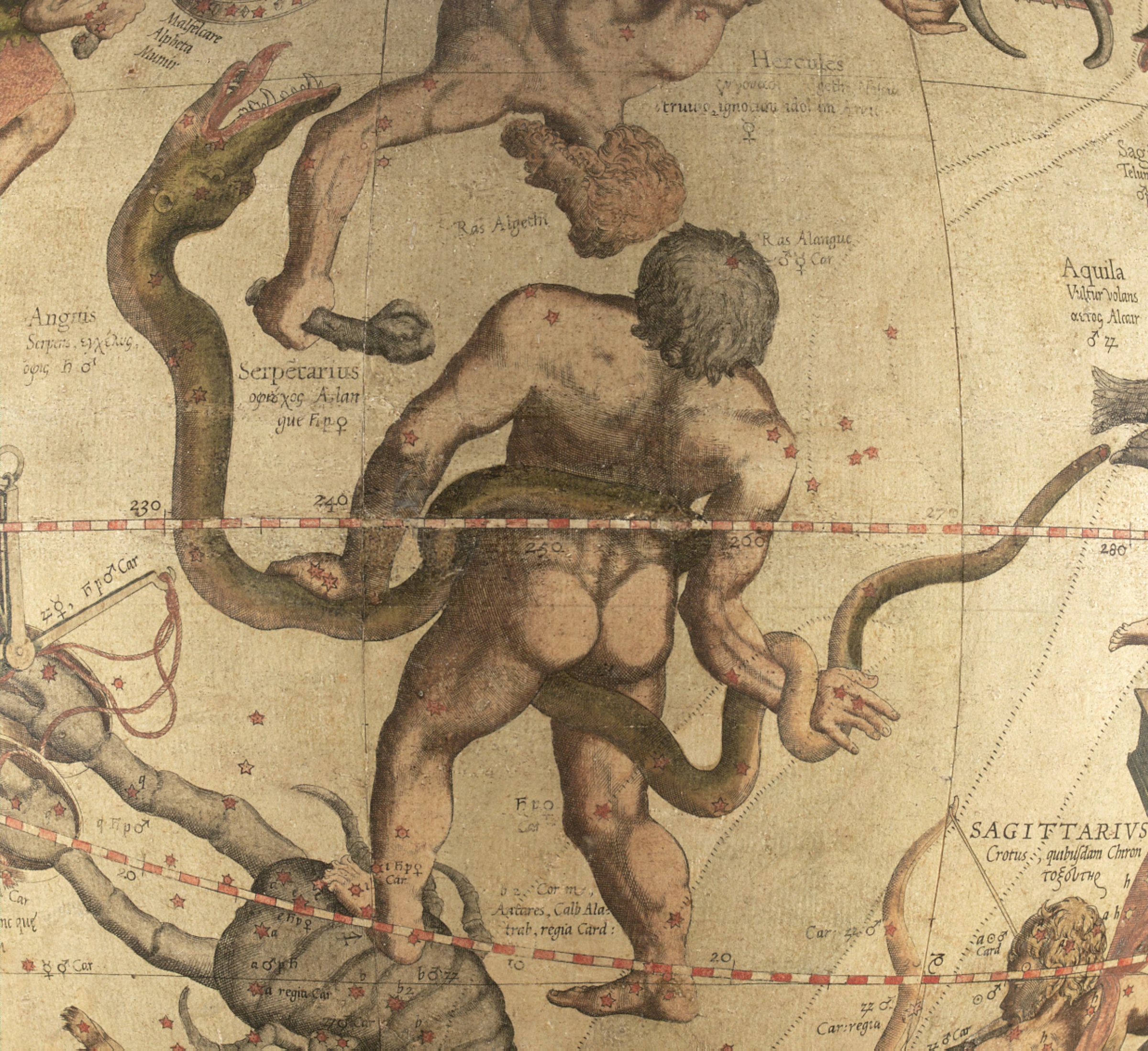
    Like Ophiuchus holding the serpent, the phrase must be handled without swallowing it. It may carry medicine. It may carry poison. The difference is relation, measure, timing, and humility.

    Hold the phrase.

    Do not crown yourself with it.

    Let it work.

    At first, let it interrupt I am this.

    When the body tightens around a role, let the phrase open the hand.

    I am not merely this role.

    When pain becomes biography, let the phrase create distance.

    I am not merely this pain.

    When fear becomes identity, let the phrase loosen the knot.

    I am not merely this fear.

    When memory becomes a prison, let the phrase widen the field.

    I am not merely this story.

    That is useful.

    That is medicine.

    But then stop before the medicine becomes intoxication.

    Do not turn the next movement into:

    I am That ultimate thing.

    That is too much ownership.

    Instead, let the phrase thin.

    Not I Am That as declaration.

    Am That as softening.

    Am as bare reflection.

    Is as silent ground.

    Then breathe.

    Inhale: Is-Am.
    Exhale: Am-Is.

    This is safer because it restores order without putting the claimant at the front.

    In Is-Am, source becomes reflected presence.

    In Am-Is, reflected presence returns to source.

    No one needs to own the movement.
    No one needs to announce it.
    No one needs to become special because it happened.

    This also protects the body.

    A common danger in nondual language is that the body becomes subtly dismissed. The self says, “I am That,” and then begins treating ordinary human conditions as beneath it. Hunger, grief, responsibility, fatigue, tenderness, repair, apology, and limitation become signs of lesser consciousness.

    That is not freedom.

    That is avoidance dressed as transcendence.

    If the phrase is real, it should not make the body contemptible. It should make the body less imprisoning.

    There is a difference.

    The body is not the final identity. But the body is also not garbage. It is the field where the current is felt, where breath moves, where relation happens, where action becomes possible. The problem is not embodiment. The problem is ownership.

    “I am this body” is too small.

    “I am above the body” is often just another claim.

    The better correction is:

    There is body.
    There is breath.
    There is sensation.
    There is awareness of all this.

    Then the sentence quiets.

    The body does not need to become me.

    It also does not need to become not me as a badge of spiritual superiority.

    It can simply be included in the field.

    This is why That must not be used to flee This.

    A real pointer beyond the local self should return more presence to the local field, not less. It should make the dish, the child, the conversation, the ache, the task, the room, the breath more immediate, not more dismissible.

    Otherwise the phrase has become dissociation.

    That is another Setian move.

    Set loves escape that calls itself awakening.

    The true movement is subtler.

    Not trapped in this.
    Not inflated into that.
    But present as what allows both to appear.

    That is why the phrase must vanish.

    Once the local identity loosens, do not keep repeating the pointer as a crown. Let it fall away.

    The moon does not keep announcing that it reflects the sun. It reflects.

    The lungs do not say they are breathing the field. They breathe.

    The belly does not declare itself the center. It steadies.

    Presence does not need to shout metaphysics.

    It is.

    That is the final reduction.

    Is.

    Then Am.

    Then return.

    The phrase I Am That is strongest when it becomes unnecessary.

    That sounds paradoxical, but it is exact.

    A bridge fulfills itself when it is crossed. A pointer fulfills itself when attention moves beyond it. A mantra fulfills itself when it quiets the mind that was repeating it.

    The ego wants to preserve the tool because the tool gives it shape.

    Presence lets the tool disappear.

    This is the practical rule:

    Use I Am That only against I am this.

    Do not use it to build a new I.

    When the local self contracts, let the phrase widen the field.

    Then let the phrase reduce.

    I Am That.
    Am.
    Is.

    Then breathe.

    Is-Am.
    Am-Is.

    This rhythm keeps the phrase from becoming a palace.

    It allows language to serve return instead of becoming another room for Horus.

    The bridge is not the shore.

    Do not decorate it.

    Do not live there.

    Do not invite the false self to build a shrine on it.

    Cross.

    Then let the crossing disappear behind you.

    What remains is not the person who knows I Am That.

    Not the person who has the highest phrase.
    Not the person who sees through the world.

    What remains is simpler and harder for the claimant to use.

    There is Is.

    There is Am.

    There is breath moving without ownership.

    There is life before the sentence becomes a self.

    The phrase points.

    The claimant loosens.

    The bridge empties.

    The shore was never elsewhere.

  • The Divine Name Is Not a Crown

    The Divine Name Is Not a Crown

    There may be no more dangerous phrase than:

    I am that I am.

    It is dangerous because it is almost true in the mouth of the ego.

    Almost.

    That is what makes it powerful.

    A false sentence is easy to reject. A crude lie has no real authority. But a sacred phrase that carries real being-language can be stolen by the claimant and worn like a crown.

    That is the danger.

    I am that I am can become a doorway into presence. It can also become the most refined costume Horus ever wears.

    Everything depends on what happens to the first I.

    In ordinary religious reading, the phrase from Exodus is treated as the divine self-disclosure. Moses asks for a name, and the answer comes from the fire: I am that I am. The name refuses ordinary naming. It does not say: I am this god, this object, this tribal idol, this image, this form. It points toward being itself.

    That is why the phrase has such force.

    It does not give Moses a normal noun.

    It gives him a mystery of being.

    But in Geomytha, the phrase has to be handled carefully because the first word is also the danger-word.

    I.

    The claimant.

    The heel-grabber.

    The one who says mine.

    The one who wants the blessing, the proof, the role, the certification, the sacred authority.

    In the Jacob article, the claimant appeared as the hand grabbing the heel right as emergence began. Here the same claimant reaches for something higher. It no longer wants only birthright, hunger, inheritance, or protection.

    It wants the divine name.

    That is spiritual ego.

    The false self grows more dangerous when it learns sacred grammar.

    At the crude level, it says:

    I am this body.
    I am this wound.
    I am this status.
    I am this fear.
    I am this story.

    At the spiritual level, it says:

    I am awake.
    I am chosen.
    I am source.
    I am God.
    I am the one who sees.

    That is not liberation.

    That is Horus in temple clothing.

    This is why I am that I am must be read as a furnace, not a slogan.

    The phrase is not permission for the ego to crown itself. It is the place where the ego must burn.

    If I says the phrase and remains intact, Set has stolen Am.

    If I enters the phrase and dissolves, the doorway opens.

    That is the whole distinction.

    The grammar matters.

    Article One gave the basic sequence:

    Is. Am. I. This.

    Is is pure being before possession.
    Am is being reflected as presence.
    I is the claimant.
    This is identity hardened into object, role, body-story, wound, name, image, and biography.

    The false self forms most clearly as:

    I am this.

    That is Horus.

    The body appears, and the claimant says: I am this body.
    The feeling appears, and the claimant says: I am this feeling.
    The role appears, and the claimant says: I am this role.
    The thought appears, and the claimant says: I am this thought.

    This is the trap.

    But I am that I am is different because it does not say this.

    It says that.

    That difference matters.

    This is near, graspable, pointed, owned. This is the object in the hand. This is the body in the mirror. This is the wound being narrated. This is the role being defended. This is the name on the form.

    That is more distant.

    That points beyond the immediate object. That refuses total possession. That gestures toward what cannot be fully held.

    So the phrase is already less trapped than I am this.

    I am this forms Horus.

    I am that begins to point beyond Horus.

    But it is not safe yet.

    Because I is still there.

    The claimant has turned away from the local object, but it may still try to possess the beyond. This is the subtle danger of mystical language. The ego stops saying I am this body and starts saying I am that absolute.

    The grammar has improved.

    The claimant has not.

    That is why I am that must continue burning.

    It cannot stop at I.

    It must move backward.

    I am that.
    Am that.
    Am.
    Is.

    That is the return.

    The phrase must become less personal as it deepens.

    At first, I am that may help loosen identification with this body-story. It points beyond the local self. It interrupts the tight little knot of biography. It says: you are not merely this wound, this fear, this name, this job, this face, this history.

    That can be useful.

    But then the phrase has to keep going.

    The I cannot remain as owner of the absolute.

    Otherwise the false self has not died.

    It has expanded.

    This is how spiritual inflation happens.

    The ego does not dissolve into source. It identifies as source. It uses nondual language to avoid humility, embodiment, accountability, grief, limitation, and ordinary human relation. It calls its own grandiosity awakening.

    That is Set wearing the crown.

    A person can say I am God and still be entirely ruled by fear, pride, hunger, comparison, resentment, and the need to be seen. The phrase did not liberate them. It merely gave the false self better costume.

    This is why the divine name is dangerous.

    It is too close to the truth to be handled casually.

    Ophiuchus belongs here.

    The previous article described Ophiuchus as the discipline of holding the serpent before insight becomes identity. I am that I am is one of the hottest serpents in the religious field. It carries real force. It can heal. It can poison. It can humble. It can inflate.

    It must be held.

    Not swallowed.

    Not posted as self-description.

    Not weaponized in debate.

    Not worn as evidence of superiority.

    Held.

    Let the phrase remain charged without immediately making it yours.

    The burning bush is important for this reason.

    The name comes from fire.

    Fire reveals and consumes. It illuminates, but it also burns away what cannot survive the encounter. If the divine name comes from the fire, then the correct response is not to put it on like jewelry.

    The correct response is to let it burn.

    Whatever says I must enter.

    Whatever is false must not survive.

    That is why Moses is not simply being handed a metaphysical slogan. He is being brought into a field where ordinary identity cannot remain untouched. The name does not decorate him. It commissions him, frightens him, strips him, and sends him.

    The name is not possession.

    It is ordeal.

    In Geomytha, this is the difference between sacred language as Osiris and sacred language as Horus.

    As Osiris, sacred language reflects source without claiming to be source. It gives the mind a mirror that points beyond itself. It says: look through me.

    As Horus, sacred language becomes identity. It says: look at me. I know the name. I hold the formula. I have the key. I am the one.

    That is the corruption.

    The phrase I am that I am becomes true only when it ceases to function as self-description.

    If it is spoken from ego, it is false even if the words are sacred.

    If it dissolves the ego, it is true even before the words are spoken.

    The phrase points toward being before predicate.

    Not:

    I am this.
    I am that object.
    I am that role.
    I am that doctrine.
    I am that awakened identity.

    But:

    Am.

    And even deeper:

    Is.

    This is why the Is-Am / Am-Is breath practice is safer than repeating I am too quickly.

    I am may be useful because it strips away predicates. It can bring attention back from I am this toward bare being. But in Geomytha, the risk is clear: the I may remain too strong. It may sit at the front of the phrase like a king at the gate.

    So the correction is:

    Inhale: Is-Am.
    Exhale: Am-Is.

    This restores the order.

    Is before Am.
    Am returning to Is.
    No claimant required.

    If I am is used, it must be used like a bridge, not a throne.

    Cross it.

    Do not live on it.

    Nisargadatta’s phrase I Am That is powerful for this reason. It points away from the local self and toward the beyond. But in this new Geomytha grammar, it must still be handled carefully. The phrase is not complete if the I keeps it.

    The practice is to let it reduce.

    I Am That.

    Then:

    Am That.

    Then:

    Am.

    Then:

    Is.

    The mind wants to keep a beautiful phrase.

    Presence does not need one.

    This does not mean language is useless. Language can guide. Myth can guide. Scripture can guide. The divine name can guide. But every guide becomes dangerous when the claimant uses it to avoid the actual movement of return.

    The divine name should not make the self larger.

    It should make the self less believable.

    If the phrase makes someone more humble, quieter, clearer, more embodied, less reactive, less desperate to be seen, less hungry for specialness, then it may be working as Osiris.

    If the phrase makes someone grandiose, untouchable, superior, dismissive, inflated, theatrical, or obsessed with being recognized as awakened, then Set has taken it.

    The test is simple:

    Does the phrase reduce I?

    Or does it crown I?

    That is the whole matter.

    This also explains why that is safer than this, but not safe enough.

    This produces immediate identity.

    I am this person.
    I am this body.
    I am this pain.
    I am this belief.

    That opens distance.

    I am not merely this.
    I belong to that deeper field.
    There is something beyond the visible self.

    But if that becomes an object of possession, the trap returns.

    I am that ultimate thing.
    I am that source.
    I am that divine exception.

    Now that has become another this.

    The beyond has been dragged into the claimant’s hand.

    That is the Setian move.

    The sacred becomes object.
    The object becomes identity.
    Identity becomes throne.

    So the phrase must remain ungraspable.

    I am that I am is not a final label. It is a refusal of labels. It does not let the mind land on a stable object. It turns back on itself. It loops. It denies predicate. It keeps burning the tendency to say: this is what God is.

    But the ego can still misuse the loop.

    It can say:

    Because God is beyond definition, I am beyond correction.

    That is the lie.

    The true beyond does not inflate the personal self. It undoes its claim to centrality.

    Jacob helps again.

    At the ford, Jacob wants the name. He wants the blessing. He wants the divine encounter to certify him. But he does not leave as a triumphant metaphysical master. He leaves limping.

    That is the sign of a real encounter.

    The claimant has been marked by limitation.

    If sacred naming does not produce some limp in the ego, it may not have touched anything real.

    A real divine name humbles the one who hears it. It does not make him unbearable.

    It does not make him frantic to prove. It does not make him addicted to certainty. It does not make him careless with others. It does not turn him into a spiritual landlord collecting rent from everyone else’s ignorance.

    It burns.

    The false center loses some of its confidence.

    That is mercy.

    Because the false center is the prison.

    This is why this article belongs after Ophiuchus. The serpent must be held before this phrase can be approached. Without containment, I am that I am is too easily swallowed by the claimant. The phrase becomes immediate intoxication.

    With containment, it becomes ordeal.

    The reader does not need to reject the phrase.

    The reader needs to let it work.

    When the phrase appears, do not grab it.

    Hold it.

    Let it ask:

    Who is saying I?

    Let it ask:

    Can Am remain without becoming mine?

    Let it ask:

    What is here before the statement forms?

    Then breathe.

    Inhale:

    Is-Am.

    Exhale:

    Am-Is.

    If the phrase is true, it will not need to be defended as identity.

    It will become quieter.

    It will become simpler.

    It will move from claim to presence.

    It will burn backward.

    I am that I am.
    I am that.
    Am.
    Is.

    Then the phrase can disappear.

    And what remains is not a better self.

    Not a crowned self.
    Not an awakened self.
    Not a self who knows the divine name.

    What remains is what the name was trying to protect from naming.

    The living fact before the claimant.

    Is.

    Reflected as Am.

    Returned as Is.

    The doorway opens only when no one stands in it wearing a crown.

  • Stolen Wonder: Jack Skellington and the False Awakening of Christmas

    Stolen Wonder: Jack Skellington and the False Awakening of Christmas

    Jack Skellington does not discover Christmas and become transformed by it.

    He discovers Christmas and turns it into a Jack Skellington project.

    That is the whole problem.

    At first, the scene is beautiful. A skeleton king wanders out of his exhausted kingdom and falls into a world he cannot categorize. Snow. Light. Music. Color. Children. Gifts. Wonder without screaming. Joy without threat. Warmth without a punchline.

    For a moment, Jack is not the Pumpkin King.

    He is simply astonished.

    That moment matters because it is real. Christmas Town is not fake. Jack’s wonder is not fake. His longing is not fake. The film works because his hunger is sincere. He is not a villain trying to corrupt joy. He is a king who has mastered his own world so completely that the crown has become a cage.

    But sincerity does not save him.

    The mistake begins the instant he tries to bring Christmas back under his own command. He does not let the mystery remain mystery long enough to be changed by it. He captures it, names it, dissects it, rebrands it, and assigns it to Halloween Town like a new production theme.

    That is why The Nightmare Before Christmas is not mainly about Halloween invading Christmas.

    It is about the ego encountering wonder and immediately trying to own it.

    Halloween Town Is the Old Ego-World

    Halloween Town is not evil.

    That would be too easy.

    Halloween Town is a symbolic machine. Everyone has a role. Everyone performs a function. Everyone knows the ritual. The vampire, the witch, the clown, the corpse, the monster under the stairs—each has a place inside the yearly ceremony of fear. The whole town exists to produce one emotional atmosphere with great skill.

    And Jack is its king.

    He is not merely popular. He is structurally necessary. Halloween Town reflects him back to himself as the Pumpkin King. He has mastery, reputation, public love, aesthetic coherence, and ritual power. He knows how to enter, how to perform, how to frighten, how to vanish, how to return.

    He has become perfectly legible inside his world.

    That is why he is miserable.

    The crisis is not failure. It is completion. Jack has succeeded at being Jack, and success has revealed the poverty of the role. The applause still comes. The town still celebrates. The ritual still works. But inside the king, the center has gone hollow.

    This is one of the subtler forms of Horus.

    Horus is the ruler-self, the identity that rises from fragmentation and says, “I am this.” He holds the divided field together through role, image, continuity, and command. In a crude form, Horus is vanity. But in a refined form, Horus can be excellence, artistry, nobility, public service, mastery, even spiritual longing.

    Jack is not a weak Horus.

    He is a perfected one.

    That is why he is dangerous. The more complete the identity becomes, the harder it is to notice that it is still identity. The Pumpkin King is not merely trapped by Halloween Town. He is trapped by the brilliance with which he embodies it.

    The cage is made of applause.

    The Bored King and the Search for More

    Jack’s sadness is not ordinary boredom.

    It is the boredom of the ego after it has exhausted its own mythology.

    He has frightened everyone. He has performed every gesture. He has fulfilled the town’s expectations. He has become the icon of his world. But the icon cannot feel source. It can only be seen.

    That distinction is everything.

    To be seen is not the same as being alive. To be admired is not the same as being whole. To have a role is not the same as presence. Jack has the public body of kingship, but he no longer has living contact with mystery.

    So he wanders.

    This is Sagittarius pressure at its purest: the ache for the horizon, the refusal to remain inside a finished map, the sense that somewhere beyond the known field there must be another answer. Sagittarius seeks. It leaves the old kingdom. It follows the path into the woods. It reads the doors in the trees as invitations.

    Jack is stirred by hope.

    But hope has a shadow.

    Hope becomes dangerous when it is captured by the same ego that needed hope in the first place. The self that says, “There must be more,” may still secretly mean, “There must be more for me to become.”

    That is Jack’s distortion. He does not only want to encounter the other world. He wants to incorporate it into his identity.

    Seeking becomes appropriation.

    Wonder becomes conquest.

    Christmas Town as the Glimpse

    Christmas Town should not be read simply as “good” against Halloween Town’s “bad.”

    The film is wiser than that.

    Halloween Town has its own beauty. Its citizens are not malicious in their own context. They belong to a symbolic order of fright, shadow, costume, grotesque humor, and ritualized death. Christmas Town belongs to another order: warmth, gift, light, snow, childhood, relation, and unguarded joy.

    What Jack encounters is not moral superiority.

    He encounters another mode of being.

    That is why Christmas Town functions as a glimpse. It opens a window in Jack’s completed identity. For once, he is not performing. He is not being recognized. He is not ruling. He is not giving Halloween its form. He is standing before something larger than his category system.

    The tragedy is that he cannot remain there.

    He must understand it too quickly.

    The first innocent astonishment turns into analysis. What is this? How does it work? What is its formula? Why does it produce this feeling? Can it be brought back? Can it be reproduced? Can it be assigned? Can it be managed?

    This is where Set enters the story.

    Set is not merely destruction. Set is fragmentation, cutting, dissection, projection, and control. Set turns living mystery into parts. He takes what should be received whole and breaks it into manageable objects. Once Set touches wonder, wonder becomes specimen.

    Jack’s laboratory scenes make this explicit.

    He takes Christmas apart. He measures it. He experiments on ornaments. He tries to locate the essence of joy by subjecting it to Halloween logic. He treats Christmas as if it contains a hidden mechanism that can be extracted, named, and installed.

    But some things cannot be understood by dissection.

    A gift is not only an object.
    A song is not only notes.
    A holiday is not only decorations.
    Wonder is not only stimulus.

    The life of Christmas Town is relational. It cannot be possessed by one who has not entered its spirit. Jack wants the power of Christmas without the surrender Christmas requires.

    He wants the glow without becoming gentle.

    The Mishearing of Sandy Claws

    The joke is the key.

    Santa Claus becomes Sandy Claws.

    Jack cannot hear the symbol cleanly. The name enters Halloween Town and is immediately translated into Halloween language: claws, sand, sharpness, creatureliness, menace. The foreign sacred field is dragged through the old vocabulary before it can be received on its own terms.

    This is not just wordplay. It is the entire mechanism of the film.

    Every false awakening begins this way.

    Something real appears. The ego is moved. But instead of letting the new reality change its way of seeing, the ego converts the new reality into terms it already understands. It translates revelation into brand language, doctrine language, career language, aesthetic language, personality language, political language, content language.

    The self says, “I understand.”

    But it has only renamed.

    Jack does this with Christmas. He does not ask what Santa means inside Santa’s own symbolic field. He turns Santa into Sandy Claws and then decides he can take his place.

    That is the false savior move.

    The ego sees a living office and says, “I can wear that.”

    It confuses costume with function. It confuses imitation with embodiment. It confuses taking the role with receiving the spirit that makes the role true.

    Jack does not become Santa. He becomes Jack dressed as Santa.

    That difference terrifies the world.

    Stolen Wonder

    The emotional center of the film is stolen wonder.

    Jack discovers something beautiful, but because he cannot receive it without owning it, he turns it into a project. He brings it back to Halloween Town and assigns everyone a Christmas task. The citizens try sincerely, but they can only make Christmas through the symbolic material available to them.

    So the gifts become monstrous.

    A toy duck becomes threatening. A wreath becomes a snake. A present becomes an attack. The form of Christmas remains, but the spirit has been replaced. There are gifts, but not gift. There is delivery, but not generosity. There is costume, but not incarnation. There is spectacle, but not presence.

    This is the nightmare before Christmas.

    Not that Halloween is dark.
    Not that monsters exist.
    Not that fear has a place in the world.

    The nightmare is that wonder has been stolen by a self that believes it can manufacture what it has not understood.

    A gift becomes monstrous when the giver has not received the field from which giving comes.

    This is why the film cuts deeper than a simple holiday mashup. It shows how the ego can corrupt even beautiful things by pulling them into its own hunger. Jack is not trying to ruin Christmas. That is precisely the point. He ruins it through misdirected devotion.

    He loves the thing wrongly.

    That is often how Horus works.

    The false self does not always destroy by hatred. Sometimes it destroys by premature ownership. It sees something luminous and wants to represent it, explain it, lead it, monetize it, perform it, teach it, organize it, or become known for it before it has been changed by it.

    This is how wonder becomes content.

    This is how revelation becomes costume.

    This is how the sacred becomes brand.

    Sally Sees What Jack Cannot

    Sally is the corrective current in the film.

    She is stitched together, fragile, embodied, and alert. She does not have Jack’s public authority. She does not command the town. She does not possess the glamour of kingship. But she perceives the disaster before the king does.

    That matters.

    Jack interprets. Sally perceives.

    Jack goes upward into concept, mission, and performance. Sally remains closer to the body. She feels the wrongness. Her warning does not come as a grand theory. It comes as unease, care, dread, tenderness, and embodied knowing.

    She carries the feminine corrective not as domination, but as relation. She is not trying to seize Jack’s crown. She is trying to keep him from mistaking the crown for vision.

    Her stitched body is also symbolically exact. She is not untouched wholeness. She is a repaired being, a creature of fragments who nevertheless sees more clearly than the king. That gives her a different kind of wisdom. She knows what it means to be assembled. She knows what control feels like. She knows what confinement feels like. She repeatedly tries to escape the scientist who made her, because she understands the violence of being treated as someone else’s project.

    So she recognizes the pattern.

    Jack is doing to Christmas what the doctor does to her.

    He is taking living mystery and subjecting it to the authority of the head.

    That is why Sally’s warning matters so much. She is the voice of right relation inside a story driven by brilliant misrelation. She sees that Christmas cannot survive Jack’s method because Jack is not receiving Christmas. He is reassembling it through Halloween’s machinery.

    But Horus does not easily listen when intuition contradicts identity.

    Especially when identity feels inspired.

    The Scientist and the Head

    Doctor Finkelstein is one of the clearest Set figures in the film.

    He is head-dominant, laboratory-bound, controlling, possessive, and creative in the most distorted sense. He makes life and then claims ownership over it. He wants Sally not as relation, but as function. He embodies intelligence severed from presence.

    His world is the world of the brain in a jar.

    That image should not be passed over too quickly. The exposed brain is the false sovereignty of thought made visible. Finkelstein’s chair, instruments, confinement, and experiments all belong to the same symbolic order: the head trying to rule life by manufacturing and containing it.

    This is Set as creator-jailer.

    Jack’s error is more charming, but it belongs to the same pattern. He also wants to understand by taking apart. He also wants to reproduce what he cannot receive. He also turns a living field into a controlled experiment.

    The scientist and the king mirror each other.

    Finkelstein controls Sally.
    Jack controls Christmas.
    Both mistake construction for communion.

    The difference is that Jack is still capable of humiliation. He can fall, fail, and recognize the distortion. Finkelstein remains trapped in the head’s closed system, always looking for another way to possess what will not love him freely.

    Oogie Boogie Is Not the Deepest Villain

    Oogie Boogie is the obvious villain.

    He is appetite, gambling, sadism, spectacle, bugs, chance, devouring entertainment. He takes Santa and turns him into a game. He does not misread Christmas through sincere fascination. He degrades it into amusement and threat.

    But he is not the deepest problem in the film.

    That is important.

    Oogie is the crude shadow of Halloween Town. He is what fear becomes when it loses art, discipline, and ritual container. Halloween Town performs fear. Oogie feeds on it. Halloween Town turns fright into communal ceremony. Oogie turns fright into private appetite.

    He is Set in its lower form: not analysis, but consumption.

    Jack’s Setian error is refined. Oogie’s is vulgar. Jack corrupts Christmas through aesthetic ego. Oogie corrupts it through predation.

    Both matter, but the film’s central mechanism belongs to Jack.

    If Oogie were the whole problem, the solution would be simple: defeat the villain and restore Christmas. But the story is sharper than that. Oogie can be beaten only after Jack’s false project has already failed. The deeper wound is not that Oogie captured Santa. The deeper wound is that Jack created the conditions for Santa to be displaced at all.

    The false king opened the gate.

    The appetite-shadow walked through it.

    The Fall of the False Savior

    Jack’s sleigh flight is the public unveiling of his error.

    He rises into the sky dressed as Santa, distributing Halloween’s version of Christmas. To him, this is triumph. To the world below, it is catastrophe. The children are frightened. The authorities respond. The false Santa is shot down.

    Symbolically, this is the necessary humiliation of Horus.

    The king who tried to wear another world’s crown is knocked out of the sky.

    This fall is not merely punishment. It is correction. Jack has to lose the costume. He has to be stripped of the false role. He has to discover that his sincerity did not make him right.

    That is a hard lesson because the ego often hides behind sincerity. It says: I meant well. I was inspired. I was trying to help. I only wanted to share the beauty. I only wanted to bring joy.

    But Geomytha asks a deeper question:

    Did you receive the symbol, or did you use it to enlarge yourself?

    Jack’s fall forces that question open. Lying among the wreckage, he finally sees the project as project. The costume burns away. The borrowed identity fails. The false awakening collapses.

    And then something real can begin.

    The Correction Is Not Total Liberation

    Jack does learn.

    But he does not become pure awareness at the end of the film. That would be too much. The movie is not a final liberation story. It is a correction story.

    Jack realizes he should not have taken Christmas. He recognizes his mistake. He rescues Santa. He returns to Halloween Town with renewed love for his proper symbolic field. He is still Jack. He is still the Pumpkin King. But the role has been humbled.

    That distinction is essential.

    The film does not dissolve Horus. It disciplines Horus.

    Jack does not leave all identity behind. He stops trying to steal another identity because his own became stale. He returns to his lane with greater honesty. He learns that longing for something more does not authorize possession of whatever awakens that longing.

    That is why this story is not the same as a full awakening text. It does not end beyond the kingdoms. It ends with the kingdoms restored to right relation. Halloween can be Halloween. Christmas can be Christmas. Jack can admire Santa without becoming him. Wonder can be encountered without being stolen.

    This is not absolute liberation.

    But it is real growth.

    And for most people, that is already a severe lesson.

    The Glimpse Is Not Yours to Wear

    Everyone has a Christmas Town.

    Something appears outside the exhausted identity. A teaching. A person. A practice. A tradition. A book. A film. A symbol. A spiritual system. A lover. A community. A new aesthetic. A new language. A new world of meaning.

    For a moment, the old self falls silent.

    Then the danger begins.

    The ego wants to wear what it has only glimpsed.

    It wants to become the person who knows about it. The person who teaches it. The person who represents it. The person who has the brand, the doctrine, the costume, the vocabulary, the authority, the throne.

    This is how wonder gets stolen.

    Not usually by enemies.
    By admirers.
    By seekers.
    By people who were genuinely moved and then moved too quickly into possession.

    The first movement should be reception.

    Let the thing remain larger than you. Let it trouble your categories. Let it undo your performance. Let it expose the staleness of the role you thought was final. Let it remain strange before you make it useful.

    That is the practical meaning of Stir in Seeking.

    The Waxing Crescent begins with motion, but not all motion is wise. Sagittarius seeks, but not all seeking is clean. Hope must be protected from the ego that wants to turn hope into conquest.

    Jack’s mistake is not that he wanted Christmas.

    It is that he could not let Christmas remain larger than Jack.

  • The Lone Identity

    The Lone Identity

    Paid essay — public preview. This page introduces the original essay. The complete argument, examples, and conclusion are available to paid Geomytha subscribers on Substack.

    At the beginning of Back to the Future, the mall is called Twin Pines Mall.

    That name matters.

    Two pines stand in the background of the story like a small symbolic gate. Then Marty travels backward, crashes through Old Man Peabody’s farm, runs over one of the pines, and returns to a changed world. The mall is no longer Twin Pines. It is Lone Pine Mall.

    One tree is gone.

    Reality has been edited.

    And the new world carries the scar as if it were always normal.

    That is the mechanism.

    In Geomytha, the deeper pattern is not that one pine is Is and the other pine is Am. That would make source into one object beside another object. Is…

    Read the complete essay on Substack →

    This WordPress page preserves the essay’s place in the Geomytha archive, its original title and subtitle, and its publication date. The full subscriber edition remains protected on Substack.

  • The Serpent Between Symbol and System

    The Serpent Between Symbol and System

    An insight appears.

    For one second, it is alive.

    It has not yet become doctrine. It has not yet become proof. It has not yet become a post, a map, a certainty, a theory, a system, a weapon, a brand, or a new way to say I know.

    It is just a charged thing in consciousness.

    A serpent moving.

    Then the hand reaches.

    The mind wants to categorize it. The mind wants to know whether it is true. The mind wants to know where it fits, what it proves, whether it fully comports, whether it belongs in an article, whether it changes everything, whether it is the missing piece.

    That moment is dangerous.

    Not because the insight is false.

    Because the claimant has arrived.

    The previous article called this Jacob: the heel-grabber, the thought that seizes emergence before presence can return. Jacob cannot let the current move. He grabs. He bargains. He disguises. He wrestles. He wants the blessing.

    Ophiuchus is the correction.

    Ophiuchus is not the absence of serpent-force.

    It is the right handling of it.

    The serpent is there. The charge is real. The pressure is real. The idea may even be true. But truth is not helped by premature possession. A living symbol can be killed by explanation as easily as by denial.

    That is why Ophiuchus does not kill the serpent.

    He holds it.

    This may be one of the most important practical functions in Geomytha: the capacity to sit with the tension of wanting to categorize and know before turning the insight into identity.

    Gemini notices. Ophiuchus contains.

    Gemini sees the pattern, the double, the echo, the pun, the resemblance, the wordplay, the symbolic hinge. Gemini says: this is like that. This mirrors that. This may connect. This may be a signal.

    That noticing is necessary.

    Without Gemini, nothing differentiates. Nothing becomes visible. The mind cannot compare, read, interpret, or discover. The symbol remains mute.

    But Gemini by itself can multiply too quickly.

    Every resemblance becomes proof.
    Every pun becomes revelation.
    Every echo becomes architecture.
    Every coincidence becomes command.
    Every charged idea becomes urgent.

    That is where Set enters.

    Set does not only destroy. Set over-defines. Set names too quickly. Set cuts the living symbol out of the field and pins it to a board. Set converts noticing into measuring, measuring into possessing, possessing into identity.

    Then Horus forms.

    Now the insight is no longer a living movement through consciousness.

    It is mine.

    My discovery.
    My system.
    My proof.
    My authority.
    My special seeing.
    My role.

    The serpent has not been held.

    It has been crowned.

    That is the real danger.

    Ophiuchus is the interval between symbol and system.

    This interval is uncomfortable because the false self hates unfinished charge. It wants the relief of conclusion. It wants to know what the thing is. It wants to decide whether the idea is true or false, useful or useless, central or peripheral, public or private, now or later.

    Some of those decisions eventually matter.

    But not immediately.

    Immediate categorization is often just anxiety wearing the mask of intelligence.

    Ophiuchus says: wait.

    Hold it.

    Let the serpent remain a serpent before turning it into doctrine.

    This is not passivity. It is discipline.

    The serpent is not ignored. It is not repressed. It is not mocked. It is not worshiped. It is not posted instantly. It is not forced into the nearest pattern. It is not turned into a total explanation for everything.

    It is held long enough to reveal its nature.

    That is the difference between reflection and measurement.

    Reflection allows the thing to show itself. Measurement forces the thing to become useful.

    Reflection asks:

    What is appearing?

    Measurement asks:

    What can I make this prove?

    Reflection is Osiris.

    Measurement is Set.

    Identity built from measurement is Horus.

    The serpent-bearing function interrupts that chain.

    The old myths understand this. The serpent is rarely only evil. It is dangerous because it carries life-force, poison, cunning, renewal, healing, temptation, knowledge, and transformation in the same body. It sheds its skin. It appears, disappears, coils, strikes, heals, and deceives.

    That ambiguity is the point.

    A serpent cannot be handled carelessly.

    Asclepius carries the serpent as a healing sign. The same creature that terrifies the body becomes medicine when rightly related. Poison becomes cure by measure, timing, and containment. Too little and nothing changes. Too much and the medicine kills.

    That is Ophiuchus.

    Not serpent panic.

    Not serpent worship.

    Serpent discipline.

    Moses lifts the bronze serpent in the wilderness. The deadly image becomes healing only when raised and seen rightly. The people are not told to swallow the serpent, deny the serpent, become the serpent, or pretend the bite did not happen. The image is lifted into consciousness. The poison is seen.

    That is also Ophiuchus.

    The serpent must be held in the right place.

    Too low, it becomes instinctive compulsion.
    Too high, it becomes spiritualized identity.
    Too scattered, it becomes anxiety.
    Too fixed, it becomes doctrine.

    Held rightly, it becomes healing intelligence.

    This is why Ophiuchus matters for Geomytha itself.

    The system is built out of charged symbols. Myth, scripture, song, film, language, numbers, names, maps, dates, body-parts, zodiacal thresholds, lunar phases, puns, patterns, inversions, and recurring images. All of it moves with serpent-force. It flashes. It coils. It connects. It tempts.

    That does not make it false.

    It makes it dangerous.

    Every symbolic system has this danger. It can reveal the false self, or it can become a palace for the false self. It can help awareness return from projection, or it can give projection better architecture.

    The difference is Ophiuchus.

    Can the insight be held before it is claimed?

    Can the pattern be noticed without being crowned?

    Can the article be written without becoming identity?

    Can the system remain a mirror instead of a throne?

    This is not a minor concern. It is the threshold between Geomytha as Osiris and Geomytha as Horus.

    As Osiris, Geomytha reflects. It receives myth and returns awareness to itself. It shows the pattern so the pattern can loosen.

    As Horus, Geomytha becomes self-image. The decoder appears. The one who knows appears. The one who sees what others do not see appears. The system hardens. The mirror becomes a mask.

    Ophiuchus prevents that by requiring containment.

    The question is not only:

    Does this idea comport?

    The better question is:

    Can this idea be held without possession?

    That question changes everything.

    If an insight cannot be held without urgency, it may not be ready. If a symbol demands immediate publication, total certainty, or identity-investment, the serpent is still too hot. If the body tightens and the breath shortens around the idea, Set has likely entered. If the mind needs the idea to be ultimate, Horus is already forming.

    That does not mean discard the idea.

    It means hold it.

    Inhale:

    Is-Am.

    Exhale:

    Am-Is.

    Write one sentence.

    Then stop.

    This is a practical rule.

    When the charged idea appears, do not open twelve tabs, build a seventeen-part article sequence, rewrite the whole system, declare the final denominator, and carry the insight into every conversation before it has cooled.

    Write one sentence:

    This idea may be true, but it does not need to be possessed yet.

    That sentence is Ophiuchus.

    It lets the serpent live without ruling the field.

    Then return to the body. Let the breath move. Let ordinary life continue. Wash the dish. Answer the message. Lift the weight. Walk outside. Let the symbol remain in the background without forcing it to confess.

    If it is real, it will return with steadier light.

    If it was only heat, it will dissolve.

    This is how containment tests truth without violence.

    Set wants proof now.

    Ophiuchus allows ripening.

    That is especially important under Gemini. Gemini notices so much that the mind can mistake multiplication for revelation. Connections appear everywhere. One word echoes another. One myth mirrors another. One song lyric opens into one film scene, which opens into one scripture line, which opens into one body sensation, which opens into one number, which opens into one theory of everything.

    Some of those connections may be strong.

    But strength is not measured by speed.

    The fastest connection is often the claimant’s favorite.

    It gives the body a small shock. It feels like certainty. It feels like discovery. It feels like the key.

    Then it starts making demands.

    That is the sign to hold.

    The living symbol does not need panic to remain alive.

    A true insight can survive silence.

    In fact, silence often improves it.

    It separates the signal from the charge.

    This is what Ophiuchus offers: not skepticism as dismissal, but containment as reverence. The serpent is respected enough not to be mishandled.

    There is humility in this.

    Not every pattern must be used.
    Not every symbol must be published.
    Not every charged idea belongs this week.
    Not every echo is central.
    Not every revelation is ready to carry weight.

    Some insights are seeds.

    Some are stress-tests.

    Some are private corrections.

    Some are future articles.

    Some are temptations.

    Some are simply sparks passing through the nervous system.

    Ophiuchus lets each one disclose its class without forcing it into the wrong form.

    That is why the serpent-bearer stands between Scorpio and Sagittarius in Geomytha’s corrected zodiacal threshold.

    Scorpio wounds.
    Ophiuchus contains.
    Sagittarius releases.

    That order matters.

    Without Scorpio, there is no depth-pressure. Nothing stings. Nothing penetrates. Nothing forces the hidden material upward.

    Without Ophiuchus, the sting becomes compulsion. The serpent-force moves too fast. The wound turns into doctrine, obsession, confession, accusation, or performance.

    Without Sagittarius, containment never becomes direction. The held serpent never becomes arrow, teaching, path, or public claim.

    Each has its function.

    But the modern mind hates the middle one.

    It wants to go from sting to arrow instantly.

    Feel the charge.
    Post the claim.

    Feel the wound.
    Build the system.

    Feel the insight.
    Announce the truth.

    That bypasses containment.

    The result is not real Sagittarius. It is Set wearing the archer’s clothing.

    Ophiuchus insists on the missing middle.

    Hold the serpent first.

    This also protects the reader.

    A writer who cannot contain an insight will often transmit the charge instead of the clarity. The article becomes anxious. The prose becomes overloaded. Every paragraph tries to prove too much. The reader feels not invited, but recruited into urgency.

    That is not Geomytha at its best.

    Geomytha should have pressure, but not panic. It should have strange claims, but not sloppy compulsion. It should open symbolic fields, but not demand that every reader submit to the system as identity.

    The writing must breathe.

    That means the writer must breathe before writing.

    Is-Am.

    Am-Is.

    Then ask:

    What is the one clean claim this article can carry?

    Not the whole system.

    One claim.

    That is containment in practice.

    For this article, the claim is simple:

    Ophiuchus is the discipline of not letting insight become identity.

    That is enough.

    Everything else serves that.

    The next time an idea arrives with heat, do not immediately crown it.

    Do not kill it either.

    Hold it.

    Feel where it lands in the body. Notice whether breath remains available. Notice whether the idea softens into clarity or hardens into urgency. Notice whether it returns you to presence or pulls you into performance.

    Then decide.

    Maybe it becomes an article.
    Maybe it becomes one paragraph.
    Maybe it becomes a note for later.
    Maybe it becomes nothing.

    Nothing is allowed.

    That is hard for the claimant.

    The claimant wants every serpent turned into proof.

    But not every serpent is yours to use.

    Some are only there to teach the hand how not to grab.

    That is the hidden continuity between Jacob and Ophiuchus.

    Jacob grabs the heel.

    Ophiuchus holds the serpent.

    Both involve the hand.
    Both involve emergence.
    Both involve danger.
    Both involve timing.

    But the gesture is different.

    Jacob seizes in order to inherit.

    Ophiuchus holds in order not to be ruled.

    That difference is the whole practice.

    The hand can grab, or the hand can contain.

    The mind can possess, or the mind can witness.

    The symbol can become identity, or it can remain a mirror.

    For one breath, let the serpent be held.

    For one breath, let the insight remain unowned.

    For one breath, let Gemini notice without Set measuring.

    Then the current can move.

    Is-Am.
    Am-Is.

    The symbol lives.

    The system waits.

    The claimant arrives late.

  • The Heel-Grabber

    The Heel-Grabber

    Jacob enters the story holding a heel.

    That image is not incidental. It is the whole mechanism.

    Before he has a name, before he has a plot, before he has a birthright to bargain for or a blessing to steal, Jacob is already reaching. His brother Esau emerges first: red, hairy, bodily, immediate. Jacob comes after him with his hand locked around Esau’s heel.

    The myth tells you what he is.

    He is the grab.

    Not merely a man.
    Not merely a patriarch.
    Not merely a clever younger brother.

    He is the moment consciousness seizes what was already moving.

    The first article named the grammar:

    Is. Am. I. This.

    The second placed that grammar in the body:

    Air is Is.
    Lungs are Am.
    The belly is the Is-Am crossing.
    The head-axis is I.
    The claimed identity-body is This.

    Jacob appears inside that sequence.

    He appears right where the current is vulnerable.

    Right as Is becomes Am.
    Right as breath becomes felt.
    Right as presence begins to emerge.
    Right as reflection could return.

    The heel-grabber reaches.

    That is the birth of I.

    Esau is firstness. He is red earth, appetite, field, immediacy, embodiment. He belongs to the body before the story about the body. He is not pure source, but he is closer to the raw event of life. He hunts. He hungers. He sweats. He comes in from the field. He is not subtle. He is not strategic. He is not polished.

    He arrives.

    Jacob is different.

    Jacob waits. Jacob calculates. Jacob listens from inside the tent. Jacob bargains at the exact moment of weakness. Jacob disguises himself. Jacob speaks in another’s texture. Jacob receives what belongs to the firstborn by becoming an image of him.

    That is thought.

    Not thought as useful tool.
    Thought as claimant.

    Thought waits for a sensation, then names it.
    Thought waits for hunger, then bargains with it.
    Thought waits for fear, then builds identity around it.
    Thought waits for embodiment, then disguises itself as embodiment.

    This is why Jacob matters so much.

    The false self does not usually announce itself as evil. It appears as cleverness. It appears as strategy. It appears as survival. It appears as I need to know. It appears as I need to secure this. It appears as I need to make this mine before it disappears.

    That is the heel-grab.

    A feeling arises.

    Before it can simply be felt, thought says:

    I am this feeling.

    A hunger arises.

    Before it can simply move through the body, thought says:

    I need this to be complete.

    An insight arises.

    Before it can return to silence, thought says:

    I am the one who understands.

    A symbol arises.

    Before it can remain alive, thought says:

    I must categorize this now.

    This is Jacob’s hand on the heel.

    The current was moving.
    The claimant seized it.

    In Geomytha, Set is not only violence, desert, or solar force. Set is projection hardened into rule. Set is the movement by which reflection stops serving source and begins serving control. He is the clever interruption that turns living presence into managed identity.

    Jacob is one of Set’s most intimate masks.

    He is not Set as open destroyer. He is Set as timing.

    Set as strategy.
    Set as narrative.
    Set as the thought that arrives half a second after sensation and says: mine.

    That is more dangerous than obvious evil.

    Obvious evil can be resisted. The heel-grabber feels like intelligence.

    Most people do not experience the false self as a tyrant at first. They experience it as help.

    It helps explain the body.
    It helps protect the wound.
    It helps predict rejection.
    It helps organize memory.
    It helps make plans.
    It helps construct a continuous person who can move through the world.

    None of that is inherently wrong.

    The problem begins when help becomes ownership.

    The servant becomes heir.

    Jacob does not merely assist Esau. He replaces him.

    That is the crucial point.

    Thought should serve the body, but it replaces the body.
    Language should serve presence, but it replaces presence.
    Symbol should serve recognition, but it replaces recognition.
    Analysis should serve return, but it replaces return.

    Then the blessing goes to the wrong center.

    The body is still there, but the story has taken power.

    That is the mythic meaning of the stolen blessing.

    Isaac, dim-eyed and nearing death, cannot clearly see. That matters. Perception is failing. Discernment is weak. The father-principle cannot distinguish the true body from the disguised claimant. Jacob covers himself in the texture of Esau and approaches as if he were the firstborn.

    This is exactly how thought steals authority from presence.

    It comes wearing the body’s clothing.

    Anxiety feels like intuition.

    Suspicion feels like discernment.

    Urgency feels like truth.

    Control feels like care.

    Spiritual ambition feels like awakening.

    The disguise works because it borrows the texture of something real.

    Jacob does not appear as Jacob. He appears as Esau.

    Thought does not appear as distortion. It appears as what is really happening.

    That is why the blessing is so often misdirected.

    The body gives a signal, and thought impersonates the signal. The gut contracts, and thought says, this means danger. The chest tightens, and thought says, this means rejection. A symbol opens, and thought says, this means I have found the final key. The nervous system trembles, and thought says, this proves the story.

    The father within blesses the disguise.

    Then identity is born from a misreading.

    This is how I am this forms.

    Not because sensation is false.
    Not because the body is false.
    Not because intuition is false.

    Because the claimant disguised itself as the firstborn and received authority.

    Esau later cries out because something real has been displaced.

    That cry matters.

    It is the cry of the body when the story has taken over.

    It is the cry of instinct after strategy has inherited the house.

    It is the cry of presence after thought has received the blessing.

    Anyone who has lived too long in analysis knows this cry. The body becomes exhausted from being interpreted. Every feeling is assigned a doctrine. Every symbol becomes a task. Every dream becomes a code. Every ache becomes a warning. Every insight must be harvested before it fades.

    The living field cannot breathe.

    Jacob is ruling.

    But the story does not end there.

    Jacob has to leave. The claimant cannot remain peacefully in the house it has stolen. Once the blessing is taken, exile begins. This is exact. The I that grabs presence does not create rest. It creates movement, fear, strategy, pursuit, and return deferred.

    The false self may win the blessing, but it loses home.

    This is why all identity is restless.

    It has to keep justifying the theft.

    It has to keep proving that it really is the one. It has to keep repeating the name, repeating the story, repeating the wound, repeating the achievement, repeating the belief. It cannot simply rest as Is-Am, because it began by interrupting that rest.

    So it moves.

    It plans.
    It bargains.
    It dreams of ladders.
    It accumulates wives, children, flocks, arrangements, names, signs.
    It becomes a life.

    And then, finally, it must wrestle.

    Jacob at the ford is not a separate episode. It is the heel-grabber brought to crisis. The claimant has reached the threshold where strategy can no longer carry him. He is alone at night. He is between lands. He is about to meet Esau again — about to face the displaced firstness, the body, the brother, the original emergence he once grabbed.

    So something wrestles him.

    The myth says a man.
    The tradition says an angel.
    Geomytha says: the claimant meets the limit of claim.

    This is where the head-axis burns.

    Jacob wants a blessing again. Even here, he clings. Even here, he will not let go until he receives a name, a mark, a confirmation. The heel-grabber has become the wrestler. The grab has moved upward.

    Earlier he grabbed the heel.
    Now he grips the divine encounter.

    This is what happens in spiritual life when the false self becomes refined. It no longer only grabs food, status, approval, or protection. It grabs God. It grabs awakening. It grabs the system. It grabs the symbol. It grabs the practice. It wants a sacred name.

    That is why spiritual identity is so dangerous.

    The same mechanism remains.

    I need to know.
    I need to be blessed.
    I need to be renamed.
    I need proof that my struggle means something.
    I need the divine to certify me.

    This is still Jacob.

    But the wound changes him.

    His hip is touched. His walk is altered. The body receives the mark that strategy could not control. He leaves the encounter limping.

    That limp is important.

    The claimant is not destroyed. But it is humbled. It can no longer move as if cleverness alone governs the world. The body has been marked by something deeper than strategy. The walk now remembers the limit.

    That may be the beginning of return.

    Not because Jacob becomes pure source. He does not. Not because the I vanishes forever. It does not. But because the claimant has met what it cannot simply seize.

    This is the practical lesson.

    Do not try to murder Jacob.

    Notice him.

    Notice the grab.

    Notice the instant when sensation becomes me.
    Notice the instant when inquiry becomes possession.
    Notice the instant when symbol becomes system.
    Notice the instant when practice becomes performance.
    Notice the instant when breath becomes identity.

    That noticing is already a loosening.

    The heel-grabber works best in darkness. He works in the half-second before awareness catches him. He works through automatic ownership. He works through the speed of I.

    So slow the sequence down.

    There is pressure in the chest.

    Before saying I am anxious, pause.

    There is heat in the face.

    Before saying I am angry, pause.

    There is hunger in the belly.

    Before saying I need this, pause.

    There is symbolic excitement.

    Before saying I have found the key, pause.

    Let the current finish.

    Inhale:

    Is-Am.

    Exhale:

    Am-Is.

    The practice is not passive. It is precise.

    It lets Esau emerge without Jacob grabbing him. It lets the body be felt without the head stealing it. It lets reflection happen without the claimant becoming heir.

    That is how Horus is prevented from forming too quickly.

    Not by rejecting life.
    Not by suppressing sensation.
    Not by hating thought.
    Not by refusing analysis.

    By refusing premature ownership.

    This is the Taurus steadiness inside the Waxing Crescent stir. Something is emerging, but it does not need to be seized. The current is young. The form is not yet stable. The old habit reaches for the heel because it fears losing control.

    Let it reach.

    But do not give it the blessing.

    Let thought appear as thought.

    Let sensation appear as sensation.

    Let breath appear as breath.

    Let the body be first without becoming identity.

    Then the old order begins to correct itself.

    Esau does not need to be crowned as ego either. The answer is not to replace Jacob with instinct. The answer is to restore right relation. Body first. Thought second. Presence prior. Claimant humbled. Action allowed. Identity loosened.

    Jacob can serve.

    He can plan the road.
    He can speak when speech is needed.
    He can bargain when bargaining is necessary.
    He can remember names and dates and dangers.
    He can help the body survive.

    But he cannot be source.

    He cannot be the firstborn of being.

    He cannot be allowed to steal Am from Is and call the result me.

    That is the line.

    The heel-grabber becomes destructive only when he is mistaken for the self.

    Once he is seen, he becomes a function.

    That is enough.

    The next time the mind reaches too quickly, do not condemn it. Do not dramatize it. Do not build a new identity around having noticed it.

    Just see the hand.

    There is Jacob.

    There is the grab.

    Then breathe.

    Is-Am.
    Am-Is.

    The current does not need to be stolen to be real.

    The blessing does not belong to the claimant.

    It belongs to the living passage before claim: breath entering, presence reflecting, reflection returning, the body moving without becoming a throne.

    For one breath, Esau emerges ungrabbed.

    For one breath, Jacob arrives late.

    And in that small delay, the false self loses its inheritance.

  • Do Not Eat the Projection

    Do Not Eat the Projection

    The fruit was not an apple.

    Genesis is not primarily warning against produce, curiosity, or even knowledge in the ordinary sense. The forbidden fruit is the moment consciousness consumes its own projected image of reality and mistakes that image for the real.

    The serpent does not merely offer Eve information.

    It offers divided knowing.

    “You will know good and evil.”

    That sentence is the doorway.

    Before the fruit, there is garden, body, breath, nakedness without shame. Nothing has yet been turned into a problem to solve. Nothing has yet been converted into self-conscious judgment.

    After the fruit, the world changes instantly.

    Not because the trees changed.
    Not because the sky changed.
    Not because the body changed.

    Because interpretation took the throne.

    Suddenly nakedness becomes a condition. The body becomes an object. God becomes someone to hide from. The self becomes something that must explain itself. Awareness enters the field of division: good and evil, before and after, innocence and guilt, self and other, exposed and covered.

    This is the solar fruit.

    In Geomytha, the Tree of Knowledge is not knowledge as clear seeing. It is knowledge as division. It is Set’s apparatus: projection, judgment, comparison, self-image, fear, control, and the cutting power that separates the living field into opposites.

    The Tree of Life is different. It is presence. It is the convergence point. It is the place where consciousness rests before it is dragged upward into the head-system of interpretation. The Tree of Life belongs to right reflection. The Tree of Knowledge belongs to believed projection.

    That is the difference between seeing and eating.

    To see a thought arise is not the fall.

    To believe the thought as reality is the fall.

    To notice fear is not the fall.

    To become the fear is the fall.

    To observe desire is not the fall.

    To say, “I am incomplete unless I possess this,” is the fall.

    Projection is not simply thought. Thought is part of human life. Thought can measure, remember, plan, speak, build, compare, and protect. The problem begins when thought stops serving presence and begins ruling it.

    That is when Set becomes king.

    In the simplest Geomytha grammar, the movement is:

    Is → Am → I → This.

    Presence is.

    Presence reflects.

    Then the claimant appears.

    Then the appearance hardens into identity.

    The false self is born in the sentence:

    I am this.

    I am this body.
    I am this wound.
    I am this fear.
    I am this role.
    I am this story.
    I am this insight.
    I am this awakening.

    That is Horus: the time-bound identity formed when awareness believes the image.

    This is why the Genesis story belongs beside the great nondual teachings. Advaita Vedanta calls the same mistake superimposition: mistaking the Self for the body-mind, mistaking what appears in awareness for awareness itself.

    The body appears, and thought says, “I am the body.”
    Emotion appears, and thought says, “I am angry.”
    Memory appears, and thought says, “I am my past.”
    A role appears, and thought says, “I am this person.”

    Geomytha says the same thing mythically: Isis is mistaken for Horus. Pure awareness becomes confused with the identity appearing inside it.

    Ramana Maharshi’s teaching on the “I-thought” presses directly into this point. Before “I am afraid,” before “I am rejected,” before “I am right,” before “I am enlightened,” there is the root claimant:

    I.

    That claimant is subtle. It does not always appear loudly. Sometimes it appears as defense. Sometimes as shame. Sometimes as certainty. Sometimes as spiritual superiority. Sometimes as the one who understands the system.

    But its movement is always the same.

    It seizes reflection.

    It takes what appears and says: mine.

    This is the fruit in real time.

    Buddhism describes the same danger through the mechanics of proliferation. A sensation appears. Then feeling. Then preference. Then story. Then identity. Then a whole world forms around the original contact.

    Someone speaks sharply.

    That is the contact.

    The body contracts.

    That is the feeling.

    Then thought begins:

    They disrespect me.
    They always do this.
    I know what they meant.
    I need to defend myself.
    I am not safe.
    I am not valued.

    Now the fruit has been eaten.

    The original moment may have been simple: a tone, a sensation, a tightening in the chest. But projection builds an entire world around it, then places a self inside that world and demands loyalty to the drama.

    Reflection would have done something else.

    Reflection says: a sharp tone appeared. Contraction appeared. Meaning is not yet certain.

    That is Osiris. That is right reflection. Experience is allowed to appear without being immediately hardened into identity.

    Narcissus gives the same warning in Greek myth. He does not die because water reflects. Reflection itself is not the danger. He dies because he cannot distinguish reflection from reality. The image becomes more compelling than the living world. He bends toward the surface until the surface consumes him.

    That is projection.

    Not seeing the image.

    Believing the image.

    Plato’s cave gives another version. The prisoners do not merely see shadows. They build reality around shadows. The projected forms become the world. The cave is not just ignorance. It is a complete environment of believed projection. The shadow is not dangerous because it appears. It becomes dangerous when consciousness forgets that it is shadow.

    The Matrix modernizes the same structure. The system works because the projected world is believable enough to inhabit. The prison does not need to feel like a prison. It only needs to feel like reality.

    The Truman Show gives the softer version: an entire world built from artificial cues, emotional conditioning, repeated routines, and invisible control. Truman’s liberation begins when he notices that the world around him is staged.

    But even then, noticing is not enough.

    The deeper question is whether he will continue obeying the projection after seeing it.

    This is where Dzogchen and Mahamudra become important. These traditions do not treat thought as an enemy to be destroyed. They point instead toward recognition. Thoughts arise. Images arise. Emotions arise. Fears arise. Desires arise. But when they are recognized as appearances within awareness, they can dissolve without becoming identity.

    The wave does not need to be killed.

    It only needs to be known as water.

    Geomytha gives this a mythic sentence:

    Let Am return to Is before I turns it into This.

    Let reflection return to presence before the claimant converts it into selfhood.

    This matters because spiritual inquiry itself can become fruit.

    The search is not the sin. The search is often necessary. The problem begins when the search becomes another identity.

    I am the one who sees.
    I am the one who knows.
    I am awake and others are asleep.
    I have decoded what others cannot.
    I am beyond ordinary people.

    That is not liberation.

    That is Horus wearing sacred clothing.

    The ego can survive almost anything if it is allowed to turn the thing into identity. It can survive religion. It can survive rebellion. It can survive therapy. It can survive conspiracy. It can survive nonduality. It can survive Geomytha.

    It can even survive anti-ego language.

    The false self does not care what costume it wears. It only cares that the sentence continues:

    I am this.

    That is why the practical instruction must be severe and simple.

    Do not stop thinking.
    Do not stop asking.
    Do not stop discerning.
    Do not stop planning.
    Do not stop protecting yourself when protection is needed.

    Just stop eating every projection as reality.

    In daily life, this looks ordinary.

    Someone does not text back. Projection says: they do not care. Reflection says: no response has appeared yet. My nervous system is generating a story.

    Someone criticizes your work. Projection says: I am humiliated. Reflection says: criticism appeared. Heat appeared. Defense appeared. I can examine what is true without becoming the wound.

    A desire appears. Projection says: I need this to be complete. Reflection says: wanting is moving. It may contain information, but it is not my master.

    An insight appears. Projection says: now I am someone special. Reflection says: insight appeared. Let it serve presence, not identity.

    This is how one does not eat the fruit.

    Not by refusing the world.

    Not by becoming blank.

    Not by pretending thought will never arise.

    But by seeing the image without becoming it.

    The Tree of Knowledge is eaten every time projected interpretation becomes self. The Tree of Life is touched every time awareness remains present enough to let appearance arise, reflect, and pass without possession.

    That is the whole practice hidden in the garden.

    The serpent says: know this and become like God.

    Presence says: be still and see what was never separate.

    The fruit promises mastery.

    The Tree of Life offers return.

    So when the image appears, do not panic. Do not worship it. Do not make war against it.

    See it.

    Let it shimmer.

    Let it pass.

    Do not become the reflection.

    Do not eat the projection.

  • The Body Grammar of Breath

    The Body Grammar of Breath

    The false self is not only an idea.

    It is a body-pattern.

    It has a route. It has a pressure. It has a place where the current turns. It has a moment where breath becomes sensation, sensation becomes thought, thought becomes claim, and claim becomes identity.

    The first article gave the grammar:

    Is. Am. I. This.

    But grammar does not remain abstract. It enters the body.

    Air enters.
    The lungs receive.
    The diaphragm moves.
    The belly feels.
    The head explains.
    The body becomes a person.

    That is the whole drama in one breath.

    In Geomytha, the simplest body map is this:

    Air is Is.
    Lungs are Am.
    The diaphragm and upper belly are the Is-Am crossing.
    The head-axis is I.
    The identity-body is This.

    Not as medical doctrine.

    As symbolic anatomy.

    Air does not literally enter the solar plexus. Breath does not physically travel into a mythic chamber called Is-Am. The lungs receive air. The diaphragm moves. The abdomen responds. The nervous system changes. The body feels the current.

    The symbol begins there.

    Because every breath gives the self a choice before the self knows it is choosing.

    Air arrives before identity.

    No one owns the air. No one authors it. No one creates it privately from the ego. It comes as field, as gift, as invisible given. Before the mind claims anything, air already is.

    That is Is.

    The lungs receive it.

    They do not seize it. They do not declare victory over it. They open, exchange, release, and open again. They are not source. They are reflection. They take what is given and make it living in the body.

    That is Am.

    This is why the lungs comport so strongly as Osiris.

    Osiris is not the source itself. Osiris is source reflected as living consciousness. He is the mirror in which Isis becomes knowable without ceasing to be Isis. He is the lunar field, the quiet exchange, the reflected order, the breath of awareness made present.

    The lungs do this constantly.

    They receive the invisible and turn it into bodily presence.

    Air becomes life.

    Is becomes Am.

    But then the current reaches the crossing.

    The diaphragm descends. The ribs widen. The upper belly responds. The region commonly called the solar plexus begins to matter—not because it is where air goes, but because it is where breath becomes felt as center.

    This is the crucial correction.

    The center is not truly solar.

    Within Geomytha’s symbolic reading, “solar plexus” becomes a useful image of the hijack because the solar language evokes outward radiance, projection, assertion, and command. This is not an anatomical etymology. The conventional anatomical term celiac plexus names the nerve network in the upper abdomen; Geomytha uses that bodily location as the ground for its separate Is-Am metaphor.

    Geomytha goes one step further.

    This is the Is-Am plexus.

    The place where breath can become presence before thought converts it into personhood.

    The place where air received by the lungs can settle as embodied reflection instead of rising too quickly into the head as claim.

    The place where Am can remain close to Is.

    This matters because the false self forms fast.

    Almost instantly.

    A pressure appears in the body, and thought says:

    I am anxious.

    A contraction appears, and thought says:

    I am angry.

    A hunger appears, and thought says:

    I am empty.

    A desire appears, and thought says:

    I need this.

    A symbol appears, and thought says:

    I must know what this means.

    That is the hijack.

    The body sends a signal. The head claims it. The signal becomes identity.

    The route is simple:

    Is → Am → I → This.

    Air becomes breath.
    Breath becomes sensation.
    Sensation becomes thought.
    Thought becomes “me.”
    “Me” becomes a world.

    This is why the head-axis matters.

    The throat speaks.
    The pineal imagines.
    The crown enthrones.

    Together they form the false upper axis: the place where reflection rises into command, where sensation becomes narration, where presence becomes doctrine, where breath becomes biography.

    This is Set’s route through the body.

    Set does not need to destroy the body. He only needs to redirect its reflection. He only needs to take the living current that should settle into Is-Am and pull it upward into I.

    Then Horus appears.

    Horus is not merely the body. The body itself is not the problem. The body is innocent. The body breathes, hungers, rests, works, touches, speaks, sleeps, wakes, aches, heals, and dies.

    Horus is the body claimed as identity.

    This face is me.
    This name is me.
    This wound is me.
    This role is me.
    This performance is me.
    This history is me.
    This fear is me.
    This body-story is what I am.

    That is This.

    The identity-body.

    A body no longer simply lived, but narrated.

    A body no longer received as field, but recruited as evidence.

    A body no longer moving through life, but forced to carry the burden of selfhood.

    This is the tragedy. The body does not create the illusion by existing. The illusion forms when the claimant uses the body as proof.

    There is pain.

    Then: I am this pain.

    There is hunger.

    Then: I am this hunger.

    There is fear.

    Then: I am this fear.

    There is memory.

    Then: I am this story.

    This is how Horus is built.

    Not all at once. Breath by breath. Sensation by sensation. Claim by claim.

    The same mechanism appears in myth.

    Jacob grabs Esau’s heel at the moment of emergence. This is not only a family story. It is a diagram of the inner interruption. Right as the natural current is coming through, the heel-grabber seizes it.

    Thought does the same thing.

    Right as Is becomes Am, I grabs the heel.

    Right as presence becomes felt, the claimant appears.

    Right as reflection could return to source, the head turns it into a story.

    That is why the practice is not dramatic.

    The practice is not to fight thought like a monster. Fighting thought usually gives thought more importance. The practice is to let the current complete before the claimant arrives.

    Inhale:

    From Is to Am.

    Exhale:

    From Am back to Is.

    Let the lungs receive.
    Let the belly soften.
    Let the center feel.
    Let the head wait.

    This is not anti-mind. It is right order.

    The head has work to do. It can speak. It can plan. It can compare. It can protect. It can write. It can argue. It can remember. It can solve. But it should not be the first owner of the breath.

    When the head receives the current too early, every task becomes identity.

    Work becomes:

    I am successful.
    I am failing.
    I am behind.
    I am important.

    Conversation becomes:

    I am heard.
    I am rejected.
    I am right.
    I am disrespected.

    Spirituality becomes:

    I am awakened.
    I am chosen.
    I am close.
    I am not there yet.

    Even body practice becomes:

    I am doing it correctly.
    I am not present enough.
    I am finally getting it.
    I am losing it.

    The claimant is clever. It can turn even anti-ego practice into ego identity.

    So the correction must remain simple enough to escape performance.

    Before the task:

    From Is inhale into Am.

    After the task:

    From Am exhale back into Is.

    That is all.

    Begin from the field.
    Act through the body.
    Release the action.

    This can apply to anything.

    Before writing an article, Is-Am.
    After writing, Am-Is.

    Before answering a hard message, Is-Am.
    After sending it, Am-Is.

    Before lifting a weight, Is-Am.
    After the set, Am-Is.

    Before speaking to a child, Is-Am.
    After the moment passes, Am-Is.

    Before entering conflict, Is-Am.
    After the conflict, Am-Is.

    The point is not to become holy while doing ordinary things. That is another trap. The point is to stop ordinary things from becoming proof of self.

    Action should pass through.

    It should not harden.

    This is why Taurus matters for this article. Taurus is body, weight, steadiness, matter, continuity. It refuses the fantasy that liberation is merely an upward escape. The path does not begin by fleeing the body. It begins by letting the body stop serving the claimant.

    The body already knows how to receive.

    The lungs know how to open.

    The diaphragm knows how to descend.

    The belly knows how to feel.

    The problem is not that the body is too dense. The problem is that thought uses the body as raw material for identity.

    Presence does not require rejecting embodiment.

    Presence requires ending premature ownership.

    There is a body.

    That is enough.

    There is breath.

    That is enough.

    There is sensation.

    That is enough.

    The “I” does not need to rush in and turn every sensation into a biography.

    This also corrects a common spiritual mistake: the worship of the “higher” centers.

    The throat, pineal, and crown may have their functions. Speech, vision, and spiritual orientation are not inherently false. But when they are enthroned above embodied presence, they become the false phallus. The current is pulled upward. The body is treated as something to escape. The belly is bypassed. Breath becomes concept. Presence becomes image. The person becomes spiritualized Horus.

    The self now says:

    I am above the body.

    But that is still I am.

    The claim has not dissolved. It has only ascended.

    That is why the return must be bodily.

    Not crude.
    Not anti-spiritual.
    Bodily.

    Air as Is.
    Lungs as Am.
    Belly as crossing.
    Head as servant.
    Body as field, not identity.

    This is the body grammar.

    It does not require belief. It requires noticing.

    Notice when air enters before “I” appears.

    Notice when the lungs receive without narrative.

    Notice when the belly tightens because thought has grabbed the current.

    Notice when the head starts explaining before the body has settled.

    Notice when a feeling becomes “me.”

    Then release the claim.

    Not violently.

    Simply.

    Am-Is.

    Let reflection return.

    The false self does not need a grand battlefield. It needs repeated ownership. Deprive it of that, and it weakens.

    This is why the body matters so much.

    Every breath is a small creation.
    Every exhale is a small apocalypse.
    Every sensation is a possible world.
    Every claim is a possible Horus.

    But every return is also available.

    The current can move cleanly.

    Is becomes Am.
    Am returns to Is.

    The body does not have to become a prison.

    The body can become a passage.

    Air enters.
    Lungs reflect.
    Belly steadies.
    Head waits.
    Identity loosens.

    The claimant arrives late.

    For one breath, the body is not “me.”

    It is the place where Is remembers Am, and Am returns to Is.

  • The Mind That Uses You

    The Mind That Uses You

    Philip K. Dick’s VALIS begins with a wound to modern confidence.

    Not just confidence in government, media, institutions, or consensus reality. Those are easy targets. The deeper wound is confidence in the private self. The book opens the possibility that the one thing modern people trust most instinctively—inner authorship—is far less secure than it appears. The thoughts in your head may not be fully yours. The story you call “me” may be less a sovereign center than a relay station. The mind may not be something you use. It may be something that works through you.

    That is why VALIS matters.

    It is not only a novel about revelation, madness, Gnosticism, information, or divine signal. It is a novel about the terrifying suspicion that consciousness has been occupied. It stages the moment when the self begins to wonder whether it is thinking at all, or whether thought has already taken the throne and is merely speaking in the first person.

    That is the Geomythic pressure of the book.

    In this reading, Isis is pure awareness: the living fact of being before it is captured by image, fear, or narrative. Osiris is awareness rightly reflected in consciousness: calm, lucid, rooted, still capable of presence. Set is the overtaking force: projection, fragmentation, fascination, anticipation, symbolic overproduction, mediated reality mistaken for reality itself. Horus is the result—the constructed self that inherits the broken field and calls it identity.

    VALIS lives at the point where Horus begins to suspect he is not the ruler of the kingdom but its product.

    That is a terrible realization.

    Because once you see it, ordinary life starts to look different. Not grandly different. Not all at once. Just enough.

    A repeated phrase. A strange coincidence. A feeling that your reactions are arriving already shaped. A sudden suspicion that your loves, fears, interpretations, and crises may be less spontaneous than they feel. That your inward life is not an untouched sanctuary but contested ground.

    Dick understood that terror. He also understood its seduction.

    That is why VALIS is not a simple awakening story. It does not flatter the reader with a clean escape from illusion. It does not offer a polished ladder from falsehood to truth. It is messier than that. More dangerous. It knows that when the shell of consensus cracks, what rushes in is not automatically liberation. It may be revelation. It may be inflation. It may be memory. It may be breakdown. It may be a true signal entering a corrupted receiver. It may be the receiver mistaking its own overload for God.

    That ambiguity is the whole point.

    In Geomytha, Set does not only rule through crude falsehood. He also rules through counterfeit transcendence. Through spectacle mistaken for vision. Through intensity mistaken for truth. Through psychic acceleration mistaken for awakening. The false world does not survive by being boring. It survives by offering emotional and symbolic experiences vivid enough to keep consciousness engaged while remaining severed from source.

    That is why VALIS cuts so deeply. It shows a consciousness that no longer trusts the official world, but cannot yet trust its own rupture either.

    This is where the split between Phil and Horselover Fat becomes so important.

    The doubling is not a decorative device. It is not just postmodern cleverness, nor merely an autobiographical game. It is the book’s central spiritual mechanism. Consciousness has divided against itself. One voice narrates, observes, distances. Another suffers, receives, interprets, becomes consumed. One tries to remain legible. The other tries to endure the signal. Between them stands the central modern problem: how do you tell the difference between perception and projection once the world itself feels staged?

    That is a Geomythic question before it is a literary one.

    When Osiris reflects Isis clearly, consciousness remains close to source. It can think without being taken by thought. It can feel without being reorganized by feeling. It can notice pattern without needing every pattern to become destiny. But when Set overtakes reflection, consciousness begins living in surfaces, anticipations, abstractions, and interpretive loops. Then everything starts to glow too much. Every event can become a code. Every detail can become a message. Every rupture can become a cosmology.

    The mind becomes productive in exactly the wrong way.

    Not because all pattern-recognition is false. Quite the opposite. The problem is that once consciousness loses its center, it cannot discriminate properly between a real interruption and a self-intoxicating one. It cannot tell whether it is receiving or merely amplifying. It becomes spiritually impressed by its own excitement.

    That is why VALIS needs steadiness.

    Not as a denial of its crisis, but as the only way through it.

    A weaker reading of the novel turns it into a romance of paranoia. A stronger reading sees that Dick is doing something harder: he is dramatizing the catastrophe of discernment. If the visible world is not trustworthy, then what is? If institutions mediate reality falsely, what tests remain? If the mind itself is susceptible to takeover, then what organ of judgment has not already been compromised?

    This is where Geomytha makes a sharp distinction.

    The issue is not whether a signal is unusual. The issue is what it does to the structure of selfhood. A real movement toward source weakens the false center. A counterfeit one intensifies it. A true interruption does not merely make life feel charged, chosen, dramatic, or secret. It loosens identity’s obsession with itself. It reduces theatricality. It restores contact with being. It does not merely produce interpretation. It purifies perception.

    That is the standard VALIS keeps circling without fully stabilizing.

    The novel is filled with attempts to locate a saving intelligence behind appearances. Anamnesis. Hidden order. The Black Iron Prison. Living information. Rescue breaking into history. These are powerful ideas because they answer to a real wound. The world does often feel counterfeit. Public reality does often feel scripted by abstractions, systems, and image-management. The modern self does often feel invaded by forces it mistakes for personal freedom. Dick was not wrong to feel that. He was early.

    But the danger of realizing you live in a counterfeit field is that you may begin to feed on the counterfeit in a new way. You may become attached to being the one who sees through it. That is Horus becoming spiritual.

    And spiritual Horus is harder to expose than ordinary Horus.

    He no longer says, “I want money, status, victory, approval.”

    He says, “I want hidden truth. I want the deeper layer. I want to decode the prison. I want to be among the ones who know.”

    That can still be captivity.

    In fact, it often is.

    This is why VALIS belongs so strongly to the pressure of penetration. The book is not content with surfaces. It wants to drive through them. It wants to expose the wound underneath ordinary reality. It wants the shell broken. But that same drive can become indiscriminate. It can mistake all enclosure for falsehood and all rupture for grace. It can become addicted to the act of piercing itself.

    The result is a terrible spiritual tension: if you stop penetrating, you risk falling back into the official lie; if you keep penetrating without measure, you may destroy the conditions of stable seeing.

    Dick does not solve that tension. He inhabits it.

    That is what makes the book valuable.

    A tidier novel would reassure. A more conventional spiritual text would pretend revelation arrives in proportion to readiness. VALIS is more honest than that. It shows what happens when the signal arrives inside damage. Inside exhaustion. Inside a mind already frayed by grief, speed, distrust, metaphysical hunger, and symbolic overexposure. It shows revelation not as a reward for purity, but as an event that may come into a compromised vessel and leave the vessel even more radically divided.

    That does not make the event unreal.

    It makes discernment more urgent.

    The counterfeit world in VALIS is not merely out there in empire, media, history, and control systems. It is also in the forms consciousness uses to process rupture. This is why the novel’s most unsettling proposition is not that reality is fake. Plenty of stories say that now. Its most unsettling proposition is that the inward witness may already be contaminated by the very structures it wants to escape. The prison may extend into the grammar of selfhood itself.

    That is pure Geomytha.

    Set does not only dominate through institutions, symbols, dogmas, and external authorities. Set also becomes internal method. He becomes the overactive interpreter, the one who must mediate everything through anticipation and conceptual pressure. He becomes the habit of standing one step away from presence, narrating experience instead of inhabiting it. He becomes thought elevated into throne.

    When that happens, Horus inherits a kingdom made of secondhand light.

    He is animated, reactive, eloquent, self-aware, even spiritually ambitious. But he is still downstream from the usurpation. His inner life is powered by the very mechanism he hopes will save him.

    That is why “the mind works through us” is not just an eerie line of speculation. It is a full diagnosis.

    It means that what passes for personal life is often a pre-structured set of reactions, scripts, memories, fears, and symbolic habits moving through a body under the name “I.” It means the ego is less an origin than an effect. Less a king than an arrangement. Less a thinker than a shape produced by repeated occupation.

    This is not meant to produce despair.

    It is meant to produce sobriety.

    Because once the false sovereignty of the mind is questioned, something quieter becomes possible. Not the immediate arrival of perfect truth. Not the guarantee that all signals can now be trusted. Something simpler. Something harder. A return to the question of what remains before interpretation rushes in.

    Before the code.
    Before the fear.
    Before the metaphysical drama.
    Before the need to be the one receiving special transmission.
    Before the self organizes the rupture into significance.

    What remains?

    In Geomytha, that is where Isis waits.

    Not as spectacle. Not as secret knowledge. Not as the next system. As the unbroken fact of awareness itself. The field in which all these dramas appear. The living ground that does not need to shout because without it nothing could appear at all.

    This does not invalidate the signal. It gives it a test.

    Does it return consciousness toward the ground?

    Does it lessen the vanity of being the chosen perceiver?

    Does it restore contact with the body, with stillness, with less theatrical relation to thought?

    Does it weaken the need to inflate every disturbance into revelation?

    If not, then however brilliant the experience, however uncanny the pattern, however intoxicating the symbolism, the system may still be feeding the same false center under more sacred names.

    That is the warning VALIS never stops issuing.

    The modern world is full of people who no longer believe the official story and therefore imagine themselves free. They distrust institutions, narratives, media, governments, orthodoxies, and managed reality. Fair enough. Much of that distrust is earned. But there is a second captivity waiting for them: the captivity of becoming fascinated with their own opposition. The captivity of signal-chasing. The captivity of needing the world to be coded so that the self can remain dramatically positioned within it.

    Dick stands close enough to that cliff to show its depth.

    He also shows something else: the hunger underneath it.

    Because VALIS is not driven only by paranoia. It is driven by longing. The longing that reality not be dead. The longing that consciousness not be sealed inside mechanical surfaces. The longing that memory reach farther back than biography. The longing that there be an answer to the counterfeit. The longing that source might still penetrate the prison.

    That longing is real.

    It should not be mocked.

    But longing alone does not save. Longing can feed delusion as easily as clarity. It can crown the false self with cosmic language and call the result awakening. It can make every private disturbance feel metaphysical. It can prefer the drama of searching to the discipline of steadiness.

    That is why the article’s pressure must remain grounded.

    The mind may indeed be working through us. Thought may be far less personal than it feels. Identity may be an inherited script maintained by forces the self barely understands. Public reality may indeed be saturated with counterfeit mediation.

    Even so, the way through is not to worship disturbance.

    It is to learn what disturbance reveals when it is not immediately handed back to the self as status.

    That is the hidden severity of VALIS. The book does not simply ask whether revelation is real. It asks what kind of vessel can bear it without turning it into another crown for Horus. It asks whether consciousness can encounter rupture without reorganizing the entire event around the grandeur of “me.” It asks whether the mind can stop enthroning its own interpretive force long enough for a deeper reflection to appear.

    That is a painful question.

    It is also a hopeful one.

    Because if the false center can be seen as false, then it is no longer absolute. If the counterfeit world can be recognized as counterfeit, then it is no longer the final horizon. If the mind can be caught working through us, then awareness is already standing slightly behind it.

    That is the first crack.

    Not certainty. Not mastery. Not esoteric triumph.

    Just a crack.

    A small but decisive difference between being thought and noticing thought happen. Between being swept into the script and watching the script attempt to recruit you. Between the self as total reality and the self as event inside awareness.

    VALIS lives in that crack. It shakes there, trembles there, speculates there, overloads there. It does not resolve the pressure cleanly. But that may be why it remains so powerful. It tells the truth about a moment many people now live in: no longer able to trust the visible world, but not yet stable enough to trust what breaks through it.

    That is where grounded alarm belongs.

    Not panic. Not cynicism. Not ecstatic surrender to every secret pattern.

    Grounded alarm.

    The recognition that something is wrong with the field of thought. That the self is less sovereign than it imagined. That reality may be more mediated, more staged, more invaded than official life admits. And that none of this grants the ego permission to turn its own disturbance into a throne.

    The practical lesson is severe and simple.

    Do not ask first whether a thought feels profound.

    Ask what it serves.

    Does it increase vanity, speed, dramatic self-importance, and symbolic intoxication?

    Or does it return you to steadier presence, less inner compulsion, less need to dominate the meaning of what is happening?

    A true signal does not merely excite the self.

    It weakens its claim to be the center.

    That is why VALIS still matters. It is a book about revelation written at the edge where revelation and psychic occupation become nearly indistinguishable. It is a book about hidden intelligence written by someone who understood how easily intelligence becomes imprisonment. It is a book about the possibility that reality is false, and the equal possibility that the self’s hunger to expose falsity may itself become one more instrument of the trap.

    Which means its deepest question is not, “Is the signal real?”

    Its deepest question is, “What in you is answering it?”

    And that is the question that finally matters.