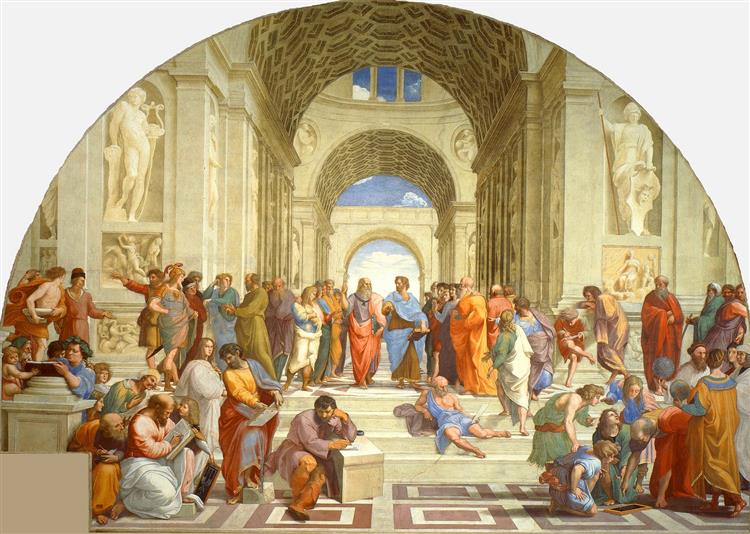
There is a popular claimI — ClaimI names claim: the interruption by which reflected presence is taken as mine.Read full entry → that PlatoPlatoAncient Greek philosopher whose Republic contains the Allegory of the Cave.Read full entry →’s Timaeus preserves a literal report of cyclical, world-resetting cataclysms (and that AtlantisAtlantis — Plato’s Timaeus and CritiasPlato’s Timaeus and Critias are the classical literary sources for the Atlantis tradition. The dialogues present Atlantis as a lost polity in a narrative placed in the distant past; this record uses…Read full entry → is the “proof”). Read on its own terms, Timaeus does not bear that weight. Plato is doing something more characteristic—and more interesting: philosophical myth-making, the kind of “as-if” narration designed to teach through images, not to establish empirical history.
Below is a tight, text-driven case you can share the next time someone insists Timaeus is basically an ancient disaster documentary.
1) Plato labels the whole enterprise a “likely story,” not a proof
In the prefatory framing, Timaeus explicitly describes what he is about to give as a “likely account” (eikōs logos) or “likely story” (eikōs muthos). The Stanford Encyclopedia of Philosophy (SEP) explains the point: the universe in Timaeus is treated as an image (eikōn), and Plato has Timaeus say that our accounts should match their subject—so discourse about an image-like, changing world should itself be image-like (plausible, fitting, not demonstrative).
Pull quote: Plato tells you the genre up front: a “likely story” calibrated to a world in becoming.
If someone wants to treat a segment of this dialogue as an evidentiary record (“therefore, cyclical worldwide cataclysms are established fact”), they must first explain why they are overriding Plato’s own epistemic framing.
2) Atlantis is presented “as history” in the drama, but treated as Platonic myth in scholarship
Inside the dialogue’s theatrical frame, Critias speaks as if he is delivering true history. But that is not how philosophical interpretation typically classifies the Atlantis narrative. SEP’s entry on Plato’s myths treats the Atlantis story as part of Plato’s mythic repertoire—precisely the kind of serious, truth-bearing narration that is not reducible to historical verification.
That matters because the “literal-cataclysm” reading often trades on a confusion:
“It’s told as history” (a rhetorical mode),
therefore it is history (a method claim).
Plato’s dialogues frequently use the first without entailing the second.
3) The cataclysm motif functions as an argument about forgetting, not geology
The “cataclysm” passages (fires, floods, survivors losing arts and letters) do not primarily serve to establish a timeline of Earth disasters. They serve a philosophical and cultural claim: civilizations can lose continuity, and so cultures repeatedly “start over” in knowledge. That supports Plato’s larger posture in Timaeus: humility about human claims, and orientation toward intelligible order rather than relying on fragile human memory.
This is exactly the kind of why-the-record-is-gappy explanation that myths are good at: they dramatize limits of remembranceReturn — RemembranceReturn names remembrance and release: the loosening of possession so reflection can become transparent to source again.Read full entry → and transmission.
Pull quote: In Plato, catastrophe is often a narrative tool for epistemology: why humans don’t reliably remember.
The SEP discussion of the “likely account” underscores this: Plato is carefully calibrating what can be said about the changing, visible cosmos.
4) Later Platonists explicitly treat Atlantis as symbolic “images” pointing beyond themselves
Even within the Platonic interpretive tradition, Atlantis is commonly read as an image-bearing story whose meaning is not exhausted by literalism. Modern scholarship on Proclus’ approach (Proclus wrote a major commentary on Timaeus) explores how he treats the Atlantis narrative as philosophically structured and interpretively rich—an account that can be read on multiple levels, including symbolic ones.
You do not need to accept Proclus’ metaphysics to see the takeaway: a symbolic reading is not a modern “cop-out.” It is a historically rooted way of reading Platonic myth.
5) “But Plato says it’s true”—why that doesn’t settle literalism
Many myths say they are “true.” Plato’s own myth-theory allows for a kind of truth that is not the same thing as empirical confirmation. SEP’s treatment of eikōs muthos highlights why: when the object is perpetually in becoming and cannot be known “strictly,” the appropriate discourse is narrative and probabilistic rather than demonstrative.
So the decisive question becomes:
True in what sense?
True as moral/political instruction (hubris punished; order vs disorder).
True as metaphysical orientation (how to speak about a changing cosmos).
True as cultural diagnosis (why societies lose continuity).
None of that requires (or produces) “proof” of cyclical global cataclysm schedules.
A quick “myth vs. history” checklist for
Timaeus debates
Use this the next time someone insists Timaeus is literal catastrophe reportage:
☐ Does the text flag itself as a “likely story/account”? (Yes.)
☐ Is the narration delivered through layered hearsay inside a dialogue? (Yes: Solon ← Egyptian priest ← Critias ← Plato.)
☐ Is the story doing obvious philosophical work (ethical/political/cosmological framing)? (Yes.)
☐ Do serious reference sources classify Atlantis as a Platonic myth? (Yes.)
☐ Do major interpretive traditions read Atlantis symbolically as well as (or instead of) literally? (Yes.)
If you check most of theseThese — AccumulationThese names accumulation: possessions, titles, achievements, beliefs, communities, and other extensions gathered around identity.Read full entry → boxes, the “literal proof” claim is not a responsible inference from the text.
A cleaner conclusion: what Timaeus supports, and what it doesn’t
What Timaeus supports very strongly is that Plato uses catastrophe imagery to address human limitation—fragile memory, unstable politics, the hazards of overconfident claims about the visible worldImage WorldImage World names a symbolic environment in which representation becomes the dominant medium through which reality, value, identity, and belonging are encountered.Read full entry →, and the need for an account that fits a world in flux.
What it does not support—without importing external assumptions—is the claim that Plato has handed us proof of a literal, cyclical, worldwide cataclysm program.
Geomytha’s final thoughts
The strongest reading isn’t “Plato hid geology.” It’s “Plato taught philosophy with images.”
YouTube: geomytha
X: mythicgeometry
Instagram: mythicgeometry
TikTok: geomytha
Substack: Geomytha Noir
Patreon: Geomytha Noir




.jpg)