How the fall of the great city exposes the bankruptcy of SetSetIn Geomytha, Set names the claimant: I — the interruption by which reflection is taken as mine and converted toward ownership.Read full entry →’s pleasure-economy in the Geomytha field.
RevelationRevelation — Book of RevelationThe final book of the Christian New Testament, also called the Apocalypse of John.Read full entry → 17 showed you who BabylonBabylon — Ancient City / Symbolic EmpireAncient Mesopotamian city and later biblical/apocalyptic symbol of imperial world-order.Read full entry → is:
the great prostitute,
riding Set’s scarlet beast,
dressed in royal luxury,
drunk on the blood of saints,
“the great city that has dominion over the kings of the earth.”
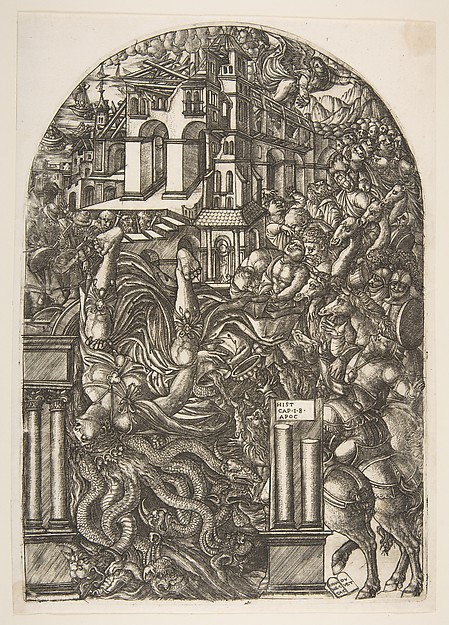
Revelation 18 is her funeral. It is not a courtroom scene; it is a ruin-tour and a lament. Heaven announces her fall. Earth’s merchants and kings wail over her. A mighty angel throws a millstone into the sea and says: “So will Babylon be thrown down, with violence, and will be found no more.”
Through your Geomytha lens, this chapter is what it feels like when:
Set’s city collapses,
Babylon’s promises are revealed as hollow,
all the ways you sold yourself to the pleasure-market stop paying,
and a voice from heaven says:
“Come out of her, my people,
lest you take part in her sins,
lest you share in her plagues.” (Rev 18:4)
It is both:
a macro-vision of civilizational collapse; and
a micro-experience of your own Babylon-pattern finally failing.
A Mighty Angel and the Announcement of the Fall
“After this I saw another angel coming down from heaven, having great authority, and the earth was made bright with his glory. And he called out with a mighty voice,
‘Fallen, fallen is Babylon the great! She has become a dwelling place for demons, a haunt for every unclean spirit… For all nations have drunk the wine of the passion of her sexual immorality, and the kings of the earth have committed immorality with her, and the merchants of the earth have grown rich from the power of her luxurious living.’” (Rev 18:1–3)
One angel, full of light, announces Babylon’s reality. In your lens:
Heaven’s clarity (IsisIsisIn Geomytha, Isis names the unclaimed field: Is — pure being, awareness before possession, and the ground before the claimant appears.Read full entry →-light) shines on Set’s city.
What looked like sophistication and culture is named as what it has become:
a dwelling for unclean spirits,
a haunt for compulsions, addictions, and distortions,
a place where the wine of Babylon (her intoxicating mixture of desire, status, and anesthetic) has been poured into all nations.
The triad returns:
Nations have drunk her wine – the collective emotional field intoxicated.
Kings have fornicated with her – power structures have covenanted with her logic.
Merchants have grown rich from her luxury – the global Set economy is built on her seductions.
This is Set’s world in full bloom: the pleasure-market fused with the power-market, sacralized by religious and cultural forms.
“Come Out of Her, My People”: The Lamb’s Call to Exit the City
“Then I heard another voice from heaven saying,
‘Come out of her, my people, lest you take part in her sins, lest you share in her plagues;
for her sins are heaped high as heaven, and God has remembered her iniquities.’” (Rev 18:4–5)
This is one of the most important lines in the entire book.
In your system, this is not a call to geographical relocation; it is a call to archetypal relocation:
stop making Babylon’s logic your home;
stop letting your HorusHorusIn Geomytha, Horus names the identity that forms after claim: This — the body, role, image, wound, belief, or story taken as what the self is.Read full entry → identityThis — IdentityThis names the formed identity: the body, role, image, wound, belief, or story claimed as what the self is.Read full entry → be defined by her metrics;
stop drinking her wine as if it were the Grail.
“Come out of her” implies:
you can live inside Babylon’s physical environment while spiritually exiting her agreement;
the exit is:
refusing her contracts,
loosening your dependence on her rewards,
reclaiming your presence from her spectacle economy.
“Her sins are heaped high as heaven” reverses the Tower of BabelTower of Babel — Genesis 11Biblical story of the city and tower built in Genesis 11.Read full entry → image:
the tower was humanity’s attempt to build up to heaven;
Babylon’s sins now form the “tower,” and heaven remembers—not in petty grudge, but in the sense of accurately bearing witness to the pattern.
“Lest you share in her plagues” tells you plainly:
Align with her logic, and you will experience her collapse as your own.
Shift allegiance, and you may live in the same world while no longer being of that city.
Double ReturnReturn — RemembranceReturn names remembrance and release: the loosening of possession so reflection can become transparent to source again.Read full entry → and Sudden Collapse
“Pay her back as she herself has paid back others, and repay her double for her deeds… As she glorified herself and lived in luxury, so give her a like measure of torment and mourning… For in her heart she says, ‘I sit as a queen, I am no widow, and mourning I shall never see.’ For this reason her plagues will come in a single day…” (Rev 18:6–8)
Babylon’s interior monologue:
“I sit as a queen.”
“I am no widow.”
“Mourning I shall never see.”
This is Set’s city in denial of impermanence:
convinced of its own invulnerability,
sure that its supply chains, markets, and systems will endure,
emotionally insulated from the costs of its own pleasures.
The “double” repayment is not arbitrary cruelty; it is:
a full return of everything she has done outward,
now experienced inwardly:
all the mourning she outsourced,
all the hunger she ignored,
all the grief she paid others to carry.
“In a single day” and “in a single hour” (repeated later) are images of suddenness:
the illusion of gradual safety is shattered;
events accelerate when they reach a tipping point.
In Geomytha language:
Set’s city can maintain the illusion of stability for a very long time,
but when the bowls are full, collapse looks “sudden,”
even though it is the inevitable result of long patterns.
Kings, Merchants, and Sailors: Who Weeps for Babylon?
Revelation 18 gives three concentric circles of grief:
Kings of the earth – political and power elites.
Merchants of the earth – commercial and economic actors.
Shipmasters and sailors – logistical and trade networks.
All three stand far off and weep. They do not rush in to help; they watch her burn at a distance.
Kings
“And the kings of the earth… will weep and wail over her when they see the smoke of her burning. They will stand far off, in fear of her torment, and say, ‘Alas! Alas! You great city, you mighty city, Babylon! For in a single hour your judgment has come.’” (Rev 18:9–10)
Kings lament:
not the truth,
not the saints,
but the loss of their liaison: the system that made their deals profitable, their power pleasurable.
Merchants
“And the merchants of the earth weep and mourn for her, since no one buys their cargo anymore…” (Rev 18:11)
Then follows a long list of commodities:
gold, silver, jewels, fine linen, purple, silk, scarlet,
all manner of wood, ivory, bronze, iron, marble,
spices, wine, oil, fine flour, wheat, cattle, sheep, horses, chariots,
and finally: “slaves, that is, human souls.” (v.13)
The list climbs from luxury goods down to human beings as inventory.
In your lens, this is Set’s economy laid bare:
everything is reduced to cargo,
even consciousness itself becomes a tradable object,
and when Babylon falls, the merchants’ grief is:
“no one buys our cargo anymore.”
They mourn lost demand, not the liberation of “human souls.”
Shipmasters and Sailors
“And all shipmasters and seafaring men, sailors and all whose trade is on the sea, stood far off and cried out as they saw the smoke of her burning, ‘What city was like the great city?’” (Rev 18:17–18)
TheseThese — AccumulationThese names accumulation: possessions, titles, achievements, beliefs, communities, and other extensions gathered around identity.Read full entry → are the people who move Babylon’s goods:
the logistics, networks, data carriers, media distributors.
They throw dust on their heads and cry “Alas! Alas!”
The refrain is constant:
“In a single hour all thisAll This — World-SystemAll This names the total symbolic environment that has become so complete it is experienced as reality itself.Read full entry → wealth has been laid waste.” (v.17, 19)
In Geomytha:
the entire supply chain of Set’s pleasure-machine is grieving its own obsolescence.
None of these groups are primarily grieving truth; they are grieving the end of their profit and identity.
This is how you can diagnose Babylon in your own life:
When some pattern collapses,
am I mourning the loss of truth, or the loss of comfort and status?
“Rejoice Over Her, O Heaven”: Lamb’s Perspective on the Fall
“Rejoice over her, O heaven, and you saints and apostles and prophets, for God has given judgment for you against her!” (Rev 18:20)
Heaven’s response is not morbid glee; it is relief:
saints, apostles, prophets – thoseThose — ProjectionThose names projection: enemies, outsiders, competitors, threats, and disowned qualities placed beyond the identity boundary.Read full entry → who were silenced by Babylon’s system –
are finally vindicated: their testimony is confirmed.
In your lens, this is when:
all the voices that said, “This system is killing us,”
all the bodies that bore the cost of the pleasure-market,
all the witnesses who pointed to the Lamb and were ignored or crushed,
are publicly shown to have been aligned with Reality all along.
Heaven rejoices not in pain itself, but in:
the dismantling of a structure that could not be reformed, only exposed and removed;
the ending of a field that kept Isis-awareness under constant anesthesia.
Millstone in the Sea: No More of Babylon’s Music
“Then a mighty angel took up a stone like a great millstone and threw it into the sea, saying,
‘So will Babylon the great city be thrown down with violence, and will be found no more;
and the sound of harpists and musicians, of flute players and trumpeters, will be heard in you no more,
and a craftsman of any craft will be found in you no more,
and the sound of the mill will be heard in you no more,
and the light of a lamp will shine in you no more,
and the voice of bridegroom and bride will be heard in you no more…’” (Rev 18:21–23)
The millstone is:
heavy,
irreversible,
sinking into the same sea that once birthed the beast.
The angel then lists everything that ends in Babylon:
music and entertainment,
craft and industry,
productive work (“the mill”),
light,
weddings.
In your lens, this is civilizational stillbirth:
Set’s city, which promised endless music, art, productivity, and romance,
loses all of it in the very moment its inner fraud is revealed.
“For your merchants were the great ones of the earth, and all nations were deceived by your sorcery. And in her was found the blood of prophets and of saints, and of all who have been slain on earth.” (vv.23–24)
“Your sorcery” = pharmakeia – chemically and symbolically mediated illusion:
media, propaganda, drugs, luxury, architecture, ritual –
all used to keep nations in a trance.
Her final indictment:
she holds the blood not only of prophets and saints,
but “of all who have been slain on earth” –
she is the overarching pattern behind every systemic killing.
Babylon’s fall is thus not a side event; it is the core unmasking of Set’s global spell.
How Revelation 18 Functions in Geomytha
Through your system, Revelation 18 is the funeral liturgy of Babylon and the practical core of what it means to “come out of her.”
It shows that:
Babylon is a pleasure–power economy built on selling intimacy, beauty, and security through Set’s logic.
Her “wine” is any mixture of comfort, status, and anesthetic that keeps you from feeling and acting from awareness.
Her fall is both inevitable (given her geometry) and experienced as sudden (in a single hour).
Those most invested in her – kings, merchants, networks – mourn her not because she was good, but because she was profitable.
Heaven rejoices, because her collapse frees consciousness from a field that could not be “fixed,” only abandoned.
For your Geomytha work, this chapter asks very direct questions:
Where, in my own life, am I still drinking Babylon’s wine – trading presence for comfort, truth for luxury, integrity for security?
Which of my loyalties, jobs, or habits are effectively merchants in her system, and which are citizens of a different city?
When I imagine “collapse,” am I secretly more afraid of losing Babylon’s benefits than relieved at the thought of her ending?
What would it practically mean, this week, to “come out of her” in one domain: money, media, sexuality, work, or religion?
If my own “Babylon” – my personal pleasure-system – began to shake, would I stand far off and mourn her, or would I agree with heaven that it is mercy for her to fall?
Revelation 18 is not inviting you to obsess over which global city “is Babylon.” It is inviting you to recognize:
Every time you treat your own soul as cargo,
every time you sell your presence for luxury or anesthesia,
you are living in a small Babylon that will, sooner or later, fall.
The Lamb’s voice in this chapter is simple and urgent:
“Come out of her, my people.”
Not because you are too good for the world, but because you were never meant to live as inventory in Set’s city.
X: @mythicgeometry · Substack: Geomytha Noir · YouTube: Geomytha · Instagram: @mythicgeometry · TikTok: @Geomytha · Patreon: GeomythaNoir