The False-Self Sentence — I Am This

Public references and limits:
Use SN 22.59 as a textual comparison and the spiritual-superiority study as a separate research reference. The project’s sentence is a diagnostic metaphor, not a diagnosis produced whenever someone says I am.
Examples include I am this role, wound, body, belief, story, religion, or insight when the form is treated as final self.
It compresses the fourfold grammar into a single sentence showing how awareness becomes self-description.
Am is seized by I and fixed as This.
'I am this patient's doctor' can coordinate care without fixing a total self. Ask whether the predicate remains role-bound and revisable. The sentence becomes false-self structure only when a limited description is treated as an exhaustive identity.
This entry’s name and mechanism belong to GEOMYTHA’s framework. The linked primary works are independent comparison witnesses, not evidence that the GEOMYTHA term originated in their cultures. Specific comparison references: SN 22.59 — Not-self discourse, primary text; Roos Vonk and Anouk Visser, “An Exploration of Spiritual Superiority: The Paradox of Self-Enhancement”. The original work, a later translation, a catalogue record and an extant manuscript are different kinds of evidence. The oldest surviving witnesses of the comparison traditions are not established by this entry.
The phrase is an internal diagnostic formula, not a claim that all identity statements are false or harmful.
Do not turn 'I am not this' into another rigid identity claim.
Where this mechanism appears
Explore the essays and Index entries linked to this mechanism.
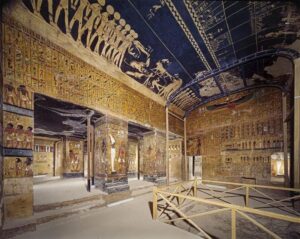 Stars, Moon, Sun, and ThroneHuman beings have always spoken about light. Religions praise light. Mystics seek light. Artists paint light. But perhaps we have been speaking too generally.…
 Babel and the Office CubicleThe office does not look like Babel. That is why nobody notices. Babel looks ancient in the imagination: brick, mud, scaffolding, a tower rising…
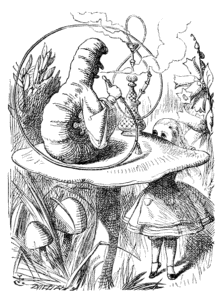 The Caterpillar as HermesThe Caterpillar does not solve Alice’s identity crisis. He names it. By the time Alice reaches him, Wonderland has already begun its work. She…
 Am This and I Am ThisPaid essay — public preview. This page introduces the original essay. The complete argument, examples, and conclusion are available to paid Geomytha subscribers on…
 Algorithms Are Hungry GodsThe feed does not look like an altar. That is why it works. It looks like boredom. It looks like rest. It looks like…
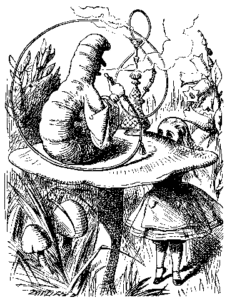 Alice and the Demonstrative WorldWonderland is not random. It only pretends to be. The body changes size. Animals talk. Time breaks. Logic loops. Queens shout. Cards become soldiers.…
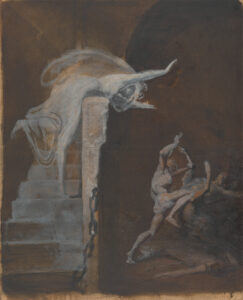 Minos’ TaurusThe monster is not the bull. That is the first correction. The bull is sacred force. Weight, muscle, breath, heat, fertility, thunder in the…
 The Center That Does Not MoveMovement appears to be the opposite of stillness. Yet without stillness, movement becomes impossible. A wheel turns because something does not. The axle remains.…
Showing 8 most recent linked essays.
 Artificial Intelligence (AI)Artificial intelligence is a broad technical field encompassing machine-based systems that can infer from inputs and generate outputs such as predictions, recommendations, decisions, or content for defined objectives. The field includes machine-learning and neural-network…
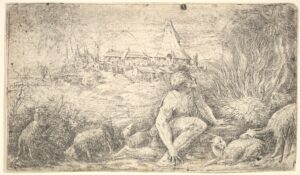 Ehyeh Asher Ehyeh — Exodus 3:14 / Burning BushIn Exodus 3, Moses asks what name he should give the Israelites when they ask who sent him. The reply includes the Hebrew formula Ehyeh Asher Ehyeh before Moses is instructed what to say…
 I Am That — Nisargadatta MaharajI Am That is a published collection of talks by Sri Nisargadatta Maharaj, translated from Marathi by Maurice Frydman and first published by Chetana in 1973.
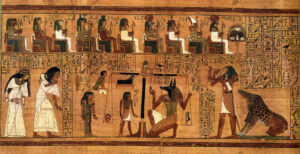 Papyrus of Ani — Weighing of the HeartThe British Museum identifies the scene as Ani’s Judgment in the Hall of Judgment. Ani’s heart is weighed against a feather representing Ma’at, truth and order. The scene belongs to the ancient Egyptian afterlife…
Follow the mechanism
Moves from
 I — ClaimI names claim: the interruption by which reflected presence is taken as mine.
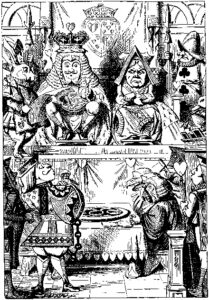 Claim Hardening into IdentityClaim hardens reflected presence into identity when I takes an appearance, role, body, wound, belief, story, insight, or other form and fixes it as This: the self-defining object in the sentence “I am this.”