The Caterpillar does not solve Alice’s identity crisis.
He names it.
By the time Alice reaches him, Wonderland has already begun its work. She has fallen out of ordinary scale. She has grown too large, shrunk too small, cried a pool of tears, forgotten what she knows, recited lessons incorrectly, and found that the world no longer confirms the self she brought into it.
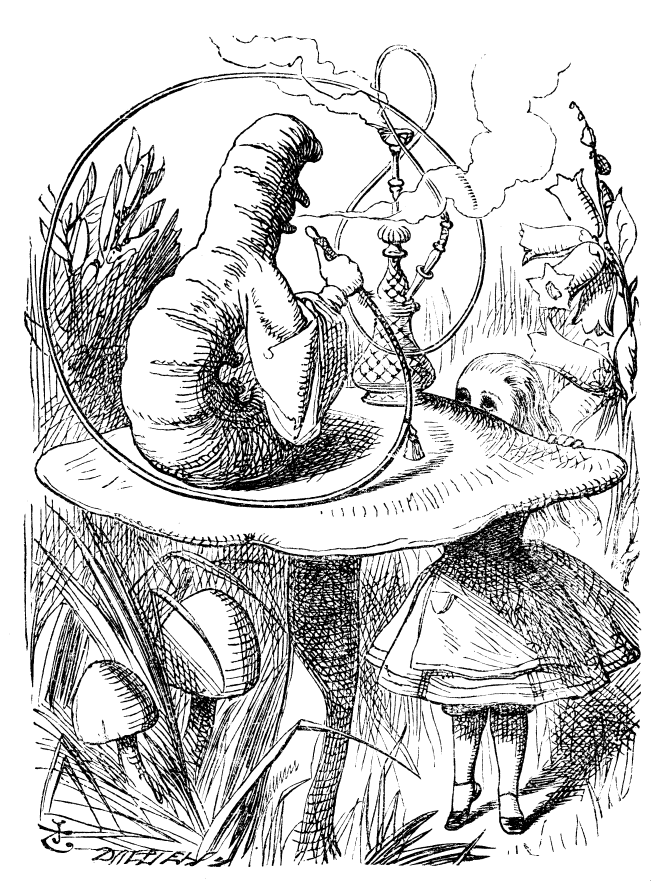
Then she meets a creature sitting on a mushroom, smoking in strange calm, asking the one question she cannot easily answer:
Who are you?
That is the whole threshold.
The Caterpillar does not ask where Alice is going. He does not ask what she wants. He does not ask whether she is frightened, lost, polite, educated, or brave.
He asks who she is.
And Alice cannot answer cleanly.
That is why the scene matters. The Caterpillar is not random weirdness inside a nonsense story. He is a threshold teacher. He appears at the exact moment when identity has become unstable enough to be questioned, but not yet clear enough to return.
He is Hermes slowed into larval form.
The Question at the Mushroom
Alice has a name.
That is not the problem.
She knows, in a surface sense, that she is Alice. But Wonderland has made the name insufficient. Her size keeps changing. Her memory keeps slipping. Her lessons come out wrong. Her body does not hold one stable relation to the world.
The name remains, but the identity underneath it wavers.
That is the crisis.
Most people think identity fails only when the name disappears. But identity can fail while the name remains completely intact. A person can still know what they are called, where they live, what role they perform, what history they carry, and still no longer believe those descriptions fully answer the question.
Who are you?
Not what are you called.
Not what happened to you.
Not what do you do.
Not what size are you today.
Who are you?
Alice has been changing too much to pretend the old answer works. That is why she becomes irritated. She wants the world to stabilize long enough for her to stabilize herself inside it.
The Caterpillar refuses to cooperate.
He does not give her an easier world.
He gives her a sharper question.
Not Just Weird
Wonderland is full of strange figures, but not all strangeness performs the same function.
Some figures confuse Alice. Some distract her. Some threaten her. Some make a joke out of law, time, manners, or logic.
The Caterpillar does something different.
He slows the field.
He sits.
Alice is agitated; he is still. Alice is changing; he is between forms. Alice is trying to explain herself; he does not hurry to accept explanation. His stillness feels almost rude because it does not flatter her urgency.
That is part of the teaching.
A real threshold does not always feel comforting. Sometimes the figure at the threshold is irritating because he refuses to participate in the false pace of panic. He will not rush just because identity is uncomfortable.
The Caterpillar’s strangeness has precision.
He appears as a creature whose entire nature is transformation. He is not yet butterfly. He is not simply worm. He is suspended between states, which makes him the right figure to confront a girl who no longer knows how to say who she is.
Wonderland’s nonsense becomes instruction when the right figure asks the right question.
Alice as Unstable I
In Geomytha, Alice is I under inquiry.
Not I enthroned. Not I as Queen. Not I as false sovereign. Not I claiming the whole field.
She is the questioning subject passing through instability.
That distinction matters. The ego is not only domination. Sometimes I is simply the point from which confusion becomes conscious. Alice asks, objects, argues, notices, wonders, resists, and tries to understand. She is not wrong to have an I.
But her I is being refined.
It can no longer rest on ordinary supports. Body-size fails. Memory fails. Social rules fail. Recitation fails. The world refuses to behave like the classroom, parlor, garden, or nursery she came from.
So Alice’s I has to meet itself without its usual furniture.
That is the crisis the Caterpillar exposes.
Alice is still Alice, but “Alice” no longer explains what is happening to her.
Hermes at the Threshold
Hermes is the god of crossings.
Roads, messages, thresholds, tricks, passages, boundaries, commerce, language, guidance, and movement between worlds all gather around him. He travels where fixed identities become less certain: between divine and human, living and dead, known and unknown, home and road.
The Caterpillar performs a similar function in miniature.
He is not Hermes in Greek costume. He is not carrying the caduceus or wearing winged sandals. He does not need to. His function is Hermetic because he occupies the crossing.
Alice has left ordinary identity but has not yet awakened.
She is inside Wonderland, but not yet owned by it.
She is changing forms, but not yet transformed.
The Caterpillar meets her at that hinge.
He gives instruction indirectly. He speaks with irritating economy. He refuses sentimental comfort. He does not rescue Alice from the threshold; he makes the threshold explicit.
That is Hermetic work.
A threshold guide does not always carry you across.
Sometimes he asks the question that makes crossing unavoidable.
The Caterpillar is Hermes slowed into larval form.
The Larval Teacher
The Caterpillar is not a finished creature.
That is the point.
A butterfly would make the symbolism too easy. It would arrive as completed transformation, wings already opened, beauty already achieved, the moral already visible. The Caterpillar is better because he is not finished.
He is the teacher between forms.
That gives his question authority. He is not asking from the throne of completion. He is asking from the middle of metamorphosis. He knows, by his very body, that identity is not always stable. A caterpillar is a creature whose current form is not its final statement.
That is why he can ask Alice who she is.
He does not ask as someone untouched by change.
He asks as change embodied.
Only a creature between identities can ask identity’s question cleanly.
Smoke, Breath, and the Body
The hookah smoke is strange, and it should not be romanticized.
But symbolically, it matters.
Smoke is breath made visible. Air taking image. Inhalation and exhalation turned into atmosphere. The Caterpillar sits inside visible breath while Alice struggles with invisible instability.
That gives the scene a bodily intelligence.
Alice’s crisis is not only mental. Her body has become unreliable as identity. She has grown and shrunk. Her relation to doors, keys, rooms, and creatures has changed with each bite and drink. She is not merely thinking, “Who am I?” She is experiencing that question through scale.
The Caterpillar’s smoke turns breath into a slow visible field.
He teaches from the place where breath becomes image.
In Geomytha, that matters because breath is one of the simplest ways Am returns to Is. The body receives. The body releases. The body does not need to become an identity in order to be real.
Alice is trying to locate herself in changing form.
The Caterpillar quietly brings the question back to breath, body, and threshold.
The Mushroom
The mushroom is medicine and risk.
One side makes Alice grow. The other makes her shrink. It gives her a way to adjust her relation to the world, but not a final answer. It changes scale, not essence.
That is important.
Many people want identity medicine to tell them who they are. The mushroom does not do that. It only shows Alice that scale can be adjusted.
Too large, and the world becomes unusable. Too small, and the world becomes unreachable. One bite enlarges. Another diminishes. The problem becomes proportion.
This is Virgo’s refinement inside the scene.
Not grand revelation.
Adjustment.
Precision.
A little from one side. A little from the other. Find the scale that lets you pass through the next door.
The mushroom does not tell Alice who she is.
It teaches her that scale is adjustable.
That is not enlightenment, but it is useful. Sometimes the next step is not a new identity. Sometimes it is a better relation to size.
Caterpillar and Cheshire Cat
The Caterpillar and the Cheshire Cat are both strange guides, but they do not do the same work.
The Cheshire Cat disperses.
He appears and disappears. His grin remains after the body is gone. He is wit without weight, logic without ground, personality floating free of embodiment. He is useful, funny, eerie, and evasive.
The Caterpillar condenses.
He has a body. He sits in one place. He asks one question. He gives one tool. He does not dissolve into a smile. He remains at the threshold and forces Alice to speak from instability.
The Cat is disembodied intelligence.
The Caterpillar is embodied threshold.
Both belong to Wonderland’s teaching field, but the Caterpillar is more precise. The Cat makes identity strange by removing the body. The Caterpillar makes identity strange by bringing Alice back to the question her body can no longer answer casually.
The Cat dissolves the body into a grin.
The Caterpillar brings the question back to the body.
The Question as Fire
“Who are you?” can sound simple.
It is not.
Asked at the right moment, it burns.
Not with spectacle. Not with punishment. Not with visible flame. It burns because every false answer becomes uncomfortable.
If Alice answers with her name, the answer is too small. If she answers with her size, the answer changes. If she answers with her memory, the memory is unstable. If she answers with her lessons, the lessons come out wrong. If she answers with manners, Wonderland mocks manners. If she answers with certainty, she is lying.
That is why the question functions like a quiet Second Death Fire.
It exposes without shouting.
Some questions are fires because they leave the false self nowhere comfortable to stand.
The Caterpillar does not destroy Alice. He destroys her ability to answer too quickly.
That is mercy in a severe form.
What This Corrects
The Caterpillar is not merely comic weirdness.
He is a threshold teacher.
He is not a simple guru.
He does not give Alice a doctrine, identity, system, or final form.
The mushroom is not merely random magic.
It is scale medicine, a tool of proportion inside an unstable world.
Alice’s crisis is not that she has no self at all.
It is that her old self-description no longer works.
And Return does not come from finding a better label.
It comes from seeing the instability of the label before rushing to replace it.
That is the hardest correction.
The false self is willing to trade one identity for another forever. It will happily say, “I am not this anymore; now I am that.” It can spiritualize, dramatize, pathologize, politicize, aestheticize, and mythologize every answer.
But the Caterpillar’s question does not ask for a costume change.
It asks what remains when costumes fail.
When the Question Finds You
Everyone eventually meets the Caterpillar.
Not literally.
But the question appears.
A role stops fitting. A body changes. A memory no longer explains the present. A belief loses authority. A title feels thin. A wound cannot carry identity anymore. A spiritual answer becomes rehearsed. A life that once felt coherent starts to feel too large, too small, or strangely borrowed.
Then the question arrives:
Who are you?
The first instinct is to answer quickly.
I am this. I am that. I am a survivor. I am a parent. I am a failure. I am awake. I am broken. I am chosen. I am healing. I am done. I am becoming.
Some of these may be useful.
None of them is source.
The practical work is not to despise every answer, but to stop mistaking the answer for the ground of being.
Ask:
When did my old identity stop answering?
What part of me wants a quick label?
What size am I trying to become?
Where is breath visible as anxiety, speech, smoke, or silence?
Who or what is asking the question I keep avoiding?
Can I stay at the threshold without rushing into a new costume?
When the question “Who are you?” becomes real, the first honest answer may be silence.
The Teacher Between Forms
The Caterpillar is not the final form.
He is not the butterfly.
He is not the answer.
He is the teacher between identities.
That is why he matters. He does not rescue Alice from change by handing her a permanent self. He does not say, “Here is who you are.” He does not turn Wonderland into a stable world or restore the old Alice intact.
He makes her look.
He makes her pause.
He makes the question exact.
This is refinement as return.
Not more information. Not more performance. Not more frantic self-definition.
A clearer recognition of where the false answer fails.
The Caterpillar does not tell Alice who she is.
He teaches her not to trust every answer that arrives too quickly.