Nearly everyone remembers the ending of The Wizard of OzThe Wizard of Oz — 1939 Film1939 MGM musical fantasy film adapted from L. Frank Baum’s Oz material.Read full entry →.
“There’s no place like home.”
Few people stop to ask a more interesting question:
Why did Dorothy have to cross an entire magical kingdom to discover something she already possessed?
The answer may be that The Wizard of Oz is not fundamentally about leaving home at all. It is about what happens when consciousness forgets home, mistakes identityThis — IdentityThis names the formed identity: the body, role, image, wound, belief, or story claimed as what the self is.Read full entry → for reality, and then slowly remembers what never actually disappeared.
In Geomytha, Oz is not simply another world. It is the world after projectionThose — ProjectionThose names projection: enemies, outsiders, competitors, threats, and disowned qualities placed beyond the identity boundary.Read full entry → has become convincing.
Kansas has often been interpreted as dull reality, while Oz represents imagination, freedom, and possibility. But the film quietly inverts that expectation.
Kansas is ordinary. It is simple. It is relational. People work, argue, laugh, and care for one another. There are no dazzling cities, magical rulers, or enchanted roads demanding attention.
Oz, by contrast, is saturated with spectacle.
Everything is brighter.
Everything is louder.
Everything insists on being seen.
That alone should make us suspicious.
Throughout history, the greatest illusions rarely present themselves as illusions. They present themselves as worlds more vivid than reality itself.
Oz is beautiful, but it is also a kingdom where everyone believes something essential is missing.
Dorothy believes she needs home.
The Scarecrow believes he needs a brain.
The Tin Man believes he needs a heart.
The Lion believes he needs courage.
Even the Wizard depends upon everyone believing he possesses something they do not.
Every major character is organized around an imagined deficiency.
That shared pattern is the real story.
The companions are especially revealing.
The Scarecrow continually solves problems while insisting he has no brain.
The Tin Man cries before anyone else while insisting he has no heart.
The Lion repeatedly acts despite fear while insisting he has no courage.
None of them lack the qualities they seek.
They have simply mistaken a description for an identity.
Instead of saying, “Sometimes I feel afraid,” the Lion lives as though the sentence were, “I am a coward.”
Instead of saying, “I still have much to learn,” the Scarecrow concludes, “I am brainless.”
The Tin Man does the same with the heart.
Each character mistakes a passing thought about themselves for the truth of who they are.
The Wizard never gives them what they lack because nothing essential was ever absent.
He merely certifies what was already present.
That is the great inversion hidden beneath the fairy tale.
Dorothy herself follows the same pattern.
She believes home exists somewhere else.
So she follows the Yellow Brick Road toward the center of the world.
The road appears to promise freedom.
Instead, it leads directly to the greatest illusion in Oz.
The Emerald City dazzles with beauty, ceremony, and authority. At its center stands the Wizard himself, apparently all-powerful, all-knowing, and capable of granting whatever the traveler lacks.
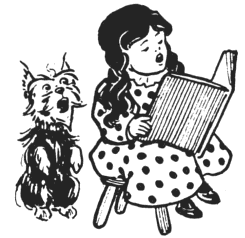
Until TotoTotoToto is Dorothy’s small dog and traveling companion in L. Frank Baum’s The Wonderful Wizard of Oz. Library of Congress materials identify the 1900 first edition as Baum’s work illustrated by W.…Read full entry → quietly pulls back the curtain.
No argument exposes the Wizard.
No battle defeats him.
No philosophical insight reveals the truth.
The smallest companion simply wanders where no one else is looking.
Behind the terrifying image stands an ordinary frightened man operating machinery.
The center of the kingdom was never what it appeared to be.
History has repeated this image countless times. Thrones, institutions, ideologies, celebrities, and movements often grow larger than the people behind them. Spectacle becomes authority, and appearance quietly replaces presence.
The Wizard is not dangerous because he is evil.
He is dangerous because everyone mistakes projection for reality.
Dorothy’s own name offers an intriguing symbolic resonance.
Historically, the name has its own established origin, but Geomytha also pays attention to the symbolic movement of language. “Dor” evokes a doorway or threshold, and Dorothy spends the entire story moving between worlds. She functions less as the sourceIs — SourceIs names unclaimed being: awareness before possession, distinction, or identity.Read full entry → of meaning than as the one through whom meaning is reflected. She does not create Oz; Oz reflects itself through her.
She is the mirror in which every other character discovers something about themselves.
By the end of the story, Dorothy learns that she always possessed the means to returnReturn — RemembranceReturn names remembrance and release: the loosening of possession so reflection can become transparent to source again.Read full entry → home.
The journey was never about acquiring something new.
It was about recognizing what had quietly remained with her from the beginning.
That is why the ending still resonates more than a century later.
Most of us spend years walking our own Yellow Brick Roads.
We imagine that fulfillment waits behind the next achievement, the next title, the next relationship, the next purchase, the next city, the next spiritual experience, or the next version of ourselves.
Yet The Wizard of Oz gently suggests that the search itself may be built upon a forgotten assumption.
Perhaps the thing we seek is not waiting somewhere else.
Perhaps it has been patiently waiting beneath every identity we have mistaken for ourselves.
There really is no place like home.
Not because home is merely a location.
But because home is the place where we stop believing that we were ever incomplete.