Everyone remembers Dorothy.
Some remember the Scarecrow, the Tin Man, and the Cowardly Lion.
Almost everyone remembers the Wizard.
Very few stop to ask a simple question:
Who actually exposes the deception at the center of Oz?
The answer isn’t Dorothy.
It isn’t Glinda.
It isn’t the Scarecrow.
It isn’t the Lion.
It isn’t even the Wizard himself.
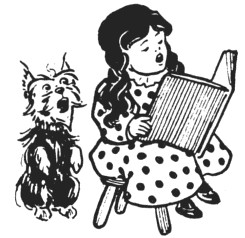
It’s TotoTotoToto is Dorothy’s small dog and traveling companion in L. Frank Baum’s The Wonderful Wizard of Oz. Library of Congress materials identify the 1900 first edition as Baum’s work illustrated by W.…Read full entry →.
The smallest character performs the most important act in the entire story.
That isn’t accidental.
Every major character in The Wizard of OzThe Wizard of Oz — 1939 Film1939 MGM musical fantasy film adapted from L. Frank Baum’s Oz material.Read full entry → believes appearances.
Dorothy believes the Wizard can send her home.
The Scarecrow believes he lacks intelligence.
The Tin Man believes he lacks a heart.
The Lion believes he lacks courage.
Even the citizens of Emerald City believe the enormous face behind the throne possesses extraordinary power.
Only Toto behaves differently.
He doesn’t search for answers.
He doesn’t ask permission.
He doesn’t seek recognition.
He simply notices.
He follows movement that everyone else ignores.
While every eye remains fixed on the giant projected image, Toto wanders toward the edge of the room.
Then he pulls back the curtain.
That single moment changes everything.
The illusion collapses, not because someone defeats it, but because someone quietly looks where no one else thinks to look.
This pattern recurs across mythology and modern storytelling.
The faithful companion often recognizes reality before the hero does.
Instinct sees what identityThis — IdentityThis names the formed identity: the body, role, image, wound, belief, or story claimed as what the self is.Read full entry → overlooks.
The mind can become fascinated by power, status, spectacle, and authority.
Instinct simply asks:
“What is actually here?”
That question is enough to dismantle entire kingdoms built upon appearance.
The Wizard loses nothing in that moment except the belief surrounding him.
The machinery was always there.
The man was always there.
Only attention changes.
This also explains one of the stranger patterns in the film.
The Wicked Witch repeatedly threatens Toto.
On the surface, it seems cruel.
Symbolically, it is almost inevitable.
Toto is dangerous because he cannot be controlled by appearances.
He doesn’t care about castles.
He isn’t impressed by titles.
He doesn’t negotiate with spectacle.
He remains faithful to immediate reality.
If the false kingdom depends upon everyone staring at the illusion, then the greatest threat isn’t the strongest warrior.
It’s the smallest creature willing to walk behind the curtain.
This pattern reaches far beyond Oz.
In Homer’s Odyssey, Argos is the only one who immediately recognizes Odysseus after twenty years away.
Kings fail.
Servants fail.
Friends fail.
The old dog does not.
Recognition comes before explanation.
In John Wick, the puppy represents the last living relationship untouched by violence and identity. Its death marks the moment the old self hardens into vengeance.
In I Am Legend, Sam keeps Neville connected to ordinary love and companionship. After Sam dies, isolation begins consuming him.
Even ancient EgyptEgyptAncient Egyptian cultural and mythic field referenced by the essay.Read full entry → places a canine figure—AnubisAnubis — Egyptian Funerary DeityEgyptian deity associated with funerary rites and the weighing scene.Read full entry →—at the threshold between worlds, not as the ruler of the dead, but as the faithful guide leading souls through transition.
Again and again, myth gives dogs the same symbolic work.
They accompany.
They recognize.
They remain faithful.
Toto himself never seeks transformation.
The Scarecrow wants intelligence.
The Tin Man wants a heart.
The Lion wants courage.
Dorothy wants home.
Toto seeks nothing.
He never wonders whether he is enough.
He never asks the Wizard to complete him.
He simply remains what he already is.
That quiet completeness allows him to perform the story’s decisive act.
Perhaps that is why Toto still resonates so deeply.
Every age builds its own Emerald Cities.
Every generation creates new Wizards whose voices seem larger than life.
The temptation is always the same: to mistake appearance for reality.
Yet somewhere beneath the noise remains a quieter faculty.
It notices what doesn’t quite fit.
It wanders toward the edge of the stage.
It pulls back the curtain.
The question is not whether Toto exists.
The question is whether we still trust him enough to follow.