Most people assume the problem begins with the ego.
Others believe the problem begins with thought.
Still others blame the body, desire, memory, language, politics, technology, or society.
But what if the problem begins somewhere much smaller?
What if it begins with a sentence?
Not a long sentence.
Not a complicated sentence.
Just three words:
I am thisThe False-Self Sentence — I Am ThisThe false-self sentence forms when claim joins reflection to a fixed object of identity: I am this.Read full entry →.
The sentence appears harmless. In ordinary life it is almost unavoidable.
I am a teacher.
I am a Christian.
I am an American.
I am successful.
I am a failure.
I am traumatized.
I am awakened.
I am a skeptic.
I am a victim.
The object changes endlessly, but the structure remains the same.
I.
Am.
This.
The sentence may be the most powerful myth-making machine humanity has ever created.
To understand why, we must begin before the sentence appears.
The moon does not create its own light.
It reflects light.
That reflectionAm — ReflectionAm names reflected presence: awareness embodied or mirrored without yet becoming ownership.Read full entry → is beautiful, useful, and real. Yet the moon remains a mirror rather than a sourceIs — SourceIs names unclaimed being: awareness before possession, distinction, or identity.Read full entry →.
In the same way, consciousness reflects being.
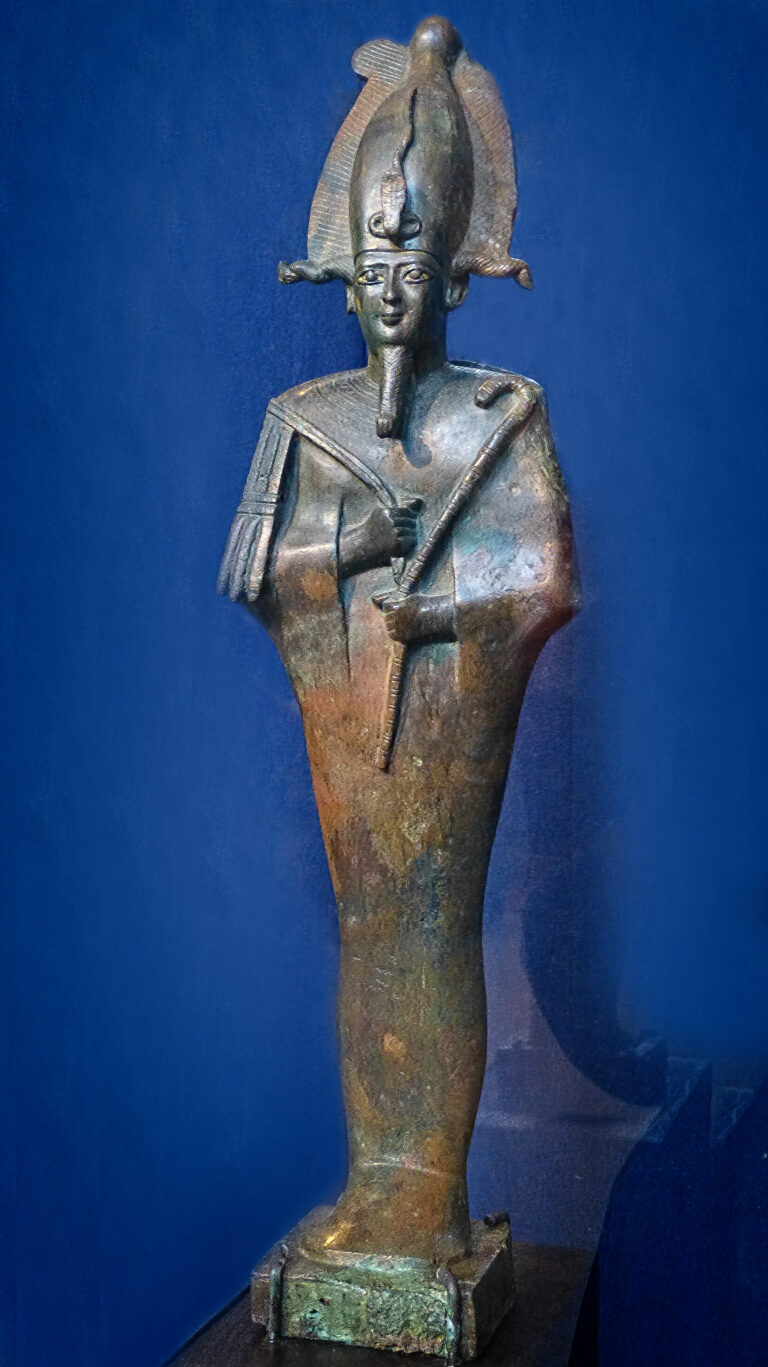
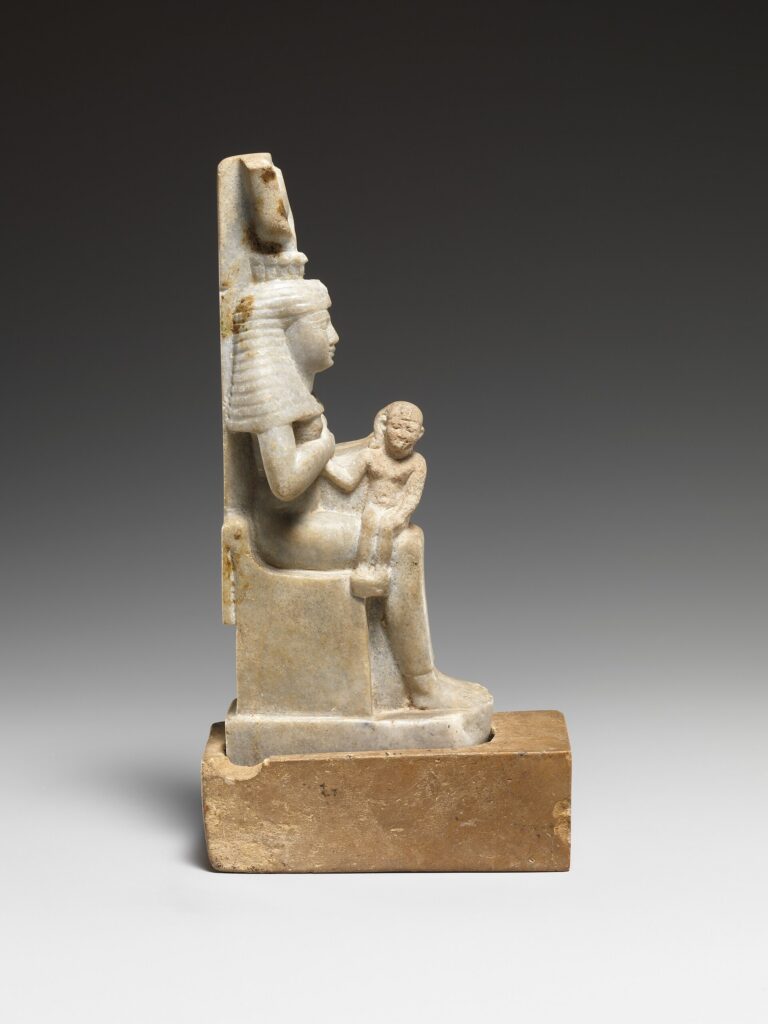
The ancient Egyptians encoded this relationship through OsirisOsirisIn Geomytha, Osiris names reflected presence: Am — awareness reflected as living consciousness without yet becoming ownership.Read full entry →.
Osiris is neither pure source nor hardened identityHorusIn Geomytha, Horus names the identity that forms after claim: This — the body, role, image, wound, belief, or story taken as what the self is.Read full entry →. He occupies the middle ground. He reflects.
This is why lunar symbolism follows him so persistently. The moon and Osiris share the same function. Both reveal something that originates elsewhere.
Reflection is not the problem.
Consciousness is not the problem.
The interruptionThe Interruption — Am → IAm → I is the interruption in which reflected presence becomes claim.Read full entry → arrives later.
The Egyptians gave that interruption a name.
SetSetIn Geomytha, Set names the claimant: I — the interruption by which reflection is taken as mine and converted toward ownership.Read full entry →.
Modern readers often treat Set as a villain, devil, or embodiment of evil. Yet the myths themselves are more subtle. Set is the force that separates, divides, measures, names, claims, and distinguishes.
Without Set there is no boundary.
Without Set there is no category.
Without Set there is no “me” and “not me.”
The same force that allows navigation can also create confusion.
The problem is not distinction itself.
The problem appears when distinction becomes possession.
When reflection is no longer merely seen.
It is claimed.
The sentence emerges:
I am this.
A body appears.
Then comes:
I am this body.
A belief appears.
Then comes:
I am this belief.
A wound appears.
Then comes:
I am this wound.
A role appears.
Then comes:
I am this role.
The role is not the problem.
The body is not the problem.
The wound is not the problem.
The belief is not the problem.
The claimI — ClaimI names claim: the interruption by which reflected presence is taken as mine.Read full entry → is the problem.
The claim hardens the reflection into identityThis — IdentityThis names the formed identity: the body, role, image, wound, belief, or story claimed as what the self is.Read full entry →.
Ancient myths returnReturn — RemembranceReturn names remembrance and release: the loosening of possession so reflection can become transparent to source again.Read full entry → to this pattern repeatedly.
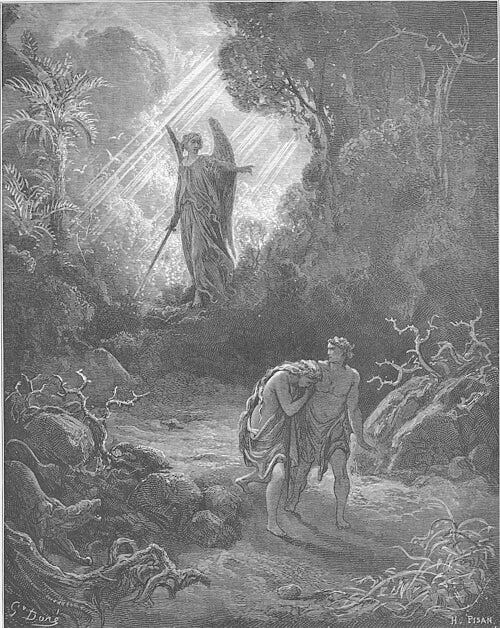
Consider Adam and Eve.
The story is often reduced to disobedience, morality, or forbidden knowledge. Yet another reading sits beneath the surface.
The fruit is not merely information.
The fruit becomes identity.
Knowledge transforms into self-definition.
The moment knowledge becomes “who I am,” the garden changes.
The sentence has appeared.
I am this.
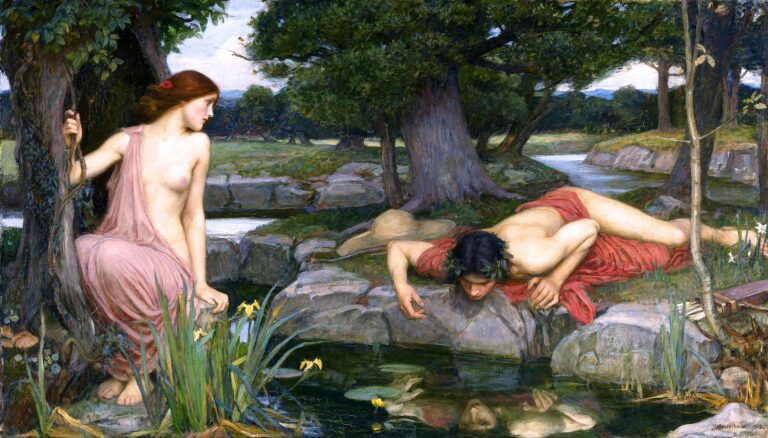
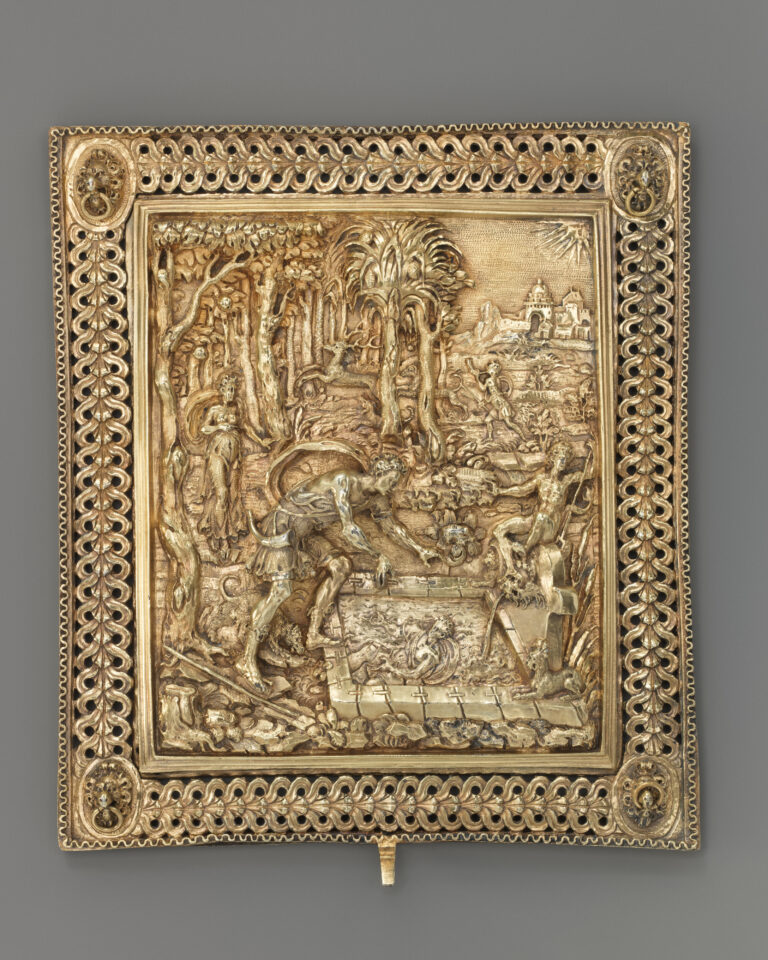
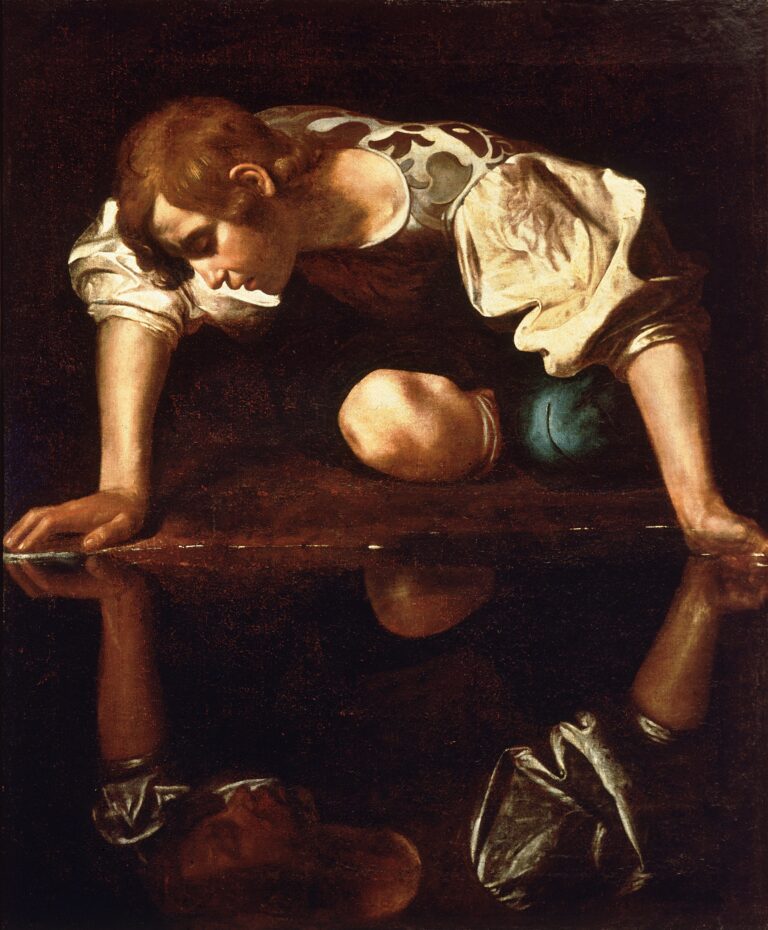
The same pattern appears in the story of NarcissusNarcissusIn Ovid’s Metamorphoses Book III, Narcissus encounters his image in a pool, initially responds to it as though it were another beloved figure, and remains attached even after recognizing the image as…Read full entry →.
The tragedy is not that he sees a reflection.
Everyone sees reflections.
The tragedy is that he mistakes the reflection for himself.
A mirror becomes reality.
An image becomes identity.
He falls in love not with being, but with a reflected appearance.
Again, the sentence is hidden beneath the story.
I am this.
The pattern scales far beyond individual psychology.
Politics often functions through the same mechanism.
The issue is rarely a policy alone.
The issue becomes identity.
I am this party.
I am this ideology.
I am this movement.
Religion often follows the same path.
A tradition becomes an identity.
A doctrine becomes a self.
A symbol becomes a possession.
Social media intensifies the process further.
Profiles, brands, opinions, achievements, grievances, and aspirations accumulate into a carefully managed image.
The image is displayed.
Defended.
Curated.
Improved.
Protected.
The image becomes the self.
The sentence grows stronger.
I am this.
Yet something strange happens whenever the sentence loosens.
The body remains.
Thought remains.
Memory remains.
Work remains.
Relationships remain.
Life continues.
What disappears is not existence.
What disappears is the claim.
A carpenter may still build tables.
A parent may still raise children.
A musician may still write songs.
The difference is subtle.
The role becomes something being performed rather than something being worshiped.
The role becomes functional rather than existential.
This distinction matters.
A carpenter saying “I am a carpenter” may simply be communicating a profession.
Identification occurs when the deeper belief emerges:
Without carpenter, I disappear.
Without success, I disappear.
Without this belief, I disappear.
Without this story, I disappear.
At that point reflection has become possession.
The claimant has seized the mirror.
This is where another Egyptian figure enters the story.
Horus.
Horus is the formed identity.
The king.
The image.
The visible self that emerges after the claim.
In symbolic terms, Horus is born when reflection becomes identity.
The process is simple:
Being reflects.
Reflection is claimed.
Claim becomes identity.
The sentence creates the king.
The king then spends his life defending the kingdom the sentence built.
Most of human history can be read through this lens.
Individuals defend identities.
Groups defend identities.
Nations defend identities.
Religions defend identities.
Civilizations defend identities.
All built upon the same small grammatical structure.
I am this.
The sentence appears everywhere because it is extraordinarily useful.
It allows orientation.
It allows memory.
It allows social organization.
Yet it also creates confusion whenever it is mistaken for reality itself.
The moon never becomes the sun.
The reflection never becomes the source.
The image never becomes the thing reflected.
The mirror functions perfectly when it remembers its role.
Perhaps human identity functions the same way.
The body can remain.
The role can remain.
The story can remain.
The reflection can remain.
The sentence simply loosens.
The claim softens.
The image becomes transparent.
And what remains is not less life.
It is life no longer trapped inside borrowed names.