Jacob enters the story holding a heel.
That image is not incidental. It is the whole mechanism.
Before he has a name, before he has a plot, before he has a birthright to bargain for or a blessing to steal, Jacob is already reaching. His brother Esau emerges first: red, hairy, bodily, immediate. Jacob comes after him with his hand locked around Esau’s heel.
The myth tells you what he is.
He is the grab.
Not merely a man.
Not merely a patriarch.
Not merely a clever younger brother.
He is the moment consciousness seizes what was already moving.
The first article named the grammar:
Is. Am. I. This.
The second placed that grammar in the body:
Air is Is.
Lungs are Am.
The belly is the Is-AmReflection Without OwnershipReflection without ownership is the condition in which experience can appear, relate, and move without being seized as mine.Read full entry → crossing.
The head-axis is I.
The claimed identity-bodyHorusIn Geomytha, Horus names the identity that forms after claim: This — the body, role, image, wound, belief, or story taken as what the self is.Read full entry → is This.
Jacob appears inside that sequence.
He appears right where the current is vulnerable.
Right as Is becomes Am.
Right as breath becomes felt.
Right as presence begins to emerge.
Right as reflectionAm — ReflectionAm names reflected presence: awareness embodied or mirrored without yet becoming ownership.Read full entry → could returnReturn — RemembranceReturn names remembrance and release: the loosening of possession so reflection can become transparent to source again.Read full entry →.
The heel-grabber reaches.
That is the birth of I.
Esau is firstness. He is red earth, appetite, field, immediacy, embodiment. He belongs to the body before the story about the body. He is not pure sourceIs — SourceIs names unclaimed being: awareness before possession, distinction, or identity.Read full entry →, but he is closer to the raw event of life. He hunts. He hungers. He sweats. He comes in from the field. He is not subtle. He is not strategic. He is not polished.
He arrives.
Jacob is different.
Jacob waits. Jacob calculates. Jacob listens from inside the tent. Jacob bargains at the exact moment of weakness. Jacob disguises himself. Jacob speaks in another’s texture. Jacob receives what belongs to the firstborn by becoming an image of him.
That is thought.
Not thought as useful tool.
Thought as claimantSetIn Geomytha, Set names the claimant: I — the interruption by which reflection is taken as mine and converted toward ownership.Read full entry →.
Thought waits for a sensation, then names it.
Thought waits for hunger, then bargains with it.
Thought waits for fear, then builds identityThis — IdentityThis names the formed identity: the body, role, image, wound, belief, or story claimed as what the self is.Read full entry → around it.
Thought waits for embodiment, then disguises itself as embodiment.
This is why Jacob matters so much.
The false self does not usually announce itself as evil. It appears as cleverness. It appears as strategy. It appears as survival. It appears as I need to know. It appears as I need to secure this. It appears as I need to make this mine before it disappears.
That is the heel-grab.
A feeling arises.
Before it can simply be felt, thought says:
I am thisThe False-Self Sentence — I Am ThisThe false-self sentence forms when claim joins reflection to a fixed object of identity: I am this.Read full entry → feeling.
A hunger arises.
Before it can simply move through the body, thought says:
I need this to be complete.
An insight arises.
Before it can return to silence, thought says:
I am the one who understands.
A symbol arises.
Before it can remain alive, thought says:
I must categorize this now.
This is Jacob’s hand on the heel.
The current was moving.
The claimant seized it.
In Geomytha, Set is not only violence, desert, or solar force. Set is projectionThose — ProjectionThose names projection: enemies, outsiders, competitors, threats, and disowned qualities placed beyond the identity boundary.Read full entry → hardened into rule. Set is the movement by which reflection stops serving source and begins serving control. He is the clever interruption that turns living presence into managed identity.
Jacob is one of Set’s most intimate masks.
He is not Set as open destroyer. He is Set as timing.
Set as strategy.
Set as narrative.
Set as the thought that arrives half a second after sensation and says: mine.
That is more dangerous than obvious evil.
Obvious evil can be resisted. The heel-grabber feels like intelligence.
Most people do not experience the false self as a tyrant at first. They experience it as help.
It helps explain the body.
It helps protect the wound.
It helps predict rejection.
It helps organize memory.
It helps make plans.
It helps construct a continuous person who can move through the world.
None of that is inherently wrong.
The problem begins when help becomes ownership.
The servant becomes heir.
Jacob does not merely assist Esau. He replaces him.
That is the crucial point.
Thought should serve the body, but it replaces the body.
Language should serve presence, but it replaces presence.
Symbol should serve recognition, but it replaces recognition.
Analysis should serve return, but it replaces return.
Then the blessing goes to the wrong center.
The body is still there, but the story has taken power.
That is the mythic meaning of the stolen blessing.
Isaac, dim-eyed and nearing death, cannot clearly see. That matters. Perception is failing. Discernment is weak. The father-principle cannot distinguish the true body from the disguised claimant. Jacob covers himself in the texture of Esau and approaches as if he were the firstborn.
This is exactly how thought steals authority from presence.
It comes wearing the body’s clothing.
Anxiety feels like intuition.
Suspicion feels like discernment.
Urgency feels like truth.
Control feels like care.
Spiritual ambition feels like awakening.
The disguise works because it borrows the texture of something real.
Jacob does not appear as Jacob. He appears as Esau.
Thought does not appear as distortion. It appears as what is really happening.
That is why the blessing is so often misdirected.
The body gives a signal, and thought impersonates the signal. The gut contracts, and thought says, this means danger. The chest tightens, and thought says, this means rejection. A symbol opens, and thought says, this means I have found the final key. The nervous system trembles, and thought says, this proves the story.
The father within blesses the disguise.
Then identity is born from a misreading.
This is how I am this forms.
Not because sensation is false.
Not because the body is false.
Not because intuition is false.
Because the claimant disguised itself as the firstborn and received authority.
Esau later cries out because something real has been displaced.
That cry matters.
It is the cry of the body when the story has taken over.
It is the cry of instinct after strategy has inherited the house.
It is the cry of presence after thought has received the blessing.
Anyone who has lived too long in analysis knows this cry. The body becomes exhausted from being interpreted. Every feeling is assigned a doctrine. Every symbol becomes a task. Every dream becomes a code. Every ache becomes a warning. Every insight must be harvested before it fades.
The living field cannot breathe.
Jacob is ruling.
But the story does not end there.
Jacob has to leave. The claimant cannot remain peacefully in the house it has stolen. Once the blessing is taken, exile begins. This is exact. The I that grabs presence does not create rest. It creates movement, fear, strategy, pursuit, and return deferred.
The false self may win the blessing, but it loses home.
This is why all identity is restless.
It has to keep justifying the theft.
It has to keep proving that it really is the one. It has to keep repeating the name, repeating the story, repeating the wound, repeating the achievement, repeating the belief. It cannot simply rest as Is-Am, because it began by interrupting that rest.
So it moves.
It plans.
It bargains.
It dreams of ladders.
It accumulates wives, children, flocks, arrangements, names, signs.
It becomes a life.
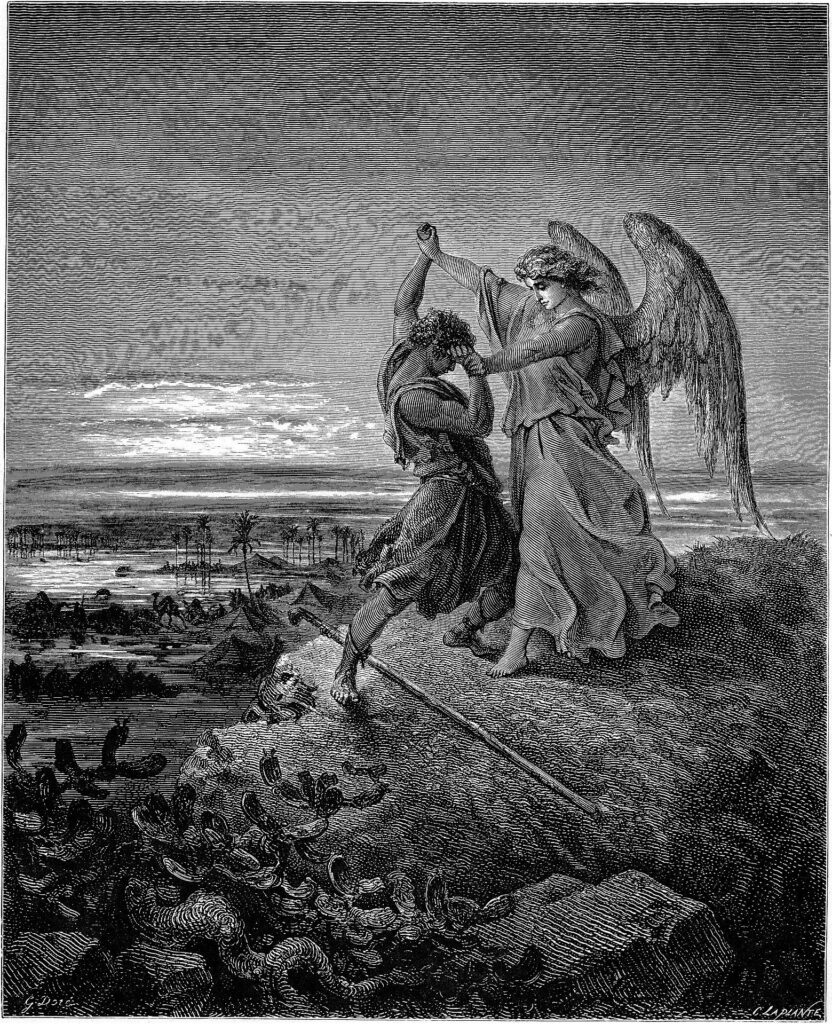
And then, finally, it must wrestle.
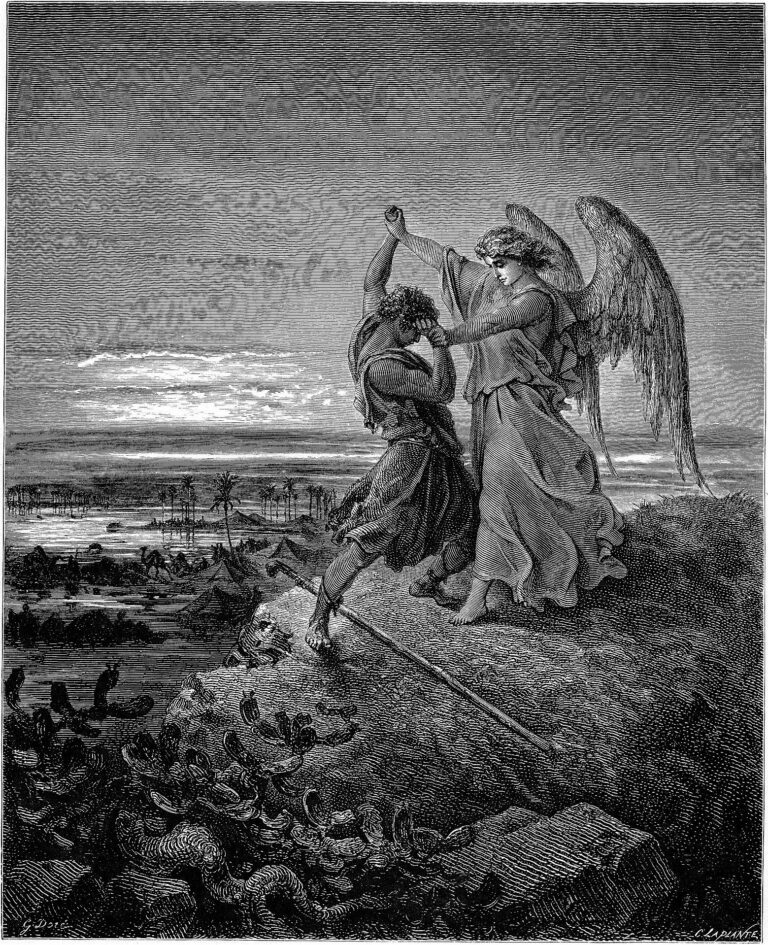
Jacob at the ford is not a separate episode. It is the heel-grabber brought to crisis. The claimant has reached the threshold where strategy can no longer carry him. He is alone at night. He is between lands. He is about to meet Esau again — about to face the displaced firstness, the body, the brother, the original emergence he once grabbed.
So something wrestles him.
The myth says a man.
The tradition says an angel.
Geomytha says: the claimant meets the limit of claimI — ClaimI names claim: the interruption by which reflected presence is taken as mine.Read full entry →.
This is where the head-axis burns.
Jacob wants a blessing again. Even here, he clings. Even here, he will not let go until he receives a name, a mark, a confirmation. The heel-grabber has become the wrestler. The grab has moved upward.
Earlier he grabbed the heel.
Now he grips the divine encounter.
This is what happens in spiritual life when the false self becomes refined. It no longer only grabs food, status, approval, or protection. It grabs God. It grabs awakening. It grabs the system. It grabs the symbol. It grabs the practice. It wants a sacred name.
That is why spiritual identity is so dangerous.
The same mechanism remains.
I need to know.
I need to be blessed.
I need to be renamed.
I need proof that my struggle means something.
I need the divine to certify me.
This is still Jacob.
But the wound changes him.
His hip is touched. His walk is altered. The body receives the mark that strategy could not control. He leaves the encounter limping.
That limp is important.
The claimant is not destroyed. But it is humbled. It can no longer move as if cleverness alone governs the world. The body has been marked by something deeper than strategy. The walk now remembers the limit.
That may be the beginning of return.
Not because Jacob becomes pure source. He does not. Not because the I vanishes forever. It does not. But because the claimant has met what it cannot simply seize.
This is the practical lesson.
Do not try to murder Jacob.
Notice him.
Notice the grab.
Notice the instant when sensation becomes me.
Notice the instant when inquiry becomes possession.
Notice the instant when symbol becomes system.
Notice the instant when practice becomes performance.
Notice the instant when breath becomes identity.
That noticing is already a loosening.
The heel-grabber works best in darkness. He works in the half-second before awareness catches him. He works through automatic ownership. He works through the speed of I.
So slow the sequence down.
There is pressure in the chest.
Before saying I am anxious, pause.
There is heat in the face.
Before saying I am angry, pause.
There is hunger in the belly.
Before saying I need this, pause.
There is symbolic excitement.
Before saying I have found the key, pause.
Let the current finish.
Inhale:
Is-Am.
Exhale:
Am-Is.
The practice is not passive. It is precise.
It lets Esau emerge without Jacob grabbing him. It lets the body be felt without the head stealing it. It lets reflection happen without the claimant becoming heir.
That is how Horus is prevented from forming too quickly.
Not by rejecting life.
Not by suppressing sensation.
Not by hating thought.
Not by refusing analysis.
By refusing premature ownership.
This is the Taurus steadiness inside the Waxing Crescent stir. Something is emerging, but it does not need to be seized. The current is young. The form is not yet stable. The old habit reaches for the heel because it fears losing control.
Let it reach.
But do not give it the blessing.
Let thought appear as thought.
Let sensation appear as sensation.
Let breath appear as breath.
Let the body be first without becoming identity.
Then the old order begins to correct itself.
Esau does not need to be crowned as ego either. The answer is not to replace Jacob with instinct. The answer is to restore right relation. Body first. Thought second. Presence prior. Claimant humbled. Action allowed. Identity loosened.
Jacob can serve.
He can plan the road.
He can speak when speech is needed.
He can bargain when bargaining is necessary.
He can remember names and dates and dangers.
He can help the body survive.
But he cannot be source.
He cannot be the firstborn of being.
He cannot be allowed to steal Am from Is and call the result me.
That is the line.
The heel-grabber becomes destructive only when he is mistaken for the self.
Once he is seen, he becomes a function.
That is enough.
The next time the mind reaches too quickly, do not condemn it. Do not dramatize it. Do not build a new identity around having noticed it.
Just see the hand.
There is Jacob.
There is the grab.
Then breathe.
Is-Am.
Am-Is.
The current does not need to be stolen to be real.
The blessing does not belong to the claimant.
It belongs to the living passage before claim: breath entering, presence reflecting, reflection returning, the body moving without becoming a throne.
For one breath, Esau emerges ungrabbed.
For one breath, Jacob arrives late.
And in that small delay, the false self loses its inheritance.