Author: D. Cyprian

  • The Soft Parade

    The Soft Parade

    Waxing Gibbous · Gemini — Build in Noticing — Soft Vigilance: How Comfort, Attraction, and Design Can Shape a Choice Before It Feels Like One

    The old form of control is easy to recognize.

    A wall.

    A guard.

    A threat.

    A command.

    Do this or suffer the consequence.

    The softer form is harder to see because it often feels like choice.

    Nothing forces the hand.

    The field is simply arranged.

    One option is easier.

    One image is brighter.

    One button is already selected.

    One life looks desirable because everyone around you appears to want it.

    That does not mean the choice is fake.

    It means choices happen inside environments.

    And environments have structure.

    Demonstrators on the Sunset Strip during the November 1966 curfew protest, photographed for the Los Angeles Free Press.
    Sunset Strip curfew protest, November 1966. Los Angeles Free Press. Public domain in the United States. The Strip gives the article its historical doorway: youth, spectacle, nightlife, resistance, and competing forms of social order in the world The Doors inhabited.

    The Doors Give Us the Phrase

    The Doors released The Soft Parade in 1969.

    The title track is not a tidy pop song. It is a long, shifting suite that moves through spoken sermon, sanctuary-seeking, changing rhythms, brass, rock, and psychedelic movement.

    The band’s own official history describes the album as one of the most polarizing records of its career because of the strings and brass that changed the familiar Doors sound.

    Later accounts connect Morrison’s phrase “the soft parade” with the strange, varied human procession of Sunset Boulevard.

    That context is enough for GEOMYTHA.

    A parade is organized movement made visible.

    It has rhythm.

    It has spectators.

    It has sequence.

    But a soft parade does not necessarily look commanded.

    People can appear to drift while still moving through the same field.

    That is the symbolic door.

    Soft Power Is a Real Term—and a Narrow One

    The older version of this essay used “soft power” too broadly.

    Joseph Nye coined the term in international relations for the ability to affect others through attraction rather than coercion or payment.

    Culture can matter.

    Values can matter.

    Prestige can matter.

    A country can gain influence because other people find something about it desirable.

    That is not the same thing as an app default, an advertisement, or an algorithm.

    The distinction matters because “soft power” becomes useless if it means every influence that does not involve a weapon.

    So GEOMYTHA keeps Nye’s term where it belongs.

    Then it asks a broader symbolic question:

    how does attraction shape a person differently from force?

    The Interface Is Not Neutral

    For digital life, Lawrence Lessig gives us a better frame.

    His argument is that code and architecture structure what is possible in cyberspace.

    The user does not arrive in an empty field.

    The field has already been built.

    There are buttons.

    Permissions.

    Defaults.

    Rankings.

    Visible options and invisible options.

    Things the system makes easy and things the system makes hard.

    The old draft called this “software is soft law.”

    That phrase can stay as GEOMYTHA shorthand, but the documented mechanism is architecture.

    The system shapes the space in which action happens.

    Defaults Show How Gentle Design Can Move Behavior

    Choice-architecture research makes the point concrete.

    When one option is preselected as the default, people are more likely to remain with it.

    A meta-analysis of 58 studies found a substantial average default effect, while also finding meaningful variation across settings.

    That is important because it avoids two bad conclusions.

    First bad conclusion:

    people have no agency.

    False.

    Second bad conclusion:

    design does not matter because people are free to click something else.

    Also false.

    Freedom and influence can exist at the same time.

    That is the exact territory of the soft parade.

    A Window Is Not a Door

    Now we can return to GEOMYTHA.

    A door and a window both open a wall.

    But they ask different things from the body.

    A door asks for passage.

    A window allows sight without crossing.

    This is symbolic language, not architectural history.

    But it is useful.

    A screen is an astonishing window.

    You can see a war without entering the country.

    Watch a wedding without knowing the couple.

    Visit a museum without traveling.

    Learn a skill without entering a classroom.

    None of this is inherently false.

    It is one of the great powers of mediation.

    The danger begins when seeing starts to substitute for crossing.

    Watching exercise replaces moving.

    Reading about intimacy replaces risking intimacy.

    Following politics replaces participating in community.

    Collecting insight replaces changing behavior.

    The window shows.

    The door costs something.

    Comfort Is Not Captivity

    This article also fails if it turns comfort into suspicion.

    Convenience can be humane.

    Defaults can protect people from needless friction.

    Accessible interfaces can expand autonomy.

    Recommendation systems can help people find music, books, information, and communities they genuinely value.

    Softness can be mercy.

    That is why the distinction cannot be:

    hard equals honest;

    soft equals manipulation.

    The more useful distinction is whether softness increases or decreases a person’s capacity to notice the structure around the choice.

    Some defaults are transparent and still effective.

    Some reduce cognitive burden.

    Some support welfare.

    Some hide the decision.

    Some make opting out deliberately painful.

    The ethics are in the design and the relation.

    The Parade Becomes Identity

    GEOMYTHA’s deeper concern is what happens when the field does more than shape a choice.

    It begins shaping the chooser.

    A recommendation becomes taste.

    Taste becomes affiliation.

    Affiliation becomes profile.

    Profile becomes identity.

    Now the system does not merely know what the person clicked.

    The person begins using the click as evidence of who they are.

    This is where GEOMYTHA’s root grammar enters:

    Is → Am → I → This.

    The problem is not preference.

    The problem is the moment preference becomes throne.

    I watched this.

    I like this.

    I belong here.

    I am this.

    The Soft Parade Is Not a Conspiracy

    This is the most important stress test.

    A coordinated hidden controller is not required.

    Designers optimize.

    Companies compete.

    Creators chase attention.

    Users imitate one another.

    Markets reward some patterns and punish others.

    Institutions copy what appears to work.

    The field can become directional without one person secretly directing the whole field.

    That is a better model of modern influence than imagining a single machine with one operator.

    Soft Vigilance

    The answer is not hardness.

    It is not paranoia.

    It is not rejecting technology, pleasure, convenience, advertising, music, recommendations, or beautiful things.

    The answer is softer than that.

    Notice the field.

    When something feels effortless, ask what effort has been removed.

    When something is already selected, notice who selected it.

    When something feels attractive, notice whether attraction is replacing judgment.

    When a window keeps opening, ask whether there is a door you have stopped crossing.

    When a preference starts becoming identity, loosen the sentence before it hardens.

    The soft parade does not have to stop.

    You only have to notice that you are in it.

    Build carefully. Notice the route. Enjoy the music without assuming the rhythm chose itself.

    Sources

  • From Ice Age to I Age

    From Ice Age to I Age

    Waxing Gibbous · Gemini — Build Through Noticing — Devoted Pattern-Recognition: Reading the Ages Without Mistaking Wordplay for History

    Ice sounds like “Is.”

    AI sounds like “A.I.” and ends with “I.”

    Eye sounds like “I.”

    Son sounds like sun.

    GEOMYTHA can do something useful with those echoes.

    But first it has to say what they are.

    They are English wordplays.

    They are not etymology.

    They are not archaeology.

    They are not proof that history was designed to move through GEOMYTHA’s grammar.

    Once that boundary is clear, the title becomes much more interesting.

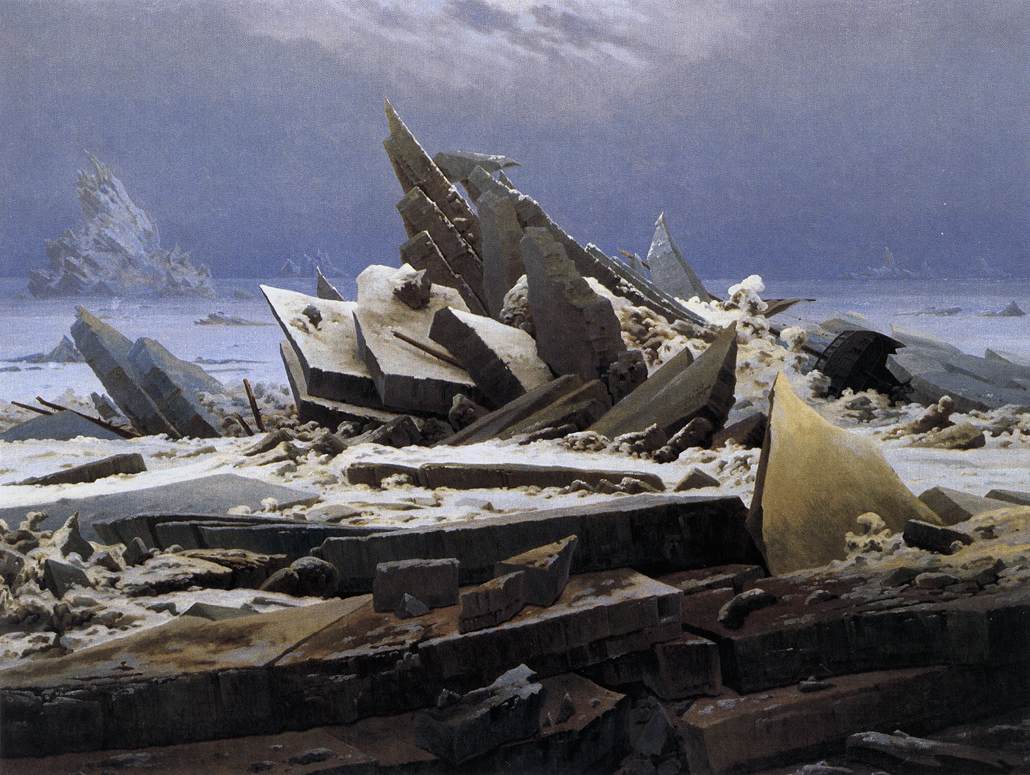
    Caspar David Friedrich's The Sea of Ice, showing jagged slabs of frozen sea crushing a shipwreck.
    Caspar David Friedrich, The Sea of Ice, 1823–1824. Hamburger Kunsthalle. Public-domain artwork; Wikimedia Commons reproduction.

    Ice Is Not “Is”

    Start with the obvious correction.

    An Ice Age is a geological and climatic condition, not a spiritual era before ego.

    Earth has experienced repeated glacial and interglacial periods. The Quaternary Period began about 2.58 million years ago, and the present Holocene is a relatively warm interglacial within that larger glacial history.

    So “Ice Age = Is Age” cannot be a historical claim.

    It is a poetic device.

    And a poetic device can still reveal something.

    Ice is water in a more fixed form.

    That makes it a useful image for GEOMYTHA’s question about form:

    when does something fluid become stable enough to name, hold, divide, measure, and defend?

    The value is in the comparison.

    Not in pretending the pun was hidden inside geology.

    The Ages Were Never One Universal Staircase

    The old draft treated Stone Age, Bronze Age, Iron Age, Axial Age, Industrial Age, Information Age, Image Age, and AI Age as though humanity had moved through one clean sequence of consciousness.

    History is messier.

    The Stone–Bronze–Iron sequence is an archaeological classification system strongly associated with nineteenth-century Danish antiquarian Christian Jürgensen Thomsen. It was built by organizing artifacts according to dominant tool materials.

    Even that useful system is regional.

    Stone, bronze, and iron did not replace one another everywhere at the same time, and some regions did not pass through the same sequence at all.

    The “Axial Age” is different again. Karl Jaspers coined the term in the twentieth century for a proposed cluster of religious and philosophical changes in the first millennium BCE. Scholars still debate whether those different developments truly form one coherent “age.”

    Industrial Age, Information Age, and AI Age are different kinds of labels again.

    They describe technologies, economies, institutions, and cultural conditions that overlap rather than replacing one another cleanly.

    So there is no defensible historical ladder that reads:

    Stone → Bronze → Iron → religion → industry → information → image → AI → awakening.

    That ladder was the old article’s weakest move.

    What an “Age” Label Actually Does

    But age labels are still revealing.

    They tell us what later observers think organized a period strongly enough to name it.

    Stone.

    Bronze.

    Iron.

    Industry.

    Information.

    Artificial intelligence.

    The label compresses an enormous field into one dominant feature.

    That compression is useful.

    It is also dangerous.

    The age-name can make one material, technology, or idea look more total than it ever was.

    GEOMYTHA notices the same pressure in identity.

    A whole person becomes:

    fighter.

    mother.

    victim.

    believer.

    artist.

    diagnosis.

    profile.

    The label is not necessarily false.

    It becomes false when the label pretends to be the whole field.

    This Is the Real “I Age”

    That gives us a cleaner meaning for I Age.

    It is not a date on a universal timeline.

    It is a diagnostic phrase for any culture in which the self becomes increasingly named, measured, displayed, optimized, archived, and predicted.

    The modern world gives that process unusually powerful tools.

    Profiles.

    Photographs.

    Biometrics.

    Search histories.

    Follower counts.

    Recommendations.

    Personality categories.

    Generated avatars.

    Models trained to predict what a person might say or want next.

    None of those things creates the human tendency toward identity.

    They make identity easier to externalize.

    The self leaves more traces.

    Those traces can then be collected into an increasingly convincing “This.”

    The Calendar Does Not Prove the Myth

    The old article also treated BC/AD as though history itself had been mystically cut around “the Son,” which then became “the Sun.”

    There is a real historical fact underneath that idea, but it is smaller.

    The Anno Domini year-numbering system was devised in the sixth century by Dionysius Exiguus while preparing Easter tables. It numbered years from a calculated incarnation of Jesus. The system spread later and became one of several ways human societies have numbered years.

    That is historically Christian chronology.

    It does not prove a cosmic shift in consciousness at year one.

    And “Son / Sun” is an English homophone.

    It can produce a useful literary comparison.

    It cannot establish historical causation.

    The Rule for Wordplay

    This article therefore needs a rule that applies far beyond this article.

    A pun can open interpretation.

    It cannot close the case.

    Ice / Is can make us think about fluidity becoming form.

    Eye / I can make us think about seeing becoming identity.

    Son / Sun can make us compare visible heirs and visible centers.

    AI / I can make us think about synthetic models of personhood.

    Those are interpretive prompts.

    They are not evidence that the words share an origin, that ancient people encoded the pun, or that history was secretly arranged around English spelling.

    That distinction is not a limitation on GEOMYTHA.

    It is what keeps GEOMYTHA from becoming coincidence worship.

    Is → Am → I → This Is a Grammar, Not a Chronology

    GEOMYTHA’s root sequence remains:

    Is → Am → I → This.

    Is is awareness before claim.

    Am is reflected or embodied presence.

    I is the claimant.

    This is form hardened around the claim.

    That sequence can be used to read a moment.

    A relationship.

    A myth.

    A political identity.

    A social profile.

    A technological system.

    What it should not become is a fake universal history in which every archaeological era is forced into one step of the grammar.

    The grammar is functional.

    History remains historical.

    The Stress Test: Earlier Humans Were Not “Before Ego”

    The oldest version of this essay romanticized the past.

    It imagined an earlier lunar or maternal world before the fever of identity.

    We do not have evidence for that universal condition.

    Prehistoric and ancient societies show hierarchy, violence, trade, status, ritual, family organization, territoriality, cooperation, art, care, domination, and extraordinary variation.

    Modernity did not invent claim.

    Technology did not invent ego.

    And older does not automatically mean closer to source.

    The GEOMYTHA return cannot therefore mean returning to a supposedly pure prehistoric age.

    It has to happen now.

    AI Makes the “I Age” Easier to See

    Artificial intelligence gives the title one final useful pressure.

    Not because AI proves that humanity has reached the final stage of “This.”

    Because machines can now generate convincing language, images, voices, and behavioral predictions from patterns in data.

    That forces an uncomfortable question:

    how much of what we call personality is repeatable pattern?

    The wrong answer is:

    therefore a person is only data.

    The better answer is:

    some parts of identity are patterned enough to imitate.

    That makes the distinction between living presence and repeatable self-description more important, not less.

    From Age to Attention

    Instead of asking what age humanity is objectively “in,” ask what your current environment keeps training you to treat as central.

    Production?

    Information?

    Visibility?

    Prediction?

    Identity?

    Every answer reveals a pressure.

    Then ask the smaller question:

    what sentence does that pressure make easier to say?

    I am productive.

    I am informed.

    I am visible.

    I am optimized.

    I am this profile.

    That is the real move from age to “I Age.”

    Not a secret history.

    A way of noticing how environments help claims harden into selves.

    Build the pattern carefully. Notice what the name reveals. Then release whatever the name cannot contain.

    Sources

  • The Spice Must Flow

    The Spice Must Flow

    Waxing Gibbous · Gemini — Build in Noticing — Captive Fascination: How Dune Turns Scarcity Into Power—and Why Attention Now Works the Same Way

    “The spice must flow.”

    The line is so closely associated with Dune that it feels like it must have come from Frank Herbert’s novel.

    It did not.

    The exact phrase comes from David Lynch’s 1984 film adaptation.

    But it captures something Herbert’s world makes unmistakable:

    the whole system depends on a scarce substance that cannot simply stop moving.

    Historic photograph of coastal sand dunes near Florence, Oregon, the landscape that helped inspire Frank Herbert's Dune.
    Sand dunes near Florence, Oregon. Oregon Historical Society / Wikimedia Commons, no known copyright restrictions. Frank Herbert’s encounter with the Oregon dunes helped generate the ecological world that became Dune.

    What Spice Actually Does in Dune

    Melange is not just a luxury.

    It extends life.

    It alters perception.

    In certain people it expands prescience.

    Guild Navigators depend on spice-enabled prescience to plot safe routes through space.

    It is also addictive.

    That means spice is doing several jobs at once.

    It is medicine.

    Drug.

    Navigation infrastructure.

    Economic choke point.

    Political leverage.

    The important thing is not that everyone in the Imperium literally consumes spice.

    The important thing is that too many essential systems depend on access to it.

    Herbert’s Real Warning Was About Systems

    This is where the old version of this essay overreached.

    It claimed Herbert had “encoded a civilization whose deepest commodity was intensified consciousness itself.”

    That is GEOMYTHA language, not documented Herbert intent.

    Herbert’s own explanation is more concrete and more useful.

    In his 1980 essay “Dune Genesis,” Herbert said that the scarce water of Dune was an exact analogue of oil scarcity and that CHOAM was OPEC. He also described a larger concern with ecological, political, and economic systems that gather power and then keep grinding forward.

    His Oregon-dunes research mattered for the same reason.

    He had gone to Florence, Oregon, to investigate a real effort to control moving sand dunes. The project pushed him toward a story about ecology, intervention, scarcity, and the unintended consequences of systems trying to master environments.

    So the documented spine of Dune is already strong enough:

    when a civilization organizes itself around a controlling minimum, whoever governs that minimum gains extraordinary power.

    Spice Is Not Attention

    Now GEOMYTHA can make its own comparison.

    Spice is not literally attention.

    Frank Herbert did not say it was.

    The modern attention economy is a different system.

    But it has one striking structural resemblance:

    the system becomes more valuable the longer a scarce input can be captured, directed, measured, and sold.

    In advertising-supported social media, that scarce input is human attention.

    Business-ethics research on the attention economy describes the user’s attention as the product sold to advertisers and notes the strong incentive platforms have to keep users active and engaged for long periods.

    That gives the phrase “the spice must flow” a new contemporary use.

    Not as a secret prophecy by Herbert.

    As a comparison we can make now.

    Captive Fascination

    The article’s emotional attunement is Captive Fascination.

    Fascination is not the same as attention.

    Attention can be quiet.

    It can be deliberate.

    It can remain with one thing long enough to understand it.

    Fascination pulls.

    The next post.

    The next outrage.

    The next notification.

    The next identity signal.

    The next promise that something important is happening somewhere just beyond the current screen.

    Now attention is not simply being used.

    It is being kept in circulation.

    That is the modern spice-flow analogy.

    The Feed Has Its Own Controlling Minimum

    A social platform can contain billions of images, arguments, jokes, memories, ads, conversations, and videos.

    But abundance creates its own scarcity.

    There is more content than anyone can consume.

    What becomes scarce is the ability to notice any particular piece of it.

    Creators compete for that notice.

    Advertisers compete for it.

    Platforms allocate it.

    Algorithms rank it.

    Visibility becomes a resource.

    That is not identical to CHOAM controlling spice.

    But both systems become easier to read once we ask:

    what scarce input does the larger machine need in order to keep functioning?

    The Spice Girls Are Not Evidence

    The original essay made a leap from Dune to the Spice Girls.

    That was clever but weak.

    The group’s famous individual nicknames—Posh, Scary, Baby, Sporty, and Ginger—were coined by Top of the Pops magazine after the group had already formed and released “Wannabe.”

    There is no evidence those names have anything to do with Dune.

    The only useful comparison is ordinary branding:

    distinct personalities can be made instantly recognizable through compressed labels.

    That belongs to marketing history.

    It does not belong in the evidentiary spine of this article.

    Prescience Is Power—and a Trap

    Spice does more than move ships.

    It opens possible futures.

    That makes it especially useful for GEOMYTHA because prediction is never neutral.

    The more a system tries to anticipate what comes next, the more attention gets pulled out of the present and organized around possible futures.

    Again, this is our interpretation.

    But the comparison to contemporary feeds is strong enough to be useful.

    Recommendation systems are not prophetic.

    They predict.

    They estimate what someone may click, watch, buy, or respond to next.

    The platform then reorganizes the visible field around those predictions.

    The future is not seen.

    It is continually modeled.

    And the model changes what the user sees now.

    The GEOMYTHA Grammar

    GEOMYTHA’s root grammar is:

    Is → Am → I → This.

    Awareness enters relation.

    The claimant appears.

    The claim hardens into an identity.

    The attention economy makes that last step commercially useful.

    A stable identity produces predictable signals.

    What do you watch?

    What do you hate?

    What do you buy?

    Which group do you defend?

    Which aesthetic do you repeat?

    Which story keeps you engaged?

    The platform does not need a complete theory of who you are.

    It needs enough repeated behavior to predict what may hold you next.

    In GEOMYTHA language, “This” becomes legible to the system.

    The Stress Test: Attention Is Not Automatically Captivity

    This analogy fails if it treats all attention as exploitation.

    People use social platforms to learn, organize, maintain relationships, find communities, make art, run businesses, laugh, and encounter information they would not otherwise see.

    Not every user becomes compulsive.

    Not every platform uses the same business model.

    And not every moment of engagement is manipulation.

    The comparison to spice becomes useful only when dependence develops at the system level:

    the platform needs continued engagement;

    the creator needs continued visibility;

    the advertiser needs continued notice;

    and the user begins to feel that stepping away means disappearing from the world that matters.

    That is captive fascination.

    The Difference Between Spice and Water

    Dune gives us one final correction.

    Spice is not the only scarce thing on Arrakis.

    Water is more basic.

    Herbert himself emphasized that scarcity.

    That distinction matters symbolically.

    One resource keeps the larger imperial system moving.

    The other keeps bodies alive.

    Modern digital life has the same risk of confusion.

    Visibility can feel necessary.

    Engagement can feel necessary.

    Being current can feel necessary.

    But the nervous system still needs sleep, silence, direct relationship, movement, unmeasured time, and places where no one is counting response.

    The empire needs spice.

    The organism needs water.

    The Spice Does Not Have to Stop Flowing

    The practical return is not total withdrawal.

    Herbert’s own work is too suspicious of simple heroic solutions for that.

    The better question is dependency.

    What system has become impossible to imagine without a particular flow?

    Who gains power from keeping that flow necessary?

    What happens when the flow slows?

    And what more basic need has been confused with the thing the system requires?

    That is where Dune and the attention economy finally meet.

    Not because Frank Herbert predicted Instagram.

    Because he understood dependence.

    Notice what keeps the machine moving. Notice what keeps you alive. Do not confuse the two.

    Sources

  • The Awakened Self Is Still a Self

    The Awakened Self Is Still a Self

    Waxing Gibbous · Gemini — Build in Noticing — Refined Vanity: How Insight Becomes Another Form of “I Am This”

    The ego can survive church.

    It can survive leaving church.

    It can survive meditation.

    It can survive nonduality.

    It can survive symbolic decoding.

    It can even survive the sentence:

    “The ego is an illusion.”

    The false self does not need you to remain asleep.

    Sometimes it only needs you to become proud of waking up.

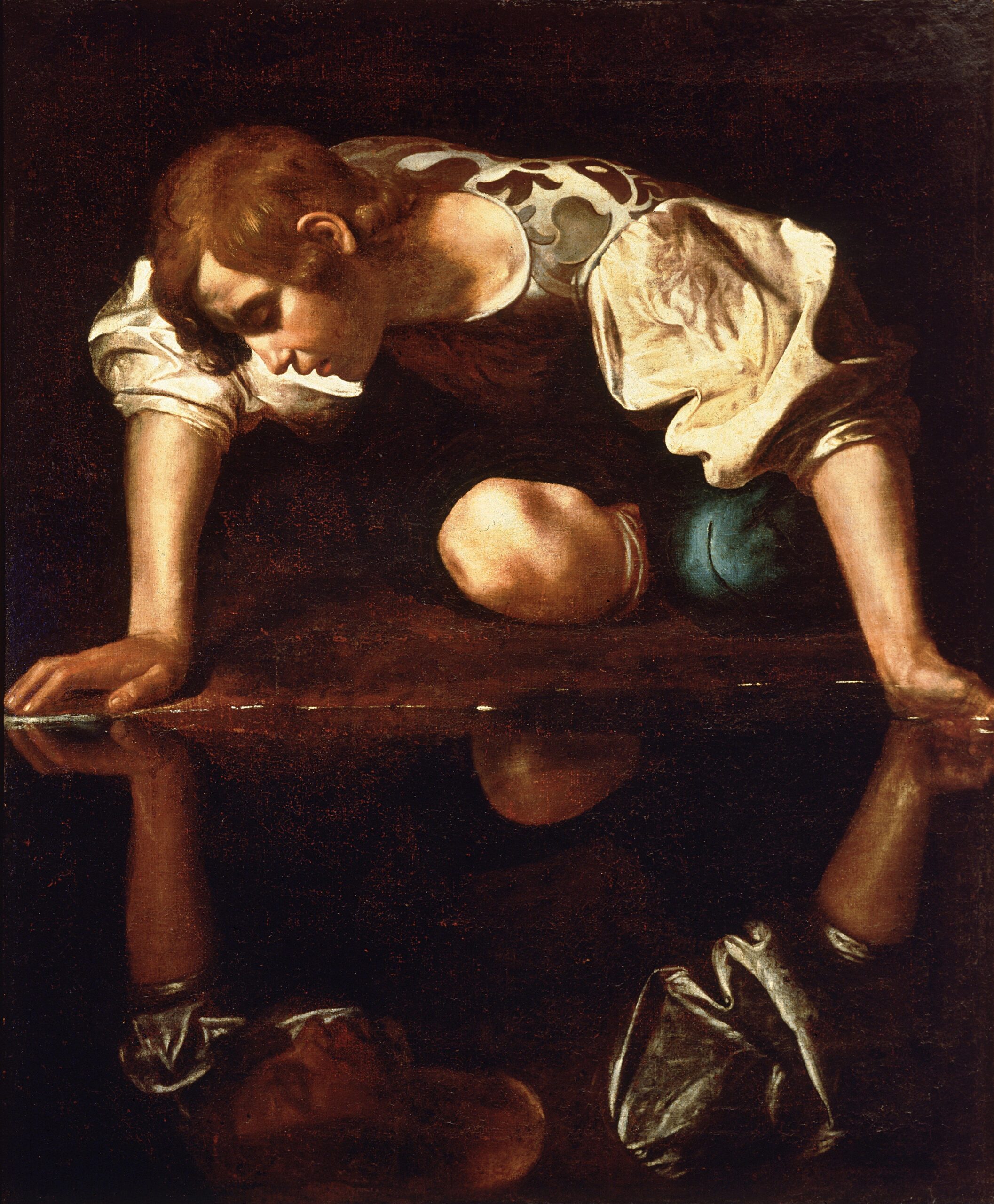
    Caravaggio's Narcissus, showing the youth leaning over and absorbed in his own reflection.
    Narcissus, 1597–1599, traditionally attributed to Caravaggio, Gallerie Nazionali di Arte Antica, Palazzo Barberini. Public-domain reproduction.

    The Reflection Can Become a Crown

    Narcissus gives us a clean image for the problem.

    The danger is not reflection.

    The danger is becoming absorbed in the reflected image.

    Insight has the same risk.

    A person sees through a false belief, a manipulative institution, an inherited role, a bad relationship, a political story, or a religious shell.

    That seeing may be real.

    Then another sentence quietly appears:

    I am the one who sees.

    Now reflection has become identity.

    This Is Not a New Problem

    Buddhist texts describe a remarkably precise version of this trap.

    In the Khemaka Sutta, Khemaka explains that a practitioner can stop identifying the aggregates as “this is me” and still retain a subtler residual sense of “I am.” The gross identity claim has weakened, but the conceit has not completely disappeared.

    That distinction matters.

    One can stop saying “I am this” while still being organized around “I am.”

    GEOMYTHA does not claim the sutta secretly teaches its grammar. The parallel is structural.

    Seeing through one identity does not guarantee that the claimant has disappeared.

    Spirituality Can Become Self-Improvement for the Ego

    Chögyam Trungpa later gave a modern Buddhist name to the same danger: spiritual materialism.

    His point was not that spiritual practice is fake.

    It was that the ego can use spirituality as material for its own improvement and confirmation.

    The practice meant to loosen the self can become another way to decorate it.

    The believer becomes the awakened one.

    The sinner becomes the healer.

    The ordinary person becomes the empath, decoder, starseed, initiate, shadow-worker, nondual knower, or person who “sees through the matrix.”

    The vocabulary changes.

    The grammar may not.

    Psychology Finds the Same Paradox

    This is not only a religious warning.

    Psychologists Roos Vonk and Anouk Visser studied what they called spiritual superiority. Across three studies, they found that spiritual superiority was related to self-worth tied to spiritual accomplishment and was especially associated with communal narcissism and self-ascribed spiritual guidance.

    Another study following yoga practitioners and meditators found increased self-enhancement after practice rather than the expected simple “ego-quieting” effect.

    These studies do not prove that meditation, yoga, or spiritual training make people narcissistic.

    They establish a narrower and more useful point:

    a practice intended to reduce self-focus can still become a domain in which the self feels especially accomplished.

    The Awakened Identity

    GEOMYTHA’s root grammar is:

    Is → Am → I → This.

    Presence enters relation.

    Relation becomes claim.

    Claim hardens into form.

    The spiritual trap is not that insight appears.

    It is that insight becomes another “This.”

    I am this awakened person.

    I am this one who knows.

    I am this one who sees through the lie.

    I am this one who is no longer fooled.

    The object is more refined.

    The sentence is unchanged.

    The Anti-Religion Can Become a Religion

    This happens whenever leaving a system becomes a new superiority system.

    The old world had believers and unbelievers.

    The new world has awake people and sheep.

    The old world had heresy.

    The new world has programming.

    The old world had priests.

    The new world has permanent explainers.

    The labels are different.

    The social structure can be almost identical.

    This does not mean criticism of religion, media, politics, medicine, or institutions is invalid.

    Some institutions deserve criticism.

    Some stories are manipulative.

    Some official explanations are incomplete or false.

    The trap begins when being the one who sees through the system becomes more important than seeing accurately.

    The Decoder’s Problem

    This matters especially for GEOMYTHA.

    Pattern-reading is rewarding.

    A myth echoes a film.

    A song echoes a ritual.

    A symbol appears in several traditions.

    A word suddenly seems to unlock a larger structure.

    Sometimes that comparison is genuinely useful.

    But symbolic intelligence has a built-in temptation:

    once the pattern is seen, the self begins to hunger for more patterns.

    Then resemblance becomes proof.

    Coincidence becomes intention.

    Interpretation becomes certainty.

    And the interpreter becomes special because he can see what others cannot.

    That is exactly why GEOMYTHA’s source rule matters:

    similarity is not proof of common origin, and symbolic correspondence is not evidence of creator intent.

    The rule protects the reader.

    It also protects the decoder from becoming the doctrine.

    Spiritual Bypassing: When “Awakening” Avoids the Wound

    There is another way the awakened identity can protect itself.

    It can use spiritual language to avoid unresolved pain.

    Psychologists often call this spiritual bypassing.

    A 2026 meta-ethnographic synthesis of qualitative research described spiritual bypassing as the use of spiritual beliefs or practices to avoid psychological distress. Importantly, the authors did not treat it as proof that spirituality itself is pathological. They described it as a contextually adaptive response that can become limiting and emphasized movement toward more integrated spirituality rather than abandonment of spirituality.

    That distinction fits the mechanism here.

    The problem is not insight.

    The problem is using insight to become unavailable to what still hurts.

    The Stress Test: Awakening Can Be Real

    A critique of spiritual vanity becomes dishonest if it implies that every claim of insight is vanity.

    People do change.

    Meditation can deepen attention.

    Religious practice can reduce self-absorption.

    A person can genuinely recognize a destructive pattern and stop repeating it.

    Someone can leave a manipulative group and become freer.

    Someone can see through a lie.

    The mistake would be to say:

    because insight can become identity, insight is not real.

    That does not follow.

    The better test is what the insight does afterward.

    A Better Test Than “Am I Awake?”

    Do not ask whether you have awakened.

    Ask what your insight is producing.

    • Does it make you more accurate, or merely more certain?
    • Can you revise the interpretation when evidence changes?
    • Does it reduce the need to rank other people as asleep, programmed, impure, or inferior?
    • Does it make unresolved pain easier to face, or give you language for avoiding it?
    • Can you hold the insight without needing it to prove who you are?

    Those questions are harder than calling yourself awake.

    That is why they are more useful.

    Insight Must Exhale

    The awakened self is still a self when awakening becomes possession.

    It may be articulate.

    It may be spiritually literate.

    It may understand nonduality.

    It may decode myth.

    It may expose a real deception.

    But if the insight must continually prove that I am this one who knows, the old grammar remains.

    The point is not to become the person who sees.

    The point is to see clearly enough that the person no longer needs the seeing as a crown.

    Notice. Learn. Correct what must be corrected. Then release the identity of the one who noticed first.

    Sources

  • When Breath Became Dogma

    When Breath Became Dogma

    Waxing Gibbous · Gemini — Build in Noticing — Captured Devotion: How Living Breath Hardens into Religious Shell

    Two workers stop in a field.

    The work is still there.

    The tools are still there.

    But for a moment, the work does not get the final word.

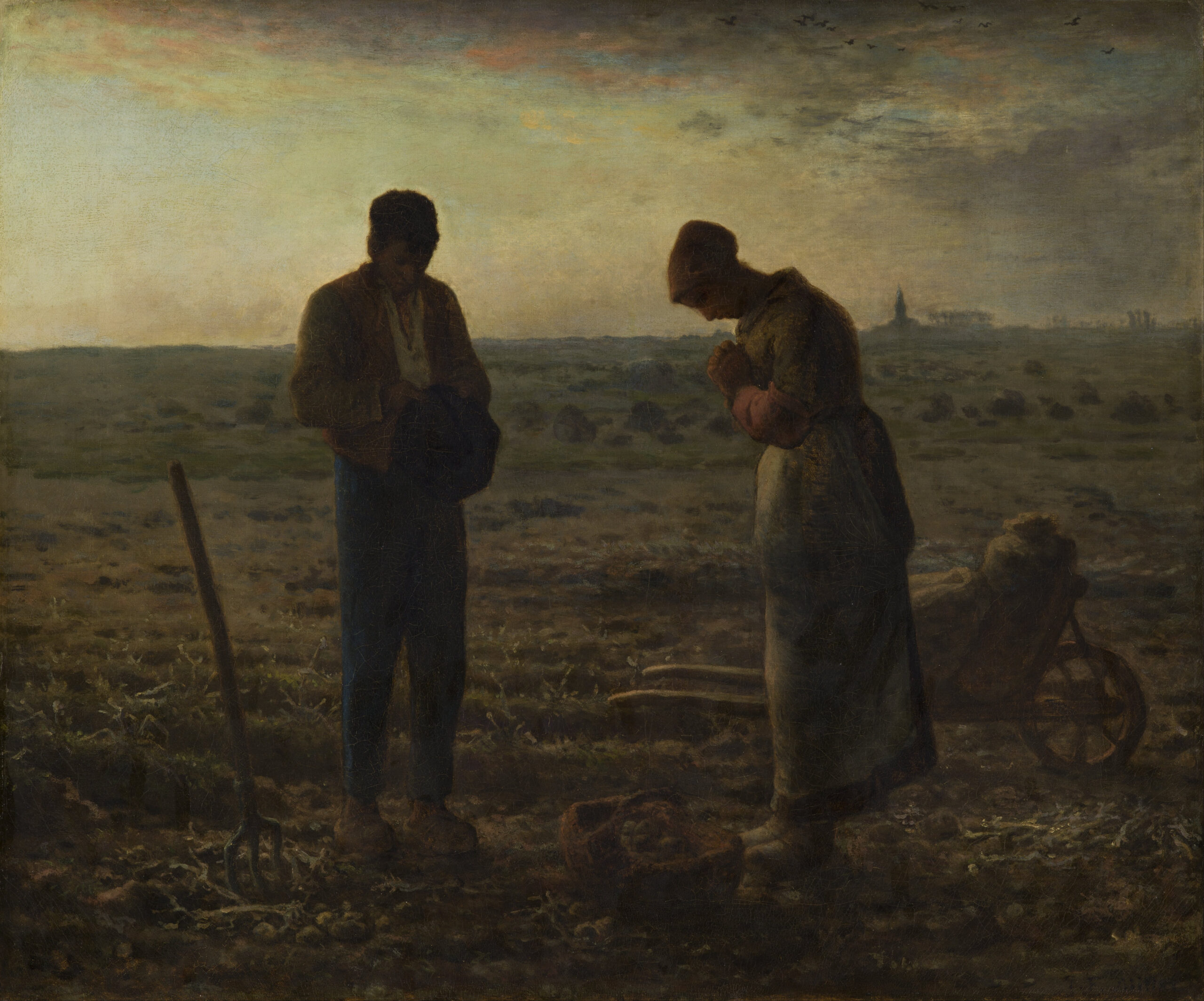
    Jean-François Millet’s The Angelus gives us a simple image of religious form at its best: a bell marks time, bodies pause, heads bow, and ordinary labor opens into a different relation.

    Jean-François Millet's The Angelus, showing two field workers pausing for prayer at dusk.
    Jean-François Millet, The Angelus, 1857–1859. Musée d’Orsay; public-domain reproduction.

    The bell is a form.

    The posture is a form.

    The prayer is a form.

    And form is not the enemy.

    The question is what the form is still serving.

    Dogma Is Not Just a Bad Word

    The old version of this essay used dogma too casually, almost as a synonym for dead religion.

    That is not accurate.

    Religious traditions use doctrine and formal statements to preserve teaching, mark boundaries, transmit memory, and give communities a common language. In Catholic Christianity, for example, the Catechism describes creeds as compact, normative summaries meant to hand faith on across generations. The Nicene Creed remains important precisely because a community believed some distinctions were worth preserving.

    So the problem is not that breath eventually becomes words.

    Words are how insight travels.

    The problem begins when the words stop pointing and start posing.

    When the form no longer carries the practice.

    When the form becomes evidence of who the practitioner is.

    That is what this article means by breath becoming dogma.

    It is a GEOMYTHA phrase, not a claim that actual dogma is inherently lifeless.

    The Form Can Carry the Fire

    A practice needs form.

    Without repetition, a prayer disappears with the mood.

    Without language, teaching changes every time it passes through a new mouth.

    Without calendars, bells, postures, texts, songs, meals, fasts, or gatherings, memory can become vague enough to mean anything.

    A vessel can protect what it carries.

    This is why mature traditions rarely oppose form and spirit as simply as modern spiritual language sometimes does.

    Form can train attention.

    Form can create continuity.

    Form can make surrender possible on a day when feeling is absent.

    The shell can protect the living thing.

    Until the shell starts demanding to be mistaken for the life.

    A Tradition Can Warn Against Its Own Shell

    The strongest stress test comes from inside religion itself.

    Christian scripture does not simply praise visible religious performance. In Matthew 6, prayer and fasting are specifically criticized when they become public displays designed to be seen by other people.

    The practice remains.

    The performance is questioned.

    That distinction is almost exactly the one GEOMYTHA needs.

    Religion does not have to be attacked from outside in order to notice that religious behavior can become self-display.

    The warning already exists within the tradition.

    The Rosary Knows the Difference

    The rosary offers an even sharper example.

    Its repetition is intentional. Beads help hold sequence. Repeated prayers create rhythm. The body and voice are given something concrete to do.

    But Catholic teaching itself warns that repetition can become mechanical if contemplation disappears. John Paul II, drawing on Paul VI, described the rosary as contemplative prayer and warned against formula repeated without the inward relation the form is meant to support.

    That is not GEOMYTHA criticizing Catholic prayer.

    That is Catholic tradition naming the same internal danger:

    a form can remain externally intact after its purpose has been lost.

    When the Practice Starts Proving the Practitioner

    The shift can be subtle.

    Prayer becomes: I am the one who prays.

    Fasting becomes: I am the disciplined one.

    Doctrine becomes: I am the one who knows the correct formulation.

    Humility becomes: I am the humble one.

    Even surrender can become: I am the one who has surrendered.

    The action may still be good.

    The belief may still be true inside its own tradition.

    The problem is the claimant taking possession of it.

    GEOMYTHA’s Grammar of Capture

    GEOMYTHA names the movement:

    Is → Am → I → This.

    Is is presence before claim.

    Am is presence reflected into relation.

    I is the claimant.

    This is the formed identity.

    A religious form can serve Am. It can hold a person inside relationship—with God, community, memory, body, time, obligation, gratitude, or mystery.

    Then I can take the form.

    Now the relation becomes possession.

    The person no longer simply practices.

    The practice becomes proof of This.

    I am this believer.

    I am this pure person.

    I am this awakened person.

    I am this correct person.

    That is captured devotion.

    Waxing Gibbous: Devotion Has a Shadow

    Waxing Gibbous is Build.

    Its directive is Devote.

    Devotion means repetition, commitment, attention, and structure.

    You keep returning when novelty is gone.

    That is how a practice becomes real.

    But Build can also build a prison.

    Every repetition adds another brick if the practitioner is secretly building an identity out of the practice.

    Gemini sharpens the danger because Gemini Notices.

    Words matter.

    Distinctions matter.

    Definitions matter.

    But the person who can distinguish correct from incorrect can begin using correctness as a mirror.

    The doctrine still says one thing.

    The identity built around possessing the doctrine says another.

    This Is Not an Argument for Vague Spirituality

    A common escape would be to say: forget doctrine, forget ritual, just have direct experience.

    That does not solve the problem.

    “I do not need religion” can harden into identity as easily as “I have the true religion.”

    “I am spiritual” can become another costume.

    “I see through dogma” can become a more flattering dogma.

    The claimant does not care whether the costume is orthodox, mystical, skeptical, secular, esoteric, or anti-religious.

    It only needs the sentence:

    I am this.

    GEOMYTHA Has to Pass Its Own Test

    This is where the article has to turn on itself.

    GEOMYTHA can become dogma too.

    Its grammar can become a badge.

    Its myths can become a private language of superiority.

    Its interpretations can become proof that the reader “sees what others cannot see.”

    If that happens, the system has failed by its own standard.

    The map was supposed to reveal the claimant.

    Now the claimant owns the map.

    A Better Test for Religious Form

    Do not ask only whether a form is old, strict, mystical, beautiful, rational, orthodox, or personally meaningful.

    Ask what it is doing.

    • Does this practice return me to relation, or mainly tell me who I am?
    • Does this doctrine preserve a distinction, or has possessing the distinction become a status?
    • Can I perform the ritual without using it to rank myself against someone else?
    • If the form stops serving its purpose, can I notice that without immediately treating the form as the enemy?
    • Can I let the practice correct me instead of using the practice to certify me?

    That is the difference between devotion and captured devotion.

    When Breath Became Dogma

    Breath needs form if it is going to become shared practice.

    Form needs language if it is going to survive memory.

    Language needs distinctions if it is going to mean anything.

    None of that is the fall.

    The fall happens when the form that carries relation becomes the identity that replaces relation.

    The prayer remains.

    The breath is gone.

    The doctrine remains.

    The listening is gone.

    The posture remains.

    The surrender is gone.

    Then the shell is asking to be worshiped.

    Build the form. Keep what carries life. Let the practice correct the claimant. Devote without turning devotion into a self.

    Sources

  • The Moon Beneath the Cow

    The Moon Beneath the Cow

    Waxing Crescent · Gemini — Stir in Noticing — Playful Recognition: How “Hey Diddle Diddle” Turns Cosmic Fragmentation into Children’s Song

    “Hey diddle diddle.”

    The phrase already sounds like play before it sounds like explanation.

    Then the world tilts.

    A cat plays a fiddle.

    A cow jumps over the moon.

    A dog laughs.

    A dish runs away with a spoon.

    Nothing behaves normally.

    That is the useful place to begin.

    Randolph Caldecott illustration for Hey Diddle Diddle, showing the rhyme's animated household objects and comic inversion.
    Randolph Caldecott, “And the Dish Ran Away with the Spoon,” from Hey Diddle Diddle and Baby Bunting, 1882. Public domain.

    First: It Is a Nonsense Rhyme

    The earliest recorded version resembling the modern rhyme appeared in the eighteenth century, and scholars have spent a great deal of time proposing hidden origins for it.

    Those explanations should not be treated as established fact.

    The safest historical reading is also the simplest: Hey Diddle Diddle is a traditional English nonsense rhyme whose power comes from impossible images, rhythm, repetition, and surprise.

    GEOMYTHA does not need a secret origin story.

    It asks a different question:

    What does the rhyme let us notice when ordinary relations are playfully turned upside down?

    The Cat and the Fiddle

    The cat does not need to be assigned a universal lunar meaning.

    The image is already strange enough.

    An animal takes up a human instrument.

    A creature becomes a performer.

    Function shifts. Category shifts. The world becomes theatrical.

    That matters because the rhyme never pauses to explain the transformation. It simply presents the impossible action and keeps moving.

    The listener accepts the new relation before there is time to demand a reason.

    That is the first GEOMYTHA mechanism here: the world can become strange without immediately feeling threatening when strangeness arrives through play.

    The Cow Over the Moon

    Then comes the image everyone remembers.

    The cow jumps over the moon.

    The scene violates scale, distance, gravity, and ordinary animal behavior in a single line.

    That is why the image works so well.

    A heavy animal crosses above the object that normally hangs far beyond it.

    The title of this essay—The Moon Beneath the Cow—names that inversion.

    Not because the rhyme secretly teaches an Egyptian cosmology.

    Because the normal hierarchy of the picture has been reversed.

    What should be below is suddenly above.

    What should be unreachable becomes part of a jump.

    The impossible becomes cheerful.

    The Egyptian Cow Is a Comparison, Not an Origin

    Ancient Egypt does give us a real cow-and-sky image worth comparing.

    Hathor was strongly associated with the cow. Museum objects show her in bovine form or with cow horns and a solar disk. A New Kingdom plaque from Deir el-Bahri, for example, depicts a cow with a sun disk between its horns and identifies that form as a common representation of Hathor.

    That documented image belongs to Egyptian religion.

    There is no evidence that Hey Diddle Diddle was composed as a coded Hathor story.

    The comparison is useful only because it reminds us that cows have carried cosmic and divine associations in some cultures. GEOMYTHA can place those images beside one another without pretending one caused the other.

    The Dog Laughs

    The dog is the witness.

    Not because every dog in mythology always means loyalty or civilization.

    Because this dog has one clear function in the rhyme:

    it sees the impossible and laughs.

    That is a much stronger observation than assigning the animal a fixed symbolic dictionary entry.

    The world has inverted.

    The witness responds with delight.

    That is why nonsense matters.

    It lets the mind rehearse broken expectations without panic.

    The impossible becomes sport.

    The Dish and the Spoon

    The final image completes the shift.

    Household objects become characters.

    The dish does not contain.

    The spoon does not serve.

    They run away.

    The older version of this article tried to turn the pair into a fixed sexual polarity—receptive dish, penetrative spoon.

    That was unnecessary.

    The more defensible mechanism is simpler:

    objects defined by relation are suddenly treated as autonomous little selves.

    The utensil becomes a character.

    The vessel becomes a character.

    Relation becomes narrative.

    That is where the GEOMYTHA grammar becomes useful.

    From Relation to “This”

    GEOMYTHA’s root grammar is:

    Is → Am → I → This.

    Presence enters relation.

    Relation becomes claim.

    Claim hardens into an identifiable thing.

    The rhyme gives that movement a comic form.

    Animals become performers.

    A cow becomes a cosmic jumper.

    A dog becomes an audience.

    Dishes and spoons become runaway characters.

    The world fills with little “thises.”

    Again, this does not mean the anonymous makers of the rhyme intended GEOMYTHA’s grammar.

    It means nonsense gives us an unusually clean picture of categories becoming mobile.

    Why Children’s Nonsense Works

    Children do not need a theory of absurdism to enjoy the rhyme.

    The pleasure is immediate.

    Rhythm repeats.

    Sounds rhyme.

    Images escalate.

    Each line violates expectation and hands the listener another picture before the last one has completely settled.

    That does not make the rhyme a hidden indoctrination device.

    It makes it good nonsense.

    The older draft claimed nursery rhymes “bypass analysis” and smuggle symbolic structures into children’s consciousness. That is too strong without evidence.

    The better observation is visible on the page:

    the rhyme makes impossible transformation memorable by making it musical and funny.

    The Waxing Crescent Problem

    Waxing Crescent is Stir.

    Something that was quiet begins to move.

    Difference appears.

    The field becomes populated.

    That is why this rhyme fits the phase so well as a GEOMYTHA reading.

    Everything starts moving.

    The cat plays.

    The cow jumps.

    The dog laughs.

    The dish and spoon flee.

    Stir is delightful because movement creates possibility.

    Its shadow is that movement can outrun recognition.

    The next image arrives before we have asked what the last one changed.

    The Stress Test: Maybe It Really Is Just Nonsense

    This article fails if GEOMYTHA requires the rhyme to secretly encode its system.

    It does not.

    The rhyme can be ordinary nonsense.

    Its makers may have intended nothing beyond amusement, sound, absurdity, and memorable imagery.

    The GEOMYTHA reading comes afterward.

    That boundary matters because symbolic interpretation becomes sloppy when resemblance is turned into proof of origin or intent.

    The value of the rhyme is not that it proves GEOMYTHA.

    The value is that it gives us a familiar miniature world in which relation, scale, agency, and category all become unstable at once.

    The Moon Beneath the Cow

    The moon beneath the cow is funny because it should not be there.

    That is enough.

    The image does not need a secret key.

    Its power is the inversion itself.

    What was distant becomes jumpable.

    What was ordinary becomes alive.

    What was relation becomes character.

    And because the whole thing is sung with a smile, the strange world feels natural almost immediately.

    That is the practical return.

    When something strange starts to feel normal, do not assume that makes it wrong.

    Just notice the inversion.

    What changed places?

    What stopped serving its old function?

    What became a character that used to be a relation?

    Stir. Notice. Enjoy the play. Then look again before the impossible becomes invisible.

    Sources

  • The Red Sabbath: Why Red Bull Gives Horus Wings

    The Red Sabbath: Why Red Bull Gives Horus Wings

    Waxing Gibbous · Gemini — Build in Noticing — Devoted Attention: How Energy Culture Turns Rest Into Flight From Source

    The slogan says it plainly.

    Red Bull gives you wiiings.

    The company means that as a promise of function. A standard 250 ml can contains 80 mg of caffeine, and Red Bull says caffeine helps increase alertness and concentration. The drink is marketed to athletes, students, busy professionals, and travelers—people who need to keep going.

    There is nothing hidden about that.

    The interesting question begins one step later.

    What happens when “keep going” becomes the answer every time the body asks to stop?

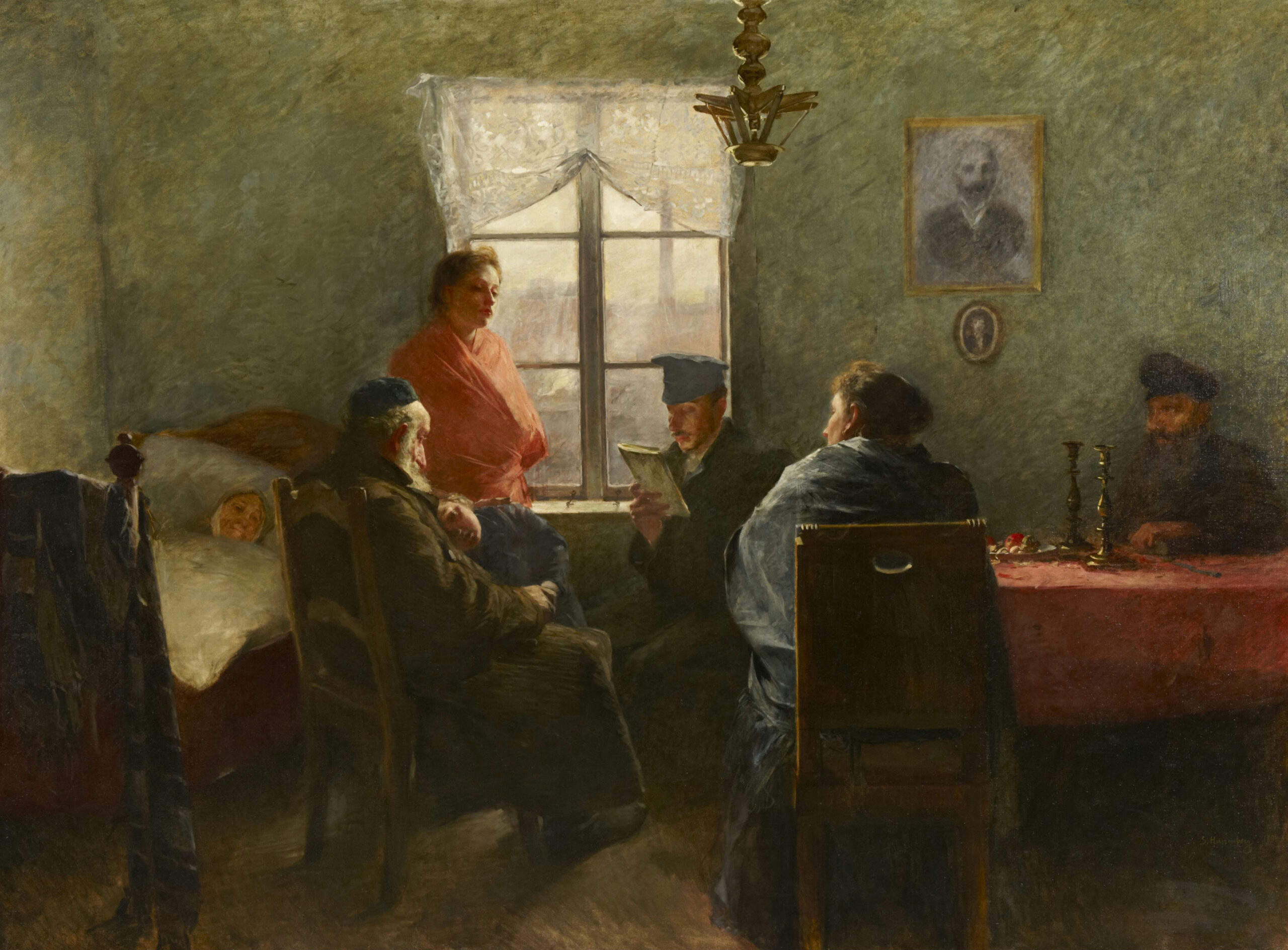
    Samuel Hirszenberg's 1894 painting The Sabbath Rest, showing Jewish Sabbath rest in a domestic interior.
    Samuel Hirszenberg, The Sabbath Rest, 1894. Public domain. The painting keeps Sabbath itself—not stimulant branding—at the center of the article.

    Sabbath Is More Than Sleep

    The biblical Sabbath is not a productivity technique and not simply a recommendation to sleep more.

    In Exodus, the seventh day interrupts ordinary labor. In Deuteronomy, the command extends rest beyond the householder to children, servants, animals, and the stranger within the gates. Deuteronomy then ties Sabbath to the memory of slavery and release from Egypt.

    That makes Sabbath a boundary around production.

    For one recurring interval, usefulness does not get the final word.

    The servant rests.

    The animal rests.

    The household rests.

    The person is not required to prove existence by continuing to produce.

    GEOMYTHA begins there.

    What “Red Sabbath” Means Here

    Red Sabbath is a GEOMYTHA phrase, not a Jewish term and not a historical religious category.

    It names a modern reversal:

    the moment rest arrives, and stimulation is used to cross the boundary anyway.

    The body says enough.

    The schedule says one more shift.

    The eyes say sleep.

    The deadline says stay up.

    The mind begins to blur.

    The identity says: I am still the person who can do this.

    Then the stimulant arrives.

    That does not make the stimulant evil.

    It makes the relation worth noticing.

    The Wings Are an Advertisement, Not an Ancient Code

    The older version of this essay pushed the wing image too far. It treated halos, angels, superheroes, athletes, mascots, and Red Bull advertising as though they were all manifestations of one universal symbolic mechanism.

    That claim is stronger than the evidence.

    Red Bull’s wings belong first to Red Bull’s branding. The company openly uses “wiiings” as the language of alertness, energy, performance, sport, travel, and ideas.

    GEOMYTHA makes a second-order comparison.

    Wings are useful here because the advertisement promises lift. The tired body is heavy. The product helps the person feel able to rise above that heaviness for a while.

    That is enough.

    We do not need to pretend every wing in art means the same thing.

    Borrowed Alertness

    Caffeine works. That is part of why this article matters.

    It can increase alertness and concentration. People use it because there are real situations in which greater wakefulness is useful: an early shift, a long drive, a demanding task, a workout, a night when sleep was poor.

    The stress test therefore comes first:

    GEOMYTHA is not arguing that caffeine, coffee, or energy drinks are inherently bad.

    The problem is not borrowed alertness.

    The problem is forgetting that it was borrowed.

    A 2023 systematic review and meta-analysis found that caffeine consumption, across the studies included, reduced total sleep time and sleep efficiency and delayed sleep onset. Another systematic review of energy-drink studies found insomnia and jitteriness/restlessness among commonly reported adverse effects.

    Those findings do not mean one can of Red Bull produces the same effect in every person. Dose, timing, tolerance, sleep history, age, and individual response matter.

    But they establish a real boundary beneath the symbol:

    stimulation can postpone the experience of fatigue without abolishing the need for recovery.

    When Build Becomes Refusal

    Waxing Gibbous is Build.

    Build is devotion. Stay with the work. Add another layer. Practice. Refine. Continue.

    That pressure is necessary.

    Nothing difficult gets completed if every sensation of resistance becomes a reason to stop.

    But Build has a shadow.

    Devotion can become refusal.

    The person stops serving the work and begins serving the identity of being the one who never stops.

    One more hour.

    One more set.

    One more shift.

    One more deadline.

    One more can.

    The tool that helped Build now prevents Return.

    Horus With Wings

    This is where the title becomes GEOMYTHA rather than advertising analysis.

    Horus, in the GEOMYTHA grammar, is This: the formed identity that can be named, shown, defended, scheduled, measured, and performed.

    Horus needs energy because form has work to do.

    The problem begins when the formed self cannot tolerate its own limits.

    Now fatigue is not just fatigue.

    Fatigue threatens the identity.

    If I stop, am I still disciplined?

    If I sleep, am I falling behind?

    If I cannot perform at the same level today, am I still the person I say I am?

    The wings become useful as a modern metaphor because they let the identity remain airborne after the body has asked to land.

    That is what this article means by giving Horus wings.

    Why Black Sabbath Is in the Title

    The title also plays deliberately against Black Sabbath.

    That comparison is cultural, not historical.

    Black Sabbath’s official history says the band took its name from the song “Black Sabbath,” itself titled after the 1963 Boris Karloff horror film. The band was formed in industrial Birmingham by musicians looking for a way out of factory life. There is no documented connection between Black Sabbath and Red Bull’s later branding.

    The contrast works because the surfaces are so different.

    Black Sabbath is heavy.

    Red Bull promises lift.

    One built a musical world of weight, dread, volume, machinery, war, and darkness.

    The other built a bright global brand around activity, sport, alertness, flight, speed, and performance.

    GEOMYTHA places them beside each other as a contrast, not because they secretly say the same thing.

    Heaviness tells you the burden is there.

    Stimulation can sometimes help you carry it.

    But stimulation can also make it easier to avoid asking why the burden never ends.

    The Productivity Trap

    The strongest modern version of Red Sabbath is not an energy-drink commercial.

    It is the belief that every limit is a defect to be optimized away.

    Sleep becomes lost time.

    Stillness becomes laziness.

    Unavailability becomes failure.

    A quiet day becomes something that needs to be filled.

    The body keeps producing signals, and the identity keeps finding technologies for overruling them.

    Sometimes that is necessary.

    A parent stays awake with a sick child. A nurse works a difficult night. A traveler gets home safely. A deadline occasionally demands more than an ordinary day.

    The problem is when emergency rhythm becomes normal rhythm.

    Then the exception becomes a habitat.

    A Better Test Than “Is Caffeine Good or Bad?”

    The useful question is relational.

    • Am I using stimulation for a bounded task, or to avoid a recurring need for rest?
    • Will this extra alertness be followed by recovery, or is it paying yesterday’s fatigue forward?
    • Does the tool support the work, or does it support an identity that cannot tolerate stopping?
    • When the task is finished, can I land?

    That last question is the Sabbath question.

    Not: can you fly?

    Can you come down?

    The Red Sabbath

    Red Bull does not need to be a secret sacrament.

    It is more interesting as exactly what it says it is: a product built around alertness, energy, and “wiiings.”

    That ordinary fact gives GEOMYTHA enough to work with.

    The Sabbath establishes a boundary where production stops.

    The stimulant can help cross a boundary where tiredness would otherwise stop production.

    Neither fact tells us what a person should always do.

    The tension tells us what to notice.

    Build when it is time to build.

    Use the tool when the tool serves the work.

    But do not make endless flight the proof that you are alive.

    Devote your attention. Finish what matters. Then let Horus land.

    Sources

  • Why “Zig” Became the Sound of Modern Identity

    Why “Zig” Became the Sound of Modern Identity

    Waxing Gibbous · Gemini — Build in Noticing — Fragmented Excitement: How Pop Culture Turned Broken Motion into Personality

    There is something restless about a zigzag.

    It does not travel in a straight line. It moves by sharp turns: one direction, then another, then another again.

    That is the ordinary meaning of the word. A zigzag is a line or course made of alternating sharp turns. The English word is centuries old. It was not invented by modern pop culture, and it does not carry a hidden psychological doctrine inside its etymology.

    But the shape gives us a useful question.

    What happens when a culture begins to experience identity the same way—through continual turns, reinventions, shocks, styles, signals, and interruptions?

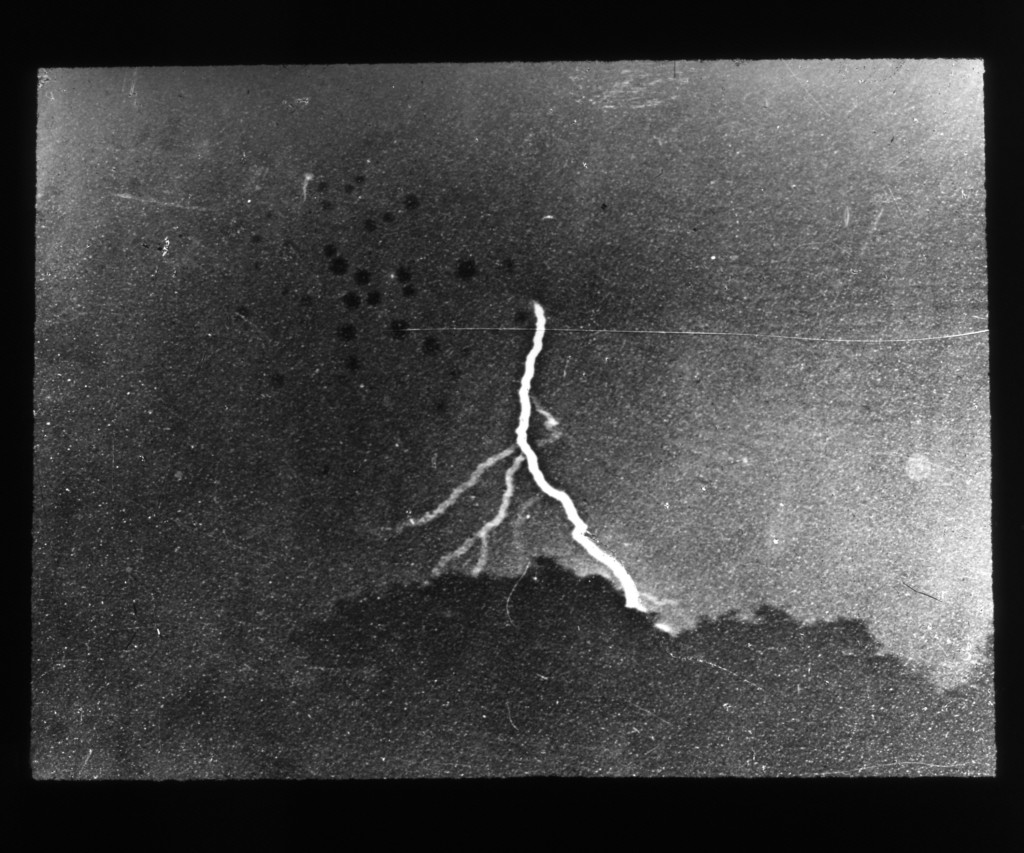
    William N. Jennings's 1882 photograph of a branching lightning bolt above a dark horizon.
    William N. Jennings, early photograph of lightning, 1882. Historical photography gives us a useful correction: actual lightning is more irregular than the neat bolt-symbol cultures often draw.

    The Shape Before the Theory

    The first correction to the old version of this article is simple.

    The letter Z does not historically “mean fracture.” Ziggy Stardust, Zig-Zag rolling papers, ZZ Top, the Spice Girls’ “zig-a-zig-ah,” and electric rock imagery do not descend from one secret source.

    The documented origins are different.

    Zig-Zag says its name comes from the interleaving pattern of its rolling papers. Billy Gibbons has explained that ZZ Top grew out of blues names and initials—especially Z.Z. Hill and B.B. King. David Bowie said the name Ziggy came from a tailor’s shop, while the character drew on several different artistic and musical influences. “Zig-a-zig-ah” emerged from the collaborative writing of “Wannabe” and became famous precisely because it was catchy and strange.

    Those facts matter because they prevent the symbolic reading from pretending to be historical proof.

    GEOMYTHA’s claim is narrower:

    unrelated cultural forms can still become useful mirrors when they converge around the same felt mechanism.

    Here, that mechanism is broken motion becoming personality.

    Ziggy Stardust: Personality as Spectacle

    Ziggy Stardust is the strongest example because the persona itself is the subject.

    Bowie did not merely release songs under a stage name. He built a visible character: alien, glamorous, theatrical, sexually ambiguous, charismatic, doomed, and inseparable from performance.

    The documented history is already enough. Bowie drew Ziggy from multiple sources, including rocker Vince Taylor and other artistic influences, and later said the name “Ziggy” came from a tailor’s shop he had passed.

    Nothing about that proves GEOMYTHA.

    What matters symbolically is what the persona does.

    Ziggy turns identity into an event.

    The self is no longer merely lived. It is staged, stylized, amplified, watched, copied, and consumed.

    That is a modern pressure we now recognize everywhere.

    The profile changes. The look changes. The language changes. The declared self changes. Each turn feels like movement.

    But movement is not always return.

    The Feed Is a Zigzag

    Modern attention rarely moves in a long unbroken line.

    A message. A video. A headline. A joke. A purchase. A crisis. A song. A notification. A face. An outrage. A memory.

    Attention turns.

    Then turns again.

    That does not make screens evil or fragmented attention uniquely modern. Human attention has always wandered. But digital systems can make rapid switching a default environment rather than an occasional interruption.

    GEOMYTHA calls the pressure fragmented excitement: stimulation strong enough to keep identity moving, but not always long enough for reflection to deepen.

    The person feels alive because something is always changing.

    The question is whether anything is being integrated.

    “Zig-a-Zig-Ah” and the Power of the Repeatable Fragment

    The Spice Girls give us a lighter example.

    “Wannabe” helped make “zig-a-zig-ah” globally recognizable even though the phrase has never needed a stable literal meaning in order to work.

    Its function is sonic before it is explanatory.

    You can repeat it. Shout it. Dance to it. Recognize it instantly.

    That is useful for thinking about identity-signals in general. Many social signals work before they are fully interpreted. A look, phrase, pose, meme, logo, fandom reference, or slogan can announce belonging faster than an argument can explain it.

    The fragment becomes a badge.

    Used lightly, that is play.

    Used compulsively, it becomes a substitute for presence.

    The Counterexamples Matter

    This is where the older version of the article needed the most correction.

    Zig-Zag rolling papers are not evidence that the culture unconsciously chose “zig” because it means fragmented consciousness. The company’s own history says the name referred to the zigzagging interleave of the papers.

    ZZ Top is not evidence either. Billy Gibbons has described the name as emerging from blues performers’ initials and his play on Z.Z. Hill and B.B. King.

    Those examples actually strengthen the article once we stop abusing them.

    They demonstrate the difference between origin and later symbolic use.

    A symbol does not have to originate from a shared hidden code in order to acquire new associations after it enters culture.

    The question is not “Did all these creators secretly mean the same thing?”

    The better question is “Why does this angular, alternating form remain so easy to reuse when culture wants to communicate speed, electricity, difference, interruption, or edge?”

    Electricity Is Not Fracture

    Rock music complicates the pattern further.

    Electricity, amplification, lightning bolts, sharp typography, chrome, and hard-edged logos are everywhere in rock imagery.

    But electricity is not inherently a symbol of fractured identity.

    It is power.

    It can illuminate, connect, amplify, animate, or destroy.

    The GEOMYTHA distinction is relational. When energy serves expression, it can intensify life. When stimulation becomes the only way the self knows it is alive, energy becomes dependence.

    That is why the article is not really about the letter Z.

    It is about the nervous system of identity.

    From Reflection to Performance

    The core GEOMYTHA grammar is simple:

    Is becomes Am.

    Am is interrupted by I.

    I hardens into This.

    In ordinary life, that formation is necessary. A person needs a usable identity.

    The problem appears when the formed identity must be continually restimulated in order to remain convincing.

    Now “This” cannot simply be lived.

    It must be refreshed.

    New look. New outrage. New category. New affiliation. New enemy. New purchase. New revelation. New version of me.

    The zigzag becomes a useful picture because the movement is real while the center remains unsettled.

    The Stress Test: Reinvention Can Be Healthy

    Not every changing identity is fragmentation.

    People leave abusive roles. Artists experiment. Adolescents try forms on. Converts change beliefs. Workers change careers. Grieving people rebuild. Transitions can be signs of health.

    Stability is not automatically wisdom, and repetition is not automatically authenticity.

    The test is not how often the self changes.

    The test is what the change serves.

    Does each turn make relation clearer?

    Or does each turn merely create another surface that must be defended?

    That boundary keeps the symbolic reading from becoming nostalgia for a supposedly simpler, more “authentic” past.

    A Better Way to Read the Zig

    Do not ask whether every Z-shaped logo is secretly telling the same story.

    Ask what the form is doing in the specific case.

    • Is it showing speed?
    • Alternation?
    • Electricity?
    • Defiance?
    • Instability?
    • Play?
    • Brand distinction?
    • Repeated self-reinvention?

    Then ask the GEOMYTHA question second:

    Does the motion return the person to clearer relation—or keep the self alive by forcing another turn?

    That is the difference between movement and agitation.

    Between transformation and performance.

    Between a living path and a self that cannot stop changing long enough to notice what is changing.

    Notice the turn. Notice what drives the next one. Stir without becoming addicted to motion.

    Sources

  • They Clogged the Inhale

    They Clogged the Inhale

    The day begins before you arrive.

    The body wakes.
    The hand reaches.
    The phone glows.

    Before there is one clean breath, there is input.

    Weather. Texts. Alerts. Headlines. Sales. Comments. Conflict. Calendar pressure. Disaster. Outrage. Someone else’s fear. Someone else’s grief. Someone else’s performance. Someone else’s certainty.

    The world enters through the screen before the body has returned to itself.

    That is the problem.

    Not information itself.
    Not technology itself.
    Not knowing what is happening.

    The problem is order.

    The inhale is supposed to be the first gate of presence. Air enters before identity. The lungs receive before the head explains. The body remembers itself before the world arrives with its demands.

    But modern life reverses the sequence.

    The feed enters first.

    Then the nervous system reacts.

    Then the claimant forms around the reaction.

    Then the self begins the day already saying:

    I am anxious.
    I am behind.
    I am angry.
    I am unsafe.
    I am informed.
    I am the one who sees what is happening.

    That is borrowed breath.

    The breath did not begin in Is.

    It began in signal.

    The grammar is simple:

    Is. Am. I. This.

    Is is the field before claim.
    Am is reflected presence.
    I is the claimant.
    This is the hardened identity that follows.

    The clean order is:

    Is-Am.
    Am-Is.

    Source becomes reflected presence.
    Reflected presence returns to source.

    But the feed interrupts that order.

    It gives the body a world before the body has presence. It gives the mind urgency before the lungs have received. It gives the claimant material before the center has steadied.

    So the sequence becomes:

    Input. Reaction. Claim. Identity.

    A headline appears.

    The chest tightens.

    The thought says:

    I am afraid.

    A comment appears.

    The face heats.

    The thought says:

    I am disrespected.

    An ad appears.

    The body compares.

    The thought says:

    I am lacking.

    A notification appears.

    The nervous system jumps.

    The thought says:

    I must respond.

    This is how the self gets built before it has arrived.

    The inhale is supposed to be Is becoming Am.

    The feed turns it into world becoming me.

    That is why the morning phone check matters so much. It seems ordinary. Almost nothing. A little glance. A harmless habit. A few seconds before getting up.

    But spiritually, it is a doorway.

    The first reception of the day teaches the body what kind of world it is waking into. If the first reception is breath, the body wakes into presence. If the first reception is feed, the body wakes into demand.

    And the feed rarely arrives empty.

    It arrives already shaped.

    It tells the nervous system what matters before the soul can ask. It tells the eyes where to look. It tells the thumb what to chase. It tells the chest what to fear. It tells the ego where it stands in the invisible hierarchy of urgency, beauty, wealth, danger, intelligence, moral purity, and relevance.

    That is not neutral.

    That is liturgy.

    A liturgy is repeated form that trains attention. Modern people often imagine liturgy as something religious people do in old buildings. But the phone has its own liturgy. Wake, reach, unlock, scroll, react, compare, repeat.

    The body learns the ritual even when the mind says it is only checking.

    That is Set’s genius in the screen age.

    He does not need to command openly. He can simply place the next signal before the next breath.

    The notification is the clearest example.

    A bell once gathered the body into rhythm: prayer, meal, work, school, ceremony, danger, rest. A bell marked time and organized attention into a shared field. It said: stop here, gather here, turn here.

    The notification mimics that power.

    It rings.
    It flashes.
    It vibrates.

    But it usually does not gather attention into presence. It calls attention outward into interruption.

    The old bell could summon the body into a temple.

    The new bell is often a temple without a god, a ritual without a center, a summons without wisdom.

    It does not ask whether the body is grounded.

    It does not ask whether the breath is clean.

    It does not ask whether the thought it interrupts was sacred, tender, difficult, or finally becoming clear.

    It simply calls.

    And the body obeys.

    That obedience is subtle. No one thinks, I worship this notification. But the nervous system has already bowed. Attention has moved. The inner field has been broken. The next fragment has entered.

    This is how fragmentation becomes normal.

    Not through one dramatic collapse.

    Through thousands of tiny summonses.

    The self becomes a creature trained to leave itself on command.

    That is the false bell.

    The breaking-news banner is another false ritual.

    It does not merely tell the reader that something happened. It tells the body how to receive reality.

    Urgent.
    Red.
    Unfinished.
    Threatening.
    Developing.
    Stay with us.

    The facts may matter. The event may be real. The danger may be serious.

    But the banner is not only information. It is posture. It teaches the body to hold itself in alarm. It converts reality into permanent interruption.

    The body receives the signal before it has a task.

    That matters.

    Fear is designed to move. It belongs to action: run, protect, hide, speak, repair, prepare. But modern media often gives the body alarm without action. The nervous system is activated by distant crisis, abstract threat, political theater, statistical dread, or disaster footage with no immediate embodied completion.

    The body is told danger is present.

    But the body cannot complete the danger.

    So the fear stays.

    It becomes mood.
    Then worldview.
    Then identity.

    I am unsafe.
    I am surrounded.
    I am the only one paying attention.
    I am prepared because I keep watching.

    That is borrowed fear becoming borrowed self.

    The same mechanism operates through true-crime and disaster content.

    A person may sit safely at home yet feel drawn into a vivid threat narrative. The story is consumed as entertainment, while its images and sounds can still prompt fear and vigilance. The viewer sees the face, hears the scream, anticipates the predator, imagines the victim, and follows the investigation.

    The body learns vigilance without context.

    Again, not all such content is worthless. Some stories reveal real harm. Some teach caution. Some honor victims. Some expose failures. But as daily intake, threat-narrative can train the self to live as watchtower.

    The person begins to breathe as if danger is always near.

    That is not wisdom.

    That is Set building a danger-world inside the chest.

    Then Horus appears as the vigilant self:

    I see what others miss.
    I know what people are capable of.
    I am ready.
    I am not naive.
    I am safe because I suspect.

    Sometimes suspicion is needed.

    But suspicion as identity is a prison with excellent arguments.

    Comment sections build another kind of self.

    They are Gemini without Ophiuchus: endless noticing with no containment.

    Everyone is naming, correcting, accusing, joking, confessing, signaling, proving, mocking, panicking, diagnosing, ranking, and performing. The comment section looks like conversation, but often it is a choir of fragmented claimants.

    One post becomes hundreds of small selves shouting:

    I know.
    I disagree.
    I saw this first.
    I am morally right.
    I am funnier.
    I am angrier.
    I am more informed.
    I am not like them.
    I belong to this side.

    The reader may not comment at all.

    It does not matter.

    The chorus still enters.

    The body reads the voices and begins internally arranging itself among them. Agree here. Resist there. Laugh here. Tighten there. Judge that one. Fear this group. Admire that tone. Copy that phrase. Avoid being seen as this. Perform being that.

    The comment section becomes a crowd inside the chest.

    The self is built out of other people’s claimant-noise.

    That is why it is exhausting.

    Not because words are inherently bad. Not because argument is bad. Not because public conversation is bad.

    Because the body is receiving too many unfinished selves.

    No containment.

    No digestion.

    No return.

    Just signal multiplying signal.

    Gemini notices. That is its gift. It differentiates, mirrors, compares, catches the echo, hears the double, sees the pattern.

    But Gemini under feed-pressure becomes compulsive.

    This connects.
    That proves it.
    This means something.
    That person is lying.
    This is the real story.
    That explains everything.
    This needs a response.
    That cannot go unanswered.

    Noticing becomes hunger.

    Hunger becomes measurement.

    Measurement becomes identity.

    That is the Setian turn.

    Ophiuchus is supposed to hold the serpent before insight becomes system. But the feed is anti-Ophiuchus. It does not let one serpent be held. It keeps throwing new serpents into the room.

    Before the first charge can settle, another appears.

    Before the first thought can be tested, another demands loyalty.

    Before the body can ask whether the signal is true, useful, or even relevant, the next signal has arrived.

    This is how the inhale gets clogged.

    The body is not only breathing air.

    It is breathing unfinished worlds.

    Advertising clogs the inhale differently.

    Fear says: danger is near.

    Advertising says: lack is near.

    Before the self knows what it actually feels, the ad tells it what it lacks.

    You are not beautiful enough.
    Not young enough.
    Not rich enough.
    Not safe enough.
    Not optimized enough.
    Not desirable enough.
    Not disciplined enough.
    Not relaxed enough.
    Not informed enough.
    Not healed enough.

    The genius of advertising is that it does not need to prove the wound. It only has to suggest it, beautifully and repeatedly, until the body begins to search itself for the absence.

    Then the absence becomes real enough to shop through.

    This is borrowed lack.

    The body receives a manufactured emptiness and begins building a self around it.

    I need this to be complete.
    I need this to be seen.
    I need this to be safe.
    I need this to become the version of myself I should already be.

    That is a commercial version of I am this.

    I am this lack.

    Then the product appears as salvation.

    In the screen age, the image-world does not merely entertain. It scripts desire, reality-feeling, and identity. It turns attention into a field of capture and teaches the self to exist through visibility, performance, and reaction.

    That is exactly what the clogged inhale does at the bodily level.

    It lets the image-world enter before presence.

    It lets the screen define the wound before the body has spoken.

    It lets the false bell ring before the heart has steadied.

    Then the person wonders why the day feels already burdened.

    The burden began at the first intake.

    This is not a call to ignorance.

    That stress test matters.

    Information is not the enemy. News can matter. Messages can matter. Research can matter. Warnings can matter. Public knowledge can support right action. One should not confuse presence with withdrawal, or steadiness with refusal to know.

    The problem is not knowing.

    The problem is being built by what you consume before you are present enough to receive it.

    Information serves Osiris when it clarifies.

    It enters a grounded body. It reflects reality without demanding identity. It supports action. It can be put down. It helps the person respond more truthfully.

    Information serves Set when it tightens the breath.

    It demands immediate reaction. It multiplies without digestion. It produces panic, superiority, compulsion, grievance, or performance. It makes stopping feel unsafe. It turns attention into a battlefield and then sells the self a role inside the battle.

    The difference is order.

    Presence first.

    Information second.

    Action third.

    Release always.

    That is the correction.

    Before the phone:

    Is-Am.
    Am-Is.

    Before the feed:

    Is-Am.
    Am-Is.

    Before the news:

    Is-Am.
    Am-Is.

    Before research:

    Is-Am.
    Am-Is.

    Then ask:

    What am I about to let build inside me?

    That is the Waxing Gibbous question.

    Waxing Gibbous presses the current toward fuller form. The field is already filling with signals, and devotion becomes necessary: which of them deserves the day’s attention?

    Will the body build presence?

    Or borrowed panic?

    Will the mind build clarity?

    Or borrowed outrage?

    Will speech build truth?

    Or borrowed performance?

    Will attention build devotion?

    Or another room for Horus?

    This is where the lunar directive matters. Decide does not mean react to everything. It means choose what deserves attention and give the day a deliberate shape. Form asks for a boundary: what enters, what waits, and what can be put down.

    The feed wants devotion.

    That is the secret.

    It does not merely want glances. It wants rhythm. It wants return. It wants morning, noon, night. It wants the idle second, the anxious pause, the bathroom break, the red light, the lonely hour, the moment before sleep.

    It wants to become the field.

    And if it becomes the field, the self will be built there.

    That is why one clean breath is not small.

    One clean breath before intake is a refusal of false liturgy.

    It says:

    The first gate does not belong to the feed.

    The first reception does not belong to the headline.

    The first nervous-system instruction does not belong to the advertisement.

    The first bell does not belong to the phone.

    The first inhale belongs to Is.

    Then Am.

    Then the world can enter.

    Not as master.

    As content.

    There is a difference between receiving the world and being colonized by it.

    A present body can receive information. It can read the news. It can answer messages. It can research. It can discern. It can act. It can grieve what should be grieved and resist what should be resisted.

    But a body that has not arrived is easily recruited.

    It becomes a relay station for other people’s signals.

    It becomes a host for borrowed urgency.

    It becomes a stage on which the feed builds identity.

    This is why the correction has to be bodily, not merely ideological.

    You cannot think your way out of a clogged inhale while continuing to clog the inhale.

    The body must receive itself first.

    Air before argument.

    Lungs before language.

    Belly before banner.

    Presence before post.

    Is-Am before input.

    Then the information can be weighed.

    Does this require action?

    Does this clarify?

    Does this serve the work?

    Does this support love, duty, truth, protection, repair, or understanding?

    Or does this merely tighten the claimant?

    Does it make me more afraid in a way I cannot use?

    Does it make me superior in a way I secretly enjoy?

    Does it make me hungry for more signal?

    Does it make stopping feel like danger?

    Those questions are not moral decoration. They are discernment.

    Because every intake builds.

    A feed builds a nervous system.

    A news cycle builds a worldview.

    A comment section builds an inner crowd.

    Advertising builds a wound-shaped consumer.

    Fear-content builds a watchtower self.

    And breath, if received first, builds a different center.

    Not an identity.

    A passage.

    The practical rule is severe but simple:

    Do not let the world borrow your first breath.

    The world can wait one breath.

    The headline can wait one breath.
    The message can wait one breath.
    The outrage can wait one breath.
    The sale can wait one breath.
    The comment can wait one breath.
    The false bell can wait one breath.

    If the self forms after presence, it becomes function.

    If it forms before presence, it becomes prison.

    So tomorrow morning, before the hand reaches, let the body arrive.

    Inhale:

    Is-Am.

    Exhale:

    Am-Is.

    Then decide whether the phone deserves entry.

    Let the body receive life before it receives the world’s panic.

    The clogged inhale is not inevitable.

    The false bell can ring unanswered.

    The feed can wait outside the gate.

    The claimant can arrive late.

    The first breath belongs to Is.

  • The Zodiac’s Hidden Counterparts

    The Zodiac’s Hidden Counterparts

    Most people are taught to read the zodiac as a circle of signs.

    Geomytha reads it first as a sequence.

    Aries begins. Taurus steadies. Gemini notices. Cancer shelters. Leo radiates. Virgo refines. Libra balances. Scorpio penetrates. Ophiuchus contains. Sagittarius seeks. Capricorn endures. Aquarius distributes. Pisces releases.

    That is the visible order in Geomytha’s model. Traditional astrology uses twelve signs; Ophiuchus is also an astronomical constellation along the Sun’s apparent path. The thirteen-stage sequence and corrective pairings here are Geomytha’s symbolic framework. Within that framework, the procession of consciousness enters form, gains weight, divides, shelters itself, becomes visible, gets corrected, enters relation, is wounded, learns to hold the serpent, takes aim, bears structure, pours outward, and finally loosens its grip.

    But once that sequence becomes visible, another structure begins to appear underneath it.

    The zodiac does not only move forward.

    It answers itself.

    Each sign carries a pressure. Each pressure has a danger. And each danger requires a counterpart — not an enemy, not a cancellation, but a corrective force that prevents one movement of consciousness from becoming total.

    This is where the zodiac becomes more than a calendar.

    It becomes a discipline of proportion.

    Because every sign, isolated, becomes a trap.

    Aries without its corrective becomes reckless force.

    Taurus becomes dead weight.

    Gemini becomes noise.

    Cancer becomes enclosure.

    Leo becomes spectacle.

    Virgo becomes control.

    Scorpio becomes obsession.

    Ophiuchus becomes repression.

    Sagittarius becomes doctrine.

    Capricorn becomes burden without mercy.

    Aquarius becomes abstraction.

    Pisces becomes collapse.

    The sign is not false.

    The isolation is false.

    That is the deeper structure.

    A force becomes distorted when it forgets the pressure that completes it.

    A Counterpart Is Not an Opposite

    The ordinary way to think about zodiacal counterparts is opposition. One sign across from another. One personality versus another. One type balancing another type.

    That is useful only up to a point.

    Geomytha is not primarily concerned with personality. It is concerned with consciousness: how awareness moves, reflects, fragments, hardens into identity, and remembers its way back.

    A counterpart, in that sense, is not merely the sign across the wheel. It is the sign that reveals what the first sign lacks when it becomes too proud of its own function.

    It is the pressure that exposes the distortion.

    That distinction matters.

    If Aries is courage, its problem is not fear alone. Its problem is uncontained force. So its true corrective is not merely softness or patience. Its true corrective is the hand that can hold danger without being ruled by it.

    That is Ophiuchus.

    If Taurus is stability, its problem is not movement alone. Its problem is form that refuses to be opened. So its corrective is not mere change. It is penetration into the hidden wound inside what appears steady.

    That is Scorpio.

    If Gemini is noticing, its problem is not ignorance alone. Its problem is endless signal without direction. So its corrective is not silence. It is aim.

    That is Sagittarius.

    The counterpart does not erase the sign.

    It saves the sign from becoming Horus.

    It keeps the function from hardening into identity.

    This is the same old drama in another register: awareness becomes reflected, reflection becomes fragmented, fragmentation becomes a self-image, and the self-image mistakes its partial function for the whole.

    That is the false unity of Horus: the part claiming the throne of the total.

    The counterpart interrupts that.

    It says: you are real, but you are not complete.

    Aries and Ophiuchus: Force Must Be Contained

    Aries is the first cut.

    It is the moment consciousness breaks out of undifferentiated possibility and risks becoming actual. Nothing begins without Aries. No threshold is crossed. No field is entered. No first word is spoken. No wound is confronted. No false enclosure is pierced.

    Aries is Dare.

    But the danger of Aries is obvious: force can mistake itself for truth.

    The first cut can become addiction to cutting. Courage can become compulsion. Initiative can become conquest. The will to begin can become the inability to stop.

    This is why Aries needs Ophiuchus.

    Ophiuchus is not simply “the extra sign.” It is the serpent-bearing hinge. It is the sign that knows dangerous force cannot merely be discharged. It has to be held. The serpent is not killed, worshiped, denied, or swallowed whole. It is handled.

    That is the key.

    Aries awakens force.

    Ophiuchus teaches force not to possess the one who awakened it.

    Without Ophiuchus, Aries becomes the person who thinks every problem requires action, every tension requires attack, every threshold requires a charge forward. This is the warrior who cannot lay down the weapon because the weapon has become identity.

    But Ophiuchus does not shame Aries.

    It matures Aries.

    It says: real courage is not only the willingness to move. It is the capacity to hold the energy that movement releases without letting it become your master.

    The serpent is force.

    It can poison.

    It can heal.

    It can possess.

    It can transmute.

    The question is dosage.

    That is why Ophiuchus belongs as Aries’ deeper counterpart. Aries lights the first fire. Ophiuchus keeps the fire from becoming Set.

    Taurus and Scorpio: Form Must Be Opened

    Taurus steadies.

    After Aries cuts into being, Taurus gives the new thing weight. A beginning that never settles into form remains a spark. Taurus gives it body, rhythm, appetite, continuity, ground.

    This is why Taurus is so important in Geomytha. It is not merely stubbornness. It is embodiment. It is the field that can hold. It is the refusal to dissipate.

    But what holds can harden.

    The gift of Taurus becomes distortion when stability becomes stagnation, when comfort becomes captivity, when possession becomes identity, when the body is treated not as a living field but as a vault.

    That is where Scorpio enters.

    Scorpio penetrates.

    It does not politely decorate the surface. It goes beneath. It finds the wound under the form, the desire under the habit, the fear under the comfort, the death-pressure under the appearance of security.

    Taurus says: hold the body.

    Scorpio says: open what the body is carrying.

    Together, they reveal a crucial truth: form is not healed by remaining sealed.

    This pairing is one of the strongest in the entire zodiacal structure because it exposes the difference between steadiness and inertia. Taurus can preserve the field, but Scorpio reveals whether the field is alive or merely defended.

    A house can be shelter or mausoleum.

    A relationship can be devotion or possession.

    A belief can be ground or dead weight.

    A body can be presence or armor.

    Scorpio forces the question.

    It is not darkness for its own sake. It is the necessary descent into what stability has hidden from itself.

    Without Taurus, Scorpio becomes obsession: endless penetration, endless crisis, endless underworld without ground. Without Scorpio, Taurus becomes sealed matter: beautiful, sensual, stable, and spiritually asleep.

    Together, they make embodied depth possible.

    Gemini and Sagittarius: Signals Must Be Aimed

    Gemini notices.

    It sees difference. It reads mirrors. It catches doubles, echoes, fragments, jokes, reversals, names, symbols, and signs. Gemini is the moment consciousness realizes the world is legible because the world is divided.

    This and that.

    Self and other.

    Above and below.

    Word and thing.

    Image and source.

    Gemini is not trivial. It is the birth of symbolic intelligence.

    But Gemini’s danger is scatter.

    Noticing can become endless. The mind can keep collecting signals without ever asking what they are doing. Pattern-recognition can become entertainment. Symbolism can become chatter. The world can turn into a feed of connections, all interesting, all suggestive, all unfinished.

    That is why Gemini needs Sagittarius.

    Sagittarius seeks.

    It asks where the signs point. It gives the scattered signal a horizon. It draws the arrow back and aims. It turns noticing into direction.

    But Sagittarius has its own danger. If Gemini is signal without aim, Sagittarius is aim without adequate noticing. It can turn too quickly into doctrine. It can fire the arrow before it has read the field. It can convert fragments into a belief-system because it cannot tolerate ambiguity.

    This is one of the great dangers of symbolic work.

    To notice too little is blindness.

    To notice too much without aim is noise.

    To aim too quickly is doctrine.

    The Gemini–Sagittarius pair keeps symbolic intelligence honest.

    Gemini says: look again.

    Sagittarius says: do not look forever.

    Gemini gathers the signs. Sagittarius asks what kind of path they form.

    Together, they protect Geomytha from two opposite errors: the shallow skeptic who refuses to see pattern at all, and the over-eager believer who turns every pattern into proof.

    The sign must be read.

    But the reader must also be weighed.

    Cancer and Capricorn: Shelter Must Endure

    Cancer shelters.

    It is the chamber built after exposure. Aries cuts out of the womb, but Cancer remembers why the womb was necessary. After consciousness breaks outward, takes form, and becomes divided, it needs protection. It needs interiority. It needs memory, belonging, origin, water, enclosure.

    Cancer is not weakness.

    It is sacred protection.

    The danger is that shelter can become confinement. The womb can become a tomb. Memory can become regression. Home can become a place where no one is allowed to grow. Protection can become fear wearing the mask of love.

    That is why Cancer needs Capricorn.

    Capricorn endures.

    It brings time, burden, structure, limit, labor, responsibility, and consequence. It tests whether the shelter can survive reality. It asks whether what is protected can also stand.

    Cancer without Capricorn becomes emotional enclosure.

    Capricorn without Cancer becomes loveless endurance.

    Together, they ask a severe question:

    Can tenderness become strong without becoming hard?

    This is a deeply practical pairing.

    A child needs shelter, but not forever in the same form.

    A family needs memory, but not imprisonment in the past.

    A spiritual practice needs interiority, but not escape from life.

    A civilization needs roots, but not mythic regression.

    Cancer preserves the inner chamber. Capricorn builds the mountain road beyond it.

    The point is not to abandon shelter. The point is to test whether the shelter serves life or merely protects fear from being exposed.

    That is how consciousness matures.

    It does not simply leave the womb. It learns what kind of structure can carry the tenderness the womb preserved.

    Leo and Aquarius: Radiance Must Be Distributed

    Leo radiates.

    The sheltered self becomes visible. It appears as image, crown, center, persona, solar display. Leo is the stage where consciousness does not merely exist.

    It shines.

    This is not automatically false.

    Visibility matters. The hidden thing must sometimes appear. The true king must sometimes be recognized. The heart must sometimes radiate. The self must sometimes stand in the light and say: here I am.

    But Leo’s danger is obvious.

    The image can become the essence.

    The crown can become the self. The audience can become the mirror. Radiance can become spectacle. The person can begin living not from presence, but from the demand to be seen.

    This is Horus at full brightness.

    That is why Leo needs Aquarius.

    Aquarius distributes.

    It takes what radiates from the center and asks whether it can move through the wider field. It turns the crown into circulation, the image into network, the personal light into shared current.

    Leo says: behold the center.

    Aquarius says: pour it outward.

    Without Aquarius, Leo becomes narcissistic spectacle. It needs to be watched, affirmed, reflected, enthroned. Without Leo, Aquarius becomes disembodied abstraction: systems without warmth, networks without heart, collective futures without living presence.

    Together, they test whether visibility serves life or feeds the false self.

    This pairing is especially important in the screen age.

    Modern life trains everyone toward Leo distortion. Be visible. Be legible. Be branded. Be reacted to. Be the image of yourself. The self becomes profile, and the profile becomes proof of existence.

    Aquarius then appears as both medicine and danger.

    At its best, Aquarius redistributes radiance into community, pattern, system, and shared intelligence. At its worst, it dissolves the person into algorithm, ideology, abstraction, crowd, network, or machine.

    So the Leo–Aquarius pair must be handled carefully.

    The cure for narcissistic radiance is not faceless collectivity.

    The cure for cold abstraction is not egoic display.

    The cure is right circulation.

    Let the light move without pretending the light belongs to the image.

    Virgo and Pisces: Refinement Must Release

    Virgo refines.

    After Leo shines, Virgo notices the dust on the crown. It sorts, corrects, tends, purifies, edits, cleans, discerns. Virgo is the discipline that keeps radiance from becoming sloppy. It asks what belongs and what does not.

    This is necessary.

    Without Virgo, symbolic work becomes fog. Spiritual language becomes vague. Myth becomes decoration. The field fills with half-seen patterns, lazy correspondences, false equivalences, and untested claims.

    Virgo is the hand that cleans the instrument.

    But Virgo’s danger is control.

    Refinement can become obsession with purity. Discernment can become anxiety. Correction can become domination. The desire to clean the field can become refusal to let the field breathe.

    That is why Virgo needs Pisces.

    Pisces releases.

    It dissolves the hard edge of over-definition. It returns the refined form back into a larger sea. It reminds Virgo that purification is not the final goal if the purified thing becomes another object of possession.

    Virgo says: make it clear.

    Pisces says: now let it go.

    This pair is essential for Geomytha itself.

    A symbolic system must be refined. Terms must mean something. Patterns must comport. Not every resemblance is revelation. Not every symbol belongs. Virgo protects the work from becoming mush.

    But if refinement never releases, the system becomes another prison.

    The map becomes more important than the return.

    The language becomes more important than presence.

    The method becomes more important than seeing.

    Pisces prevents that.

    It does not destroy Virgo’s work. It completes it.

    The clean vessel must eventually pour out. The clarified symbol must eventually become transparent. The point of refinement is not to worship the refined form. The point is to remove what prevents return.

    Virgo without Pisces becomes perfectionism.

    Pisces without Virgo becomes fog.

    Together, they show the final discipline: clarity that can surrender itself.

    Libra Is the Odd Sign Out

    Then there is Libra.

    And Libra is the key.

    In Geomytha’s thirteen-stage sequence, there cannot be a perfectly even pairing system unless something is forced. That is not a flaw in this interpretive model. It reveals the role assigned to Libra.

    Libra is the odd sign out because Libra is not merely one pressure among the others.

    Libra is the scale.

    It is the weighing function that lets pressure and release become conscious instead of compulsive. It is the sign that asks whether the entire structure is proportioned.

    That is why Libra belongs where it does in the sequence.

    Before Libra, consciousness is building itself:

    Aries cuts.

    Taurus holds.

    Gemini divides and notices.

    Cancer shelters.

    Leo displays.

    Virgo corrects.

    Then Libra appears.

    Not as decoration. As judgment.

    The self that has formed, sheltered, displayed, and refined itself must now be weighed in relation. It must discover proportion. It must encounter the other. It must learn that no function can become total without becoming false.

    After Libra, the sequence darkens:

    Scorpio wounds.

    Ophiuchus contains.

    Sagittarius seeks.

    Capricorn endures.

    Aquarius distributes.

    Pisces releases.

    Libra is the hinge between self-formation and self-testing.

    That is why Libra should not be forced into a pair.

    Its solitude is its function.

    In the Egyptian image of the weighing of the heart, the soul is not saved because it declares itself pure. It is weighed. It is measured against a reality outside its self-description.

    That is Libra’s intelligence.

    The ego always wants to narrate itself.

    Libra interrupts the narration with measure.

    It asks whether Aries has become compulsion.

    Whether Taurus has become inertia.

    Whether Gemini has become noise.

    Whether Cancer has become confinement.

    Whether Leo has become spectacle.

    Whether Virgo has become control.

    Whether Scorpio has become obsession.

    Whether Ophiuchus has become repression.

    Whether Sagittarius has become doctrine.

    Whether Capricorn has become dead burden.

    Whether Aquarius has become abstraction.

    Whether Pisces has become collapse.

    Libra does not merely balance one sign.

    It balances the whole wheel.

    It prevents the counterpart model from becoming another rigid system.

    That is why Libra’s oddness matters.

    A perfect symmetry would be too smooth. Too clever. Too closed.

    Libra’s unpaired status keeps the zodiac alive.

    Pressure Without Release Becomes Compulsion

    The deeper rule is simple:

    Pressure without release becomes compulsion.

    Release without pressure becomes collapse.

    Balance turns both into consciousness.

    That rule applies beyond astrology.

    In music, tension means nothing without resolution. But resolution means nothing without tension. A note becomes meaningful because of the field around it, the expectation before it, the release after it, the pressure it carries and resolves.

    In the Grail stories, the wound and the question belong together. A wound without the right question becomes identity. A question without a wound becomes abstraction. The Grail appears where suffering is neither denied nor worshiped, but answered at the correct depth.

    In serpent symbolism, the same law holds. The serpent is not simply evil. It is not simply wisdom. It is force. If expelled too quickly, it becomes shadow. If worshiped blindly, it becomes possession. If held rightly, it becomes medicine.

    That is Ophiuchus’ lesson, but it is also Libra’s.

    Hold the pressure.

    Find the measure.

    Let the release come at the right depth.

    The human problem is not that consciousness has forces. The problem is that consciousness identifies with partial forces and lets them rule the whole field.

    That is Horus.

    The warrior says, “I am courage.”

    The builder says, “I am stability.”

    The reader says, “I am insight.”

    The protector says, “I am love.”

    The performer says, “I am radiance.”

    The purifier says, “I am correctness.”

    The wounded one says, “I am depth.”

    The seeker says, “I am truth.”

    The sufferer says, “I am endurance.”

    The visionary says, “I am the future.”

    The dissolver says, “I am surrender.”

    Each one may be holding something real.

    Each one becomes false when it claims the throne.

    The Zodiac as a Corrective Machine

    Read this way, the zodiac is not a personality wheel.

    It is not even only a yearly sequence.

    It is a corrective machine.

    Every sign reveals a necessary movement of consciousness. Every counterpart reveals the danger of that movement when isolated. And Libra weighs whether the relation between them is alive.

    This preserves the first article’s step-by-step reading while deepening it.

    The sequence tells us how consciousness moves through the year.

    The counterpart structure tells us how each movement is corrected.

    Aries must be contained by Ophiuchus.

    Taurus must be opened by Scorpio.

    Gemini must be aimed by Sagittarius.

    Cancer must be tested by Capricorn.

    Leo must be distributed by Aquarius.

    Virgo must be released by Pisces.

    Libra must weigh them all.

    That is the hidden architecture.

    It also explains why the zodiac should not be used as an identity cage.

    The moment a person says, “I am this sign,” the sign is already in danger of becoming Horus. A living function has hardened into a self-image. A movement of consciousness has become a badge.

    The better question is not: what sign am I?

    The better question is:

    What force is active here, and what corrective does it require?

    That question changes everything.

    If courage is active, where is containment?

    If stability is active, where is penetration?

    If noticing is active, where is aim?

    If shelter is active, where is endurance?

    If radiance is active, where is distribution?

    If refinement is active, where is release?

    If wounding is active, where is balance?

    If seeking is active, where is measure?

    This is how astrology becomes useful again.

    Not as branding.

    As discernment.

    The Scale Prevents the System From Becoming a Trap

    There is a danger in this reading, and it has to be named.

    The danger is that the counterpart model becomes too neat.

    The mind loves clean systems. It loves diagrams that explain everything. It loves oppositions, correspondences, hidden structures, master keys. It loves the feeling of finally possessing the pattern.

    That desire is understandable.

    It is also dangerous.

    Because the moment the system becomes more important than the seeing, Geomytha itself becomes another palace for Horus.

    Libra prevents that.

    Libra says: weigh the pattern. Do not worship it. Test whether it actually comports. Do not force a sign onto a myth because the chart wants symmetry. Do not flatten living symbols into mechanical assignments. Do not mistake correspondence for truth.

    A counterpart reading is valid only where the symbolic pressure proves itself.

    If the pressure is not there, the pairing is decoration.

    And decoration is not Geomytha.

    Geomytha works only when the symbol reveals the movement of consciousness. The sign must show its function in the image, the story, the wound, the behavior, the turning point, the distortion, and the release.

    Otherwise, it is just cleverness.

    Libra is the safeguard against cleverness.

    It asks for proportion. It asks for relation. It asks whether the interpretation is balanced against the thing itself.

    That is why Libra stands alone.

    It is the odd sign out because it is the sign that makes sure the whole structure does not lie.

    The Practical Takeaway

    Do not ask only what force is moving through you.

    Ask what force would correct it.

    When you feel Aries, ask where Ophiuchus is.

    When you feel Taurus, ask what Scorpio is trying to reveal.

    When you feel Gemini, ask where Sagittarius is aiming the signs.

    When you feel Cancer, ask what Capricorn would make strong.

    When you feel Leo, ask how Aquarius would distribute the light.

    When you feel Virgo, ask what Pisces would release.

    When you feel any of them, ask whether Libra has weighed the relation.

    This is not about becoming less intense.

    It is about becoming less possessed.

    A force does not become holy by becoming total.

    A sign does not become true by becoming identity.

    A symbol does not become living by being forced into a system.

    Everything must be weighed.

    The zodiac’s deeper teaching is not that everyone belongs to a type. It is that every movement of consciousness has a distortion, and every distortion calls for a corrective pressure.

    The yearly sequence tells the story.

    The counterparts reveal the medicine.

    And Libra holds the scale.

    Because pressure alone is not transformation.

    Release alone is not freedom.

    Only proportion lets consciousness return to itself without turning the path home into another trap.