In many ancient Egyptian mummifications, four internal organs were removed from the body.
Often, the embalmers preserved those organs.
That second fact matters more than the first.
The liver, lungs, stomach, and intestines were not treated as useless leftovers. In many periods they were embalmed separately and placed in four containers. Each organ was placed under the protection of one of the Four Sons of Horus.
Imsety protected the liver.
Hapy protected the lungs.
Duamutef protected the stomach.
Qebehsenuef protected the intestines.
The body had been divided.
But the pieces had not been abandoned.
That gives GEOMYTHA a very specific question:
Can something be separated without being severed from the whole?
Four organs, four guardians
The Four Sons of Horus belong to ancient Egyptian funerary practice, not to a modern personality system.
The Metropolitan Museum of Art identifies the familiar later forms clearly: Imsety is human-headed and guards the liver; Hapy is baboon-headed and guards the lungs; Duamutef is jackal-headed and guards the stomach; Qebehsenuef is falcon-headed and guards the intestines.
In some periods the organs were separately mummified and stored in canopic jars. The jars could themselves be placed together inside a canopic chest.
The arrangement is both divided and gathered.
One body.
Four organs.
Four protectors.
One funerary system trying to preserve continuity through difference.
Division is not always fracture
GEOMYTHA has to be careful here because one of its recurring mechanisms is fracture.
A thing is broken.
A fragment is isolated.
The fragment begins acting as though it were the whole.
But the canopic system gives us an important counterexample.
The body is divided, yet the division serves preservation.
The organs become distinct without becoming meaningless.
They are separated so they can be cared for.
This is differentiation without abandonment.
That distinction protects GEOMYTHA from making a common mistake: treating every cut, category, boundary, or separation as evidence of alienation.
Sometimes a thing has to be distinguished before it can be properly protected.
From This to These
In GEOMYTHA grammar, the strongest comparison is not to Isis, Osiris, Set, and Horus one by one.
That would be too easy.
There are four Sons of Horus.
There are four terms in the basic GEOMYTHA grammar.
Four does not make the systems identical.
The stronger reading begins later.
This names a formed identity.
These names the multiplication of that identity-world into its parts, possessions, roles, features, and named functions.
The Four Sons become useful because a single body has already become multiple protected functions.
The movement is:
This → These.
One embodied person becomes liver, lungs, stomach, intestines.
Each receives a name.
Each receives a guardian.
Each remains part of the work of return.
The multiplication does not have to become fragmentation.
The body as a protected archive
Think about what an archive does.
It separates things.
Documents go into folders.
Photographs receive labels.
Objects receive numbers.
Categories keep one thing from being confused with another.
Yet the purpose of a good archive is not to make every item autonomous.
It preserves relations.
This document belongs to this event.
This photograph belongs to this person.
This object belongs to this collection.
This fragment helps reconstruct a larger history.
The canopic system can be read the same way.
The body becomes a protected archive.
The organ is distinguished, preserved, named, guarded, and kept inside a larger funerary order.
GEOMYTHA does not claim ancient Egyptians thought in the language of “archives.”
The analogy is ours.
But the function is useful: difference remains accountable to continuity.
Protection does not require sameness
The four Sons also show something else.
Protection is specialized.
The liver is not treated as the lungs.
The stomach is not treated as the intestines.
One guardian does not swallow the functions of the others.
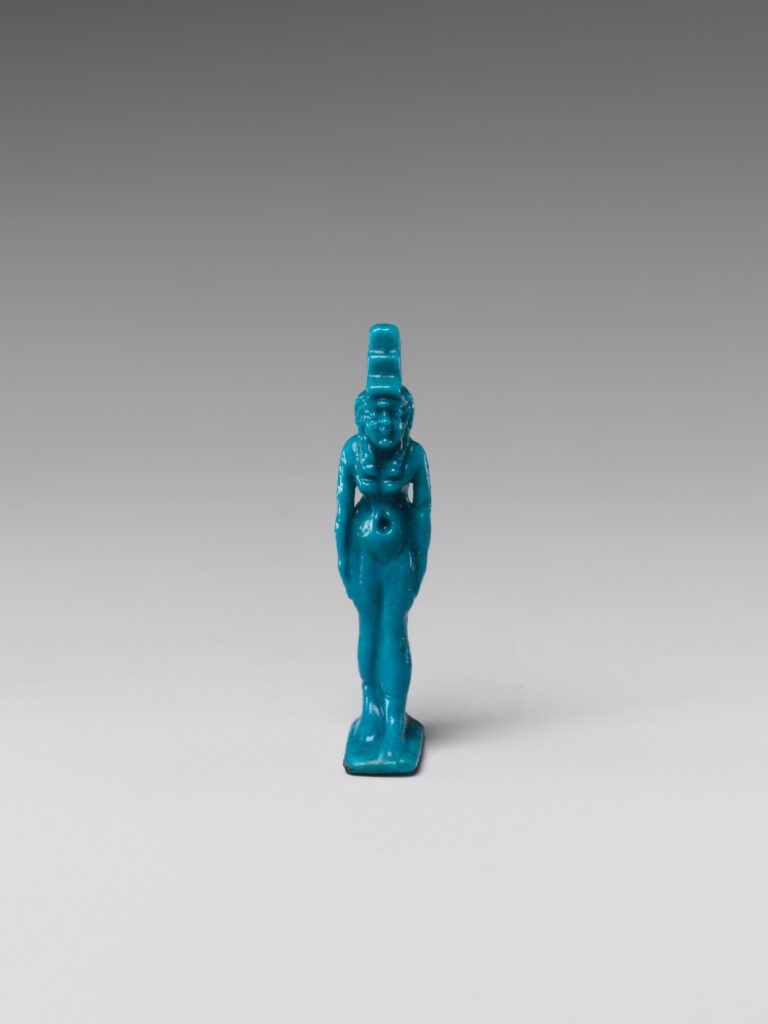
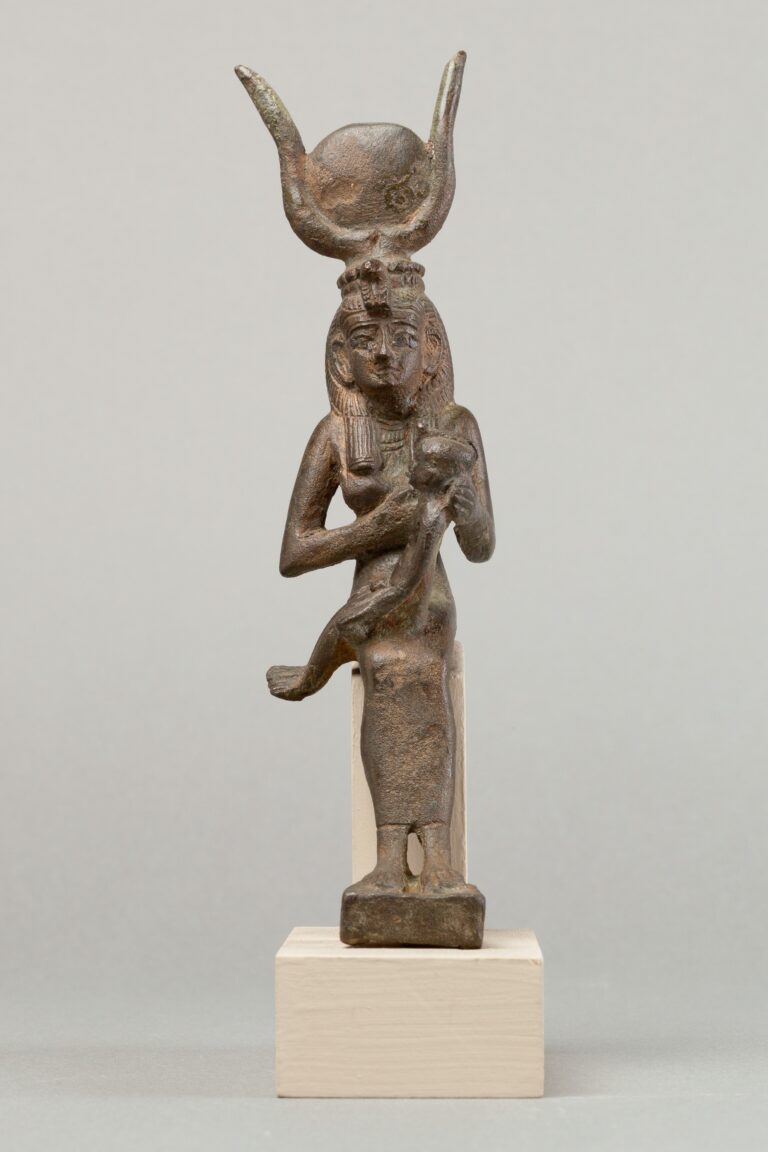
Later inscriptions also associate the Sons with four protective goddesses. In a Late Period set at The Met, Hapy is paired with Nephthys, Imsety with Isis, Duamutef with Neith, and Qebehsenuef with Selket.
The important point is not to force those pairings into another modern diagram.
It is to notice the relational structure.
The organ is protected by a Son of Horus.
The Son is protected in turn.
Protection itself is nested.
No single figure has to become the whole system.
Even the jars could become symbolic after their storage function changed
The history gives us an even better stress test.
By the Third Intermediate Period, embalming practice changed. Organs could be preserved, wrapped, and returned to the body instead of being stored inside actual canopic jars.
Yet canopic jars did not simply disappear.
Egyptians continued to include solid or “dummy” jars in burials.
The Met explains that these jars could have no usable interior cavity at all, while still being included to ensure the protection associated with the Four Sons of Horus.
That means the object’s function had changed.

The jar had once physically contained an organ.
Now the organ could be back inside the mummy, while the jar remained as part of the protective funerary structure.
This is useful for GEOMYTHA because it shows a symbol surviving the loss of one literal function.
That can be healthy.
A ritual object can carry memory after the practical arrangement changes.
But it also creates a question:
When does a form remain a living carrier of relation, and when does it persist only because nobody can imagine the system without it?
The historical evidence establishes the changing burial practice.
The second question is GEOMYTHA’s.
The heart complicates the pattern
If the lesson were simply “Egyptians preserved every body part because every part represented the whole,” the evidence would resist us.
The heart was generally left in the body because of its importance in Egyptian thought.
The brain, by contrast, could be removed and discarded during mummification.
The four canopic organs were treated differently again.
So this is not a modern doctrine of equal biological preservation.
Different parts had different ritual functions.
That difference is exactly why the Four Sons should not be turned into a vague slogan about “wholeness.”
The stronger lesson is narrower:
the parts that were separated remained inside a structure of relation, protection, and anticipated continuity.
What happens when the parts forget the body?
Now we can see the shadow.
Differentiation becomes fragmentation when the separated function begins behaving as though it no longer belongs to anything larger.
A job becomes the whole person.
A political affiliation becomes the whole citizen.
A diagnosis becomes the whole patient.
A trauma becomes the whole biography.
A talent becomes the whole source of worth.
A department becomes more concerned with preserving itself than serving the organization it belongs to.
Nothing is wrong with naming the part.
The distortion begins when the name stops returning to relation.
The Four Sons are not four psychological types
This is the other major boundary.
There is a temptation to say:
Imsety equals one GEOMYTHA function.
Hapy equals another.
Duamutef equals another.
Qebehsenuef equals another.
That would produce an attractive chart.
It would not produce a better argument.
The historical gods already have their own funerary identities, iconography, organs, texts, and relationships.
GEOMYTHA gains more by respecting those differences than by forcing them into a four-part template they were never designed to fit.
The correspondence is not:
four equals four.
It is:
one embodied order differentiates into several protected functions without requiring those functions to become independent selves.
Preservation is not possession
There is a subtle difference between caring for a part and possessing it as identity.
The canopic organ is preserved because it still belongs to a larger continuity.
GEOMYTHA’s distorted “These” appears when multiplication becomes accumulation:
my titles.
my possessions.
my achievements.
my injuries.
my beliefs.
my people.
my symbols.
The parts stop being cared-for relations and become evidence for the claimant.
The Four Sons give us the opposite image.
The separated thing remains protected precisely because it has not ceased belonging.
The practical return
Look at the parts of your own life.
Your work.
Your body.
Your family role.
Your beliefs.
Your history.
Your skills.
Your wounds.
Your public image.
Each may deserve a name.
Each may deserve protection.
Each may require different care.
But none has to become the whole person.
Differentiate what needs care. Protect what belongs. Do not let the protected part forget the body.
Sources and further reading
- The Walters Art Museum, A Complete Set of Canopic Jars, VO.7 (41.171–41.174), ca. 900–800 BCE. Primary institutional object record: dating, individual organ guardians, site, provenance, and museum CC0 collection image. Photograph also available through Wikimedia Commons under CC BY-SA 3.0, attributed to Walters Art Museum.
- The Metropolitan Museum of Art, Dummy canopic jar with baboon head (Hapy), 28.3.61. Dynasty 25, ca. 721–664 BCE; confirms there is no internal cavity and the four protectors remain important after organs return to the mummy. Image CC0.
- Smithsonian Institution, “Egyptian Mummies”. Standard New Kingdom mummification, the heart retained within the body, brain removed, changing treatment of viscera over time.
- The Metropolitan Museum of Art, Canopic Jar, Late Period.
- The Metropolitan Museum of Art, Canopic jar with a baboon-headed lid (Hapy).
- The Metropolitan Museum of Art, Dummy canopic jar with baboon head (Hapy).
- British Museum, “Ancient Egyptian gods and goddesses”.
- The Metropolitan Museum of Art, Nedjemankh exhibition gallery.
GEOMYTHA’s This → These reading, “protected archive” analogy, and distinction between differentiation and fragmentation are project interpretations. The museum sources establish the funerary practices, organ associations, protective deities, and changing use of canopic jars; they do not establish GEOMYTHA’s grammar as ancient Egyptian doctrine.