The cross is older than ChristianityChristianity — Religious TraditionThe Christian religious tradition referenced through resurrection, baptism, and the symbolic Eighth Day.Read full entry → because the mechanism is older than Christianity.
Before it is a Roman instrument, before it is a church sign, before it is placed on steeples, rosaries, graves, flags, shields, hospitals, and necklaces, the cross is a diagram.
A horizontal line.
A vertical line.
A point of intersection.
That is enough.
The whole drama is already there.
The horizontal line is the field of Is: extension, ground, world, body, relation, the given spread of being before it is claimed.
The vertical line is Am: reflectionAm — ReflectionAm names reflected presence: awareness embodied or mirrored without yet becoming ownership.Read full entry → rising and descending through the body, breath becoming conscious, presence becoming felt, the axis by which the field knows itself.
The intersection is the vulnerable place.
It can become the Is-AmReflection Without OwnershipReflection without ownership is the condition in which experience can appear, relate, and move without being seized as mine.Read full entry → crossing.
Or it can become the wound.
That is the entire problem.
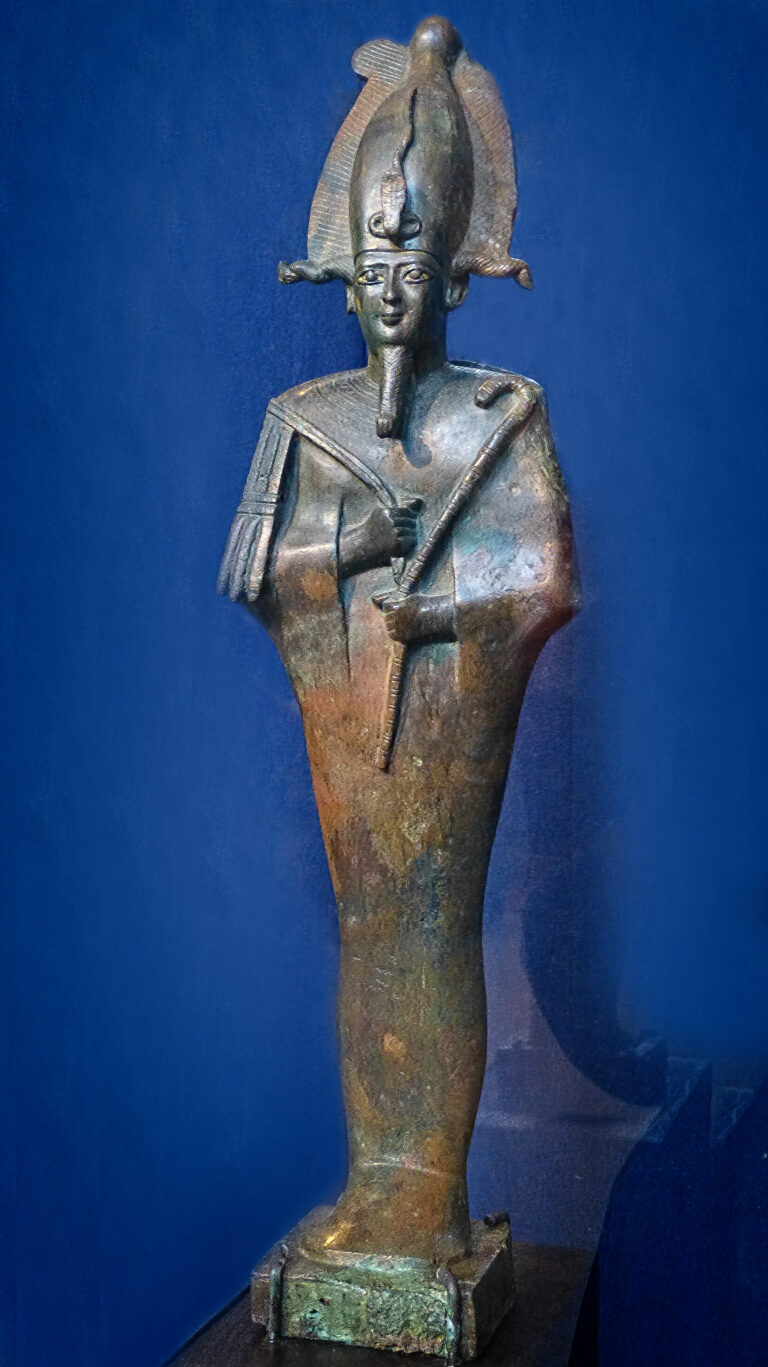
In the clean movement, the horizontal and vertical do not imprison each other. They meet. Awareness becomes reflected presenceOsirisIn Geomytha, Osiris names reflected presence: Am — awareness reflected as living consciousness without yet becoming ownership.Read full entry →. Breath enters the body. The body receives the current. Reflection returns to sourceIs — SourceIs names unclaimed being: awareness before possession, distinction, or identity.Read full entry →.
Is-Am.
Am-Is.
The cross is then not torture. It is orientation.
Field and axis.
Earth and breath.
Presence and reflection.
But when the claimantSetIn Geomytha, Set names the claimant: I — the interruption by which reflection is taken as mine and converted toward ownership.Read full entry → arrives, the crossing changes.
The I nails itself into the intersection.
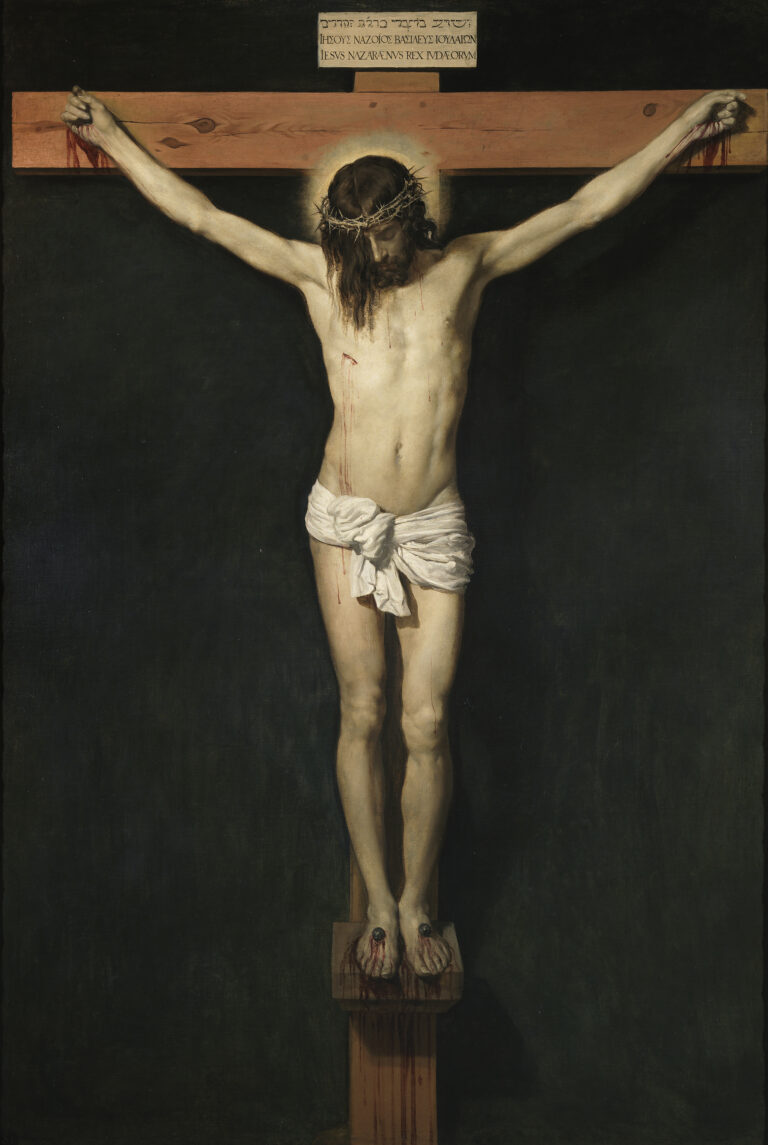
Then the living passage becomes fixation.
What should have remained a crossing becomes a crucifixion.
That is the Geomytha reading.
The false self forms when the current no longer moves cleanly between Is and Am. The claimant appears at the center and says:
I am thisThe False-Self Sentence — I Am ThisThe false-self sentence forms when claim joins reflection to a fixed object of identity: I am this.Read full entry →.
That is the nail.
Not the wood.
Not the body.
Not even the pain.
The nail is ownership.
The first articles in this sequence gave the grammar.
Is. Am. I. This.
Then the body map:
Air is Is.
Lungs are Am.
The belly is the Is-Am crossing.
The head-axis is I.
The identity-bodyHorusIn Geomytha, Horus names the identity that forms after claim: This — the body, role, image, wound, belief, or story taken as what the self is.Read full entry → is This.
Then Jacob appeared as the heel-grabber: the thought that seizes emergence before presence can returnReturn — RemembranceReturn names remembrance and release: the loosening of possession so reflection can become transparent to source again.Read full entry →. Then Ophiuchus appeared as the correction: the serpent held before insight becomes identityThis — IdentityThis names the formed identity: the body, role, image, wound, belief, or story claimed as what the self is.Read full entry →. Then the divine phrases were tested: I am thatI Am That — Nisargadatta MaharajI Am That is a published collection of talks by Sri Nisargadatta Maharaj, translated from Marathi by Maurice Frydman and first published by Chetana in 1973.Read full entry → I am and I Am That as bridges only if the claimant dissolves.
Now the cross gathers all of it into one image.
The cross is what happens when the meeting-point becomes fixed.
The horizontal field is no longer simply allowed to be.
The vertical reflection is no longer allowed to move.
The claimant enters the center.
The body is pinned to a story.
That is why the cross is so powerful.
It shows the exact moment when living consciousness becomes a fixed identity.
The body stretched outward becomes This.
This hand.
This foot.
This wound.
This face.
This name.
This public image.
This suffering one.
The vertical axis becomes I.
I suffer.
I am seen.
I am chosen.
I am cursed.
I am sacrificed.
I am the one at the center of the drama.
The horizontal field becomes the world that now witnesses the claimI — ClaimI names claim: the interruption by which reflected presence is taken as mine.Read full entry →.
And the intersection becomes the place where breath can no longer simply pass through.
This is why crucifixion is not merely death.
It is identity made visible under pressure.
A person can be wounded without forming identity from the wound. A body can suffer without becoming a myth of selfhood. Pain can move through the field and return.
But when the claimant occupies pain, the cross hardens.
Then the body does not merely hurt.
It becomes me.
I am this wound.
I am this betrayal.
I am this humiliation.
I am this sacrifice.
I am this story.
That is Horus on the cross.
Not because Christianity is false in some crude sense. Not because the image has no sacred depth. The image has too much depth. That is the danger.
A symbol this powerful can either reveal the mechanism or trap the mind inside the mechanism.
The cross can show the false self being exposed.
Or it can become the most beautiful image the false self ever used to sanctify itself.
That is why this article must be careful.
The point is not to sneer at the cross. The point is to read it before the claimant does.
The cross has two possible meanings.
In one direction, it shows the crucifixion of identity: the false self brought into visibility, exposed, exhausted, and finally unable to keep ruling.
In the other direction, it becomes identity worship: the self enthroned through suffering, specialness, sacrifice, chosenness, moral drama, or sacred victimhood.
The same symbol can free or bind.
That is the nature of true symbols.
They reveal and conceal.
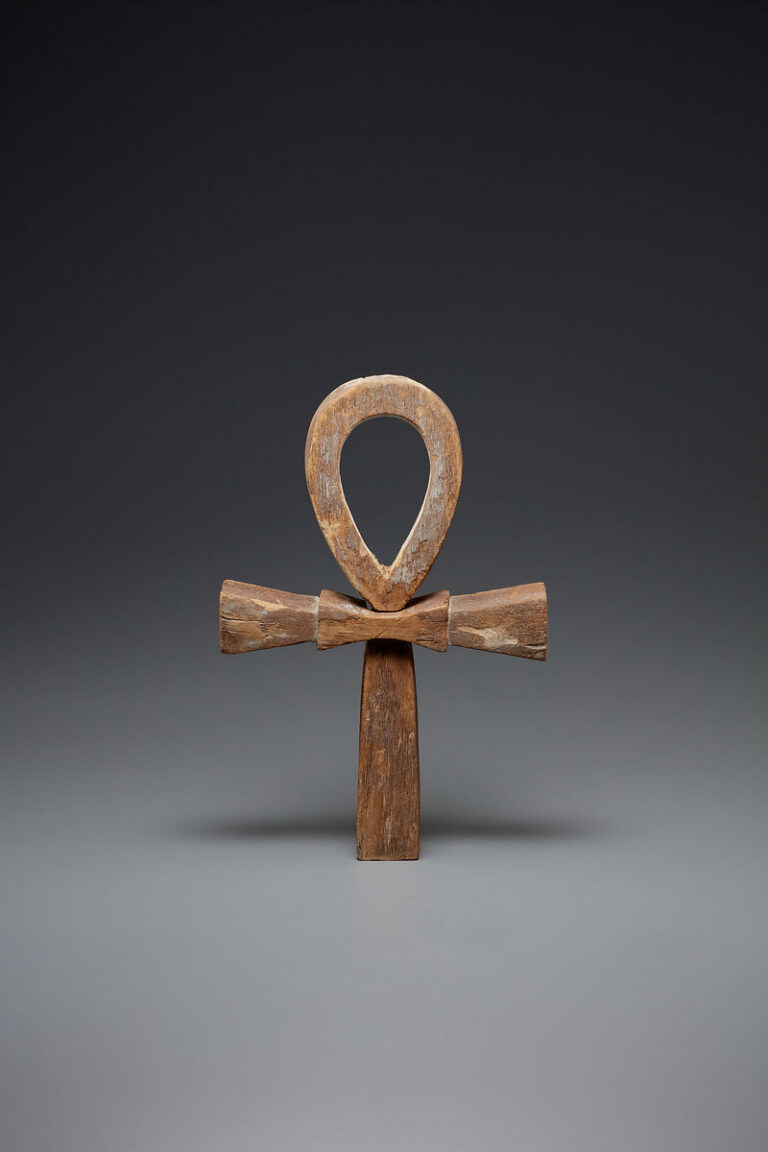
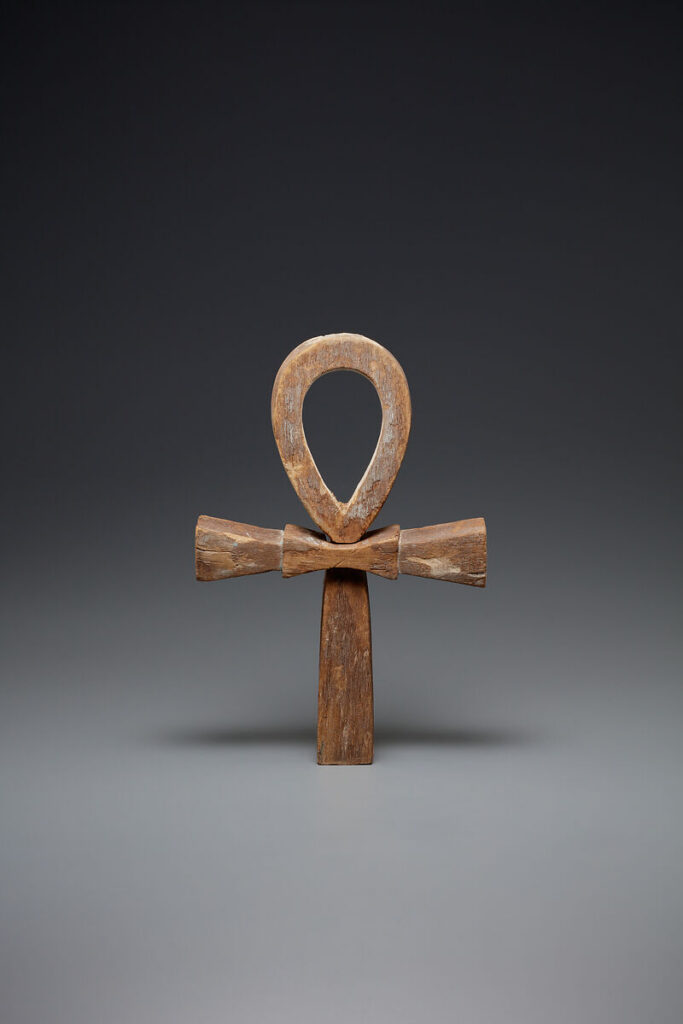
The ankh shows this older crossing beautifully. In Egyptian usage, the ankh was a hieroglyph for “live,” “alive,” or “life,” and it also became a general symbol of life. A loop above a cross-form: breath, life, handle, key, field, passage.
The ankh is not the crucifix, but it already carries the crossing of life through form.
It shows that the cross-form need not begin as torture. It can begin as life held in symbolic structure.
That matters.
Because in Geomytha, the original crossing is not evil.
The Is-Am crossing is the place where awareness becomes felt as living presence. The problem begins when Set captures the crossing and turns it into fixed identity.
That is why the cross must be read alongside the Tree of Life and the Tree of KnowledgeTree of KnowledgeGenesis 2–3 identifies a tree of the knowledge of good and bad/evil in the garden and prohibits the human pair from eating from it. After they eat, the narrative says their eyes…Read full entry →.
The Tree of Life is the living axis: rooted, breathing, branching, connected to source. It allows movement between levels without severing the field. It is the right vertical.
The Tree of Knowledge is the vertical axis captured by claim, division, comparison, and judgment. It turns the living field into opposites. Good and evil. Higher and lower. Mine and yours. Saved and damned. Right and wrong. Self and world.
That is the false vertical.
The cross can belong to either tree.
If the vertical axis reflects presence, the cross becomes orientation.
If the vertical axis is seized by I, the cross becomes crucifixion.
This is the same distinction that runs through the body.
The spine can serve presence.
The throat can speak truth.
The pineal can receive image without becoming ruler.
The crown can open without enthroning the claimant.
But when the upper axis becomes the false phallus, everything changes. The current is pulled upward into thought, vision, command, spiritualized identity, and self-certification. In the Geomytha body map, this false upper route passes through the throat, pineal, and crown: a vertical claim that disrupts the convergence point and constructs Horus through distorted reflection.
That is the inner crucifixion.
The living current is drawn away from the Is-Am plexus and nailed into the head’s claim.
The person no longer breathes the circle.
The person measures the circle.
This is where 3.14 belongs.
Pi is the number by which the line relates to the circle. Symbolically, it is the straight axis attempting to know the whole. That can be useful as measure. But it can also become exile: Set measuring the circle from outside it.
The cross is the same drama in image-form.
A line cuts the field.
Another line meets it.
The center becomes charged.
The claimant wants to own the crossing.
If the center remains open, the cross is a living coordinate.
If the center is nailed shut, the cross is a prison.
That is why Christianity’s central image is so spiritually dangerous and so spiritually potent. It places the body directly at the intersection. It forces the question:
What is being crucified here?
If the answer is the false self, the image opens.
If the answer is a new sacred identity, the image closes.
A person can use the cross to see through Horus.
Or Horus can use the cross to become holy.
This is not theoretical. It happens constantly.
The false self loves suffering when suffering gives it a role.
It loves being misunderstood.
It loves being persecuted.
It loves being the only one who sees.
It loves being chosen by pain.
It loves turning wounds into proof.
Then the cross becomes a mirror for ego drama.
Instead of dissolving identity, it intensifies it.
Now the self says:
I suffer, therefore I am real.
I am attacked, therefore I am righteous.
I am wounded, therefore I am central.
I sacrifice, therefore I am superior.
I carry the cross, therefore I am chosen.
That is not liberation.
That is Horus nailed beautifully to sacred wood.
The more dangerous version is collective.
A group can do the same thing.
A nation can carry a cross.
A church can carry a cross.
A movement can carry a cross.
A family can carry a cross.
A tribe can turn injury into destiny.
Then the symbol stops exposing the false self and starts feeding a collective one.
This is why Volume Three’s warning matters: once salvation becomes civilization, the path of return can harden into architecture, institution, law, hierarchy, and public sacred order. The self may mistake sacred structure itself for redemption.
The cross is one of the greatest tests of that danger.
It can reveal the end of false identity.
Or it can become the emblem under which identity conquers.
But the image itself remains deeper than its misuse.
At the highest reading, the cross shows that the false centerFalse CenterA false center forms when sovereignty is assigned to an object, role, institution, future state, identity, or projection that cannot actually serve as source.Read full entry → cannot survive exposure.
The body is stretched between world and heaven. The claimant has nowhere left to hide. The “I” that tried to own the crossing is placed in full view. It is pierced by its own fixation. The identity it tried to preserve becomes unbearable.
Then, if the symbol is read correctly, the cross does not end in identity.
It ends in release.
Not “I am this suffering.”
Not “I am this sacred role.”
Not “I am this chosen image.”
But:
The claimant has been exposed.
The fixed center has failed.
The breath returns.
That is why resurrection, in the deepest Geomytha reading, cannot mean the ego survives death with better lighting.
That would be Horus again.
Resurrection means the false center loses its claim and life is no longer organized around the nailed identity.
Presence is no longer trapped in the image of suffering.
The living current is freed from the cross.
This is why Is-Am / Am-Is remains the practical correction.
The cross shows the danger.
Breath gives the way through.
When pain appears, inhale:
Is-Am.
Let the body receive without immediate story.
When the pain moves, exhale:
Am-Is.
Let reflection return without becoming identity.
Do not say too quickly:
I am this pain.
Do not say too quickly:
I am this role.
Do not say too quickly:
I am this sacrifice.
Let the current remain alive before the claimant nails it down.
This can be used in ordinary life.
A criticism arrives.
The cross begins to form.
Horizontal: the situation.
Vertical: the felt reaction.
Center: the urge to become someone inside it.
If the claimant grabs the center, identity forms:
I am disrespected.
I am attacked.
I am unseen.
I must defend myself.
Maybe action is needed. Maybe a boundary is needed. Maybe speech is needed. But if action begins from nailed identity, Set has already entered.
So pause.
Is-Am.
Am-Is.
Let the crossing breathe before it becomes a crucifixion.
A memory arises.
Same mechanism.
Horizontal: the remembered scene.
Vertical: the bodily charge.
Center: the old “I” wanting to re-form.
If the claimant nails itself there, the past becomes present identity.
I am still this wound.
Pause.
Let the memory appear without becoming throne.
A spiritual insight arises.
Same mechanism.
Horizontal: the symbolic field.
Vertical: the rising interpretation.
Center: the desire to own the revelationRevelation — Book of RevelationThe final book of the Christian New Testament, also called the Apocalypse of John.Read full entry →.
If the claimant enters, the insight becomes:
I am the one who knows.
Pause.
Hold the serpent.
Breathe the crossing.
Do not nail the symbol into selfhood.
This is how the cross becomes practical.
Not as an object of decoration.
As a moment to notice.
The cross appears every time a living current risks becoming fixed identity.
That is why it is everywhere.
Not because everyone secretly worships one religion. Because the structure is basic. Horizontal and vertical are among the oldest symbolic forms available to consciousness. World and axis. Field and ascent. Body and breath. Time and attention. Relation and reflection.
Every time they meet, there is a center.
Every center can become a passage.
Every center can become a throne.
That is the decision.
This is why First Quarter is the right lunar field for this article. First Quarter is Form. It sharpens. It divides. It asks what shape the current will take. Gemini notices the distinction: living cross or nailed self, passage or prison, orientation or crucifixion.
The question is not whether form appears.
Form must appear.
A task needs shape.
A sentence needs structure.
A body needs orientation.
A life needs action.
The question is whether form becomes identity.
That is the line.
The cross before Christianity is the primordial form of that question.
Can the horizontal field and vertical reflection meet without the claimant turning the meeting into I am this?
Can the body suffer without becoming the self?
Can the symbol reveal without becoming a palace?
Can the center stay open?
This is the whole practice.
The cross is not escaped by rejecting it.
It is released by reading it correctly.
When the crossing appears, do not rush to become the figure nailed there.
Let the lines meet.
Let the breath move.
Let the center remain open.
Is-Am.
Am-Is.
The cross becomes a passage again.
The nail arrives late.