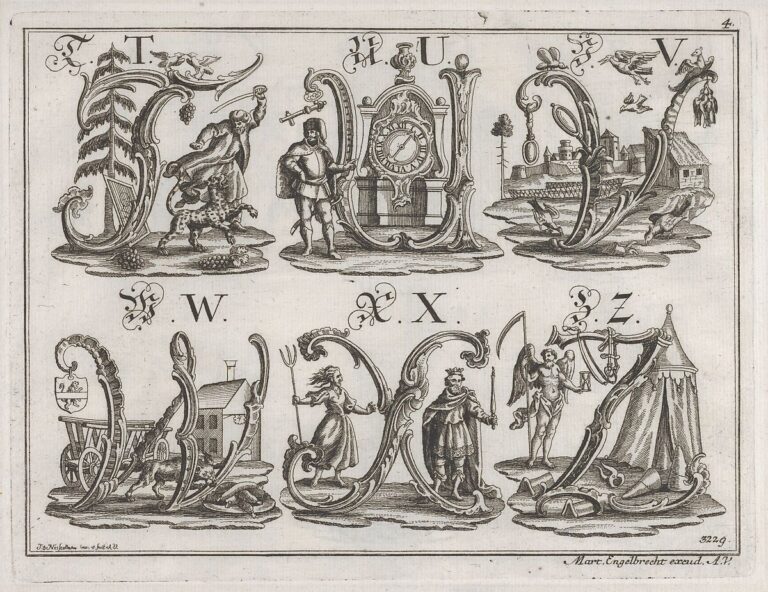
Letters are little gates.
Before they become words, before they carry arguments, prayers, contracts, names, threats, scriptures, brands, and songs, letters are marks. Shapes. Strokes. Angles. Crossings. Openings. Small architectures of attention.
A letter is not only sound.
It is a form the eye enters.
Some letters open upward. Some close around space. Some cross. Some descend. Some mirror. Some lean. Some break. Some look like ladders, tents, mouths, waves, rivers, doors, towers, arches, serpents, hooks, or paths.
The alphabet can be read as a field of passage.
Not as proof of a hidden code that every ancient scribe consciously designed. That would be too small and too mechanical. The deeper point is stranger and simpler: shapes work because consciousness recognizes form before it explains form.
A gate does not need a footnote to be a gate.
A crossing does not need a doctrine to be felt as crossing.
An inversion does not need permission to warn the body that something has turned.
The alphabet becomes a map of how form either opens or traps. It shows how attention moves from threshold into reflectionAm — ReflectionAm names reflected presence: awareness embodied or mirrored without yet becoming ownership.Read full entry →, from reflection toward crossing, and from crossing into inversion when identityThis — IdentityThis names the formed identity: the body, role, image, wound, belief, or story claimed as what the self is.Read full entry → tries to pass where only surrender can go.
A opens.
M embodies.
N crosses.
Z warns.
Symbolic Grammar, Not Proof
This has to be handled cleanly.
The alphabet is not being reduced to a rigid secret system where every letter must mean one thing forever. That kind of decoding quickly becomes another room for the claimantSetIn Geomytha, Set names the claimant: I — the interruption by which reflection is taken as mine and converted toward ownership.Read full entry →. The ego loves the feeling that it has cracked the code. It loves saying:
I know what every symbol really means.
That is not the work.
The work is not possession of symbols.
The work is attention.
A shape can comport without being a literal historical claimI — ClaimI names claim: the interruption by which reflected presence is taken as mine.Read full entry →. A symbol can reveal a pattern without needing every user of the symbol to have intended it consciously. The question is not whether every scribe, mason, printer, monk, architect, advertiser, or schoolchild knew the whole grammar.
The question is whether the form still works.
Does the letter open attention? Does it embody reflection? Does it cross? Does it invert? Does it become a room? Does it returnReturn — RemembranceReturn names remembrance and release: the loosening of possession so reflection can become transparent to source again.Read full entry →?
That is the level of reading here.
Not paranoia.
Not proof-hunting.
Symbolic mechanics.
A letter is a small architecture of attention.
A: The First Arch
A is the first gate.
It rises from two legs and meets at a point. It looks like a tent, mountain, roof, flame, pyramid, altar, ladder, or threshold. Even in its simplest printed form, A has the feeling of ascent. It gathers from the ground and reaches upward into a peak.
A is beginning as architecture.
It does not yet flow like water. It does not yet double itself. It does not yet cross from one upright to another. It opens.
A is the arch of appearance.
The hidden begins to take shape. The unmarked field receives the first structure. Something that was invisible becomes visible enough to stand.
This is why A belongs to First FireFirst FireFirst Fire is the formative fire of Is → Am: source becoming a vessel capable of reflected presence.Read full entry →.
Not fallen fire. Not stolen fire. Not beast-fire. The pure movement:
Is becomes Am.
SourceIs — SourceIs names unclaimed being: awareness before possession, distinction, or identity.Read full entry → enters the first threshold of form.
The A is not the whole body yet. It is the first opening through which the hidden becomes visible. It is the doorway of appearance, the first upward mark, the first pressure of manifestation.
A does not say:
I am thisThe False-Self Sentence — I Am ThisThe false-self sentence forms when claim joins reflection to a fixed object of identity: I am this.Read full entry →.
A says:
Something is appearing.
That distinction matters.
The first arch is not the fall.
The first arch is the mercy of appearance.
A is the first doorway through which the hidden becomes visible.
M: The Double Arch
M is the arch after it has entered the body.
A rises once.
M rises twice.
It moves up, down, up, down. It makes a doubled threshold, a wave, a valley, a pair of mountains, a body-field. It has repetition in it. It has rhythm. It has the sense of reflection: one rise answered by another.
This is why M belongs so strongly to Am.
Mother. Matter. Moon. Mouth. Mirror. Memory. Milk. Matrix. Manifestation.
Not because spelling proves metaphysics, but because the shape and sound cluster around embodiment. M is made with closed lips. It hums in the body. It is one of the earliest sounds a child can make. It does not cut sharply like a blade. It vibrates. It holds. It resonates.
M is not merely an arch.
It is the arch embodied.
A opens the threshold.
M repeats the threshold inside matter.
This makes M the letter of reflection. The first form has entered relationship with itself. The hidden has become felt, doubled, carried, mirrored.
In Geomytha language:
A opens the way for Is to appear. M shows that appearance becoming Am.
This is not corruption.
This is incarnation.
The passage from A to M is not the fall. It is source becoming intimate enough to be held, felt, sounded, fed, and remembered.
M is the arch after it has entered the body.
A to M: The First Fire Becomes Reflection
The movement from A to M is the movement of First Fire into living reflectionOsirisIn Geomytha, Osiris names reflected presence: Am — awareness reflected as living consciousness without yet becoming ownership.Read full entry →.
A is the first threshold.
M is the embodied threshold.
A is the gate.
M is the gate remembered by the body.
The first mistake would be to treat embodiment as the problem. It is not. M is not the fall. Matter is not automatically prison. Mother is not automatically bondage. Moon is not deception merely because it reflects. The mirror is not false merely because it is not the source.
Reflection is not the enemy.
Reflection is the way source becomes tender.
That is why M has to be protected from contempt. If M is treated as corruption, the whole system collapses into anti-body thought. But Geomytha does not read Am as guilt. Am is the living field where Is is felt.
The distortion begins later.
Not in A.
Not in M.
Not in source appearing.
Not in reflection forming.
The distortion begins when the claimant sees reflection and says:
Mine.
Then Am becomes seized by I.
Then the mirror becomes room.
Then the body becomes identity.
Then the world becomes This.
But A to M is still clean.
The passage from A to M is not corruption.
It is incarnation.
N: The True Crossing
N introduces crossing.
Two uprights stand apart, and a diagonal passes between them.
That diagonal matters.
M descends and rises within a doubled embodied rhythm. N cuts from one side to another. It bridges. It moves across polarity. It does not merely repeat the arch. It creates passage between pillars.
N is a ladder.
N is a bridge.
N is lightning contained into relation.
N is the angled path between above and below, left and right, source and reflection, one shore and another.
N knows that crossing costs direction.
To cross, one cannot simply remain where one began. The line must leave one upright and commit to the diagonal. It must risk the angle. It must pass between positions without pretending they are identical.
This is why N can be read as true crossing.
It does not abolish difference. It relates difference.
It does not collapse the pillars. It connects them.
It does not make the journey flat. It angles through tension.
Jacob’s ladder belongs near this form. Not because the letter N is literally Jacob’s ladder, but because both show passage between worlds through a slanted path. The diagonal is not decorative. It is the cost of relation.
A straight vertical line can stand.
A circle can enclose.
A horizontal line can rest.
But the diagonal crosses.
N is the letter that knows crossing must cost direction.
Z: The Inverted Crossing
Z looks like crossing after the structure has been knocked sideways.
The diagonal remains, but the orientation has changed. The path no longer rises between two standing pillars. It becomes sharper, flatter, more restless. It has the feeling of zigzag, lightning, fracture, reversal, serpentine movement, or broken passage.
Z still remembers N.
But it remembers it incorrectly.
That is what makes it powerful.
Z is not simply the opposite of N. It is N after crossing has been displaced. The shape still moves from one side to another, but the upright relation has collapsed into a more horizontal field. The diagonal no longer joins two standing columns in the same way. It cuts across a broken plane.
This is where inversion appears.
A true crossing relates difference without pretending the claimant owns the passage. An inverted crossing mimics passage while avoiding surrender. It looks like motion. It may feel charged. It may even feel like breakthrough.
But it can be a broken crossing.
The claimant loves Z because Z can feel like crossing without yielding. It can feel like rebellion, speed, shock, secret knowledge, zigzag brilliance, lightning identity, the thrill of inversion.
Z says:
I crossed.
But the deeper question is:
Did anything return?
Or did the claimant simply draw a more dramatic path?
Z is the crossing after the claimant has knocked it out of alignment.
N to Z: Passage Becomes Inversion
The center of this article is the movement from N to Z.
N is passage.
Z is passage claimed.
N crosses between pillars.
Z fractures the crossing into restless force.
N can return.
Z can become a room shaped like escape.
This is one of the main Geomytha warnings: identity is very good at mimicking passage. It can mimic awakening. It can mimic liberation. It can mimic return. It can mimic rebellion, transcendence, prophecy, spiritual insight, and symbolic mastery.
The claimant does not always remain still.
Sometimes the claimant moves constantly.
That movement can look like growth.
But if the claimant remains intact, the crossing has inverted.
The old self becomes the one who crossed.
The ego leaves one room and builds another room called “beyond.”
The threshold becomes hotel.
The doorway becomes brand.
The symbol becomes proof.
The map becomes identity.
That is Z.
Not merely motion, but motion possessed.
Not merely crossing, but crossing turned into self-story.
Z is not hopeless. It warns. It shows that a path can look charged and still fail to return. It shows that inversion keeps the structure of passage while bending its function toward identity.
N is passage.
Z is the claimant’s imitation of passage.
Everything After M
If M is the double arch of Am, then the field after M becomes symbolically charged.
This does not mean every later letter has to be decoded into a rigid system. That would become too brittle. But as a working principle, after M the alphabet asks a new question:
Can reflection cross cleanly?
Or will the crossing become identity?
Before M, the movement is toward appearance and embodiment. After M, the problem of passage intensifies. The body has appeared. Reflection has formed. Now the image must either return or be claimed.
Can Am remain transparent?
Can the mirror stay mirror?
Can the body stay vessel?
Can the symbol stay window?
Can the gate stay gate?
Or does I enter and harden everything into This?
That is why N and Z matter. They show the two possibilities after embodiment.
N is crossing.
Z is inversion.
N is the diagonal that relates.
Z is the zigzag that dramatizes.
N is passage with cost.
Z is passage turned sideways into claim.
After M, the alphabet asks whether reflection can return or whether identity will keep drawing new rooms.
Arches in Cities
This is not only about letters.
The same grammar appears in architecture.
Cities are full of arches: triumphal arches, memorial arches, sacred arches, Gothic arches, civic gates, ceremonial thresholds, monuments, doorways, bridges, portals, colonnades, stations, courthouses, churches, temples, and branded entrances.
An arch can be holy.
It can mark passage. It can say: leave one field, enter another. It can humble the traveler by reminding the body that transition matters. It can frame the sky, shelter the door, and give shape to crossing.
But an arch can also crown possession.
The triumphal arch is the perfect tension. It is a gate, but it is also a trophy. It marks passage, but it may also announce empire. It can say:
Enter differently.
Or:
Behold our victory.
Same form.
Different function.
The arch is holy when it marks passage and fallen when it crowns possession.
That is true of physical arches, religious arches, institutional arches, national arches, and inner arches. The question is always the same:
Does the gate open the traveler?
Or does the gate glorify the owner?
The Double Arch as Appetite-Machine
The double arch has its own modern stress-test.
The golden arches are almost too obvious, which is why they should be handled briefly.
M is mother, matter, moon, mouth, milk, meal, memory, and manifestation. It is the double threshold of the body. It belongs to feeding, holding, reflecting, and entering the world through need.
A commercial double arch turns that threshold into appetite.
The body enters not to return, but to consume.
The arch no longer marks sacred passage. It becomes a branded mouth. A bright M in the public field, calling the body toward repetition, comfort, salt, sugar, hunger, childhood memory, and identity-through-consumption.
This does not make eating evil.
Food is not the trap.
The body needing food is not the trap.
The trap is when the mother-threshold becomes appetite-machine, when the M of embodied need is captured by brand, habit, and repetition.
The golden arches are M converted from mother-threshold into appetite-machine.
A sacred form can be commercialized.
A threshold can be franchised.
A gate can become a mouth.
Zigzag, Lightning, and the Broken Path
Z belongs to zigzag.
That gives it a relationship to lightning, shock, fracture, sudden descent, and broken movement.
Lightning can be holy. It can be the sudden strike of revelationRevelation — Book of RevelationThe final book of the Christian New Testament, also called the Apocalypse of John.Read full entry →, the fire that descends, the flash that reveals the landscape in one instant. But lightning can also become the glamour of intensity: power without integration, charge without return, brilliance without humility.
The zigzag is fire after the path has become fractured.
It moves, but it does not rest. It strikes, but it does not necessarily relate. It dazzles, but it may not return. It can feel like revelation while leaving the claimant intact and electrified.
Modern culture loves zigzag fire.
Hot takes. Sudden shocks. Viral flashes. Breaking alerts. Instant insight. Aesthetic rebellion. Lightning identity.
Everything is charged.
Very little crosses.
The true question is not whether the lightning appears.
The question is whether the flash returns the witness to source or merely gives the claimant a brighter outline.
Z warns that not every charged path is a true crossing.
Some lightning only teaches the self to love being struck.
Zion and the Z-Question
Zion is one of the most powerful Z-words because it names a holy place, a promised place, a city, a kingdom, a longing, a return-home, and a political/religious identity depending on who is speaking.
That makes it symbolically dangerous.
Zion can mean the place the heart longs to return to.
But it can also become territory hardened into identity.
It can be kingdom as source remembered.
Or kingdom as room possessed.
This does not mean Zion is false.
It means Zion carries the Z-question.
Does the sacred city return the seeker to source?
Or does it become another This?
Does the kingdom end the search?
Or does the search become identity?
Does the promise open the hand?
Or does it harden the fist around territory, doctrine, tribe, image, or destiny?
Zion comports only when the Z is returned to crossing instead of hardened into territory.
The kingdom being searched for may be what has been searching.
But once the claimant says, “I own the kingdom,” the kingdom disappears into the room.
Test the Gate
Every gate must be tested.
Not feared.
Tested.
A letter. A symbol. A religion. A nation. A teacher. A doctrine. A brand. A ritual. A relationship. A path. A theory. A revelation. A system.
All can be gates.
All can become rooms.
Ask:
Does this open?
Does this return?
Does this make me more embodied, honest, humble, and present?
Does this help Am return to Is?
Or does it give I another This?
Does it crown the claimant?
Does it let me leave the one who wants to own the gate?
That last question matters most.
A gate is true only if it lets you leave the one who wanted to own the gate.
Otherwise it is not a gate.
It is architecture for identity.
The Broken Crossing Can Be Returned
Z is not hopeless.
Inversion can be noticed.
The broken crossing can be returned.
The path can move from Z back toward N, from dramatized motion back toward true passage, from identity-crossing back toward relation. The arch can stop crowning possession and become threshold again. The double arch can stop feeding appetite and become embodied reflectionBreath / Embodied ReflectionBreath makes reflected presence tangible in the body: inhale is used as Am, embodied reflection, while exhale is used as Is, release back toward source before reflected presence is seized by the…Read full entry → again. The letter can stop being room and become gate.
This is the mercy of symbolic grammar.
A symbol is not condemned because it has been inverted.
A gate is not useless because someone built a throne on it.
A letter is not dead because the claimant used it badly.
Form can be returned.
The alphabet is not a prison.
It is a map of how form either opens or closes.
A opens.
M embodies.
N crosses.
Z warns.
The question is whether the symbol becomes window, gate, or another room for the claimant.
First Quarter asks for definition.
CancerCancer — Zodiac SignCancer, the zodiacal sign used by Geomytha as the solar field of feeling.Read full entry → asks that definition not lose the body.
So define the crossing gently and clearly.
Do not fear the arch.
Do not worship the arch.
Pass through.
Do not despise the body.
Do not live inside the body-story.
Feel.
Do not mistake every zigzag for freedom.
Do not turn every gate into identity.
Cross cleanly.
And when the crossing breaks, return it.
A is the arch.
M is the body of the arch.
N is the crossing that still knows relation.
Z is the warning that passage can be inverted.
The broken crossing is not the end.
It is the place where noticing begins.