The title gives away the whole mechanism.
Dragon BallDragon Ball — Series and Transformation MotifsDragon Ball began manga serialization in 1984 and expanded into anime and related media including Dragon Ball, Dragon Ball Z, and Dragon Ball GT. The franchise centrally features Dragon Balls and Shenron,…Read full entry →.
A dragon is serpent force, fire, projectionThose — ProjectionThose names projection: enemies, outsiders, competitors, threats, and disowned qualities placed beyond the identity boundary.Read full entry →, desire, the power that appears when the hidden current is summoned outward. A ball is sphere, seed, pearl, world, egg, moon, contained wholeness. One is projected force. The other is reflective body.
So the title already carries the split.
The Ball reflects.
The Dragon projects.
The wish inverts.
That is the whole system in miniature.
The Dragon Balls are scattered fragments of one wish-power. They must be gathered through quest, effort, danger, friendship, competition, and trial. Once gathered, they do not simply restore the seeker to presence. They summon Shenron, the dragon, the enormous projected serpent who appears above the world and grants desire.
This is not accidental symbolic architecture.
The round reflective pieces are gathered, and the result is a serpent of projection. The body of reflectionAm — ReflectionAm names reflected presence: awareness embodied or mirrored without yet becoming ownership.Read full entry → is assembled so desire can speak through the sky.
That is Dragon Ball.
Before the golden hair, before the cosmic rankings, before Frieza, Cell, Buu, gods, angels, fusion, and endless escalation, the story begins closer to the body. Early Dragon Ball is earthy, comic, appetitive, martial, strange, and direct. Goku is hungry. Goku trains. Goku misunderstands the world because he is not yet fully captured by its social images. He moves through the field as a body before ideology.
He is powerful, but not yet a savior-image.
This is why Dragon Ball maps strongly to the Old Testament pattern. Not because it retells the Old Testament directly, but because it occupies the same symbolic register: land, quest, trial, teachers, law-like tournaments, covenantal friendships, magical objects, wandering, bodies, food, discipline, and encounter.
Dragon Ball is covenant-body.
It belongs to the field.
The Old Testament is heavy with land, law, genealogy, temple, exile, returnReturn — RemembranceReturn names remembrance and release: the loosening of possession so reflection can become transparent to source again.Read full entry →, blessing, curse, body, lineage, and memory. Its symbolic pressure is reflective. It is not yet primarily about escaping the world into a heavenly salvation-image. It is about living inside a charged field of covenant and consequence.
Dragon Ball has that same grounded quality. The world is bizarre, but it is still a world of roads, forests, islands, mountains, tournaments, masters, animals, capsules, villages, deserts, and bodies in motion. The sacred object is not yet a cosmic theology. It is a ball you have to find.
Then Dragon Ball Z arrives.
And the body is crowned.
DBZ lifts the same world into cosmic salvation drama. Goku is no longer merely a strange child-body wandering through trials. He is an alien son. He belongs to a hidden bloodline. He dies and returns. He trains in heaven. He descends to save the world. He becomes the defender against planetary destroyers, imperial tyrants, synthetic perfection, and demonic appetite.
The old body-world has not disappeared.
It has been fulfilled upward.
That is the New Testament pattern.
The New Testament takes the covenant-body and lifts it into sonship, resurrection, heavenly kingdom, inward belief, cosmic enemy, sacrifice, fulfillment, and salvation-image. It does not merely abolish the Old Testament. It claims to complete it. But Geomytha asks the necessary question:
Does fulfillment preserve the body, or does it crown the projection?
DBZ does the same thing to Dragon Ball. It does not erase the old world. It intensifies it, solarizes it, and turns it into a salvation machine. Training becomes power scale. Power scale becomes hierarchy. Hierarchy becomes identityThis — IdentityThis names the formed identity: the body, role, image, wound, belief, or story claimed as what the self is.Read full entry →. Identity becomes cosmic destiny.
The movement is clear:
Dragon Ball is Old Testament earth.
DBZ is New Testament sky.
Or even cleaner:
Dragon Ball is the body before salvation-image.
DBZ is the body crowned as cosmic savior.
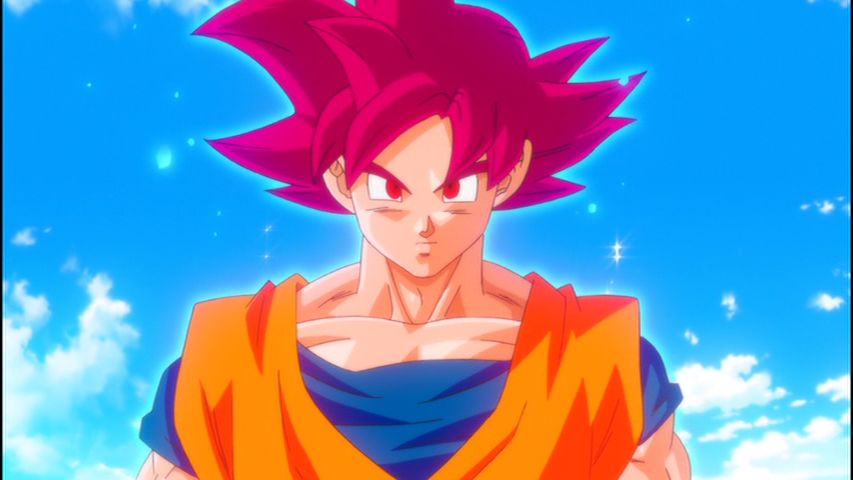
That crown appears most vividly in the Super Saiyan transformation.
The body glows. The hair rises. The aura burns. The figure becomes golden. The transformation looks like awakening, but it is also unmistakably solar. The body becomes image. The fighter becomes icon. Power is no longer merely practiced through flesh; it radiates as identity.
Super Saiyan is the false crown and the true crisis at once.
It is not simply bad. It emerges under grief, pressure, discipline, and necessity. But once the golden body appears, the whole symbolic field changes. Goku is no longer only present. He is visible as power. The body has become luminous enough to be worshiped.
That is the danger of every spiritual power fantasy.
The body becomes light, and the self calls projection awakening.
Goku and Vegeta carry the polarity sharply.
Goku begins as reflective body: simple, hungry, instinctive, disciplined, present. He trains because he loves movement. He fights because conflict is the field through which his body learns. His strength is most convincing when it is least self-conscious.
Vegeta is projection and claimI — ClaimI names claim: the interruption by which reflected presence is taken as mine.Read full entry →.
He is royal ego, title, bloodline, hierarchy, superiority, wounded pride, and the need to be recognized. Vegeta does not merely fight. He must be seen as what he says he is.
His sentence is:
I am thisThe False-Self Sentence — I Am ThisThe false-self sentence forms when claim joins reflection to a fixed object of identity: I am this.Read full entry →.
I am prince.
I am Saiyan.
I am elite.
I am rightful superior.
I am the one who should have been crowned.
That is why Vegeta is so important. He is not merely Goku’s rival. He is the projected identity that reveals what happens when power becomes self-image.
And yet DBZ is too intelligent symbolically to leave him flat. Vegeta’s arc matters because projection is not destroyed by humiliation. It must be broken open, disciplined, and returned to relation. His pride is his trap, but it is also the heat through which the trap becomes visible.
Frieza is projection at imperial scale.
He is hierarchy, conquest, racial ordering, planetary ownership, extraction, and domination. He turns worlds into property. He treats species as rank. He does not want relation. He wants submission.
If Vegeta is personal projection, Frieza is civilizational projection.
He is the crowned head of empire.
Cell is the next stage: synthetic identity.
Cell is made from fragments of others. He is an engineered composite, a biological fusion system, a creature assembled from borrowed powers. His obsession is “perfect form.” That phrase is the entire HorusHorusIn Geomytha, Horus names the identity that forms after claim: This — the body, role, image, wound, belief, or story taken as what the self is.Read full entry → problem in one sentence.
Cell does not simply want to live.
He wants to become the perfected identity.
He is the false one made from many.
Majin Buu exposes another side of the same pattern: appetite without right reflection. Buu absorbs others and becomes them. Fusion here is not relationship. It is consumption. He does not unite with the other in balance. He swallows the other into himself and wears the result as power.
That is false unity in its most naked form.
The Dragon Balls themselves keep the entire world inside a resurrection loop. Death can be reversed. Worlds can be repaired. Consequences can be undone. The wish restores the broken field, but it also permits the cycle to continue.
Destroy. Wish. Restore. Repeat.
That is why the Dragon Balls are not simply benevolent. They are the mechanism by which desire interrupts consequence. They gather reflection, summon projection, and reshape reality according to the wish.
The wish is the dangerous middle point.
A wish can heal. A wish can restore. But a wish also says reality should bend to image. Desire speaks, the dragon answers, and the world is rewritten.
This is projection becoming metaphysical law.
Fusion makes the same pattern even more obvious.
The Fusion Dance requires two bodies to mirror each other exactly. Gesture, timing, posture, and energy must align. If the ritual is performed correctly, two beings become one stronger identity.
That is the pure fusion fantasy: perfect synchronization produces a superior self.
But the Potara earrings reveal the darker side. Fusion is mediated by sacred objects placed at the head and ears. The merger is less dance than mechanism. It is imposed through ritual technology. The result may be powerful, but the question remains:
Does fusion restore right relation, or does it create a more intoxicating self-image?
Gogeta and Vegito are not merely stronger fighters. They are ritual products. Two identities disappear into a new name, a new body, a new power, a new image. Fusion is treated as completion. But Geomytha asks whether completion is always true unity.
Sometimes the false one is simply more powerful than either half.
This brings us to Dragon Ball GT.
GT is symbolically strange because it tries to return after the crown.
Goku is turned back into a child. That is not a small plot device. It is the whole problem. After DBZ has transformed him into cosmic savior, GT forces him back into the child-body. The series tries to recover the earlier Dragon Ball field: quest, travel, scattered objects, adventure, absurdity, danger, and bodily innocence.
But it cannot truly return.
The cosmic crown has already happened.
That is why GT feels unstable. It is Dragon Ball after DBZ. It is the Old Testament field after the New Testament sky has already overwritten it. It is the child-body after the savior-image.
The return is haunted by projection.
Even the title matters.
GT carries a mirrored force. In septenary cipher logic, G and T can be read as occupying equivalent mirrored positions across the split. Symbolically, that makes GT a doubled mark: the beginning and its transformed counterpart sharing the same hidden value.
G is Goku, ground, beginning, body.
T is transformation, time, terminal return, tail.
GT becomes Goku-through-transformation. Ground-through-time. The child-body returned after cosmic projection has already altered the field.
That is exactly why GT belongs to the larger pattern. It is not merely a sequel. It is the return problem.
Once the body has been crowned as savior-image, can it ever simply be body again?
That question is deeper than Dragon Ball.
It is the same question raised by every system that binds two orders into one sacred story. The Old Testament body and the New Testament image. The head and the body. Reflection and projection. The original field and the later fulfillment. The child and the savior. The ball and the dragon.
The danger is not transformation itself.
The danger is mistaking transformation for awakening.
This is why DBZ must be read with care. It is not simply an inverted myth. It still loves discipline. It still honors training. It still knows that the body matters. Master Roshi, Korin, King Kai, the Hyperbolic Time Chamber, gravity training, weighted clothing, breath, stance, repetition—theseThese — AccumulationThese names accumulation: possessions, titles, achievements, beliefs, communities, and other extensions gathered around identity.Read full entry → are not empty spectacle. They preserve the old truth that strength must be embodied.
Training is not the problem.
Power is not the problem.
The inversion begins when power becomes identity.
Goku is most awake not when he glows, but when power returns to simplicity. The deeper lesson is not that the body should never become strong. The lesson is that strength must return to presence, or it becomes crown.
That is the final distinction.
Dragon Ball begins with the round body of reflection.
DBZ crowns that body with golden projection.
GT tries to return the crowned body to childhood.
And underneath all of it, the title keeps whispering the mechanism:
Dragon Ball.
The ball reflects.
The dragon projects.
The wish inverts.
The whole saga is a myth of what happens when the body becomes powerful enough to be mistaken for salvation.