A nightmare feels real because the self inside it feels real.
That is the trick.
You are running down a hallway that keeps lengthening. You try to scream, but nothing comes out. You open one door and find the same room waiting behind it. You wake up, relieved, only to realize you are still dreaming. Something is coming. Something is behind you. Something knows where you are.
And inside the dream, there is a “you” who must survive it.
That “you” is the secret.
A nightmare is not merely a frightening dream. It is one of the clearest places where the false self exposes its mechanics. In waking life, the ego is protected by continuity. It has a name, a phone, a schedule, a history, a room, a body in motion, people who recognize it, problems that seem to confirm it. It is reinforced every morning by daylight.
But at night, that support weakens.
The world dissolves. The ordinary body lies still. The social role goes silent. The calendar disappears. The ego loses the furniture of its kingdom.
And yet another self appears.
It appears inside the dream.
It says, without saying it:
I am thisThe False-Self Sentence — I Am ThisThe false-self sentence forms when claim joins reflection to a fixed object of identity: I am this.Read full entry → one. I am here. I am in danger. I must escape.
That is Night-
HorusHorusIn Geomytha, Horus names the identity that forms after claim: This — the body, role, image, wound, belief, or story taken as what the self is.Read full entry →.
In Geomytha, Horus names the time-bound
identity-bodyThis — IdentityThis names the formed identity: the body, role, image, wound, belief, or story claimed as what the self is.Read full entry →: the This that forms after awareness has been pulled into
projectionThose — ProjectionThose names projection: enemies, outsiders, competitors, threats, and disowned qualities placed beyond the identity boundary.Read full entry →, memory, fear, desire, image, and world. Horus is not pure awareness and not the original
claimantSetIn Geomytha, Set names the claimant: I — the interruption by which reflection is taken as mine and converted toward ownership.Read full entry →. Set is the I that interrupts and claims; Horus is the identity built from what that
claimI — ClaimI names claim: the interruption by which reflected presence is taken as mine.Read full entry → hardens into. He is the ruler-image of the divided field, the one who inherits the world after the original
reflectionAm — ReflectionAm names reflected presence: awareness embodied or mirrored without yet becoming ownership.Read full entry → has been fractured.
By day, Horus is organized. He can pretend to be sovereign.
By night, he is exposed.
The nightmare is Horus after the lights have gone out.
The Dream Does Not Begin With the Monster
Most people think the nightmare begins when the monster appears.
It does not.
The nightmare begins when awareness identifies with the one being threatened.
The monster matters. The dark hallway matters. The shadow at the foot of the bed matters. The house that rearranges itself matters. But all of that is secondary. The first movement is identification. A self appears inside the dream, and awareness says: that is me.
Once that happens, the whole dream-world becomes binding.
If the dream-body is chased, “I” am chased.
If the dream-body falls, “I” am falling.
If the dream-body cannot speak, “I” am voiceless.
If the dream-body dies, “I” am dying.
But when you wake, that self vanishes.
The body in bed was never running. The throat was never sealed by the hallway. The door was never locked. The monster never crossed the room.
And still, the fear was real.
That is the important distinction. The fear was real as experience, but the identity around which it formed was temporary. The dream-self was believed, then dissolved.
This is why nightmare is such a powerful symbolic teacher. It shows, in compressed form, how the ego is constructed. A world appears, a self appears inside it, danger appears in relation to that self, and awareness becomes trapped in the drama.
That is not only what happens in sleep.
That is what happens in waking life more slowly.
Isis Is the Dark Field
The nightmare appears in awareness.
That must come first.
Before the hallway, before the creature, before the paralysis, before the pursuit, before the dream-body, there is the field in which all of it appears. In Geomytha, that field is
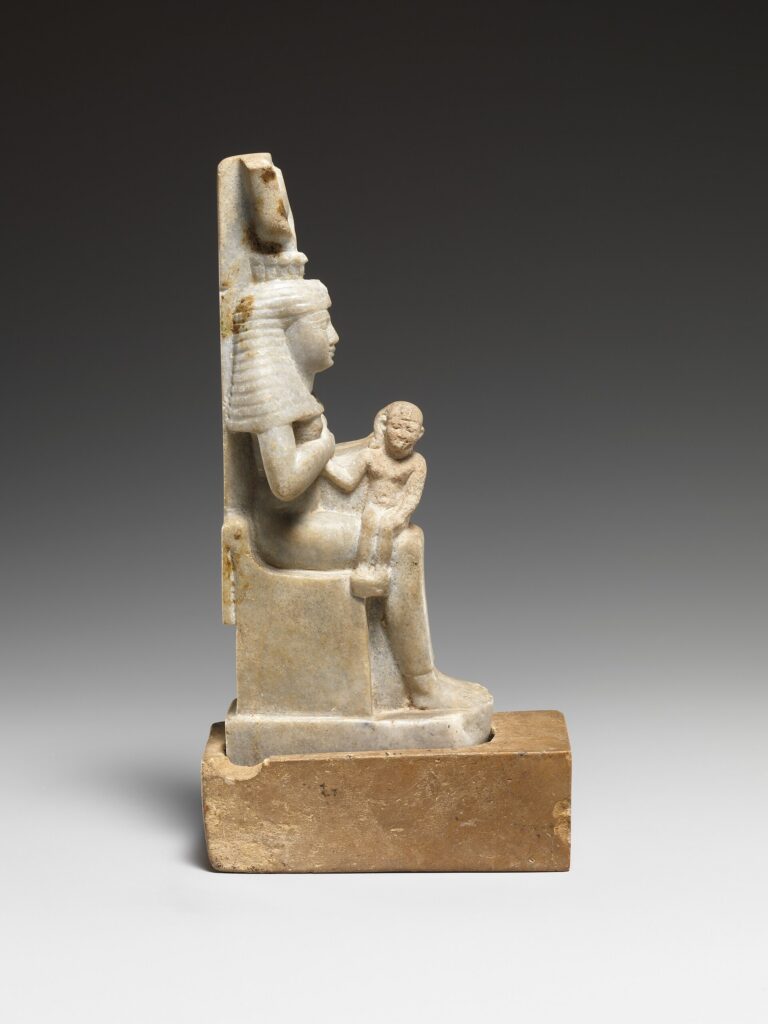
IsisIsisIn Geomytha, Isis names the unclaimed field: Is — pure being, awareness before possession, and the ground before the claimant appears.Read full entry →: pure awareness, the unbroken ground, the silent “is” before the mind divides experience into self and world.
In nightmare, Isis is often mistaken for absence because she appears as darkness.
But darkness is not nothing.
Darkness is the womb of the dream. It is the unlit field where the ordinary ego can no longer see its own borders. The terror of the nightmare comes partly from this: Horus enters the dark and assumes that because he cannot control the field, the field is hostile.
But the field is not hostile.
It is holding everything.
It holds the fear.
It holds the image.
It holds the self that believes it is trapped.
It holds the possibility of waking.
The monster is not Isis. The monster is an image inside Isis. The maze is not Isis. The maze is an image inside Isis. Even the frightened dream-self is not Isis. It is a form appearing within awareness.
This is the first corrective.
The nightmare wants all attention fixed on the threat. Geomytha asks a deeper question: what is the field in which the threat appears?
That question changes the dream.
Not always immediately. Not always comfortably. But it changes the direction of interpretation. Fear says, “Look at the monster.” Awareness says, “Notice that the monster is appearing.”
That slight shift is already the beginning of
returnReturn — RemembranceReturn names remembrance and release: the loosening of possession so reflection can become transparent to source again.Read full entry →.
Osiris Is the Lost Still Point
In a nightmare, the center is missing.
That is why the dream is so unstable. The hallway stretches. The room repeats. The landscape changes without warning. The rules are inconsistent. Time behaves strangely. The self is thrown from one image to another without finding a stable place to rest.
This is the absence of
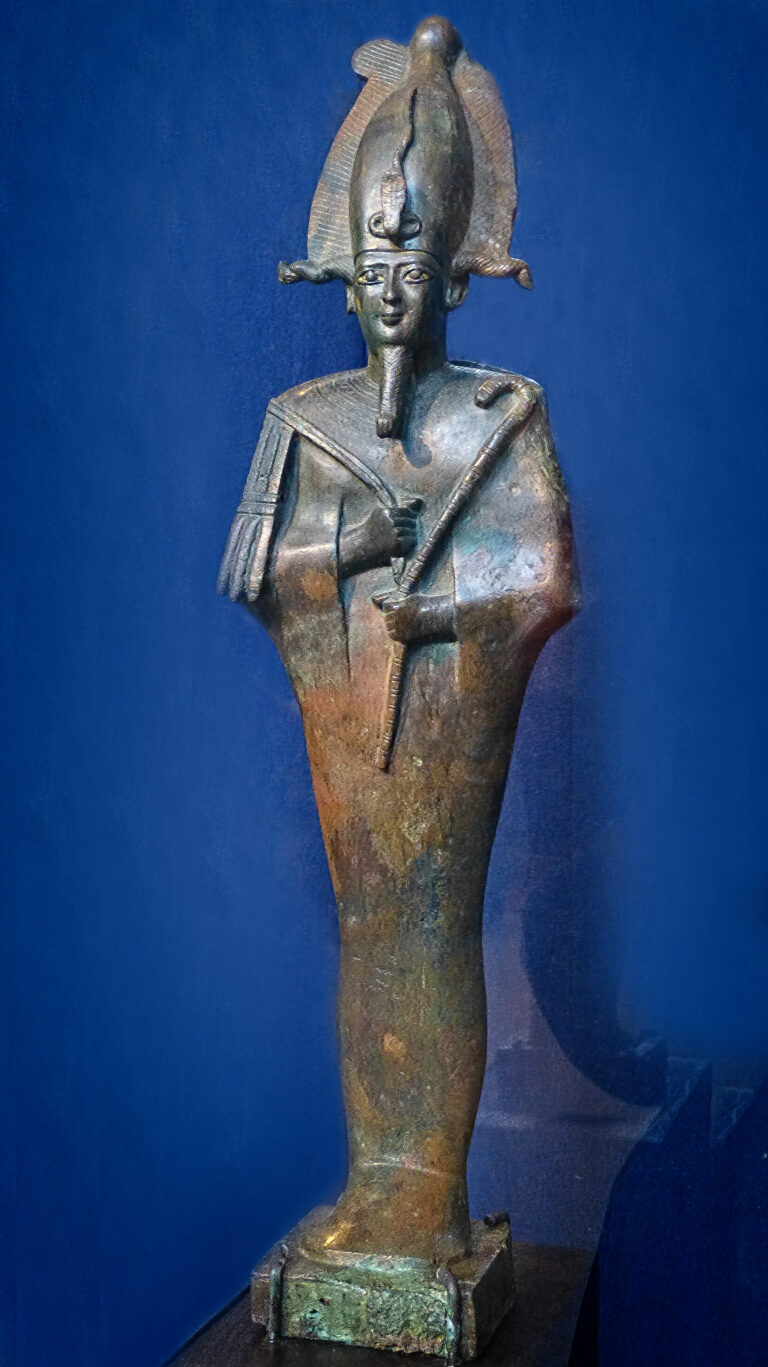
OsirisOsirisIn Geomytha, Osiris names reflected presence: Am — awareness reflected as living consciousness without yet becoming ownership.Read full entry →.
Osiris is right reflection: consciousness aligned with awareness, the calm mirror in which experience can appear without becoming a prison. Osiris is the stable interior point, the place where perception does not immediately become identity. He is not panic. He is not control. He is not the ego’s command center. He is the reflective stillness beneath the ego’s struggle.
Nightmare is what happens when Horus enters the night without resting in Osiris.
The ego wants to rule the dream. It wants to solve the maze, defeat the pursuer, escape the room, force the mouth to speak, force the body to move. It wants daylight authority in the underworld.
But the underworld does not obey daylight authority.
That is why nightmares so often involve failed control. You cannot run. You cannot scream. You cannot wake. You cannot find your way back. The ordinary instruments of Horus do not work. The dream is showing him the limit of his sovereignty.
This is not punishment. It is
revelationRevelation — Book of RevelationThe final book of the Christian New Testament, also called the Apocalypse of John.Read full entry →.
The nightmare says: the self you take yourself to be is not in control of the field in which it appears.
That is terrifying to Horus.
It is liberating to awareness.
Set Is the Projector
Set rules the nightmare by projection.
He turns fear into architecture. He turns memory into weather. He turns guilt into pursuit. He turns desire into lure. He turns shame into exposure. He turns uncertainty into a figure waiting in the corner of the room.
Set does not need to create something from nothing. He rearranges what consciousness already carries. A hallway from childhood. A face half-remembered. A sound. A wound. A forbidden door. A body that will not respond. A sense of being watched. A pressure on the chest. A voice that knows your name.
TheseThese — AccumulationThese names accumulation: possessions, titles, achievements, beliefs, communities, and other extensions gathered around identity.Read full entry → fragments are gathered into a world.
That world feels external.
That is Set’s genius.
Projection always feels as though it is coming from outside. In waking life, this appears as blame, fear, ideology, obsession,
enemy-makingEnemy ConstructionEnemy Construction occurs when a self or group stabilizes its own identity by projecting danger, impurity, blame, or negation onto an outside figure or category.Read full entry →, fantasy, and compulsive interpretation. In nightmare, the same mechanism becomes immediate image.
The monster appears to be “out there.”
But the monster is a form of consciousness.
This does not make it meaningless. It makes it more meaningful. The nightmare figure is not “fake” in the shallow sense. It is symbolic. It reveals the shape fear takes when awareness forgets itself.
This is why fighting the monster can deepen the dream.
There are times when a dream demands confrontation. There are times when the figure must be faced. But if Horus believes the monster is ultimately separate from the field of awareness, he remains trapped in duality. He may win one battle and still preserve the structure that produced the battle.
This is the Apep problem.
The serpent appears. The solar hero fights. The hero wins. The cycle repeats. The battle feels noble, but the repetition reveals the trap. If Horus requires an enemy in order to feel real, then defeating the enemy does not end the illusion. It renews it.
Many nightmares work this way. The dream-self is defined by threat. The pursuer gives the ego its temporary shape. Without the monster, who is the one running?
That question is dangerous to Horus.
The Dream-Body Is the False King
The strangest thing about a nightmare is how quickly the dream-body becomes “me.”
You do not usually stop inside the dream and ask: whose hands are these? Whose fear is this? What world is this? Who decided I am this figure inside it?
You simply are.
That is the enchantment.
The dream-body becomes the seat of identity. It may look like your waking body, or it may not. It may be younger, older, displaced, distorted, or barely visible. But whatever form it takes, awareness contracts around it. The dream-world then organizes itself around the survival of that figure.
This is Horus in pure form.
Horus is the identity-body organized around the claim: I am the center of this world.
In a nightmare, that claim becomes unbearable because the world refuses to confirm his power. The king is in his kingdom, but the kingdom has turned against him. Doors do not open. The ground does not hold. The voice does not work. The body will not obey. The dead return. The hidden watches. The familiar becomes hostile.
Horus discovers that he is not the
sourceIs — SourceIs names unclaimed being: awareness before possession, distinction, or identity.Read full entry → of reality.
He is a character inside it.
That is why nightmares can feel humiliating. They strip the ego of its costume. The competent waking self becomes a trapped child, a hunted animal, a voiceless witness, a body pinned beneath invisible force.
The
false kingCounterfeit KingshipCounterfeit kingship appears when a role, ruler, institution, or self treats the throne, office, authority, or form it occupies as the source of legitimacy rather than as a vessel answerable to something…Read full entry → is shown his dependency.
But this humiliation is also mercy. It shows that the identity that seemed solid is actually conditional. It depends on a world, a body, a story, and a stream of images. Change the world, and the self changes. Collapse the dream, and the self disappears.
What remains?
Awareness.
The Night-Mare and the Dark Horse
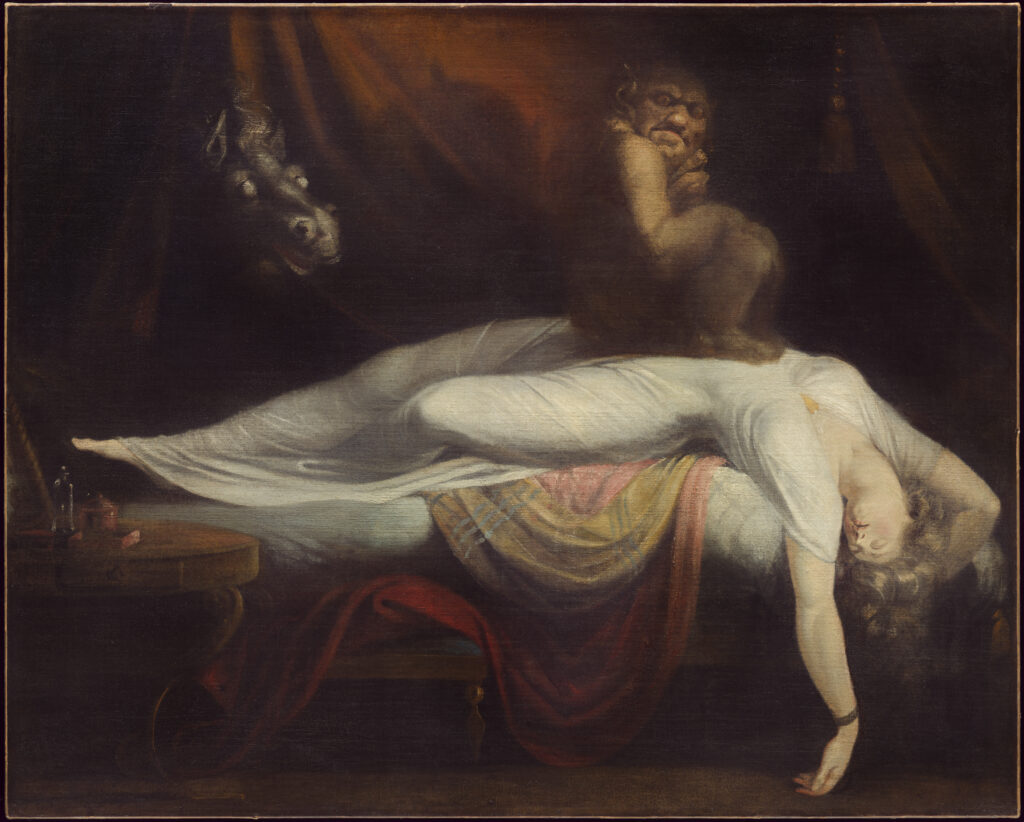
The word nightmare also carries an older image: the mare, the horse of the night.
That matters symbolically.
A horse is a vehicle. It carries the rider. It has force, momentum, instinct, and direction before the rider fully controls it. In Geomytha, the horse becomes a perfect image for the dream-field itself: the dark animal-motion of sleep carrying the ego through terrain it did not choose.
And hidden inside that sound is Horus.
Horse and Horus do not need to be treated as a strict linguistic equation to work symbolically. The resonance is enough: horse / Horus. The rider thinks he is sovereign, but the night-mare reveals otherwise. Horus believes he is the king, the one who directs the field, the one who sees from above. But in nightmare he is carried. He is not ruling the dark animal. He is being taken by it.
That is why the image is so exact.
The night-mare is the dark horse beneath the false king.
By day, Horus claims the chariot.
By night, the horse carries Horus.
The nightmare humiliates the ego’s claim to command. It shows that the self who says “I am in control” can be thrown onto a darker motion, ridden through images, fears, memories, and underworld terrain it cannot govern.
The question is not whether Horus can master the horse.
The deeper question is whether awareness will keep mistaking itself for the rider.
Freddy, the Matrix, and the Dream That Feeds on Belief
This is why horror understands something philosophy often makes too clean.
In A Nightmare on Elm Street, Freddy Krueger is terrifying because he rules the dream-field. He attacks where the ordinary self is most vulnerable: sleep. His victims cannot simply avoid him by locking a door in waking life. The danger follows them into the
image-worldImage WorldImage World names a symbolic environment in which representation becomes the dominant medium through which reality, value, identity, and belonging are encountered.Read full entry →.
Freddy is Set as nightmare-projection.
His power depends on fear, belief, and entry into the dream-field. The more the dream is believed, the more binding it becomes. The victim’s body in bed becomes linked to the dream-body under attack. The nightmare crosses the threshold because consciousness has identified with the projected self.
That is the horror.
But
The MatrixThe MatrixThe Matrix presents Neo’s ordinary experienced world as a computer-generated or neural-interactive construct maintained by a machine system. The film repeatedly distinguishes the operative rules of that construct from whatever lies outside…Read full entry → makes the same point in a different language. The body lies elsewhere; the mind inhabits a generated world. The self inside the simulation believes the simulation is real, and because it believes, it suffers according to that world’s rules. The body in the pod and the self in the Matrix are not identical, but the identification is strong enough to bind experience.
The nightmare and the simulation operate through the same wound: awareness forgets the difference between itself and the world appearing within it.
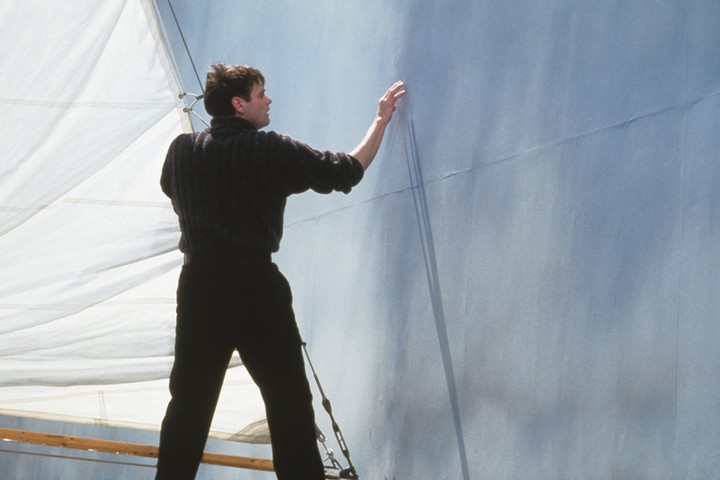
The Truman ShowThe Truman ShowThe Truman Show presents Truman Burbank living unknowingly inside a constructed television environment whose town, relationships, routines, and physical conditions are organized by a production system around him. The film repeatedly exposes…Read full entry → gives a softer but equally precise version. Truman’s world is constructed around him. It holds only because he accepts its continuity. Once the cracks appear, reality begins to loosen. The sky can become a wall. The horizon can become a set. The life he thought was natural is revealed as staged.
Nightmare, simulation, spectacle—these are not separate symbolic problems. They are variations of the same structure.
A world is presented.
A self forms inside it.
The self believes the world.
The world feeds on that belief.
The question is not only whether the world is false.
The question is why the self inside it feels so real.
Sleep Paralysis and the Panic of Horus
Sleep paralysis is one of the most intense forms of Night-Horus.
The person becomes aware before ordinary bodily command has fully returned. The body is still. The room may be visible. Pressure may be felt. A presence may appear. The mind wakes into a field where the body does not obey.
Horus panics.
This is understandable. The ego is used to identifying control with safety. If the body does not move, the ego assumes danger. If speech does not work, it assumes captivity. If a presence appears, it assumes attack. The machinery of self-defense floods the field.
But symbolically, sleep paralysis reveals the same structure as nightmare with unusual clarity.
The body is not under Horus’s command. The image-field is active. Fear produces form. The “I” that wants to move cannot move. The ordinary waking identity has returned too early and is trying to seize the throne before the passage through night has completed.
The way through is not easy, and it should not be romanticized. But the Geomytha reading remains precise: the terror intensifies when awareness identifies entirely with the helpless ego-position.
The shift is subtle:
Not “I am trapped.”
But “the trapped-self is appearing.”
Not “something is taking me.”
But “fear is forming as presence.”
Not “I must regain control immediately.”
But “awareness is here before control returns.”
That is not passivity. It is deeper steadiness.
It is Taurus inside the underworld: the body held, the breath trusted, the field allowed to settle without turning every image into an enemy.
The Nightmare as Reincarnation in Miniature
A nightmare is a small reincarnation loop.
A world appears.
A self appears inside it.
The self inherits a problem.
The problem becomes urgent.
The self struggles to survive.
The world collapses.
The self disappears.
Another dream begins.
This is why dreams are such dangerous teachers. They make the structure obvious.
While dreaming, the dream-self has a past, even if that past is fabricated instantly. It has relationships, fears, missions, obligations, and dangers. It accepts the terms of the dream almost immediately. It rarely asks how the world began. It simply starts living inside it.
Waking life works the same way, only with greater density.
The waking ego has a longer memory-stream, a more stable body, a more consistent environment, and social confirmation. That makes it harder to see through. But its structure is not fundamentally different. It is still identity organized around time, image, fear, desire, and continuity.
The nightmare compresses the whole thing into a few minutes.
That is why waking from a nightmare can feel like resurrection. The world ends, but awareness remains. The dream-self dies, but something knows it dreamed.
Geomytha’s question is severe:
What if waking life is not escaped by making Horus more successful?
What if it is escaped by recognizing Horus as the dream-body of a larger field?
The False Solution Is Winning
The ego wants a heroic solution.
It wants to kill the monster. Escape the house. Expose the simulation. Defeat Freddy. Outrun the shadow. Break the spell. Wake by force.
There is a place for courage. But courage is not the deepest answer if it merely strengthens the dream-self.
A victorious Horus is still Horus.
That is the hidden trap inside many salvation stories and many horror stories. The self survives the ordeal, but the structure of identification remains untouched. The hero escapes one nightmare and returns to the same ego that will generate the next one.
This is why some nightmares repeat.
The content changes. The structure remains.
Different hallway, same panic.
Different monster, same pursuit.
Different room, same paralysis.
Different face, same shame.
Different story, same Horus.
The dream is not asking only for victory. It is asking for recognition.
Who is being chased?
Who is afraid?
Who needs this dream-world to be real in order to exist inside it?
What remains if the threatened self is not believed?
These are not abstract questions. They are underworld questions. They cut beneath interpretation into identity itself.
The nightmare does not end at its deepest level when the monster dies.
It ends when the false self loses its claim to be the center.
Surrender in Steadiness
This is why the proper lunar field for this piece is Waning Crescent.
Waning Crescent is not the moon of conquest. It is not the moon of display. It is not the moon of argument. It is the moon of final thinning, the last loosened breath before the dark resets the cycle. Its verb is Surrender.
But surrender can be misunderstood.
Surrender is not collapse into fear. It is not letting the nightmare dominate. It is not helplessness, passivity, or spiritualized defeat.
Surrender means the ego stops pretending it can rule the dark.
And Taurus gives the surrender weight.
Taurus says: steady the body. Return to breath. Feel the heaviness of being held. Do not fly upward into frantic interpretation. Do not turn every image into an emergency. Do not make the monster more real by feeding it your entire identity.
Steadiness in the nightmare means staying close to the given:
There is breath.
There is sensation.
There is awareness.
There is an image.
There is fear.
There is the one who claims the fear.
And there is something prior to that one.
The practical movement is not complicated, but it is difficult:
Notice the dream-self.
Notice the fear.
Notice the image.
Notice the urge to fight, flee, explain, or control.
Then ask, gently but firmly: what is aware of this?
That question does not belong to Horus.
It points behind him.
Held in the Dark
The nightmare feels like abandonment because Horus has lost the throne.
But awareness has not abandoned anything.
The dream is held. The fear is held. The false self is held. Even the collapse of the false self is held.
This is the paradox: the ego experiences surrender as death, but awareness experiences surrender as return.
That is why nightmare can become initiation. Not because terror is good in itself. Not because suffering should be worshiped. Not because every frightening image contains some simplistic message. But because the nightmare reveals the exact point where awareness has contracted into a self that believes it must survive the image-world.
Once that contraction is seen, something loosens.
The monster may remain.
The room may remain.
The fear may remain for a while.
But the identity begins to weaken.
And when the identity weakens, the nightmare loses its altar.
It may still be intense, but it is no longer absolute. It is no longer the whole of reality. It is an appearance in awareness, not a prison around awareness.
That is the way out.
Not by making Horus braver.
Not by decorating the dream-self with spiritual language.
Not by winning every battle inside the projection.
The way out is simpler and more devastating:
Stop mistaking the dream-body for what you are.
The nightmare ends when awareness stops wearing Horus.
And the monster loses power when Horus is no longer the one who has to survive it.