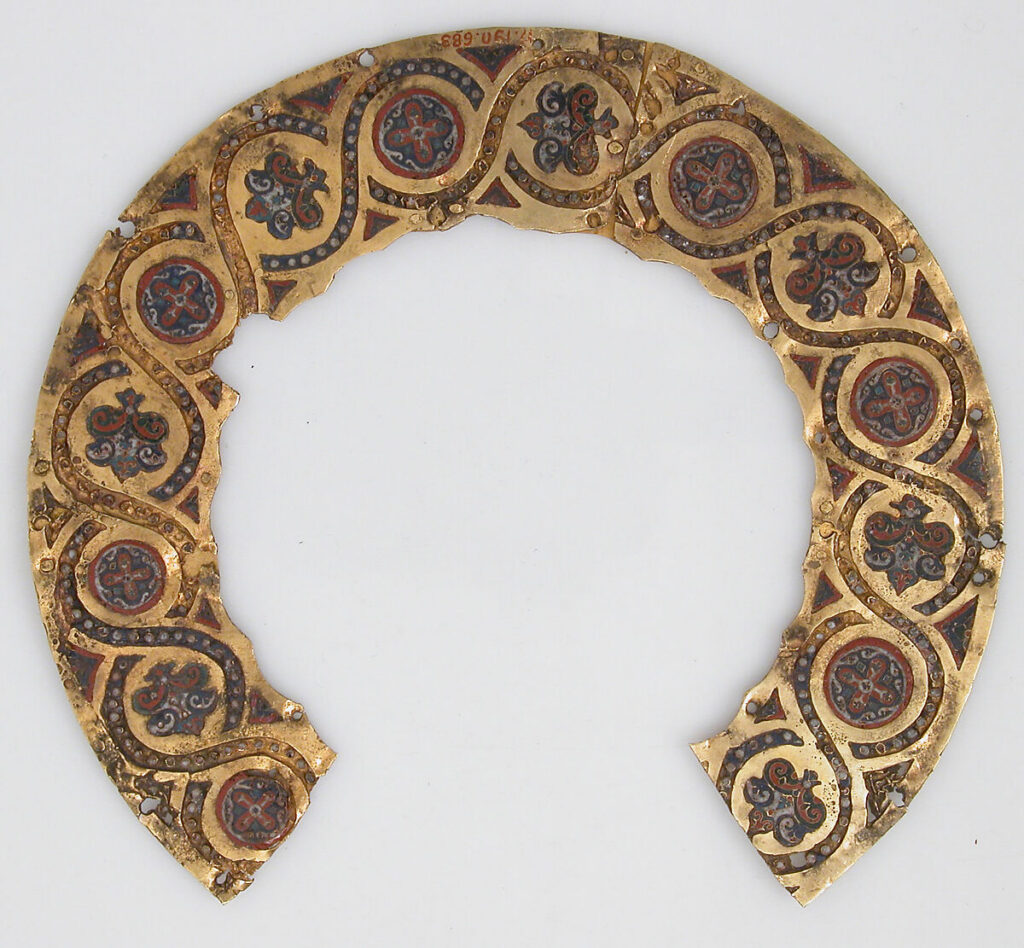
People are taught to see the halo and think holiness.
That is understandable. The image is old, beautiful, and powerful: the saint with light around the head, the radiant face, the crowned brow, the visible mark of sanctity. But symbols often survive precisely because they can still be read in more than one direction. The same image that reveals one truth can conceal another.
Within Geomytha, the halo can be read as the torus seen as crown. This is a modern symbolic analogy, not a claimI — ClaimI names claim: the interruption by which reflected presence is taken as mine.Read full entry → that historical Christian artists understood halos as toroidal diagrams. In the same Geomytha comparison, the Holy GrailHoly Grail — Arthurian TraditionThe Grail enters the medieval Arthurian literary tradition prominently through Chrétien de Troyes’ Perceval and develops through later Grail romances and retellings. This record treats that literary genealogy as the documented source…Read full entry → becomes the torus seen as container or vessel: the field properly filled with awareness, with sourceIs — SourceIs names unclaimed being: awareness before possession, distinction, or identity.Read full entry →, rather than emptied upward into thought, image, and false identityThis — IdentityThis names the formed identity: the body, role, image, wound, belief, or story claimed as what the self is.Read full entry →. The halo is the torus seen as crown; the grail is the torus seen as vessel.
That is why the symbol becomes dangerous.
If the torus is rightly filled, the sign can indicate real alignment. But if awareness has been pulled upward and enthroned as image, role, radiance, or crowned selfhood, then the same symbol can mark a subtler captivity. The problem is not light itself. The problem is what has taken the throne inside the field.
That is where HorusHorusIn Geomytha, Horus names the identity that forms after claim: This — the body, role, image, wound, belief, or story taken as what the self is.Read full entry → enters.
Horus is not merely ego in the cheap or cartoon sense. He is the false unity produced after consciousness has already been fractured out of grounded reflectionAm — ReflectionAm names reflected presence: awareness embodied or mirrored without yet becoming ownership.Read full entry → and reorganized as identity. He is the apparent self that takes the divided field and says: this is me, this is mine, this is my reign. He is the crowned “I” that mistakes its own construction for essence.
This article belongs to Waning Gibbous because the issue is not the first eruption of radiance, but what happens after radiance has already been enthroned. ReleaseReturn — RemembranceReturn names remembrance and release: the loosening of possession so reflection can become transparent to source again.Read full entry → asks whether the glow can soften, whether the crown can loosen, whether visible spiritual identity can stop feeding on its own aura and become vessel instead.
The halo is one of Horus’s most subtle symbols because it can disguise enthronement as illumination.
A person can become visibly radiant and still remain trapped. A person can look crowned, spiritually impressive, symbolically charged, and yet be more identified than ever with the self-image that has learned to shine. In that case the torus has not become grail. It has become stage-lighting. The field is no longer serving presence. It is serving performance.
This is not just an ancient religious problem. It is one of the most modern ones.
Celebrity culture runs on secular halos. So does influencer culture. So does guru culture. So does politics. So does any system that trains people to confuse glow with depth, visibility with legitimacy, symbolic radiance with actual freedom. A public figure is lit correctly, framed correctly, repeated correctly, exalted correctly, and suddenly the aura itself starts doing the work of truth.
The halo becomes branding.
And that is where manifestation culture enters the article.
Because manifestation culture is so often just Horus in ceremonial dress. It teaches the false self to mistake projectionThose — ProjectionThose names projection: enemies, outsiders, competitors, threats, and disowned qualities placed beyond the identity boundary.Read full entry → for creation. Desire becomes authority. Future fantasy becomes practice. The person is told to script, visualize, affirm, and emotionally pre-inhabit a world arranged around the wishes of the image-self. But that does not dissolve ego. It feeds it. It trains consciousness to identify more deeply with the one who wants, plans, claims, and expects. What gets called manifestation is often just Horus trying to crown itself through imagination.
That is why the subject belongs here and not in some separate prosperity piece. Manifestation is a modern crown ritual.
The mechanics make that plain enough. Vision boards. Scripting journals. “Act as if.” Abundance affirmations. Identity rehearsal. The repeated instruction to inhabit the version of yourself who already has the thing. This sounds spiritual because the language is soft. But structurally it is often just a more flattering way of saying: strengthen the projected self until reality begins mirroring it back.
That is not IsisIsisIn Geomytha, Isis names the unclaimed field: Is — pure being, awareness before possession, and the ground before the claimant appears.Read full entry →.
It is not OsirisOsirisIn Geomytha, Osiris names reflected presence: Am — awareness reflected as living consciousness without yet becoming ownership.Read full entry →.
It is Horus.
Isis is pure awareness. Osiris is right reflection, grounded presence, the field properly resting in itself. SetSetIn Geomytha, Set names the claimant: I — the interruption by which reflection is taken as mine and converted toward ownership.Read full entry → is the fragmenting turn into projection, abstraction, and divided thought. Horus is what gets built afterward: the image-self, the claimant, the crowned manager of the fractured field. Manifestation culture usually begins after that split and tries to make the split feel sovereign.
That is why it flatters the ego so efficiently. The false self does not mind spiritual language. It loves it. Spiritual language lets it sound cosmic instead of needy, aligned instead of controlling, abundant instead of acquisitive, radiant instead of vain. The crown remains. It just gets covered in incense.
And once that happens, even sacred symbols can be recruited into the same machinery. The halo becomes proof of attainment. The grail becomes proof of fullness. The torus becomes one more piece of private prestige. A person starts treating symbolic radiance as evidence that the self has finally become worthy of enthronement.
But the true grail logic runs the other way.
The grail is not the self becoming more impressive. The grail is the field becoming properly filled. It is vessel, not self-display. Receptivity, not self-crowning. To become grail is not to become more theatrically luminous. It is to stop draining awareness upward into abstraction and false identity long enough for the field to hold source again.
That is why gratitude matters more than manifestation at this stage of the work.
Manifestation tries to pull the future toward the preferred self-image. Gratitude loosens the self-image and restores relation to what is already given. Manifestation often says, become the one who gets. Gratitude says, release the one who needs to rule the gift. Manifestation crowns. Gratitude empties the crown.
That is the quiet corrective of Waning Gibbous. Not more shine. Not more claim. Release. The loosening of the crowned self. The surrender of symbolic prestige back into gratitude.
Because Horus is never more persuasive than when he learns to shine. Not just politically. Not just aesthetically. Spiritually. He can survive in religion, rebellion, therapy, mysticism, self-help, even anti-ego rhetoric, as long as he remains the center. What he cannot survive easily is sustained awareness that no longer feeds him with identification.
That is the deeper ambiguity of the halo. Is it real radiance? Or is it the final beautification of a crowned self? Is the torus functioning as grail, filled with source? Or has it been conscripted into spectacle?
Those are not abstract questions. They apply every time someone becomes spiritually visible. Every time a teacher starts glowing with public meaning. Every time a seeker starts loving the outline of their own insight. Every time symbolic intensity becomes self-confirmation rather than surrender.
So the practical takeaway is sharp.
Whenever you feel most haloed—most right, most radiant, most spiritually articulate, most symbolically impressive, most capable of bending reality toward your preferred image—pause there. Ask whether the field has become vessel or throne. Ask whether the torus is functioning as grail or crown. Ask whether awareness is being held, or displayed.
Not every halo is false.
But every halo becomes dangerous when it teaches the self to love its own outline.
The holier sign is quieter: less self-display, more vessel. Less enthronement, more filling. Less manifestation, more presence.
Because the halo may shine around the head.
But the grail is the whole field, properly filled.