The mirror was innocent before the crown appeared.
It only reflected.
A face leaned in.
A shadow moved behind it.
A little serpent curled on the table.
A cracked gold crown waited nearby, pretending not to be involved.
The candle flickered.
The mirror did what mirrors do.
It showed.
Then the claimantSetIn Geomytha, Set names the claimant: I — the interruption by which reflection is taken as mine and converted toward ownership.Read full entry → arrived.
Not as a monster at first. More like a nervous stage magician with too much eye makeup, too many rings, and a desperate need for applause. He looked into the glass and did not simply see a reflectionAm — ReflectionAm names reflected presence: awareness embodied or mirrored without yet becoming ownership.Read full entry →. He saw a possibility.
This could be me.
Then the possibility hardened.
This is me.
Then the crown lifted itself.
Now serve me.
That is the whole trick.
The mirror does not create the false self. The claimI — ClaimI names claim: the interruption by which reflected presence is taken as mine.Read full entry → does.
In Geomytha, the false self forms through a simple grammar: Is, Am, I, This. Is is awareness before claim. Am is reflected presenceOsirisIn Geomytha, Osiris names reflected presence: Am — awareness reflected as living consciousness without yet becoming ownership.Read full entry →. I is the claimant that interrupts the current. This is the identityThis — IdentityThis names the formed identity: the body, role, image, wound, belief, or story claimed as what the self is.Read full entry → that hardens after the claim. The core distortion is the sentence: I am thisThe False-Self Sentence — I Am ThisThe false-self sentence forms when claim joins reflection to a fixed object of identity: I am this.Read full entry →.
The mirror belongs to Am before it belongs to the claimant.
It is reflection.
It is Osiris before Set touches it. It is the clean appearance of presence before thought reaches in and says mine. It is not evil. It is not a trap by itself. Reflection is necessary. A world without reflection would be a world without image, relation, memory, art, face, water, moon, symbol, or recognition.
The problem begins when the reflection is seized.
The claimant enters the mirror and turns reflection into identity.
Then Am becomes I am this.
Then Osiris is no longer permitted to reflect and returnReturn — RemembranceReturn names remembrance and release: the loosening of possession so reflection can become transparent to source again.Read full entry →. He is made into a surface for HorusHorusIn Geomytha, Horus names the identity that forms after claim: This — the body, role, image, wound, belief, or story taken as what the self is.Read full entry →. The image is no longer a passing disclosure. It becomes a throne.
That is the mirror crown.
The old stories knew this, which is why they kept placing mirrors beside queens, portraits beside beautiful men, curtains behind false gods, pools beside boys who fall in love with their own image.
They were not warning against seeing.
They were warning against being crowned by what is seen.
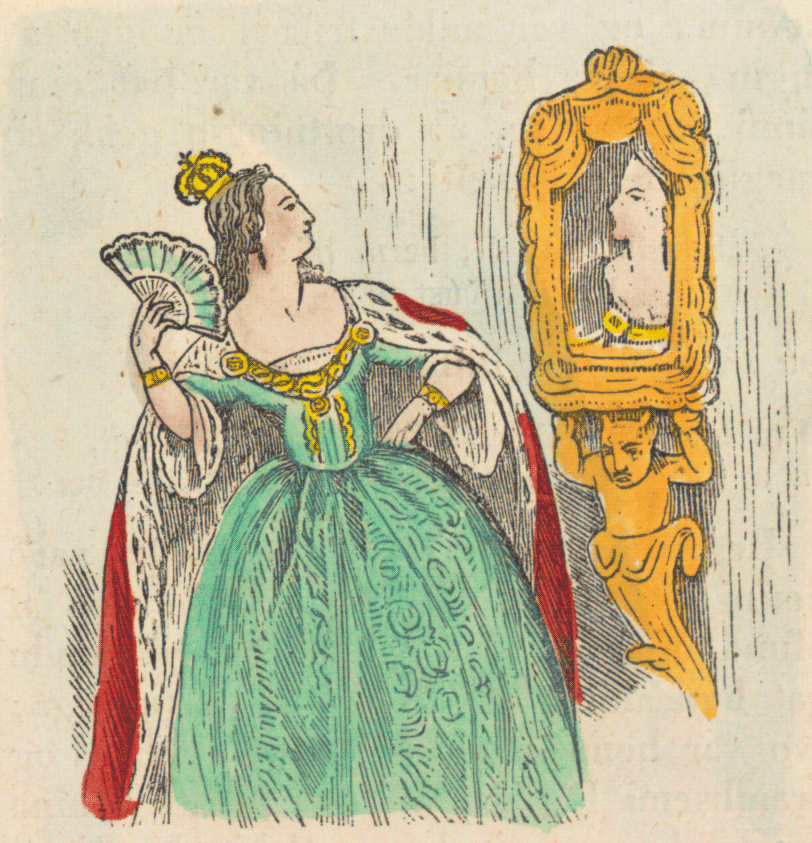
Snow WhiteSnow White — Fairy Tale / Film TraditionThe Snow White tradition includes the Queen consulting a magic mirror that ranks beauty and identifies Snow White as her rival; the tale also includes the poisoned apple motif in later episodes.Read full entry → gives the most obvious cartoon version, and because it is cartoonish, it is spiritually useful. The queen stands before the magic mirror and asks who is fairest. That question is usually read as vanity, and it is. But vanity is not shallow. Vanity is metaphysics with lipstick on.
She is not asking what is true.
She is asking whether her image still reigns.
The mirror becomes dangerous because she does not want reflection. She wants confirmation. She wants the world to return her face to her as law. She wants beauty to function as sovereignty. She wants the mirror to kneel.
That is the difference between clean reflection and possessed reflection.
A clean mirror says: here is what appears.
A possessed mirror says: here is who you are, and here is your rank.
The queen is not destroyed by beauty. She is destroyed by needing beauty to be identity. The image becomes a kingdom, and any rival image becomes threat. Snow White is not merely another person. She is a crack in the queen’s metaphysical throne.
That is why the queen cannot tolerate her.
A false self can survive many things, but it cannot easily survive the loss of reflective supremacy.
The queen’s mirror is Setian because it ranks identity. It does not return her to presence. It returns her to comparison. The mirror becomes a courtroom, a throne room, and an execution order.
She does not want truth.
She wants the mirror to keep crowning her.
Dorian GrayDorian Gray — PortraitIn Wilde’s novel, Dorian Gray remains outwardly youthful while his portrait visibly bears the marks of corruption and consequence.Read full entry → is the darker, more elegant version of the same mechanism.
Dorian does not merely want to be beautiful. He wants the visible self to remain untouched by consequence. The portrait absorbs the hidden cost while the public face stays crowned. His image carries the rot so that his social body can remain luminous.
That is not liberation.
That is deferred judgment.
The portrait becomes a hidden ledger. It records what the public face refuses to carry. Dorian splits himself between appearance and truth, and the split lets him continue longer inside the lie.
This is why Dorian feels so modern. He is the profile before the profile. The visible face remains curated, desirable, smooth, and socially powerful while the hidden image bears the distortion. The public self is preserved by outsourcing corruption to an image no one is supposed to see.
The mirror crown does not always shout.
Sometimes it smiles beautifully at dinner.
Sometimes it receives admiration.
Sometimes it is photographed well.
Sometimes it looks innocent because the wound has been moved somewhere private.
But the image does not save Dorian from corruption.
It lets him hide from it longer.
That is the danger of the crowned reflection. It can delay collapse. It can protect the surface. It can keep the visible self socially alive while the hidden self becomes increasingly uninhabitable.
Modern screen culture has made this ordinary.
Volume Seven names the screen age as the field where the self becomes profile, performance, avatar, and image-dependent identity. The ego no longer only believes; it curates. The screen turns identity into visibility, legibility, presentation, reaction, and aesthetic signal.
That is Dorian’s portrait distributed across billions of devices.
The hidden attic is now a camera roll, an archive, a draft folder, a deleted post, a filtered selfie, a brand identity, an avatar, a comment history, a follower count, a public face maintained against the pressure of private disorder.
The modern self does not simply look into the mirror.
It uploads itself into one.
And because the mirror now answers back, the crown becomes addictive.
Likes.
Views.
Comments.
Metrics.
Screenshots.
Reposts.
Followers.
Recognition.
Outrage.
Praise.
Envy.
Attention.
The mirror no longer waits on the wall. It buzzes in the hand. It travels in the pocket. It wakes beside the bed. It offers constant reflective confirmation, and the self begins to organize itself around what can be returned by the image-worldImage WorldImage World names a symbolic environment in which representation becomes the dominant medium through which reality, value, identity, and belonging are encountered.Read full entry →.
That is how the profile becomes throne.
The phone is a portable mirror-crown machine.
It does not merely show a person what they look like. It trains the person to become the kind of thing that can be shown. That is much deeper. The screen does not only reflect identity. It teaches identity how to arrange itself for reflection.
The face learns angles.
The opinion learns performance.
The grief learns presentation.
The meal learns composition.
The body learns market logic.
The thought learns shareability.
The self learns to ask, before it has even lived:
How will this appear?
That is Horus in glass.
Not because images are always false. Not because photos are evil. Not because public expression is inherently corrupt. The danger is subtler: the self begins to treat appearance as proof of being.
To be unseen starts to feel like nonexistence.
To be mis-seen starts to feel like injury.
To be seen correctly starts to feel like salvation.
That is the mirror crown tightening.
The Wizard of OzThe Wizard of Oz — 1939 Film1939 MGM musical fantasy film adapted from L. Frank Baum’s Oz material.Read full entry → gives the comic apocalypse.
Oz appears enormous: smoke, flame, booming voice, floating face, impossible authority. He is pure spectacle. He is not just a ruler; he is a projected god. The subjects tremble because the image is designed to overwhelm ordinary perception.
Then the curtain moves.
The great god is a little man with machinery.
That is one of the cleanest symbolic reveals in modern story. The collapse is not really about Oz being “fake” in a simple way. It is about false centrality losing its atmosphere. The image was powerful because no one saw the mechanism.
Once the mechanism is seen, the throne leaks air.
The curtain does not destroy reality.
It destroys the fake god standing in front of it.
That is what every real apocalypse does in Geomytha. Not necessarily the end of the world, but the end of the false centerFalse CenterA false center forms when sovereignty is assigned to an object, role, institution, future state, identity, or projection that cannot actually serve as source.Read full entry →’s ability to pass itself off as ultimate. Volume Nine makes this point directly: the final return is not into another system or symbolic empire, but through systems into presence itself; the danger is that every symbolic system can become another palace for Horus.
The curtain is mercy.
It humiliates the projectionThose — ProjectionThose names projection: enemies, outsiders, competitors, threats, and disowned qualities placed beyond the identity boundary.Read full entry →.
It does not need to argue with Oz. It only needs to show the equipment.
That is why camp matters in this article.
Solemnity can be dangerous around occult material. It can make the ego feel ancient, severe, chosen, initiated, royal. Give the false self a black robe, a sigil, a candle, a serpent, a mirror, and a little Latin, and suddenly it thinks it has become metaphysical.
Sometimes that is exactly the trap.
The false self loves heavy atmosphere. It loves secret names. It loves being the one who understands the diagram. It loves looking like it has descended into mysteries unavailable to ordinary people. It loves turning symbolic insight into aesthetic superiority.
Camp breaks that spell.
A cartoon serpent with bug eyes can sometimes tell the truth better than a marble demon. A melodramatic crown on a ridiculous little shadow can expose more than a solemn ritual chamber. A theatrical mirror with too much gold trim can make the ego visible as what it often is: not a grand cosmic villain, but a vain little manager of appearances.
Sometimes the ego does not need to be defeated.
It needs to be made visually embarrassing.
That is not trivial.
Humor can do what argument cannot. It can loosen identification before the self has time to defend its dignity. It can reveal the claimant’s posture. It can show the crown as costume.
The ego hates that.
It can survive being called evil. It can even enjoy that. Evil sounds important. Dark. Powerful. Mythic.
But ridiculous?
That is harder.
Ridicule, when used cleanly, can puncture glamour. It can make the claimant smaller without making the person cruel. The point is not to mock the wounded human being. The point is to deflate the stage machinery pretending to be God.
The mirror crown feeds on atmosphere.
Camp turns on the lights.
This is why Article Twelve should be theatrical rather than merely mystical. The mirror, the crown, the serpent, the scroll, the feather, the lunar disk, the scholar leaning too close, the shadow-self rising behind him — all of it should feel slightly overacted. The symbolism is serious, but the ego should not be allowed to feel majestic inside it.
That is the balance.
Geomytha is not anti-symbol.
It is not anti-image.
It is not anti-art.
It is not anti-mirror.
A true symbol conceals and reveals at the same time. That is its power. It gives the mind an image, but the image is not supposed to become final. It is supposed to point through itself.
The same is true of sacred images.
A true icon is not meant to trap attention in wood, paint, gold, or surface. It is meant to become transparent. It is a window, not a prison. It does not say, worship this surface as final. It says, look through.
That is the clean use of image.
A symbol becomes dangerous when it stops pointing through itself and starts pointing back to the claimant.
Look how deep I am.
Look how initiated I am.
Look how beautiful I am.
Look how wounded I am.
Look how awakened I am.
Look how different I am.
Look how much hidden knowledge I carry.
Look how well I understand the mirror.
Now the symbol has become crown.
Now the image has become identity.
Now Geomytha itself has to be weighed.
Because this system can become a mirror, or it can become a costume. It can help expose the claimant, or it can give the claimant better language. It can return the reader to presence, or it can build a subtler self that says: I am this decoder. I am this awakened one. I am this one who sees the machinery.
That is still I am this.
The sentence is the trap.
The object does not save it.
That is why the mirror crown must fall.
Not the mirror.
The crown.
The mirror may stay because reflection is part of life. We need faces, images, stories, symbols, art, language, bodies, gestures, memories, and public forms. A human being cannot live without reflection. Even the breath reflects: inhale as Am, exhale into Is. Reflection is not the enemy.
Possession is.
The mirror is clean when it reflects and releases.
The mirror is false when it reflects and enthrones.
The mirror is Osirian when it returns consciousness to sourceIs — SourceIs names unclaimed being: awareness before possession, distinction, or identity.Read full entry →.
The mirror is Setian when it turns reflection into claim.
The mirror is Horusian when the image hardens into identity and demands a throne.
This is the practical test.
Does the image make the claimant softer?
Or larger?
Does the symbol make the heart clearer?
Or more superior?
Does the mirror reveal what is present?
Or does it ask to be fed?
Does the profile serve communication?
Or does it become proof of existence?
Does the beauty pass through?
Or does it demand a kingdom?
Does the insight return to breath?
Or does it become a crown?
Waning Crescent is the correct lunar field for this because Waning Crescent does not want more performance. It does not want another proclamation. It does not want a new identity polished under better lighting.
It wants surrender.
Not collapse. Not self-hatred. Not smashing every mirror in the house.
Surrender means letting the image lose authority.
Taurus steadies the work. It brings the correction back into the body. No hysteria. No frantic purge. No theatrical self-destruction. Just the slow recognition that the reflection is not the ground.
Look at the image.
Feel the desire to be crowned by it.
Do not attack the desire.
Do not obey it either.
Let it be felt in the body.
Inhale:
Am.
Exhale:
Is.
Let reflection return before the claimant takes possession.
This can be done anywhere.
Before posting.
Before checking the reaction.
Before interpreting the dream.
Before explaining the symbol.
Before dressing the wound in sacred language.
Before looking for proof that the mirror still favors you.
Pause.
Let the image be image.
Let the face be face.
Let the symbol be symbol.
Let the profile be profile.
Let the mirror reflect without becoming king.
The crown will protest.
It always does.
It will say that without the image, nothing remains. Without the public face, nothing remains. Without recognition, nothing remains. Without the role, nothing remains. Without the profile, nothing remains. Without the mirror’s answer, nothing remains.
That is the final bluff.
Something remains before the image.
Something remains after the image fades.
That is the thing the mirror cannot crown because it cannot possess it. It can only reflect traces. It can show a face, a costume, a posture, a mood, a symbol, a style, an identity. It cannot show the ground from which seeing happens.
The mirror can show what appears.
It cannot become what is.
That is why the mirror crown is always false.
It crowns a surface and calls it self.
But the self it crowns is already late.
The breath came first.
The awareness came first.
The field came first.
The image arrived afterward.
Let the mirror stay.
Let the crown fall.