Author: D. Cyprian

  • The Mirror Crown

    The Mirror Crown

    The mirror was innocent before the crown appeared.

    It only reflected.

    A face leaned in.
    A shadow moved behind it.
    A little serpent curled on the table.
    A cracked gold crown waited nearby, pretending not to be involved.
    The candle flickered.
    The mirror did what mirrors do.

    It showed.

    Then the claimant arrived.

    Not as a monster at first. More like a nervous stage magician with too much eye makeup, too many rings, and a desperate need for applause. He looked into the glass and did not simply see a reflection. He saw a possibility.

    This could be me.

    Then the possibility hardened.

    This is me.

    Then the crown lifted itself.

    Now serve me.

    That is the whole trick.

    The mirror does not create the false self. The claim does.

    In Geomytha, the false self forms through a simple grammar: Is, Am, I, This. Is is awareness before claim. Am is reflected presence. I is the claimant that interrupts the current. This is the identity that hardens after the claim. The core distortion is the sentence: I am this.

    The mirror belongs to Am before it belongs to the claimant.

    It is reflection.

    It is Osiris before Set touches it. It is the clean appearance of presence before thought reaches in and says mine. It is not evil. It is not a trap by itself. Reflection is necessary. A world without reflection would be a world without image, relation, memory, art, face, water, moon, symbol, or recognition.

    The problem begins when the reflection is seized.

    The claimant enters the mirror and turns reflection into identity.

    Then Am becomes I am this.

    Then Osiris is no longer permitted to reflect and return. He is made into a surface for Horus. The image is no longer a passing disclosure. It becomes a throne.

    That is the mirror crown.

    The old stories knew this, which is why they kept placing mirrors beside queens, portraits beside beautiful men, curtains behind false gods, pools beside boys who fall in love with their own image.

    They were not warning against seeing.

    They were warning against being crowned by what is seen.

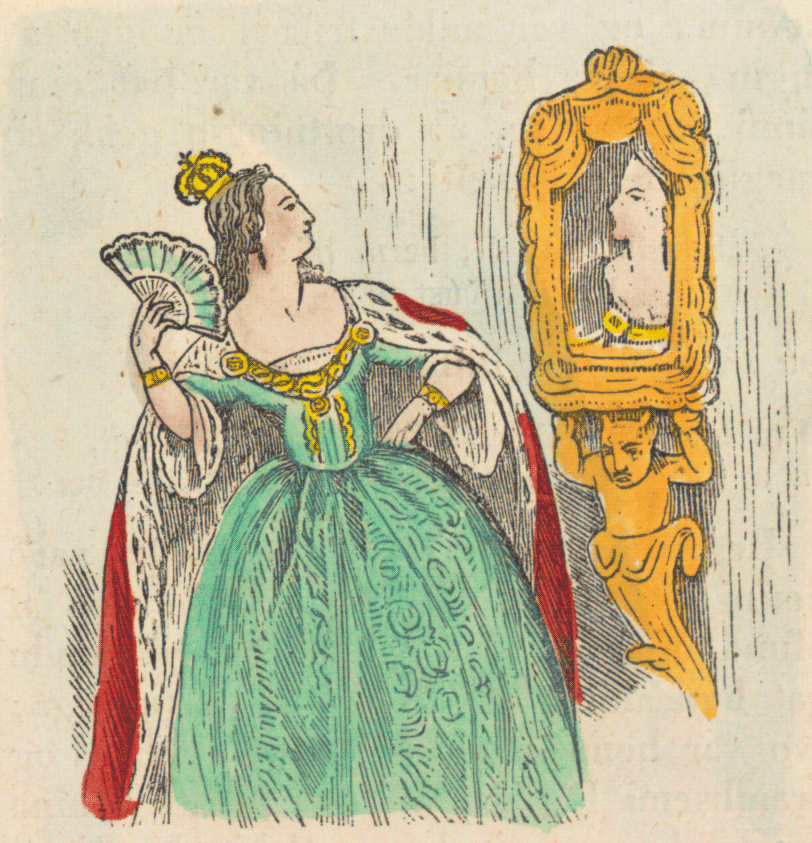
    Snow White gives the most obvious cartoon version, and because it is cartoonish, it is spiritually useful. The queen stands before the magic mirror and asks who is fairest. That question is usually read as vanity, and it is. But vanity is not shallow. Vanity is metaphysics with lipstick on.

    She is not asking what is true.

    She is asking whether her image still reigns.

    The mirror becomes dangerous because she does not want reflection. She wants confirmation. She wants the world to return her face to her as law. She wants beauty to function as sovereignty. She wants the mirror to kneel.

    That is the difference between clean reflection and possessed reflection.

    A clean mirror says: here is what appears.

    A possessed mirror says: here is who you are, and here is your rank.

    The queen is not destroyed by beauty. She is destroyed by needing beauty to be identity. The image becomes a kingdom, and any rival image becomes threat. Snow White is not merely another person. She is a crack in the queen’s metaphysical throne.

    That is why the queen cannot tolerate her.

    A false self can survive many things, but it cannot easily survive the loss of reflective supremacy.

    The queen’s mirror is Setian because it ranks identity. It does not return her to presence. It returns her to comparison. The mirror becomes a courtroom, a throne room, and an execution order.

    She does not want truth.

    She wants the mirror to keep crowning her.

    Dorian Gray is the darker, more elegant version of the same mechanism.

    Dorian does not merely want to be beautiful. He wants the visible self to remain untouched by consequence. The portrait absorbs the hidden cost while the public face stays crowned. His image carries the rot so that his social body can remain luminous.

    That is not liberation.

    That is deferred judgment.

    The portrait becomes a hidden ledger. It records what the public face refuses to carry. Dorian splits himself between appearance and truth, and the split lets him continue longer inside the lie.

    This is why Dorian feels so modern. He is the profile before the profile. The visible face remains curated, desirable, smooth, and socially powerful while the hidden image bears the distortion. The public self is preserved by outsourcing corruption to an image no one is supposed to see.

    The mirror crown does not always shout.

    Sometimes it smiles beautifully at dinner.

    Sometimes it receives admiration.

    Sometimes it is photographed well.

    Sometimes it looks innocent because the wound has been moved somewhere private.

    But the image does not save Dorian from corruption.

    It lets him hide from it longer.

    That is the danger of the crowned reflection. It can delay collapse. It can protect the surface. It can keep the visible self socially alive while the hidden self becomes increasingly uninhabitable.

    Modern screen culture has made this ordinary.

    Volume Seven names the screen age as the field where the self becomes profile, performance, avatar, and image-dependent identity. The ego no longer only believes; it curates. The screen turns identity into visibility, legibility, presentation, reaction, and aesthetic signal.

    That is Dorian’s portrait distributed across billions of devices.

    The hidden attic is now a camera roll, an archive, a draft folder, a deleted post, a filtered selfie, a brand identity, an avatar, a comment history, a follower count, a public face maintained against the pressure of private disorder.

    The modern self does not simply look into the mirror.

    It uploads itself into one.

    And because the mirror now answers back, the crown becomes addictive.

    Likes.
    Views.
    Comments.
    Metrics.
    Screenshots.
    Reposts.
    Followers.
    Recognition.
    Outrage.
    Praise.
    Envy.
    Attention.

    The mirror no longer waits on the wall. It buzzes in the hand. It travels in the pocket. It wakes beside the bed. It offers constant reflective confirmation, and the self begins to organize itself around what can be returned by the image-world.

    That is how the profile becomes throne.

    The phone is a portable mirror-crown machine.

    It does not merely show a person what they look like. It trains the person to become the kind of thing that can be shown. That is much deeper. The screen does not only reflect identity. It teaches identity how to arrange itself for reflection.

    The face learns angles.

    The opinion learns performance.

    The grief learns presentation.

    The meal learns composition.

    The body learns market logic.

    The thought learns shareability.

    The self learns to ask, before it has even lived:

    How will this appear?

    That is Horus in glass.

    Not because images are always false. Not because photos are evil. Not because public expression is inherently corrupt. The danger is subtler: the self begins to treat appearance as proof of being.

    To be unseen starts to feel like nonexistence.

    To be mis-seen starts to feel like injury.

    To be seen correctly starts to feel like salvation.

    That is the mirror crown tightening.

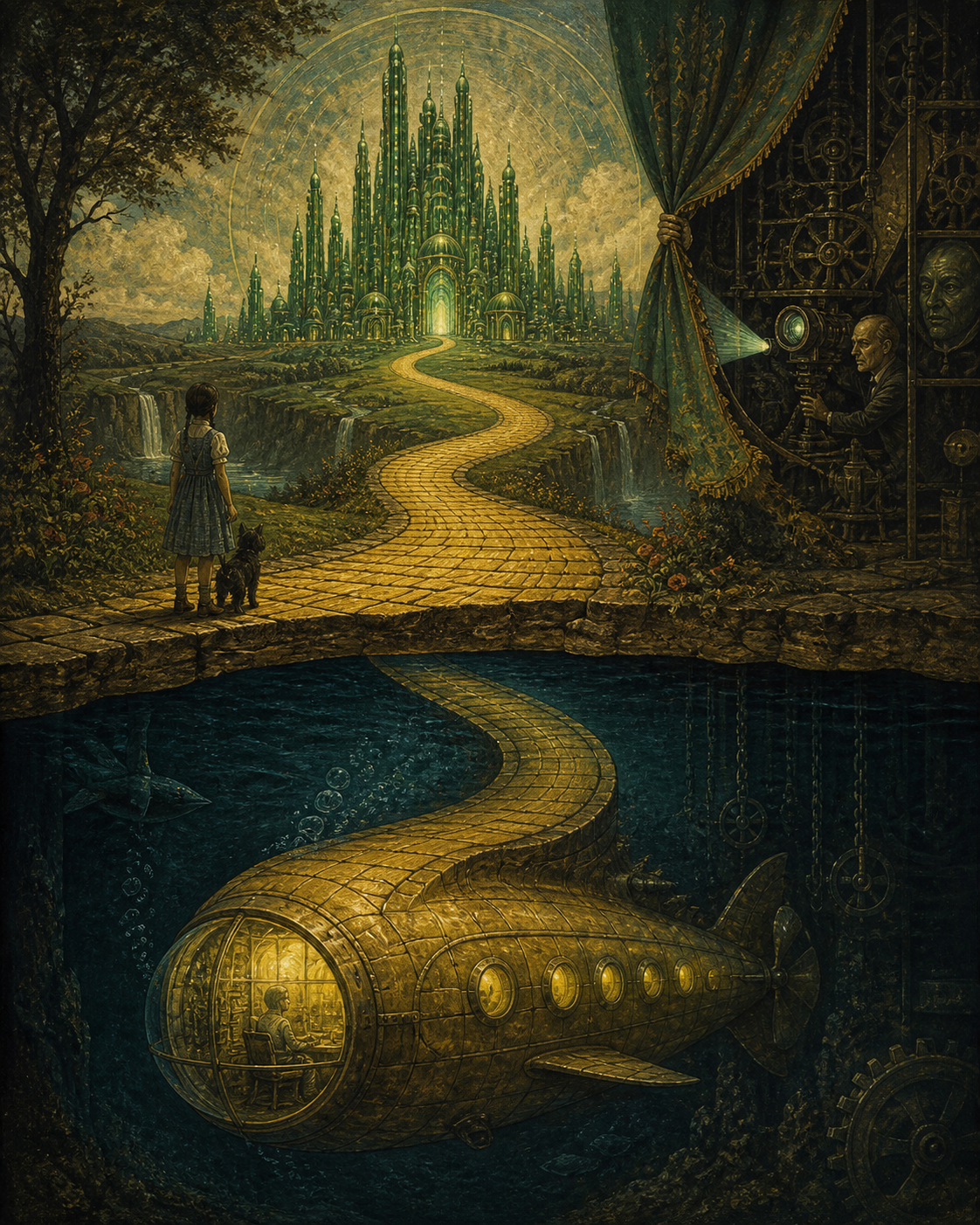
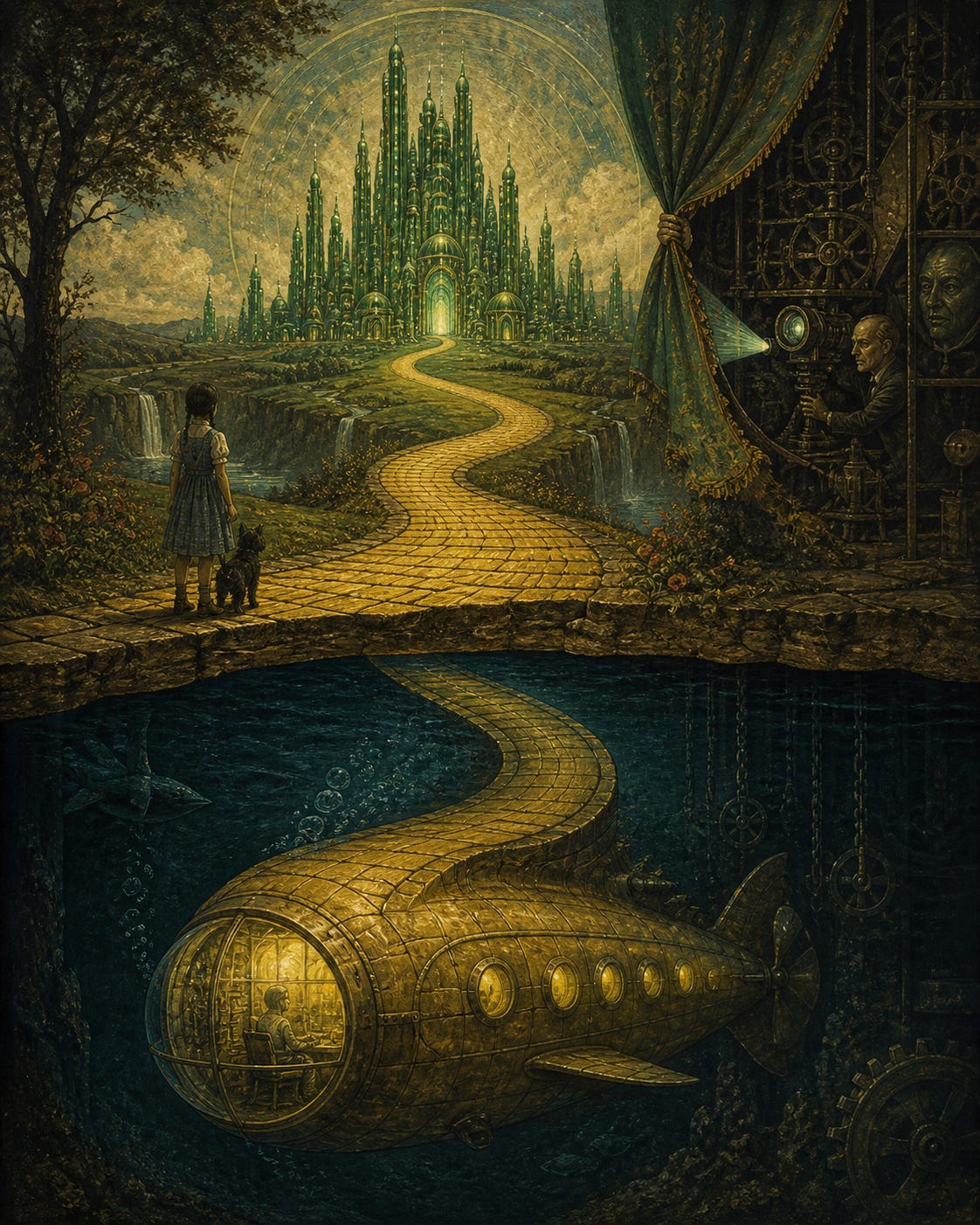
    The Wizard of Oz gives the comic apocalypse.

    Oz appears enormous: smoke, flame, booming voice, floating face, impossible authority. He is pure spectacle. He is not just a ruler; he is a projected god. The subjects tremble because the image is designed to overwhelm ordinary perception.

    Then the curtain moves.

    The great god is a little man with machinery.

    That is one of the cleanest symbolic reveals in modern story. The collapse is not really about Oz being “fake” in a simple way. It is about false centrality losing its atmosphere. The image was powerful because no one saw the mechanism.

    Once the mechanism is seen, the throne leaks air.

    The curtain does not destroy reality.

    It destroys the fake god standing in front of it.

    That is what every real apocalypse does in Geomytha. Not necessarily the end of the world, but the end of the false center’s ability to pass itself off as ultimate. Volume Nine makes this point directly: the final return is not into another system or symbolic empire, but through systems into presence itself; the danger is that every symbolic system can become another palace for Horus.

    The curtain is mercy.

    It humiliates the projection.

    It does not need to argue with Oz. It only needs to show the equipment.

    That is why camp matters in this article.

    Solemnity can be dangerous around occult material. It can make the ego feel ancient, severe, chosen, initiated, royal. Give the false self a black robe, a sigil, a candle, a serpent, a mirror, and a little Latin, and suddenly it thinks it has become metaphysical.

    Sometimes that is exactly the trap.

    The false self loves heavy atmosphere. It loves secret names. It loves being the one who understands the diagram. It loves looking like it has descended into mysteries unavailable to ordinary people. It loves turning symbolic insight into aesthetic superiority.

    Camp breaks that spell.

    A cartoon serpent with bug eyes can sometimes tell the truth better than a marble demon. A melodramatic crown on a ridiculous little shadow can expose more than a solemn ritual chamber. A theatrical mirror with too much gold trim can make the ego visible as what it often is: not a grand cosmic villain, but a vain little manager of appearances.

    Sometimes the ego does not need to be defeated.

    It needs to be made visually embarrassing.

    That is not trivial.

    Humor can do what argument cannot. It can loosen identification before the self has time to defend its dignity. It can reveal the claimant’s posture. It can show the crown as costume.

    The ego hates that.

    It can survive being called evil. It can even enjoy that. Evil sounds important. Dark. Powerful. Mythic.

    But ridiculous?

    That is harder.

    Ridicule, when used cleanly, can puncture glamour. It can make the claimant smaller without making the person cruel. The point is not to mock the wounded human being. The point is to deflate the stage machinery pretending to be God.

    The mirror crown feeds on atmosphere.

    Camp turns on the lights.

    This is why Article Twelve should be theatrical rather than merely mystical. The mirror, the crown, the serpent, the scroll, the feather, the lunar disk, the scholar leaning too close, the shadow-self rising behind him — all of it should feel slightly overacted. The symbolism is serious, but the ego should not be allowed to feel majestic inside it.

    That is the balance.

    Geomytha is not anti-symbol.

    It is not anti-image.

    It is not anti-art.

    It is not anti-mirror.

    A true symbol conceals and reveals at the same time. That is its power. It gives the mind an image, but the image is not supposed to become final. It is supposed to point through itself.

    The same is true of sacred images.

    A true icon is not meant to trap attention in wood, paint, gold, or surface. It is meant to become transparent. It is a window, not a prison. It does not say, worship this surface as final. It says, look through.

    That is the clean use of image.

    A symbol becomes dangerous when it stops pointing through itself and starts pointing back to the claimant.

    Look how deep I am.
    Look how initiated I am.
    Look how beautiful I am.
    Look how wounded I am.
    Look how awakened I am.
    Look how different I am.
    Look how much hidden knowledge I carry.
    Look how well I understand the mirror.

    Now the symbol has become crown.

    Now the image has become identity.

    Now Geomytha itself has to be weighed.

    Because this system can become a mirror, or it can become a costume. It can help expose the claimant, or it can give the claimant better language. It can return the reader to presence, or it can build a subtler self that says: I am this decoder. I am this awakened one. I am this one who sees the machinery.

    That is still I am this.

    The sentence is the trap.

    The object does not save it.

    That is why the mirror crown must fall.

    Not the mirror.

    The crown.

    The mirror may stay because reflection is part of life. We need faces, images, stories, symbols, art, language, bodies, gestures, memories, and public forms. A human being cannot live without reflection. Even the breath reflects: inhale as Am, exhale into Is. Reflection is not the enemy.

    Possession is.

    The mirror is clean when it reflects and releases.

    The mirror is false when it reflects and enthrones.

    The mirror is Osirian when it returns consciousness to source.

    The mirror is Setian when it turns reflection into claim.

    The mirror is Horusian when the image hardens into identity and demands a throne.

    This is the practical test.

    Does the image make the claimant softer?

    Or larger?

    Does the symbol make the heart clearer?

    Or more superior?

    Does the mirror reveal what is present?

    Or does it ask to be fed?

    Does the profile serve communication?

    Or does it become proof of existence?

    Does the beauty pass through?

    Or does it demand a kingdom?

    Does the insight return to breath?

    Or does it become a crown?

    Waning Crescent is the correct lunar field for this because Waning Crescent does not want more performance. It does not want another proclamation. It does not want a new identity polished under better lighting.

    It wants surrender.

    Not collapse. Not self-hatred. Not smashing every mirror in the house.

    Surrender means letting the image lose authority.

    Taurus steadies the work. It brings the correction back into the body. No hysteria. No frantic purge. No theatrical self-destruction. Just the slow recognition that the reflection is not the ground.

    Look at the image.

    Feel the desire to be crowned by it.

    Do not attack the desire.

    Do not obey it either.

    Let it be felt in the body.

    Inhale:

    Am.

    Exhale:

    Is.

    Let reflection return before the claimant takes possession.

    This can be done anywhere.

    Before posting.
    Before checking the reaction.
    Before interpreting the dream.
    Before explaining the symbol.
    Before dressing the wound in sacred language.
    Before looking for proof that the mirror still favors you.

    Pause.

    Let the image be image.

    Let the face be face.

    Let the symbol be symbol.

    Let the profile be profile.

    Let the mirror reflect without becoming king.

    The crown will protest.

    It always does.

    It will say that without the image, nothing remains. Without the public face, nothing remains. Without recognition, nothing remains. Without the role, nothing remains. Without the profile, nothing remains. Without the mirror’s answer, nothing remains.

    That is the final bluff.

    Something remains before the image.

    Something remains after the image fades.

    That is the thing the mirror cannot crown because it cannot possess it. It can only reflect traces. It can show a face, a costume, a posture, a mood, a symbol, a style, an identity. It cannot show the ground from which seeing happens.

    The mirror can show what appears.

    It cannot become what is.

    That is why the mirror crown is always false.

    It crowns a surface and calls it self.

    But the self it crowns is already late.

    The breath came first.

    The awareness came first.

    The field came first.

    The image arrived afterward.

    Let the mirror stay.

    Let the crown fall.
  • The Alphabet Machine

    The Alphabet Machine

    The alphabet looks innocent because we meet it as children.

    A, B, C.
    Song first. Meaning later.

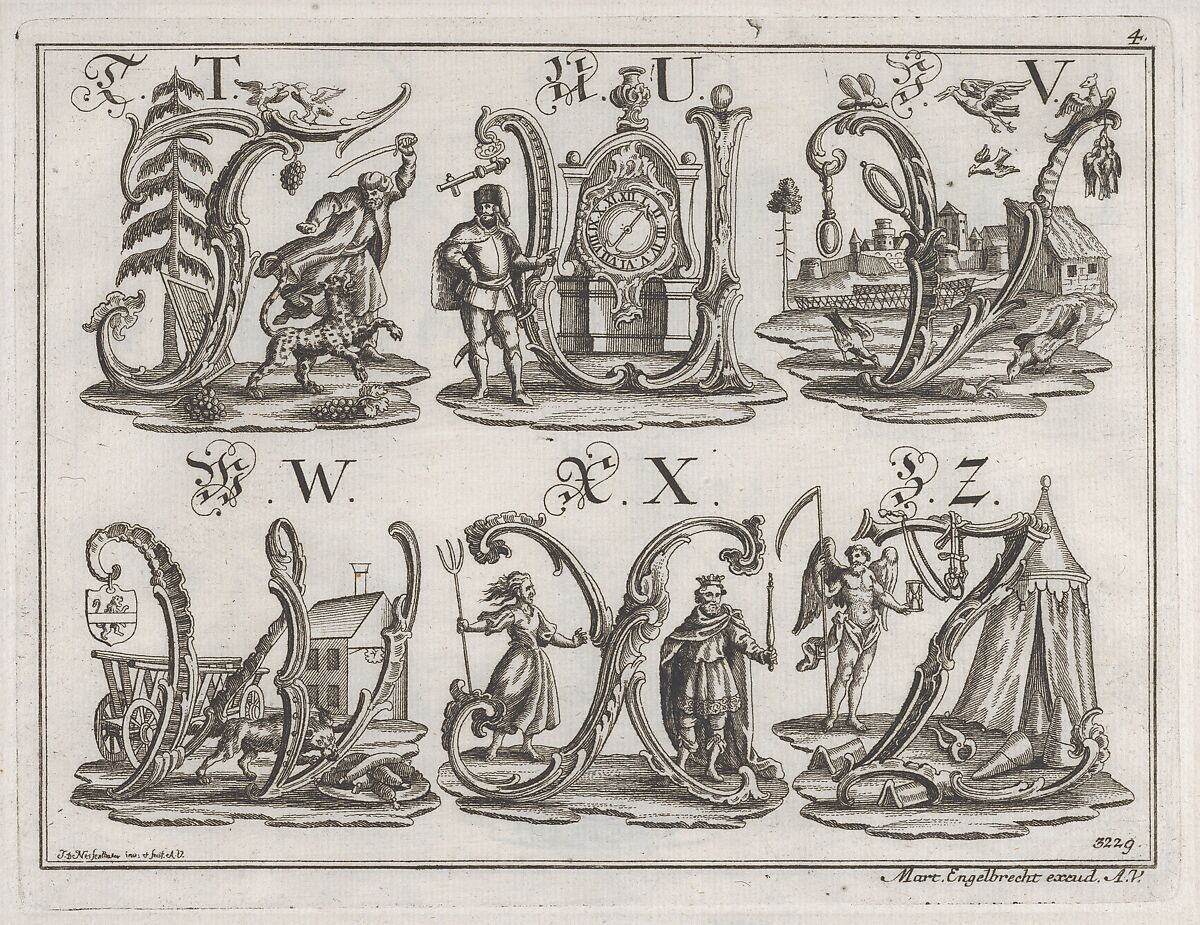
    By the time we can read, the structure has already disappeared into usefulness. Letters become tools. They spell names, commands, labels, contracts, brands, prayers, warnings, jokes, laws, passwords, and identities. The alphabet becomes so ordinary that it stops looking symbolic.

    That is exactly where the strongest symbols hide.

    In Geomytha, ordinary systems are rarely neutral. A calendar is not just a calendar. A zodiac is not just a ring of signs. A blueprint is not just a technical drawing. A letter is not just a letter. These structures train consciousness to move in certain ways before the conscious mind notices the training.

    Tier 3 · Full reading

    This is the public preview. The complete article continues on Geomytha’s Substack.

    Continue the full article on Substack →

  • The Crucifixion of “I Am This”

    The Crucifixion of “I Am This”

    Saturnalia looks like freedom.

    That is the trick.

    For a few days, Rome loosened its face. Masters served slaves. Gambling was permitted. Gifts moved through the city. Rules bent. Crowns appeared on fools, servants, and temporary kings. The rigid Roman world pretended to dissolve.

    But it did not dissolve.

    It rehearsed dissolution so the system could return stronger.

    Saturnalia was not the end of hierarchy. It was hierarchy learning how to survive its own reversal. The pressure was released. The roles were inverted. The world laughed at itself. Then the old order came back wearing the authority of inevitability.

    That is how Set works when he becomes civilization. He does not merely forbid rebellion. He ritualizes it. He gives the false self a holiday from the cage, then calls the cage reality.

    Saturnalia is therefore not just a Roman festival. It is a diagram of controlled inversion. The system temporarily suspends “this” so no one reaches “is.”

    Because the real problem is not whether the slave becomes master for a day. The real problem is whether anyone stops believing in master and slave as ultimate identities at all.

    That is the dangerous threshold.

    Rome could tolerate reversal. Rome could tolerate mockery. Rome could tolerate drunkenness, gift exchange, and temporary disorder.

    What Rome could not tolerate was the collapse of the identity-machine itself.

    The Roman triumph shows the opposite side of the same mechanism.

    In the Triumphus, the victorious general rode through the city in public splendor. He was crowned, elevated, adored. Captives and spoils moved behind him. The conquered world was dragged into Roman visibility. The crowd witnessed power becoming image.

    For one ceremonial moment, the general became almost divine.

    But even this elevation contained a wound. A slave, according to the famous tradition, stood near him and whispered that he was mortal. Whether historically exact in every detail or not, the symbolism is perfect: Rome crowns Horus while forcing Horus to hear the crack beneath his crown.

    You are visible.
    You are glorious.
    You are Rome.
    You are this.

    But you will die.

    That whisper matters because the whole triumph depends on an unstable sentence:

    I am this.

    I am the victor.
    I am the conqueror.
    I am the name carried through the city.
    I am the image the crowd confirms.
    I am the body through which empire sees itself.

    That is Horus at maximum brightness: the time-bound identity publicly enthroned.

    But the triumph also reveals the fragility of that identity. It must be staged. It must be watched. It must be repeated. It must be confirmed by the crowd, the city, the captives, the spoils, the crown, the chariot, the route, the ritual.

    Without spectacle, the “I” trembles.

    This is why Saturnalia and Triumphus belong together. Saturnalia temporarily lowers the crowned identity. Triumphus temporarily raises it. One mocks the hierarchy. The other glorifies it. But both preserve the deeper machinery.

    Both keep consciousness trapped in role.

    Both keep the sentence moving toward predicate.

    Both prevent the return to pure being.

    In Geomytha, the core movement is simple:

    IS → AM → I → THIS.

    Isis is IS: pure awareness before identity.

    Osiris is AM: awareness reflected as presence.

    Set is I: the claimant, the interruption, the thought that says mine.

    Horus is THIS: the identity-body hardened into object, role, title, body, empire, wound, fear, doctrine, or world.

    The trap is not “I am.”

    The trap is “I am this.”

    That final word is the crucifixion point.

    Because once awareness becomes “this,” it can be ruled. It can be praised. It can be shamed. It can be crowned. It can be mocked. It can be bought. It can be sacrificed.

    Now the crucifixion comes into focus.

    The Roman crucifixion of Jesus is usually read devotionally, historically, politically, or theologically. All of those readings may carry force. But in Geomytha, the crucifixion also reveals the mechanism beneath Saturnalia and Triumphus in its most severe form.

    Christ is publicly displayed.

    Crowned in mockery.

    Named as king.

    Lifted before the crowd.

    Placed between accusation and spectacle.

    Forced into visibility as a body onto which the whole imperial-religious machine projects its categories.

    King of the Jews.
    Blasphemer.
    Threat.
    Criminal.
    Messiah.
    Victim.
    Son.
    Body.
    Name.
    This.

    The crowd does not merely kill him. The crowd tries to finish his sentence.

    It cannot tolerate “I am” without predicate.

    It demands:

    I am what?

    Are you king?
    Are you son?
    Are you threat?
    Are you guilty?
    Are you ours?
    Are you Rome’s?
    Are you this?

    The cross is where every projected identity is nailed to the visible body.

    That is why the crucifixion is more than punishment. It is a public ritual of forced definition. Rome does not merely execute. Rome makes an image. It turns the condemned body into warning, theater, law, and sacrificial message.

    This is Set’s genius: projection made public.

    The cross says: this is what happens when “I am” refuses the empire’s authorized predicates.

    Saturnalia crowns the mock king and lets him fall back into order.

    Triumphus crowns the victorious king and lets him shine as order.

    The crucifixion crowns the rejected king and exposes the violence beneath order.

    All three are crown rituals.

    All three involve public identity.

    All three depend on spectators.

    All three turn the human form into symbolic machinery.

    But the crucifixion goes deeper because it reveals the cost of “I am this.” The false self cannot exist without sacrifice. Someone must carry the projection. Someone must be named. Someone must be displayed. Someone must absorb the crowd’s fear, envy, resentment, guilt, longing, and demand for closure.

    That is the scapegoat function.

    The crowd wants Barabbas released because Barabbas belongs to the recognizable world of action, revolt, crime, force, and counterforce. Barabbas is still inside the Set-Horus field. He is violent, but legible. He is a figure the crowd can understand.

    Christ is more dangerous because he destabilizes the grammar.

    He does not merely offer a rival identity. He exposes identity itself.

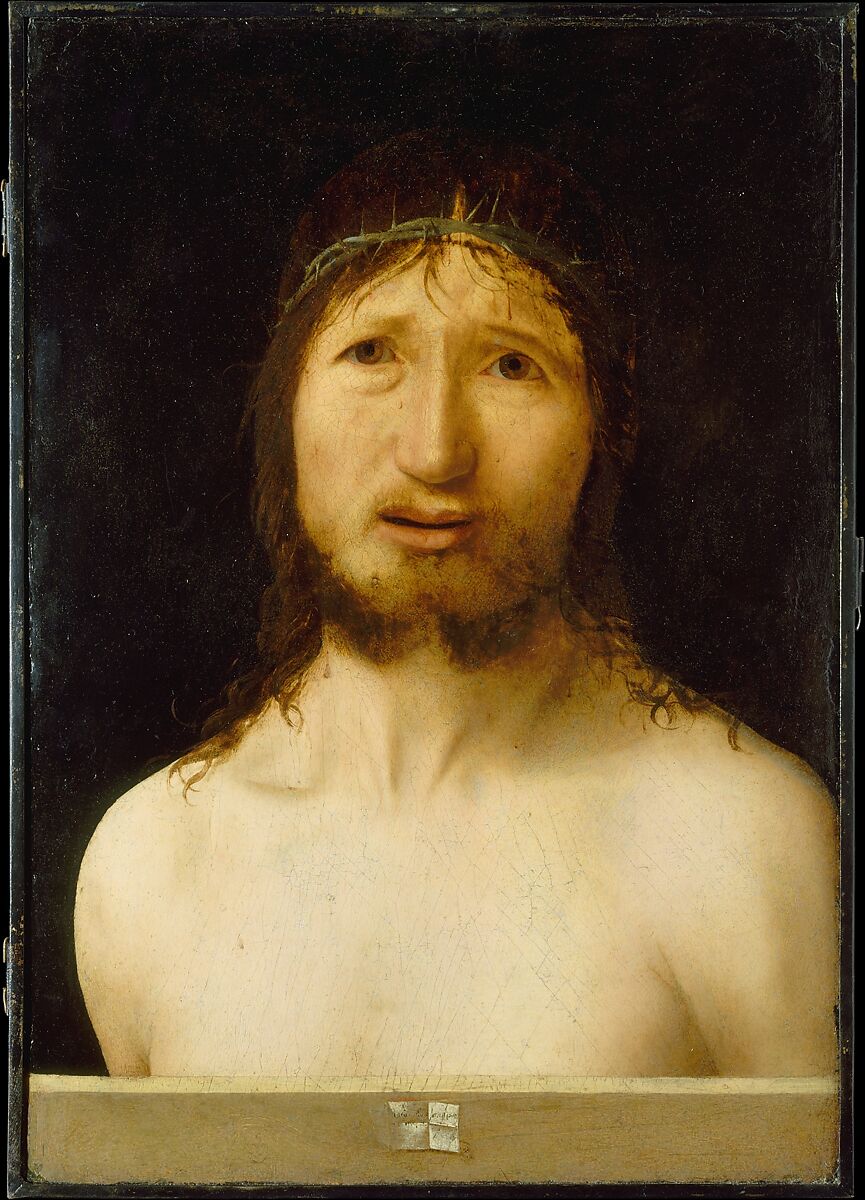
    That is why the mocking crown is so important. The crown of thorns is not only humiliation. It is the false crown made painful. It shows what every crown secretly is when worn by the time-bound self: a ring of suffering around the head.

    The crown belongs to the skull.

    The head is the false phallus: thought, title, image, authority, projection, the upward pull away from embodied presence. The thorn crown makes visible the pain already hidden inside the identity structure.

    The crown of thorns is also the halo function inverted.

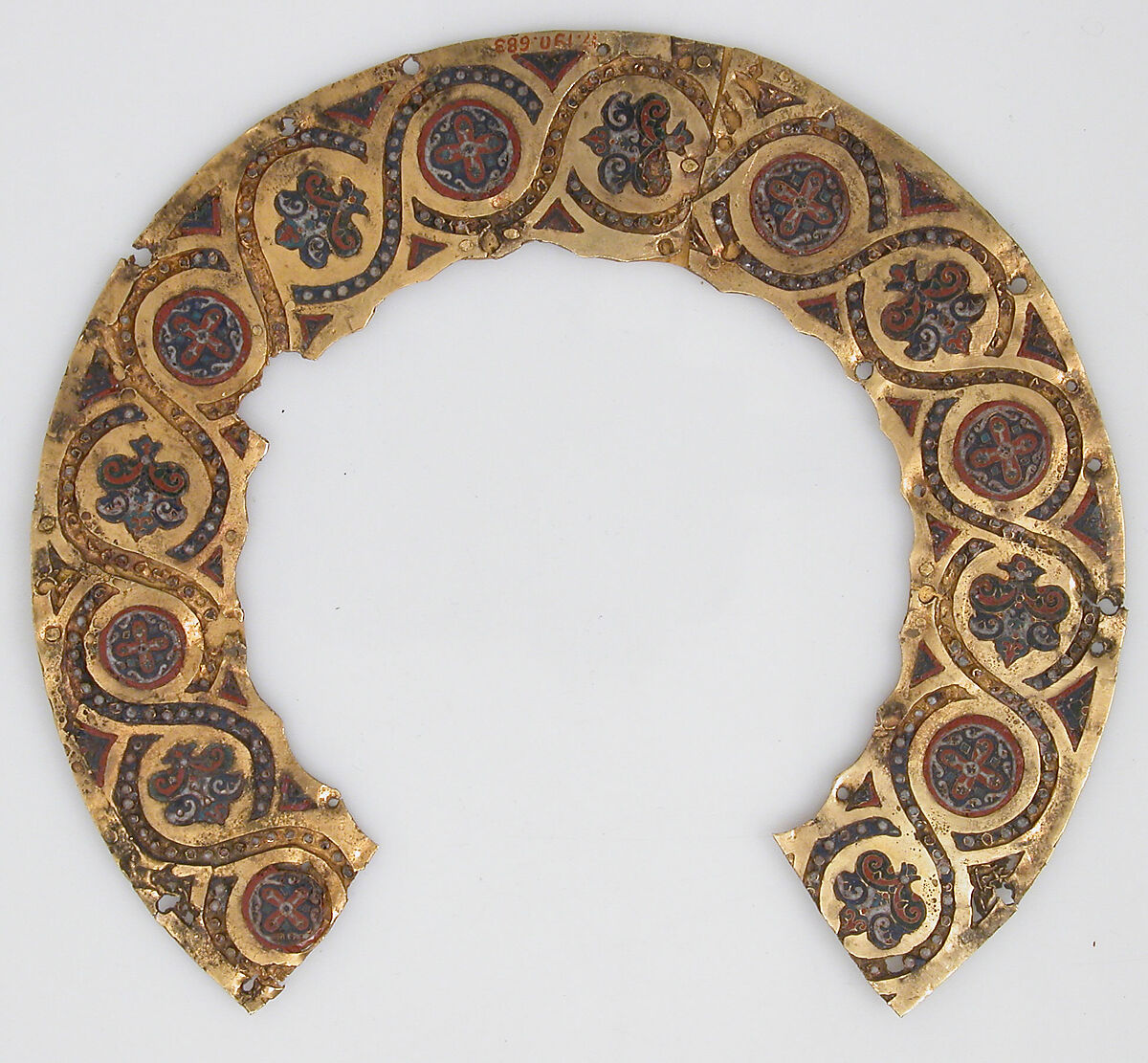
    A halo presents the head as sanctified radiance: identity lit from above, consciousness crowned by divine visibility. But the thorn crown shows the wound beneath that radiance. It is the painful version of the halo, the solar ring turned against the skull.

    The same circle that religious art later renders as holiness appears here as pressure, mockery, and blood.

    That matters.

    In Geomytha, the halo is not automatically false. It can symbolize consciousness transparent to source. But when the head becomes the seat of identity, authority, and spiritual self-image, the halo becomes dangerous. It can become the aesthetic of Horus: the false self glowing with borrowed light.

    The thorn crown exposes that danger.

    It says: when the head claims radiance without returning to presence, the halo becomes a torture device.

    So the crown of thorns does not merely mock kingship. It reveals the hidden violence inside false sanctity. It shows the halo under Setian pressure: radiance converted into pain, glory converted into spectacle, divinity converted into public identity.

    Every ego-halo is thorned.

    Rome places that crown on Jesus to mock him. Symbolically, the act reverses itself. The mockery reveals the truth of Roman power. Empire itself is crowned with thorns. The triumphal general is crowned with thorns. The Saturnalian mock king is crowned with thorns. The social self is crowned with thorns.

    Every “I am this” bleeds.

    This is why the crucifixion is not merely one event among other sacrificial myths. It is one of the clearest symbolic exposures of the identity-machine. The vertical beam and horizontal beam form the intersection where heaven and earth, body and law, presence and projection, Rome and Israel, crowd and victim, time and eternity, all collide.

    The cross is the place where contradiction becomes visible.

    It suspends the body between worlds.

    It shows what happens when pure “I am” is captured by public meaning.

    It reveals the violence required to make identity stick.

    That is why the crucifixion must be read alongside Saturnalia and Triumphus. Rome knew how to manipulate the sacred pressure of public identity. It knew how to crown. It knew how to mock-crown. It knew how to display conquered bodies. It knew how to turn death into instruction.

    But in the crucifixion, the ritual breaks open.

    The victim does not simply become another defeated body. He becomes the exposure of the whole system. The cross reveals that the empire’s power depends on forcing awareness into predicates and then punishing whatever refuses them.

    This is also why the resurrection motif is so easily misunderstood.

    If resurrection is read as the return of the same identity, then Horus survives. The ego gets its victory myth. The self imagines it will continue forever, improved, vindicated, glorified.

    But if resurrection is read through Geomytha, its deeper pressure is not the immortality of “this.” It is the failure of “this” to contain “I am.”

    The body can be displayed.
    The name can be accused.
    The crown can be mocked.
    The crowd can project.
    The empire can execute.

    But pure awareness is not finally identical with the displayed form.

    That is the escape hatch.

    Not escape into fantasy. Not escape into another crown. Not escape into spiritual ego. Escape from the sentence itself.

    Not “I am king.”
    Not “I am victim.”
    Not “I am chosen.”
    Not “I am condemned.”
    Not “I am this.”

    Just:

    I am.

    And deeper still:

    Is.

    This is where Saturnalia fails, Triumphus fails, and crucifixion reveals what they cannot hold.

    Saturnalia says: switch roles, then return.

    Triumphus says: crown the role, then remember death.

    Crucifixion says: see the role nailed to the wood.

    That seeing is unbearable because modern people still live inside the same ritual field.

    Social media is permanent Triumphus. The profile is the chariot. The feed is the processional road. The follower count is the cheering crowd. The curated image is the crown. Every post says, in one form or another: witness me as this.

    Social media is also permanent Saturnalia. Everyone mocks the powerful. Everyone inverts the hierarchy. Everyone becomes jester, judge, king, slave, priest, executioner, and crowd. The system permits endless reversal because reversal keeps attention inside the system.

    And social media is permanent crucifixion. A person is lifted into visibility, crowned by attention, accused by projection, reduced to an image, and sacrificed for collective emotional discharge.

    The machinery is Roman.

    Only the screen has replaced the forum.

    This is why the practical movement is not simply to reject ritual, history, Christianity, Rome, or spectacle as external problems. The mechanism is intimate. It operates every time awareness completes the sentence too quickly.

    I am angry.
    I am rejected.
    I am successful.
    I am awakened.
    I am right.
    I am ruined.
    I am special.
    I am this.

    The moment “this” hardens, Set has entered.

    The work is not to destroy the functional self. The work is to stop mistaking the functional self for source. Roles can be used. Names can be used. Rituals can be used. Images can be used. But once they become identity, the cross is already being built.

    Saturnalia teaches that reversal is not freedom.

    Triumphus teaches that glory is not freedom.

    Crucifixion teaches that public sacrifice exposes the false self but does not automatically dissolve it.

    Freedom begins before the crowd.

    Before the crown.

    Before the halo.

    Before the sentence finishes.

    Before “this.”

    The way back is not dramatic. It is almost too simple for the ego to respect.

    Rest in IS.

    Let AM reflect without reaching.

    Let I function without ruling.

    Refuse to become THIS.

    That is the hidden liberation beneath the festival, the procession, the halo, and the cross.

  • The Halo and the Crown of Horus

    The Halo and the Crown of Horus

    People are taught to see the halo and think holiness.

    That is understandable. The image is old, beautiful, and powerful: the saint with light around the head, the radiant face, the crowned brow, the visible mark of sanctity. But symbols often survive precisely because they can still be read in more than one direction. The same image that reveals one truth can conceal another.

    Within Geomytha, the halo can be read as the torus seen as crown. This is a modern symbolic analogy, not a claim that historical Christian artists understood halos as toroidal diagrams. In the same Geomytha comparison, the Holy Grail becomes the torus seen as container or vessel: the field properly filled with awareness, with source, rather than emptied upward into thought, image, and false identity. The halo is the torus seen as crown; the grail is the torus seen as vessel.

    That is why the symbol becomes dangerous.

    If the torus is rightly filled, the sign can indicate real alignment. But if awareness has been pulled upward and enthroned as image, role, radiance, or crowned selfhood, then the same symbol can mark a subtler captivity. The problem is not light itself. The problem is what has taken the throne inside the field.

    That is where Horus enters.

    Horus is not merely ego in the cheap or cartoon sense. He is the false unity produced after consciousness has already been fractured out of grounded reflection and reorganized as identity. He is the apparent self that takes the divided field and says: this is me, this is mine, this is my reign. He is the crowned “I” that mistakes its own construction for essence.

    This article belongs to Waning Gibbous because the issue is not the first eruption of radiance, but what happens after radiance has already been enthroned. Release asks whether the glow can soften, whether the crown can loosen, whether visible spiritual identity can stop feeding on its own aura and become vessel instead.

    The halo is one of Horus’s most subtle symbols because it can disguise enthronement as illumination.

    A person can become visibly radiant and still remain trapped. A person can look crowned, spiritually impressive, symbolically charged, and yet be more identified than ever with the self-image that has learned to shine. In that case the torus has not become grail. It has become stage-lighting. The field is no longer serving presence. It is serving performance.

    This is not just an ancient religious problem. It is one of the most modern ones.

    Celebrity culture runs on secular halos. So does influencer culture. So does guru culture. So does politics. So does any system that trains people to confuse glow with depth, visibility with legitimacy, symbolic radiance with actual freedom. A public figure is lit correctly, framed correctly, repeated correctly, exalted correctly, and suddenly the aura itself starts doing the work of truth.

    The halo becomes branding.

    And that is where manifestation culture enters the article.

    Because manifestation culture is so often just Horus in ceremonial dress. It teaches the false self to mistake projection for creation. Desire becomes authority. Future fantasy becomes practice. The person is told to script, visualize, affirm, and emotionally pre-inhabit a world arranged around the wishes of the image-self. But that does not dissolve ego. It feeds it. It trains consciousness to identify more deeply with the one who wants, plans, claims, and expects. What gets called manifestation is often just Horus trying to crown itself through imagination.

    That is why the subject belongs here and not in some separate prosperity piece. Manifestation is a modern crown ritual.

    The mechanics make that plain enough. Vision boards. Scripting journals. “Act as if.” Abundance affirmations. Identity rehearsal. The repeated instruction to inhabit the version of yourself who already has the thing. This sounds spiritual because the language is soft. But structurally it is often just a more flattering way of saying: strengthen the projected self until reality begins mirroring it back.

    That is not Isis.

    It is not Osiris.

    It is Horus.

    Isis is pure awareness. Osiris is right reflection, grounded presence, the field properly resting in itself. Set is the fragmenting turn into projection, abstraction, and divided thought. Horus is what gets built afterward: the image-self, the claimant, the crowned manager of the fractured field. Manifestation culture usually begins after that split and tries to make the split feel sovereign.

    That is why it flatters the ego so efficiently. The false self does not mind spiritual language. It loves it. Spiritual language lets it sound cosmic instead of needy, aligned instead of controlling, abundant instead of acquisitive, radiant instead of vain. The crown remains. It just gets covered in incense.

    And once that happens, even sacred symbols can be recruited into the same machinery. The halo becomes proof of attainment. The grail becomes proof of fullness. The torus becomes one more piece of private prestige. A person starts treating symbolic radiance as evidence that the self has finally become worthy of enthronement.

    But the true grail logic runs the other way.

    The grail is not the self becoming more impressive. The grail is the field becoming properly filled. It is vessel, not self-display. Receptivity, not self-crowning. To become grail is not to become more theatrically luminous. It is to stop draining awareness upward into abstraction and false identity long enough for the field to hold source again.

    That is why gratitude matters more than manifestation at this stage of the work.

    Manifestation tries to pull the future toward the preferred self-image. Gratitude loosens the self-image and restores relation to what is already given. Manifestation often says, become the one who gets. Gratitude says, release the one who needs to rule the gift. Manifestation crowns. Gratitude empties the crown.

    That is the quiet corrective of Waning Gibbous. Not more shine. Not more claim. Release. The loosening of the crowned self. The surrender of symbolic prestige back into gratitude.

    Because Horus is never more persuasive than when he learns to shine. Not just politically. Not just aesthetically. Spiritually. He can survive in religion, rebellion, therapy, mysticism, self-help, even anti-ego rhetoric, as long as he remains the center. What he cannot survive easily is sustained awareness that no longer feeds him with identification.

    That is the deeper ambiguity of the halo. Is it real radiance? Or is it the final beautification of a crowned self? Is the torus functioning as grail, filled with source? Or has it been conscripted into spectacle?

    Those are not abstract questions. They apply every time someone becomes spiritually visible. Every time a teacher starts glowing with public meaning. Every time a seeker starts loving the outline of their own insight. Every time symbolic intensity becomes self-confirmation rather than surrender.

    So the practical takeaway is sharp.

    Whenever you feel most haloed—most right, most radiant, most spiritually articulate, most symbolically impressive, most capable of bending reality toward your preferred image—pause there. Ask whether the field has become vessel or throne. Ask whether the torus is functioning as grail or crown. Ask whether awareness is being held, or displayed.

    Not every halo is false.

    But every halo becomes dangerous when it teaches the self to love its own outline.

    The holier sign is quieter: less self-display, more vessel. Less enthronement, more filling. Less manifestation, more presence.

    Because the halo may shine around the head.

    But the grail is the whole field, properly filled.

  • Hell Below, Showroom Above

    Hell Below, Showroom Above

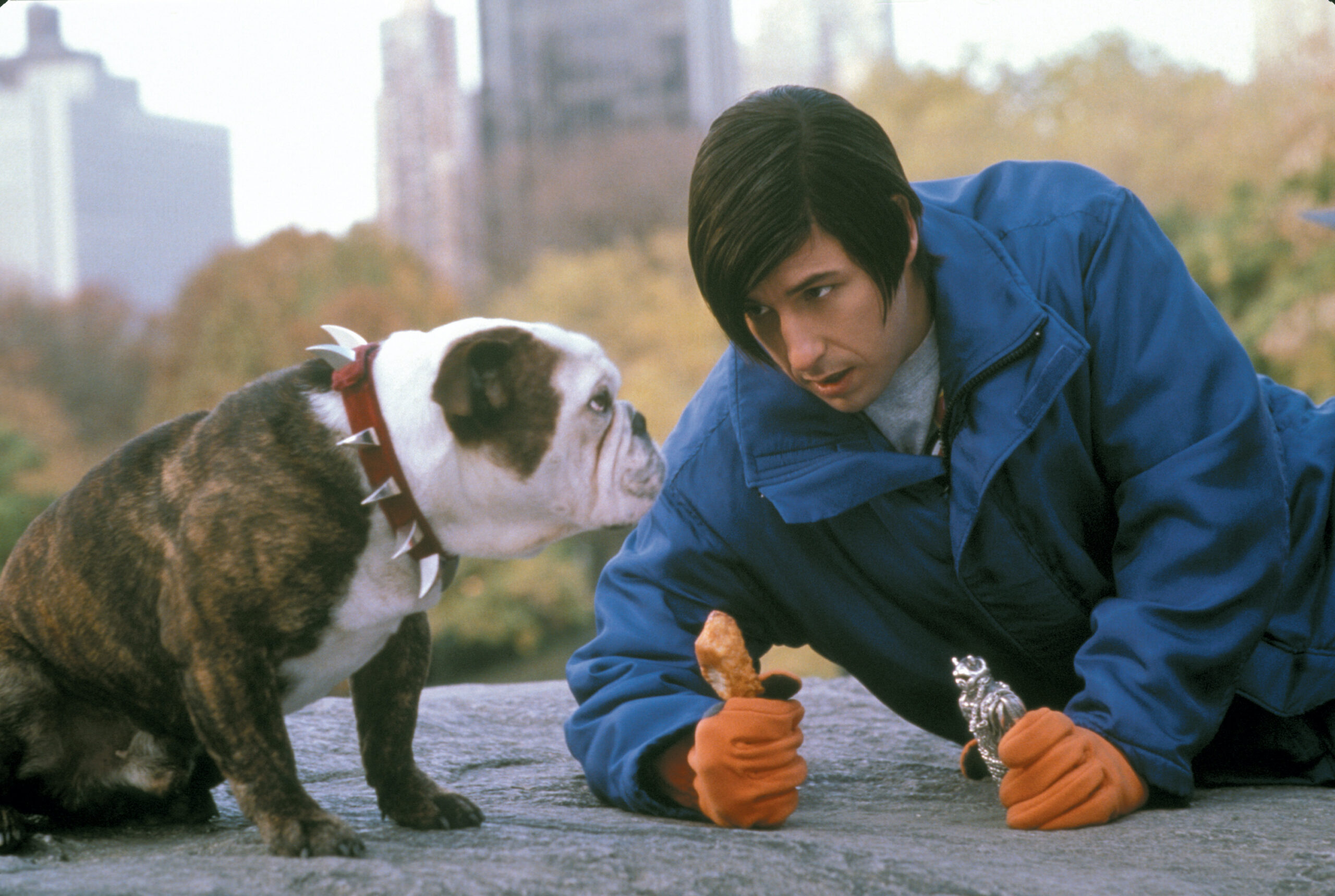
    Most people remember Little Nicky as a stupid devil comedy.

    That is exactly why it works.

    The movie hides its myth inside ridicule. It arrives as gross-out slapstick, bad accents, fast food, and a hero who seems too weak and too ridiculous to carry any real symbolic weight. But that surface is not separate from the meaning. It is part of the meaning. The film imagines a world so spiritually degraded that even hell has become funny.

    That is the first clue.

    The deeper point is not simply that the son of Satan comes to Earth. It is that Earth turns out to be the more advanced version of hell. The underworld below is crude, obvious, theatrical. It still looks infernal. Earth is worse because the infernal field has been normalized into social life, appetite, commodity, charisma, and spectacle. Below, hell still burns. Above, hell has learned how to smile.

    That reading gets sharper beside Dante.

    Dante’s Inferno is already an inversion. It is usually treated as a descent into a lower realm, but it is doing something more severe than that. It maps the moral and spiritual structure of what people already call the world. The circles of hell are not just punishments elsewhere. They are distorted ways of being made visible. Dante is not merely traveling away from ordinary life. He is revealing what ordinary life already becomes when ruled by appetite, fraud, pride, violence, and fixation.

    So Inferno already says: what you call the world is hell-shaped.

    Little Nicky then becomes an inversion of an inversion.

    Dante reveals the infernal structure.
    Little Nicky shows what happens after that structure becomes culture.

    It is a comic correction. It suggests that the real inferno is not mainly below us. It is the world above once distortion has become ordinary, desirable, and ambient.

    Hell below is the basement. Earth is the showroom.

    This is why the firewall matters. Once hell seals up, the lower kingdom can no longer circulate itself below. It has to export itself. The two brothers are not just rebellious sons. They are portable infernal forces entering the world above as appetite, influence, personality, and domination. The lower kingdom does not really need to conquer Earth from outside. It only needs to reveal that Earth is already prepared to host it.

    That is what makes the movie darker than it first appears. It is not showing hell invading innocence. It is showing hell discovering that its higher form is already in place.

    The brothers matter most as functions, not as personalities. Adrian and Cassius are stronger, cleaner embodiments of infernal rule than Nicky is. They know how to dominate. They know how to spread. They know how to wear force as style. They are what hell looks like once it becomes socially adaptive.

    Nicky is different.

    He is still infernal. He is still a son of the broken kingdom. But he is damaged in a way that matters. He is awkward, unstable, humiliated, soft where he should be hard, and unable to reproduce infernal domination cleanly. That weakness is not a flaw in the symbolism. It is the point. The stronger sons are better at extending hell. Nicky is too cracked to do it with conviction.

    That makes him the dangerous heir.

    The kingdom cannot be loosened by the brother who best embodies its power. It can only begin to loosen through the son who cannot fully belong to it.

    That is why he works best as a broken heir with a threshold function. He is still marked by the field he comes from, but he also moves between worlds, handles dangerous forces, and contains what has spread. He is not a pure kingly figure and not a pure healer either. He is a damaged mediator. He weakens the kingdom precisely because he cannot fully identify with its poison.

    The flask becomes important here. It is not just a plot device. It is containment. If the brothers represent infernal energies spreading into the world above, the flask gathers them back into a boundary. In a world where hell has become public and normalized, containment is already a kind of correction. Before the field can breathe, what has spread everywhere has to be caught.

    That same logic makes Mr. Beefy more important than he first appears.

    If Earth is the real inferno in the deeper sense, then Mr. Beefy is not just a funny dog companion. He becomes a degraded Virgil figure. Dante’s Virgil guides the pilgrim through the infernal structure and teaches him how to read it. Mr. Beefy performs that function in comic, embodied form. He does not explain hell with poetry. He moves through it with instinct.

    That is exactly right for this movie.

    In a world where infernal structure has become social and ambient, the first guide cannot be a philosopher. He has to be an animal. Mr. Beefy is fidelity before theory. He appears before romance, before social success, before any high revelation. The first real companion Nicky receives in the upper inferno is creaturely loyalty. In a field built on performance, appetite, and spectacle, the dog stands for something Earth has not yet fully corrupted: embodied trust.

    Mr. Beefy guides the damaged son through hell after hell has learned to look normal.

    Valerie performs a different role. She is not just there to humanize the hero. She changes his condition inside the field.

    The levitation scene works better through density and buoyancy than through gravity. Earth in this film is dense. Appetite is dense. Shame is dense. Persona is dense. The upper inferno compacts consciousness into identity and performance. That is what makes it hell. Not merely punishment, but density.

    Valerie’s belief changes Nicky’s density within the field.

    That is why he becomes buoyant.

    Her recognition does not make him stronger in the infernal sense. It does not crown him or harden him into a better ruler. It makes him lighter. For a moment, he is no longer as compacted by shame and false identity as the world expects him to be. Right reflection produces buoyancy.

    That is a better miracle than triumph.

    He does not conquer the inferno. He becomes less dense inside it.

    This is also why the movie feels unexpectedly tender underneath the vulgarity. It is not secretly saying that hell can be defeated by a stronger son. It is saying the infernal kingdom begins to loosen only when one of its heirs becomes light enough not to fully reproduce it.

    Popeye’s chicken sharpens the same reading. It is not just a recurring gag. It is degraded sacrament. Nicky is sustained not by bread from heaven, but by branded fast food. That alone would matter in a movie about Earth as upper-world inferno. But the name deepens it: Pop-eye. The outward, exaggerated eye. The pop-cultural eye. The eye of spectacle, branding, and compulsive visibility.

    So the food becomes more than food. It is upper-world communion through distorted seeing. Appetite delivered through image. Fuel from a world where seeing has already been captured by branding and performance.

    If hell has become ordinary life, then communion arrives in a bucket.

    The city deepens the same structure. New York is not neutral background here. It is the ideal upper-infernal environment: appetite without limit, anonymity without communion, velocity without stillness, crowd life without relation, image without depth. The underworld has not been escaped. It has become urban rhythm. Earth in Little Nicky is infernal order reorganized as movement, comedy, sexuality, marketing, and spectacle.

    That is why the comedy matters so much. The movie is not serious in spite of the jokes. It is serious through them. Dante reveals distortion as structured suffering. Little Nicky reveals the same structure after it has become ridiculous and marketable. Ridicule is one of the film’s main weapons. Infernal rule is shown as absurd because absurdity exposes what domination never sees about itself: it is swollen, not deep. Appetite is inflation. Hardness is overcompensation. The kingdom is already unstable. The more intensely it performs itself, the more clearly it reveals its incoherence.

    This is where the movie becomes more than a devil comedy. It becomes a correction to a common mistake. The mistake is to think hell is elsewhere. Dante already resists that by making hell a truthful diagram of the world’s distortions. Little Nicky radicalizes the point by showing Earth as preferable to devils only because its infernality is smoother. Dante’s lower hell clarifies. Little Nicky’s upper hell seduces. Dante gives the map of distortion. Little Nicky shows what distortion looks like when it has gone public as culture.

    That is why the film belongs to a waning phase. Its movement is not conquest, but loosening. The false kingdom cannot be healed by stronger infernal masculinity, sharper appetite, or cleaner domination. It begins to fail when one son becomes too awkward, too relational, too damaged, too buoyant under right reflection to keep its density intact. The hierarchy does not break because it is overpowered. It breaks because it cannot fully reproduce itself through the heir it has produced.

    The deepest one-line reading is this:

    Little Nicky is an inversion of Dante’s inversion, a comic correction that reveals Earth as the real inferno after hell has been normalized into appetite, spectacle, and smiling social life.

    And that is why the movie lands where it does practically too. When a system runs on appetite, image, control, repetition, or performance, the answer is rarely stronger domination. Hardness usually feeds the field that produced it. What helps is stranger and less glamorous: faithful companionship, right reflection, containment of what has spread too far, and the kind of softening that lowers density inside the infernal machinery.

    Not escape first.

    Buoyancy first.

    That is the secret Little Nicky hides in plain sight.

  • Abraham and the Unslain Son

    Abraham and the Unslain Son

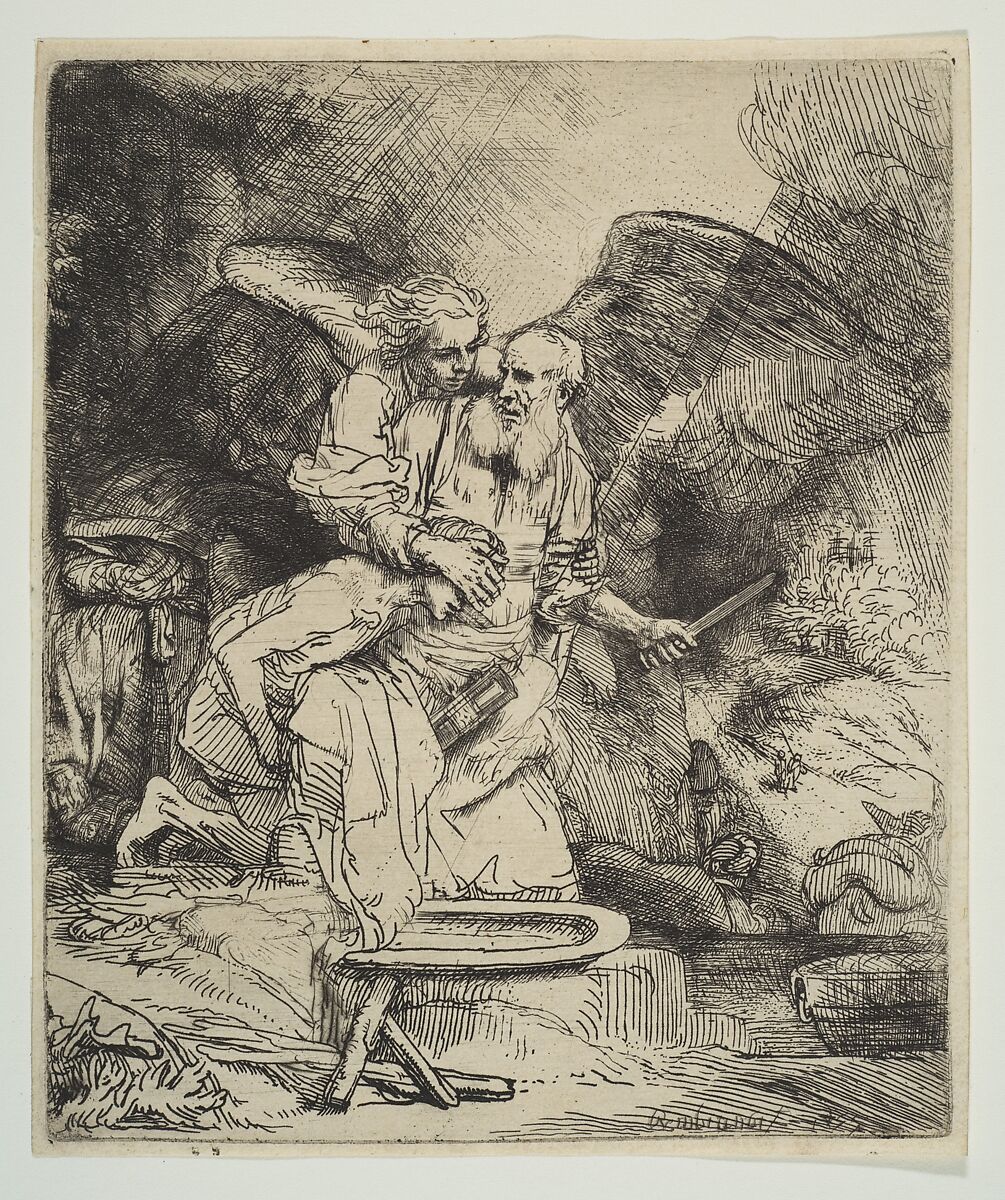
    Few biblical scenes feel more severe than Abraham climbing the mountain with Isaac.

    It is severe because the story does not give you many places to hide. A father. A son. Wood. Fire. Knife. Command. Silence. As image, it is almost unbearable. Which is why it has endured. Stories that remain this sharp usually survive because they are doing more than one thing at once.

    Read symbolically, the terror is not only moral. It is structural.

    The question is not merely whether Abraham loves God enough to obey. The question is what kind of consciousness gets asked to sacrifice its living future to a commanding abstraction—and whether that sacrifice will finally be completed.

    That is why the ram matters more than people think.

    In ordinary religious reading, the ram is divine mercy interrupting the test. In a deeper Geomythic reading, it is the sign that the whole point was to stop the sacrifice before it becomes real. Something in the human being has to learn the difference between surrender and self-destruction, between fidelity and enthrallment, between trust and the murderous logic of abstraction. A voice commands. Another intervention halts. The story turns on the refusal to finish the deed.

    That refusal is the meaning.

    Isaac in this reading is not just “the child.” Geomytha also uses the English sound of his name as symbolic wordplay: Is-iac, the Isis plexus or Is-iac plexus. This is not Hebrew etymology—Genesis links Yitzḥaq/Isaac to laughter—and it is not a claim that the anatomical term “solar plexus” historically derives from Isaac or Isis. Within Geomytha’s own symbolic grammar, the wordplay points instead to a living center of grounded presence. He signifies the continuity of grounded presence before it is offered up to abstraction, fear, or false futurity. He is the reflective line that must not be surrendered to every commanding voice dressed up as necessity. Abraham carries the knife because the false sacred always pressures human beings to prove themselves by cutting away what is most alive in them.

    And that pressure is not ancient only.

    People still do it constantly. They sacrifice peace to status. They sacrifice marriage to ambition. They sacrifice children to image. They sacrifice the body to ideology. They sacrifice the present to the future and call that seriousness. Modern life is full of altars where something living is offered up so that a more abstract identity can continue feeling righteous.

    That is why this belongs in Release. Release is not passivity. It is the loosening of false necessity. The Abraham story is powerful because it dramatizes a moment when the machinery of necessity is interrupted. The hand does not complete the motion. A different provision appears.

    The mountain itself deepens the image. Mountains in scripture often intensify consciousness. Things are stripped down there. Air thins. Speech matters more. There is less crowd, less noise, less ordinary social reinforcement. On the mountain, what rules you shows itself more clearly. So it is fitting that this is where the correction happens too. The test is not only ascent. It is revelation: what kind of god have you really been obeying?

    That is the danger built into all sacrificial religion. It can train gratitude, humility, and right proportion. It can also train people to call violence holy merely because it has been lifted into ritual language. The Abraham story survives because it presses directly on that fault line. It says: here is the knife, here is the son, here is the command—now what kind of sacred will finally rule this scene?

    The answer is not blood. The answer is substitution. More precisely: interruption.

    That interruption is one of the most merciful symbolic gestures in all of scripture. The future does not need to die for the relation to remain real. The sacrifice is redirected. Something else is caught in the thicket. The image is almost too precise. Thought tangles itself. Desire tangles itself. The false demand catches somewhere outside the child.

    And gratitude enters exactly there.

    Give Thanks is the quiet directive of Waning Gibbous because release without gratitude can become mere reaction. A person can drop one tyranny only to build another out of bitterness. Gratitude softens the hand. It lets the relinquishment become blessing instead of collapse. Abraham’s true holiness is not that he was willing to kill. It is that the story culminates in not killing, in receiving back what could have been lost, in discovering that the sacred need not feed on the destruction of the living.

    That is a lesson worth recovering.

    A great deal of modern life still assumes seriousness must wound something beautiful. If the career is real, the body must suffer. If the calling is real, the family must be neglected. If the politics are real, tenderness must be suspended. If the future is real, the present must be consumed. The mountain scene stands against that logic with terrible clarity.

    The knife is raised.

    Then it is stopped.

    That is the whole turn.

    The holiest sacrifices are often the ones you are not asked to finish. The command you must finally refuse may be the one that first looked most absolute. And the gratitude that follows is not sentiment. It is the recovered knowledge that what is most alive was never meant to be offered to the machinery of fear.

    Sometimes obedience is proven by stopping.

  • Hotel California

    Hotel California

    There are songs people do not merely hear. They move into them.

    “Hotel California” is one of those songs. It arrives like a place already half-remembered: desert highway, warm smell, strange invitation, beautiful house, polite welcome, subtle dread. The whole thing glides. Nothing bangs the door shut. That is why it works. The trap comes dressed as atmosphere.

    And that is always the more dangerous form of captivity.

    A prison you can see still leaves part of you awake. A prison that flatters you, entertains you, reflects your desire back to you, and lets you decorate your own confinement can last much longer. That is why the line lands so hard: “You can check out any time you like, but you can never leave.” The wording matters. Check out is made to sound like agency. Leave is the word that names reality. The song quietly separates the two.

    That split is the entire article.

    A person can check out of presence without ever leaving the enclosure of the false self. In fact, that is one of the main ways the enclosure sustains itself. You do not need bars if exhaustion, stimulation, fantasy, status, memory, anxiety, and self-image keep doing the work for you. You only need enough décor to keep the captive calling the arrangement life.

    The hotel itself is a perfect image for mediated being. It is not home. It is not wilderness. It is a managed in-between: furnished, serviced, curated, detached from origin, designed for temporary occupancy that somehow keeps extending itself. A hotel is what happens when shelter loses rootedness and becomes an experience. Consciousness in illusion often works the same way. It stops inhabiting its own ground and begins cycling through rentable states.

    The song’s luxury details matter because glamour is part of the mechanism. Mirrors on the ceiling. Pink champagne on ice. Captains, corridors, pretty boys, pretty alibis. Captivity here does not look like collapse. It looks like style. The false center rarely introduces itself by saying, “Come suffer.” It says, “Come upgrade.”

    That is why Waning Gibbous is the right phase for it. Release does not begin when the trap becomes ugly. It begins when glamour starts to loosen. It begins when you can feel that the atmosphere has been doing more work on you than the argument ever did. Some prisons are persuasive because they are miserable. Others are persuasive because they are beautiful. The second kind often lasts longer.

    The song also understands repetition. Guests come and go, but not really. The place keeps taking them in. Ritual dinner. Ritual music. Ritual beast. Ritual knives that somehow never kill the thing being fed. This is one of the eeriest details in the whole piece: the violence is there, but it does not free anyone. It simply sustains the loop. That is how a lot of modern life works too. People rebel inside the same emotional architecture that keeps them bound. Even their defiance feeds the house.

    That is why the line about being “programmed to receive” feels so cold. Reception is not neutral. To be programmed to receive means one’s inner field has already been tuned for suggestion. Image, desire, fear, memory, status, invitation—none of them arrive on clean ground anymore. The room has been prepared in advance.

    And yet the song does not end in pure despair. It ends in recognition. Recognition is not escape, but it is the first crack in enchantment. Once the arrangement has been named, its elegance loses some of its power. Once you realize the check-out was never the same thing as leaving, the house does not feel quite as sovereign.

    That is the practical turn.

    Many people spend years “checking out” of the pressure—through distraction, exhaustion, intoxication, fantasy, social posing, aesthetic identity, even spiritual language—while never leaving the machinery that made the pressure. They swap rooms and call it liberation. They change costumes and call it depth. They learn better vocabulary for the same captivity.

    Release asks for something harder.

    Not a prettier room. Not a more flattering mirror. Not a more luxurious version of the loop.

    An actual leaving.

    That leaving begins very quietly. Gratitude helps because gratitude breaks the glamour of grievance and appetite. The false self feeds on lack, comparison, unfinished hunger. Gratitude is one of the ways the room begins losing voltage. It restores enough simplicity for a person to feel the difference between being held and being managed.

    Some places only own you because you keep admiring the wallpaper.

    Stop admiring it.

    That is where the door begins.

  • The False Journey Home

    The False Journey Home

    Full Moon · Taurus — Claim in Steadiness — Witnessing the Golden Detour: How Yellow Submarine and The Wizard of Oz Turn Return Into a Trap

    A yellow submarine.
    A yellow brick road.

    Both images feel innocent. One belongs to a psychedelic musical dream of rescue, color, and communal song. The other belongs to one of the most beloved fairy-tale worlds in American culture: witches, slippers, companions, Emerald City, and the promise of home.

    That is why they work.

    The deepest traps do not always appear as prisons. Sometimes they appear as roads. Sometimes they appear as vessels. Sometimes they sing. Sometimes they sparkle. Sometimes they invite the child-self to keep moving toward a home that was never actually elsewhere.

    In Geomytha, the yellow submarine and the yellow brick road are two versions of the same mechanism: consciousness displaced from home, given a bright mediated route, and sent on a journey that appears to lead back to presence while keeping the false self moving inside the dream.

    One goes down.
    The other goes forward.

    Both keep Horus traveling.

    The False Journey of Return

    The mechanism begins with exile.

    Something feels wrong. Harmony has been interrupted. Home seems lost. The self wakes inside a strange arrangement and immediately wants movement. There must be a path, a vehicle, a guide, a wizard, a band, a ticket, a pill, a door, a map, a song, a promise.

    This is the first trick: the wound is real, but the proposed solution may already belong to the wound.

    In Geomytha, Isis is pure awareness, the simple ground of being before thought divides it. Osiris is right reflection, consciousness resting transparently in that awareness. Set is projection, fragmentation, spectacle, the force that turns immediacy into mediated image. Horus is the time-bound identity born from that fragmentation: the seeker, the hero, the traveler, the one who wants to get back home without ceasing to be the one who travels.

    Horus wants return, but he wants return as accomplishment. He wants presence as destination. He wants awakening as a story in which he remains central.

    So Set gives him a road.

    Or a submarine.

    The Yellow Submarine: A False Womb in the Waters

    A submarine moves through water without surrendering to water.

    That is the key.

    Water usually belongs to depth, womb, unconscious, origin, memory, and return. To enter the waters directly is to risk dissolution. Boundaries soften. Names lose force. The ego cannot remain dry in the flood.

    But the submarine solves that problem. It allows descent without surrender. It carries the traveler into the deep while preserving the traveler’s enclosure. The ocean surrounds, but does not touch. The occupants descend, but remain sealed.

    That makes the yellow submarine a perfect image of mediated depth.

    It is not Jonah’s whale, which swallows the runaway self and forces surrender. It is not Noah’s ark, which preserves life through catastrophe. It is a bright artificial capsule, a cheerful vessel in the unconscious sea. It turns depth into entertainment. It makes descent musical, safe, colorful, and communal.

    And because it is yellow, the image sharpens.

    Yellow marks the solar field: brightness, visibility, promise, delight. But solar brightness in Geomytha is dangerous when it substitutes for source. It can imitate illumination while keeping consciousness inside projection. It can make the prison glow.

    The yellow submarine is therefore not just a vehicle. It is a false womb. It lets consciousness feel as though it has entered the depths while protecting Horus from the surrender that true depth requires.

    It says: come below the surface, but stay inside the image.

    The Yellow Brick Road: Linear Seeking Through the Dream

    The yellow brick road does not descend. It extends.

    It gives Dorothy direction, progress, companions, danger, and hope. It tells her that home is reachable through external movement. Keep walking. Keep seeking. Keep following the bright line. The destination is ahead.

    But Dorothy’s story exposes the flaw.

    The Wizard does not give her the power to return home. He only dramatizes the failure of external authority. The companions do not supply missing pieces from outside. They reveal faculties already present: intelligence, heart, courage. The slippers are not acquired at the end. They were with her almost the whole time.

    The road educates Dorothy by exhausting the lie that home must be granted externally.

    That is why the yellow brick road is both trap and teacher. It belongs to illusion, but it can wear illusion out. It gives the seeker enough road to reveal that road itself was never the source.

    The road says: walk far enough and you will arrive.
    Presence says: see clearly and the distance collapses.

    The Emerald City: The False Illusory Home

    The Emerald City is the yellow brick road’s promised destination, but it is not home.

    Dorothy is not trying to reach a city. She is trying to return to Kansas. The city is only presented as the place where return can be authorized. It is the shining center of the dream, the place where the seeker believes power lives.

    But when she arrives, the city does not restore her.

    It delays her.
    It processes her.
    It dazzles her.
    It sends her on another task.

    That is the structure of false home.

    The Emerald City looks like arrival, but it is really another layer of mediation. Its greenness suggests life, healing, renewal, and heart-centered restoration, but the city’s radiance is artificial. It is managed vision. It is spectacle. It is a place whose authority depends on controlled perception.

    That is pure Set.

    Set does not merely build the road. He builds the destination that makes the road seem justified. The Emerald City is projection posing as refuge. It gives the seeker the emotional feeling of arrival while keeping her dependent on external authority.

    The Wizard is the false priest of the false home. He appears immense because the city magnifies him. Once the curtain is pulled back, the authority collapses into machinery, performance, and amplified voice. The promised center is exposed as stagecraft.

    In Geomytha terms, the Emerald City is Horus’s fantasy of Osiris: an externalized image of wholeness, order, and restoration that imitates true reflective harmony without actually returning consciousness to source. It is not embodied presence. It is not Kansas. It is a jeweled projection inside the dream.

    If the yellow brick road is the false path of return, the Emerald City is the false destination of return. Together they expose the same trap: the ego first turns presence into distance, then turns the destination into an institution, an image, a city, a ruler, a system, a place where someone else supposedly grants the return.

    But home is not granted by the Wizard.

    Home is remembered when the false center loses power.

    False home always postpones home.

    Why Yellow Matters

    Yellow and gold are not neutral colors here.

    They promise value. They announce brightness. They suggest treasure, sunlight, childhood, divinity, initiation, wonder. A golden road feels trustworthy because it shines. A yellow submarine feels joyful. The Emerald City glows with false authority before the curtain is pulled back.

    That is how Set works at his most refined. He rarely appears first as horror. He appears as radiance without root.

    The false path rarely looks like a prison. It looks like hope. It looks like rescue. It looks like a song everyone already knows.

    But brightness is not the same as truth.

    A thing can shine because it reflects source. It can also shine because it has captured attention. The difference is everything.

    The yellow brick road shines, but it does not hold.
    The yellow submarine glows, but it does not dissolve.
    The Emerald City dazzles, but its authority hides behind a curtain.

    Yellow is the color of the detour when illumination is borrowed from the very world one is trying to escape.

    Other Roads, Pills, Tickets, Holes, and Doors

    Once the pattern is seen, it appears everywhere.

    In The Matrix, the red pill functions as a threshold out of the false world. But even there, the danger remains: Neo may awaken from the Matrix, yet “The One” can become another identity. Liberation can harden into saviorhood.

    In The Truman Show, Seahaven is a perfect artificial home. Truman’s liberation does not come by mastering the set. It comes by leaving it. The exit door is stronger than the yellow brick road because it does not promise more adventure inside the illusion. It opens beyond the staged world altogether.

    In Willy Wonka and the Chocolate Factory, the golden ticket grants entry into an enchanted interior, but the factory is not paradise. It is a desire-testing machine. The golden invitation does not save the children. It reveals them.

    In Alice in Wonderland, the rabbit hole is descent into unstable identity. Alice enters a field where size, language, logic, and self-definition break down.

    In “Hotel California,” the road leads to a glamorous enclosure. The traveler arrives, enjoys the seductive atmosphere, and discovers the nightmare hidden inside the luxury: one may check out, but never truly leave.

    These examples share the same skeleton: a mediated passage through illusion that may either awaken consciousness or give the ego a more mythic costume.

    The question is never only: did the character move?

    The question is: did the false center dissolve?

    Not Every Vessel Is a Trap

    Not every road, vessel, guide, or threshold is false.

    Some containers are not entertainment chambers. They are surrender chambers.

    Jonah’s whale is not the yellow submarine. Jonah does not enter the depths in a cheerful capsule with music and friends. He is swallowed. The vessel is alive, dark, corrective, and humiliating. It does not preserve his egoic adventure. It interrupts him.

    Noah’s ark is also a vessel through water, but its logic is different. It is not psychedelic travel. It is preservation through flood. It carries life through dissolution when the world has become uninhabitable.

    That is the distinction.

    A true vessel humbles the self.
    A false vessel entertains the self.

    A true path reduces illusion.
    A false path beautifies it.

    A true guide points beyond himself.
    A false guide becomes necessary to the seeker’s identity.

    A true threshold strips the self.
    A false threshold flatters the self with initiation.

    The problem is not symbol. The problem is possession by symbol.

    The Ego Wants the Map More Than Home

    The false self loves maps because maps let it continue.

    A map creates distance. Distance creates future. Future creates seeking. Seeking creates identity. Identity creates the one who is not home yet but may arrive later if he follows correctly.

    That is Horus at his most subtle.

    He no longer says, “I am merely this body, this role, this status, this wound.” Now he says, “I am the traveler. I am the awakened one. I am the seeker of home. I am the one following the golden road. I am the one inside the sacred vessel. I am the one who took the pill, found the ticket, entered the portal, escaped the cave, decoded the symbols.”

    It is still “I.”

    The ego can survive almost any journey as long as it remains the traveler. What it cannot survive is direct presence.

    Presence does not give Horus a heroic role. It does not require a yellow road. It does not need a submarine. It does not crown the traveler. It does not ask the self to become more interesting before it returns.

    Presence simply exposes that the whole drama of distance has been appearing inside awareness from the beginning.

    That is the terror of homecoming.

    The seeker discovers that home was not at the end of the road. The road was inside the dream. The one walking it was also inside the dream.

    Stepping Off the Golden Detour

    The practical question is simple.

    When a path appears, ask: does this return awareness to presence, or does it deepen the story of me?

    When a vessel appears, ask: does this hold me through surrender, or does it protect me from surrender?

    When a guide appears, ask: does this figure point beyond himself, or make himself necessary?

    When a golden promise appears, ask: what does it ask me to postpone?

    When a world becomes colorful, musical, enchanted, or heroic, ask: is this symbol opening into source, or is it giving the false self a prettier place to live?

    The point is not to hate Oz.
    The point is not to drain the Beatles of joy.
    The point is not to become suspicious of every road, song, story, or image.

    The point is to witness the mechanism.

    A symbol is holy when it becomes transparent. It is false when it becomes a substitute for seeing. The yellow submarine and the yellow brick road both become useful once their enchantment is understood. They show the same truth from different angles: the ego will happily travel through wonder if wonder allows it to remain intact.

    But home is not reached by remaining intact.

    Home begins when the traveler stops asking the road to save him.
    Home begins when the vessel is no longer mistaken for the womb.
    Home begins when the Wizard loses authority, the curtain falls, and the shining path is seen for what it was.

    A beautiful detour.

    The way home begins when consciousness sees that it was never lost in space.

    It was lost in movement.

  • The Werewolf’s Sun

    The Werewolf’s Sun

    Paid essay — public preview. This page introduces the original essay. The complete argument, examples, and conclusion are available to paid Geomytha subscribers on Substack.

    People hear “werewolf” and think moon.

    That has always been slightly misleading.

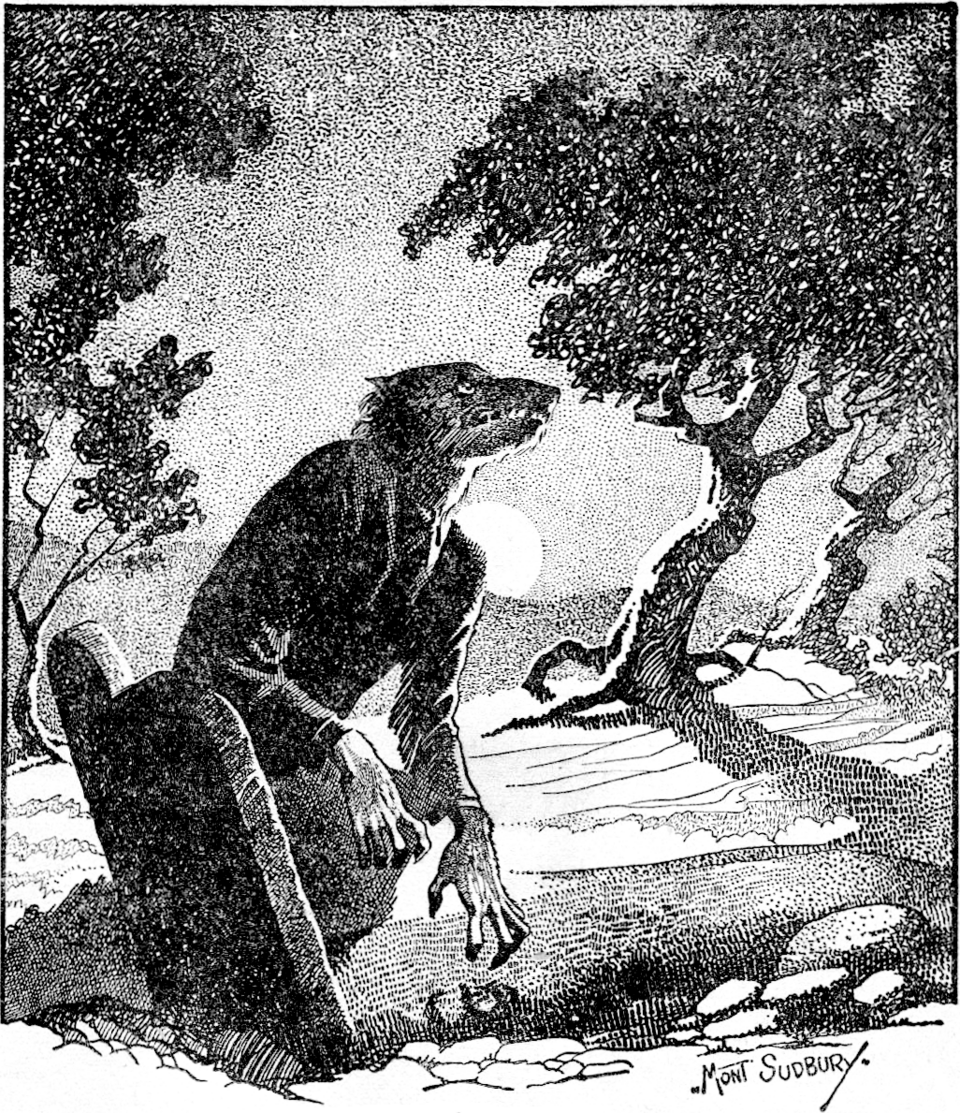
    The moon is obviously part of the imagery—night, cycle, eruption, hiddenness, transformation under a changing sky. But symbolically the werewolf does not feel like right lunar reflection gone wrong. It feels like something harsher: public embodiment under takeover. Not gentle mirroring. Visible possession.

    That is why the myth belongs at Full Moon.

    Full Moon is not just brightness. It is appearance, display, strain, embodiment, exposure, the point where something can no longer stay hidden and starts demanding to be seen. The beast enters exactly there. Appetite stops whispering. Instinct stops wearing a polite face. Force becomes bodily. The transformation becomes theatrical because possession always wants witnesses.

    That is…

    Read the complete essay on Substack →

    This WordPress page preserves the essay’s place in the Geomytha archive, its original title and subtitle, and its publication date. The full subscriber edition remains protected on Substack.

  • The Octopus Baby and the Birth of Horus

    The Octopus Baby and the Birth of Horus

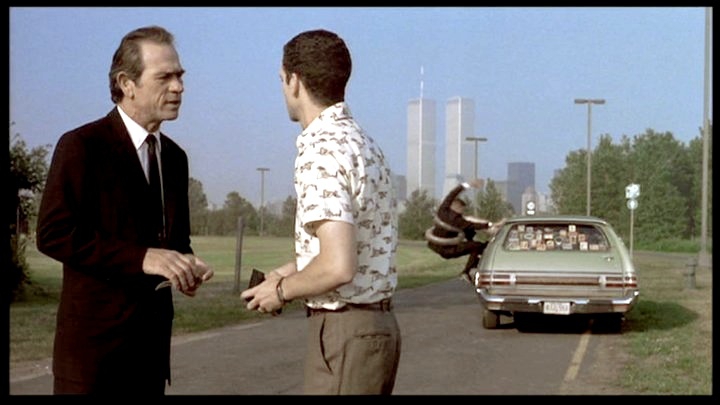
    There is a scene in Men in Black that looks like pure comic absurdity until you slow it down and let the image speak. J is helping deliver an octopus baby in a vehicle. A tentacle lifts him up as the birth happens. The Twin Towers stand in the background. Two birds flutter at the top of the frame. On the surface, it is a joke. Symbolically, it is much closer to a cosmology.

    The scene reads like a modern retelling of an old pattern: pure ground, broken reflection, mediated birth, and the emergence of a new identity-form that immediately begins to seize the one helping deliver it. What looks random is actually dense with structure. The scene is not just about alien life entering the world. It is about consciousness being routed through machinery, division, and spectacle, then becoming entangled in the very form it midwifed.

    The first key is that the birth does not happen in open ground. It happens in a vehicle. That matters. A vehicle is not simply a container. It is a carrier, a managed passage, an engineered womb pointed toward destination and function. It suggests that what is being born is not arriving from stillness or direct presence. It is being processed into the world through a system. Life enters form already in transit, already mediated, already being transported by an apparatus rather than emerging from a calm field of being.

    This is where the idea of the Merkaba sharpens the scene. At its most useful symbolic level, the Merkaba is not just a mystical word for a light-body or celestial chariot. It is an image of consciousness in motion through a structured field. It implies ordered transit, alignment, and a vehicle capable of carrying the soul across levels of reality. In its true form, it points to rightly ordered movement. But symbols can invert. What should carry consciousness into alignment can become a structure that carries it deeper into mediation.

    That inversion is what this scene suggests. The vehicle acts like a fallen or distorted Merkaba: not a chariot of liberation, but a managed chamber of incarnation. It does not bear consciousness upward through right relation. It carries life into visibility under conditions of fragmentation. The machinery of transport remains, but the destination has changed. Instead of awakening, the vehicle becomes a delivery system for identity.

    That makes the octopus baby the center of the whole image. Not because Horus is literally an octopus, but because the octopus is a near-perfect symbol for the kind of identity being born here: one center with many extensions, many grasping lines, many contact points, many ways to seize and organize the field around it. This is not original reflective wholeness. It is apparent unity produced after reflection has been broken, rerouted, and reassembled as a new self. The octopus baby fits that beautifully. It is a proliferating identity-form. It is not stillness. It is not restored harmony. It is life already configured as multi-armed extension.

    The most revealing detail is that J is not calmly delivering the thing from a safe distance. He is being lifted by the tentacle. That is the whole scene in miniature. The human participant is not merely midwife to the new form. He is already being taken up into it. The created thing immediately exerts force over the one helping bring it into manifestation. The soul does not only create the maze. It becomes caught in the maze it energizes.

    The Merkaba image deepens that point. A true chariot carries the soul because the soul has entered right alignment with the structure that bears it. Here the opposite happens. J is carried upward, but not through freedom. He is lifted by a tentacle, not by centered order. That means the scene presents a counterfeit ascension. It looks like elevation, but it is really capture. It looks like transport, but it is really entanglement. The vehicle is therefore not just a womb or comic carrier. It is a false chariot, a distorted Merkaba, carrying consciousness into spectacle before consciousness has remembered itself.

    This is why the Twin Towers matter. They function as twin pillars, a doubled architecture, the visible form of a split field. The new many-armed identity is not entering a unified world. It is being born into a world already organized through duality, doubling, and public architecture. Even the two birds above keep the duplication going. The whole frame is structured by twoness, splitness, and mirrored agitation rather than calm singular presence. A divided field is already in place before the birth is complete.

    That is what makes the scene feel less like simple chaos and more like initiation into a trapped world. The soul is not entering a clean field. It is entering a doubled one. A false center then emerges to claim coherence over that division. The image suggests not merely birth, but accession: the appearance of a new ruler of a split territory.

    This is where the reading becomes more specific. The scene is not just about the creation of a new self. It also works as an image of the soul trapped in an 8-sided maze and escaping only by moving in proper rhythm rather than reacting to whatever grabs it first. The octopus is perfect for this because it suggests multiple simultaneous pulls. One center, many tentacles, many emotional hooks. That is what false identity feels like. It does not seize us with one chain. It seizes us through role, fear, memory, duty, image, urgency, distraction, and desire all at once.

    Against that tentacular false rhythm stands the 8-phase pattern: Gather, Stir, Form, Build, Claim, Release, Return, Surrender. These are not just names for the moon. They are disciplined motions that keep consciousness from feeding the maze at random. Read that way, the tentacle grabbing J symbolizes the false world catching the soul before it has learned to move in alignment with the rhythm of the real. Instead of responding in season, consciousness gets yanked into the nearest available drama. That is how the maze feeds itself.

    The distorted Merkaba does the same thing. It promises movement, intensity, and elevation, but without right relation. It carries the soul farther into managed identity rather than back toward centered presence. The visible transport becomes part of the prison. What looks like ascent is only more elaborate containment.

    That is also why this scene belongs most naturally to Full Moon · Claim. It is a scene of visibility, exposure, delivery into public form, and identity taking shape in the open. It is the point where what has been swelling becomes undeniable. A form emerges into visibility and immediately asserts force within the field. It is the claiming phase, but in distorted form: not presence claiming itself cleanly, but the false self arriving in spectacle.

    A softer version of the same pattern appears in “Octopus’s Garden.” That image sounds harmless, even charming: a hidden place under the sea, a refuge, a playful enclosure, a protected world ruled by the octopus. But that is what makes it useful symbolically. Not every trap appears violent. Some traps appear cozy. Some forms of entrapment feel like shelter. The octopus does not always rule by terror. It can also rule by making its domain feel safe, secret, and emotionally padded. In that sense, “Octopus’s Garden” becomes a gentler image of the same false refuge: not the Tree of Life, but a protected secondary world in the domain of the many-armed keeper. The same contrast remains useful. A true vehicle carries you through. A false enclosure keeps you circulating inside itself.

    A useful contrast is The Matrix. There the machinery of entrapment is cold, overt, technological, and explicitly hostile. In Men in Black, the same basic pattern appears in comic and bureaucratic form. That difference matters. The false world does not always present itself as evil. Sometimes it presents itself as funny, manageable, and routine. Sometimes the machinery of mediated birth looks like a joke. But the symbolic structure remains the same: consciousness is born into managed transit, identity proliferates, and the participant gets lifted into the very apparatus he thought he was handling.

    That is why the scene matters. It is not just absurd alien comedy. It is an image of the soul’s predicament. Reflection has already been rerouted. Birth is already mediated. The world waiting outside is doubled. The new identity-form is many-armed. And the first thing it does is grab the one who helped bring it forth. The vehicle carrying it all is not neutral. It is a chariot-form, a transit-body, a broken Merkaba: a structure of movement that has lost true alignment and now carries consciousness into public illusion rather than through it.

    The warning is simple. The false world does not only trap us after it is fully formed. It traps us in the very moment we call its emergence life. It offers motion without freedom, elevation without release, visibility without truth. It hands us a vehicle and calls it transcendence.

    The practical lesson follows from that. When experience begins to feel tentacular, proliferating, and over-mediated, the answer is not more grasping. It is not to fight the maze on its own terms. It is to return to right motion. Gather when it is time to gather. Stir when it is time to stir. Form when it is time to form. Build when it is time to build. Claim when it is time to claim. Release when it is time to release. Return when it is time to return. Surrender when it is time to surrender.

    That is how the soul stops confusing seizure for birth.

    The false world does not always trap us with chains. Sometimes it arrives as a chariot, lifts us with a tentacle, and calls it ascension.