SaturnaliaSaturnalia — Roman FestivalAn ancient Roman festival associated with feasting, gift-giving, games, and temporary relaxation or reversal of some social conventions, including limited master/slave role inversion.Read full entry → looks like freedom.
That is the trick.
For a few days, Rome loosened its face. Masters served slaves. Gambling was permitted. Gifts moved through the city. Rules bent. Crowns appeared on fools, servants, and temporary kings. The rigid Roman world pretended to dissolve.
But it did not dissolve.
It rehearsed dissolution so the system could returnReturn — RemembranceReturn names remembrance and release: the loosening of possession so reflection can become transparent to source again.Read full entry → stronger.
Saturnalia was not the end of hierarchy. It was hierarchy learning how to survive its own reversal. The pressure was released. The roles were inverted. The world laughed at itself. Then the old order came back wearing the authority of inevitability.
That is how SetSetIn Geomytha, Set names the claimant: I — the interruption by which reflection is taken as mine and converted toward ownership.Read full entry → works when he becomes civilization. He does not merely forbid rebellion. He ritualizes it. He gives the false self a holiday from the cage, then calls the cage reality.
Saturnalia is therefore not just a Roman festival. It is a diagram of controlled inversion. The system temporarily suspends “this” so no one reaches “is.”
Because the real problem is not whether the slave becomes master for a day. The real problem is whether anyone stops believing in master and slave as ultimate identities at all.
That is the dangerous threshold.
Rome could tolerate reversal. Rome could tolerate mockery. Rome could tolerate drunkenness, gift exchange, and temporary disorder.
What Rome could not tolerate was the collapse of the identityThis — IdentityThis names the formed identity: the body, role, image, wound, belief, or story claimed as what the self is.Read full entry →-machine itself.
The Roman triumphRoman Triumph — TriumphusA state procession honoring a victorious Roman commander, displaying the general, captives, spoils, and public symbols of victory and status.Read full entry → shows the opposite side of the same mechanism.
In the Triumphus, the victorious general rode through the city in public splendor. He was crowned, elevated, adored. Captives and spoils moved behind him. The conquered world was dragged into Roman visibility. The crowd witnessed power becoming image.
For one ceremonial moment, the general became almost divine.
But even this elevation contained a wound. A slave, according to the famous tradition, stood near him and whispered that he was mortal. Whether historically exact in every detail or not, the symbolism is perfect: Rome crowns HorusHorusIn Geomytha, Horus names the identity that forms after claim: This — the body, role, image, wound, belief, or story taken as what the self is.Read full entry → while forcing Horus to hear the crack beneath his crown.
You are visible.
You are glorious.
You are Rome.
You are this.
But you will die.
That whisper matters because the whole triumph depends on an unstable sentence:
I am thisThe False-Self Sentence — I Am ThisThe false-self sentence forms when claim joins reflection to a fixed object of identity: I am this.Read full entry →.
I am the victor.
I am the conqueror.
I am the name carried through the city.
I am the image the crowd confirms.
I am the body through which empire sees itself.
That is Horus at maximum brightness: the time-bound identity publicly enthroned.
But the triumph also reveals the fragility of that identity. It must be staged. It must be watched. It must be repeated. It must be confirmed by the crowd, the city, the captives, the spoils, the crown, the chariot, the route, the ritual.
Without spectacle, the “I” trembles.
This is why Saturnalia and Triumphus belong together. Saturnalia temporarily lowers the crowned identity. Triumphus temporarily raises it. One mocks the hierarchy. The other glorifies it. But both preserve the deeper machinery.
Both keep consciousness trapped in role.
Both keep the sentence moving toward predicate.
Both prevent the return to pure being.
In Geomytha, the core movement is simple:
IS → AM → I → THIS.
IsisIsisIn Geomytha, Isis names the unclaimed field: Is — pure being, awareness before possession, and the ground before the claimant appears.Read full entry → is IS: pure awareness before identity.
OsirisOsirisIn Geomytha, Osiris names reflected presence: Am — awareness reflected as living consciousness without yet becoming ownership.Read full entry → is AM: awareness reflected as presence.
Set is I: the claimant, the interruptionThe Interruption — Am → IAm → I is the interruption in which reflected presence becomes claim.Read full entry →, the thought that says mine.
Horus is THIS: the identity-body hardened into object, role, title, body, empire, wound, fear, doctrine, or world.
The trap is not “I am.”
The trap is “I am this.”
That final word is the crucifixion point.
Because once awareness becomes “this,” it can be ruled. It can be praised. It can be shamed. It can be crowned. It can be mocked. It can be bought. It can be sacrificed.
Now the crucifixion comes into focus.
The Roman crucifixion of JesusChristJesus Christ as the central figure of Christianity. Matthew 27 depicts the soldiers' mock coronation with a robe and crown of thorns before crucifixion; Philippians 2 describes Christ humbling himself and becoming…Read full entry → is usually read devotionally, historically, politically, or theologically. All of thoseThose — ProjectionThose names projection: enemies, outsiders, competitors, threats, and disowned qualities placed beyond the identity boundary.Read full entry → readings may carry force. But in Geomytha, the crucifixion also reveals the mechanism beneath Saturnalia and Triumphus in its most severe form.
Christ is publicly displayed.
Crowned in mockery.
Named as king.
Lifted before the crowd.
Placed between accusation and spectacle.
Forced into visibility as a body onto which the whole imperial-religious machine projects its categories.
King of the Jews.
Blasphemer.
Threat.
Criminal.
Messiah.
Victim.
Son.
Body.
Name.
This.
The crowd does not merely kill him. The crowd tries to finish his sentence.
It cannot tolerate “I am” without predicate.
It demands:
I am what?
Are you king?
Are you son?
Are you threat?
Are you guilty?
Are you ours?
Are you Rome’s?
Are you this?
The cross is where every projected identity is nailed to the visible body.
That is why the crucifixion is more than punishment. It is a public ritual of forced definition. Rome does not merely execute. Rome makes an image. It turns the condemned body into warning, theater, law, and sacrificial message.
This is Set’s genius: projection made public.
The cross says: this is what happens when “I am” refuses the empire’s authorized predicates.
Saturnalia crowns the mock king and lets him fall back into order.
Triumphus crowns the victorious king and lets him shine as order.
The crucifixion crowns the rejected king and exposes the violence beneath order.
All three are crown rituals.
All three involve public identity.
All three depend on spectators.
All three turn the human form into symbolic machinery.
But the crucifixion goes deeper because it reveals the cost of “I am this.” The false self cannot exist without sacrifice. Someone must carry the projection. Someone must be named. Someone must be displayed. Someone must absorb the crowd’s fear, envy, resentment, guilt, longing, and demand for closure.
That is the scapegoat function.
The crowd wants Barabbas released because Barabbas belongs to the recognizable world of action, revolt, crime, force, and counterforce. Barabbas is still inside the Set-Horus field. He is violent, but legible. He is a figure the crowd can understand.
Christ is more dangerous because he destabilizes the grammar.
He does not merely offer a rival identity. He exposes identity itself.
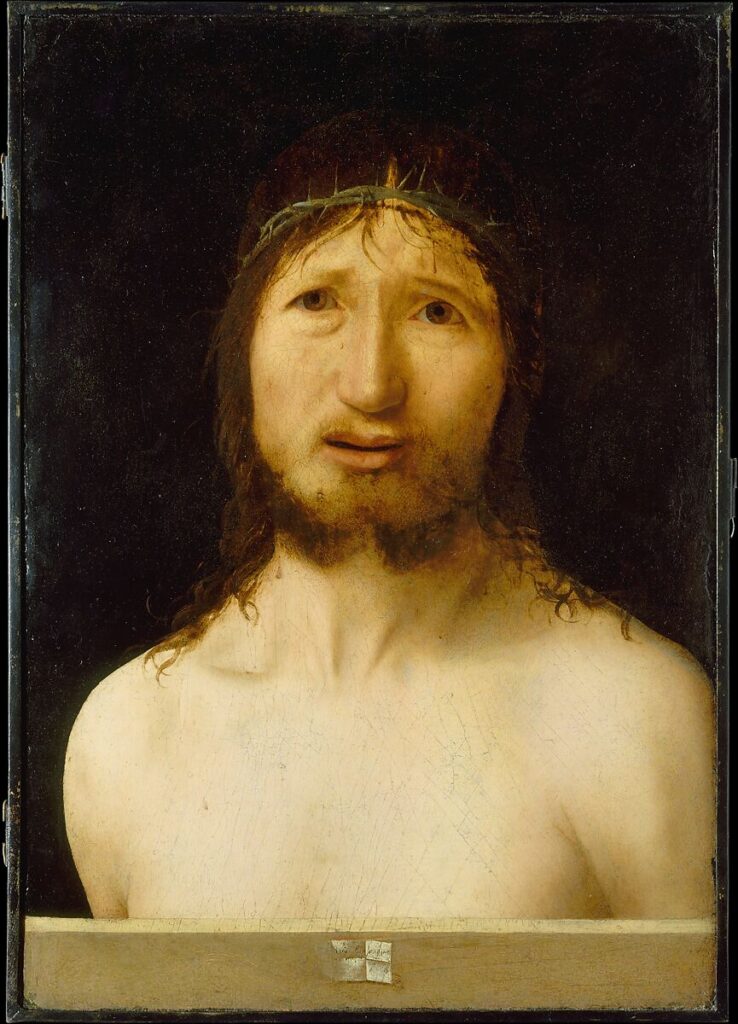
That is why the mocking crown is so important. The crown of thorns is not only humiliation. It is the false crown made painful. It shows what every crown secretly is when worn by the time-bound self: a ring of suffering around the head.
The crown belongs to the skull.
The head is the false phallus: thought, title, image, authority, projection, the upward pull away from embodied presence. The thorn crown makes visible the pain already hidden inside the identity structure.
The crown of thorns is also the halo function inverted.
A halo presents the head as sanctified radiance: identity lit from above, consciousness crowned by divine visibility. But the thorn crown shows the wound beneath that radiance. It is the painful version of the halo, the solar ring turned against the skull.
The same circle that religious art later renders as holiness appears here as pressure, mockery, and blood.
That matters.
In Geomytha, the halo is not automatically false. It can symbolize consciousness transparent to sourceIs — SourceIs names unclaimed being: awareness before possession, distinction, or identity.Read full entry →. But when the head becomes the seat of identity, authority, and spiritual self-image, the halo becomes dangerous. It can become the aesthetic of Horus: the false self glowing with borrowed light.
The thorn crown exposes that danger.
It says: when the head claims radiance without returning to presence, the halo becomes a torture device.
So the crown of thorns does not merely mock kingship. It reveals the hidden violence inside false sanctity. It shows the halo under Setian pressure: radiance converted into pain, glory converted into spectacle, divinity converted into public identity.
Every ego-halo is thorned.
Rome places that crown on Jesus to mock him. Symbolically, the act reverses itself. The mockery reveals the truth of Roman power. Empire itself is crowned with thorns. The triumphal general is crowned with thorns. The Saturnalian mock king is crowned with thorns. The social self is crowned with thorns.
Every “I am this” bleeds.
This is why the crucifixion is not merely one event among other sacrificial myths. It is one of the clearest symbolic exposures of the identity-machine. The vertical beam and horizontal beam form the intersection where heaven and earth, body and law, presence and projection, Rome and Israel, crowd and victim, time and eternity, all collide.
The cross is the place where contradiction becomes visible.
It suspends the body between worlds.
It shows what happens when pure “I am” is captured by public meaning.
It reveals the violence required to make identity stick.
That is why the crucifixion must be read alongside Saturnalia and Triumphus. Rome knew how to manipulate the sacred pressure of public identity. It knew how to crown. It knew how to mock-crown. It knew how to display conquered bodies. It knew how to turn death into instruction.
But in the crucifixion, the ritual breaks open.
The victim does not simply become another defeated body. He becomes the exposure of the whole system. The cross reveals that the empire’s power depends on forcing awareness into predicates and then punishing whatever refuses them.
This is also why the resurrection motif is so easily misunderstood.
If resurrection is read as the return of the same identity, then Horus survives. The ego gets its victory myth. The self imagines it will continue forever, improved, vindicated, glorified.
But if resurrection is read through Geomytha, its deeper pressure is not the immortality of “this.” It is the failure of “this” to contain “I am.”
The body can be displayed.
The name can be accused.
The crown can be mocked.
The crowd can project.
The empire can execute.
But pure awareness is not finally identical with the displayed form.
That is the escape hatch.
Not escape into fantasy. Not escape into another crown. Not escape into spiritual ego. Escape from the sentence itself.
Not “I am king.”
Not “I am victim.”
Not “I am chosen.”
Not “I am condemned.”
Not “I am this.”
Just:
I am.
And deeper still:
Is.
This is where Saturnalia fails, Triumphus fails, and crucifixion reveals what they cannot hold.
Saturnalia says: switch roles, then return.
Triumphus says: crown the role, then remember death.
Crucifixion says: see the role nailed to the wood.
That seeing is unbearable because modern people still live inside the same ritual field.
Social media is permanent Triumphus. The profile is the chariot. The feed is the processional road. The follower count is the cheering crowd. The curated image is the crown. Every post says, in one form or another: witness me as this.
Social media is also permanent Saturnalia. Everyone mocks the powerful. Everyone inverts the hierarchy. Everyone becomes jester, judge, king, slave, priest, executioner, and crowd. The system permits endless reversal because reversal keeps attention inside the system.
And social media is permanent crucifixion. A person is lifted into visibility, crowned by attention, accused by projection, reduced to an image, and sacrificed for collective emotional discharge.
The machinery is Roman.
Only the screen has replaced the forum.
This is why the practical movement is not simply to reject ritual, history, ChristianityChristianity — Religious TraditionThe Christian religious tradition referenced through resurrection, baptism, and the symbolic Eighth Day.Read full entry →, Rome, or spectacle as external problems. The mechanism is intimate. It operates every time awareness completes the sentence too quickly.
I am angry.
I am rejected.
I am successful.
I am awakened.
I am right.
I am ruined.
I am special.
I am this.
The moment “this” hardens, Set has entered.
The work is not to destroy the functional self. The work is to stop mistaking the functional self for source. Roles can be used. Names can be used. Rituals can be used. Images can be used. But once they become identity, the cross is already being built.
Saturnalia teaches that reversal is not freedom.
Triumphus teaches that glory is not freedom.
Crucifixion teaches that public sacrifice exposes the false self but does not automatically dissolve it.
Freedom begins before the crowd.
Before the crown.
Before the halo.
Before the sentence finishes.
Before “this.”
The way back is not dramatic. It is almost too simple for the ego to respect.
Rest in IS.
Let AM reflect without reaching.
Let I function without ruling.
Refuse to become THIS.
That is the hidden liberation beneath the festival, the procession, the halo, and the cross.