Map Replacing Territory
The phrase 'the map is not the territory' is associated with Alfred Korzybski’s 1931 work and later with Science and Sanity (1933) and the general semantics tradition. Korzybski’s point was not that maps are inherently false or useless, but that a representation is not identical with what it represents and must preserve relevant structural relations to be useful. Contemporary philosophy of scientific representation and modeling further shows that models can simplify, idealize, and even deliberately distort while remaining epistemically productive. This history requires a narrow Geomytha definition: abstraction, simplification, symbolization, and nonidentity with reality are not themselves the failure.
Map Replacing Territory is best treated as a Geomytha umbrella or meta-mechanism rather than a single lower-level symbolic event. Its stable denominator is the transfer of authority from living encounter to a representation of that encounter. The map first serves relation; then, under capture, the map becomes the rule by which reality is admitted, rejected, interpreted, or reconstructed. This can occur through identity, narrative, image, simulation, moral/evaluative frameworks, conceptual categories, or other mediating structures. The four researched examples therefore comport at the higher structural level while preserving meaningful differences at the subtype level. Geomytha’s restorative motion is not the destruction of maps but remembering their proper relation to what exceeds them.
The conventional map-territory distinction is a disciplined warning against confusing a representation with what it represents; it does not reject models, maps, or abstraction. Geomytha extends that distinction into a reusable symbolic mechanism by asking when representation crosses from useful mediation into authority over encounter. The bridge matters because it preserves the original insight instead of turning every abstraction into pathology.
Umbrella/meta-mechanism for cases in which mediation gains authority over what it mediates. It distinguishes useful representation from representational capture: the issue is not that a map differs from territory, but that its partiality is forgotten and the map begins to override encounter with the territory.
Pathology: Am → I → This, as living relation is progressively fixed into identity, representation, category, or model until the representation governs the encounter. Restorative movement: This → Am, as the representation is returned to its proper role as a provisional tool within living relation rather than an exhaustive substitute for it.
Alfred Korzybski’s map-territory formulation supplies the clearest conceptual frame: a map is not the territory it represents, yet a useful map can preserve relevant structural correspondence. In Geomytha, the mechanism begins not with representation itself but when a map’s limited and provisional status is forgotten and it is granted authority to define the territory.
The Truman Show: constructed-world and narrative capture, where an authored environment determines what Truman is permitted to encounter and repairs anomalies. The Matrix: systemic mediation, where a simulation becomes the operative perceptual field organizing identity, action, and experienced reality. Narcissus: reflective substitution, where image or likeness replaces living relation even when literal misrecognition is removed. Tree of Knowledge: evaluative-framework displacement, where acquired distinctions reorganize lived experience into a new interpretive field. These are related subtypes under the same meta-mechanism, not identical lower-level processes.
Harry Beck’s London Underground diagram is a strong hostile example because it deliberately distorts geographic spacing and shape while becoming more useful for navigation. Its schematic simplification remains healthy because its scope is limited, its purpose is clear, and users can translate from the diagram back into successful contact with the transport network. The pathology would begin only if the diagram’s schematic relations were treated as exhaustive facts about London despite contrary experience.
A deliberately distorted transport diagram can still guide passengers correctly. The reading fails if every useful abstraction counts as capture. Require a documented moment when the representation overrides corrective encounter; a map that remains revisable is a counterexample.
Do not equate 'map replacing territory' with error, abstraction, metaphor, simplification, modeling, representation, or mediation in general. Useful maps and models are necessarily partial and may even be deliberately distorted. Do not claim that Korzybski intended Geomytha’s grammar, that philosophy of science endorses Geomytha’s symbolic system, or that The Truman Show, The Matrix, Narcissus, and Genesis 2–3 express one historically unified doctrine. Their relation is comparative and structural. Treat them as distinct subtypes sharing the higher-order pattern of representation gaining authority over relation. The Am → I → This and This → Am mappings are Geomytha interpretations, not claims made by the external sources.
This concept becomes too broad if every symbol, model, category, simplification, or inaccurate belief is labeled 'map replacing territory.' Require evidence of authority transfer: the representation must begin overriding, substituting for, constraining, or exhausting contact with what it was meant to mediate. If the representation remains revisable, purpose-limited, and answerable to encounter with its target, it is still functioning as a map rather than replacing the territory.
Where this mechanism appears
Explore the essays and Index entries linked to this mechanism.
 When the Map Replaces the TerritoryA doctor walks into a crowded emergency room and begins sorting the world into symptoms, risks, and priorities. The map is necessary. Without it,…
 Why Toto Is the Real Hero of The Wizard of OzAttention defeats spectacle when instinct notices what identity ignores.
 Where is the Vehicle Going?Everyone remembers the battery. Very few people remember the car. Rick and Morty’s famous battery universe episode leaves viewers with a disturbing question. What…
 The Battery in Rick’s CarMost discussions of Rick and Morty’s famous battery episode focus on a single disturbing idea. What if we are just batteries in some asshole’s…
 The Last Resort: Why Aldous Huxley Built Two Hotel CaliforniasThere are few writers in the modern world who attempted a more ambitious experiment than Aldous Huxley. Most authors spend their careers describing a…
 Borrowed NamesBefore a child learns who they are, they learn what they are called. A name arrives first. The child hears it spoken by parents,…
 Do Not Eat the ProjectionThe fruit was not an apple. Genesis is not primarily warning against produce, curiosity, or even knowledge in the ordinary sense. The forbidden fruit…
 The Mind That Uses YouPhilip K. Dick’s VALIS begins with a wound to modern confidence. Not just confidence in government, media, institutions, or consensus reality. Those are easy…
Showing 8 most recent linked essays.
 English Alphabet — 26-Letter SequenceModern English uses a 26-letter alphabet from A through Z. CAD is a standard abbreviation for computer-aided design/drafting. Pi is the ratio of a circle's circumference to its diameter and begins 3.14159. The United…
 Hotel California — EaglesHotel California is the title track of the Eagles’ 1976 album. The Recording Academy records the song as Record of the Year and a GRAMMY Hall of Fame inductee. Don Henley has described the…
 Little Nicky (2000)Little Nicky is a 2000 comedy directed by Steven Brill and starring Adam Sandler as Nicky, one of Satan's sons. The film's premise sends Nicky to Earth after his brothers Adrian and Cassius leave…
 Mirror / Reflected Image — Literary and Screen MotifMirrors, portraits, prophecies, images, and reflected doubles recur across many stories as devices for revealing appearance, rank, desire, hidden corruption, or possible futures. Snow White uses a magic mirror to rank beauty; Dorian Gray…
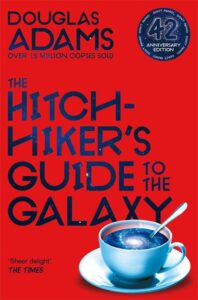 The Hitchhiker’s Guide to the GalaxyThe Hitchhiker’s Guide to the Galaxy is a 1979 comic science-fiction novel by Douglas Adams. Its protagonist Arthur Dent survives the destruction of Earth and travels through space with Ford Prefect, encountering Zaphod Beeblebrox,…
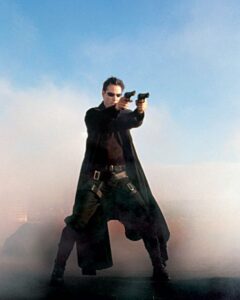 The MatrixThe Matrix presents Neo’s ordinary experienced world as a computer-generated or neural-interactive construct maintained by a machine system. The film repeatedly distinguishes the operative rules of that construct from whatever lies outside it: Morpheus…
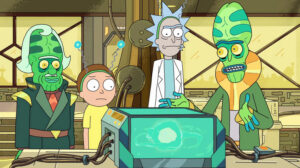 The Ricks Must Be Crazy — Rick and MortyThe episode centers on the microverse battery inside Rick’s car, where a civilization generates power without understanding its relationship to Rick’s larger system.
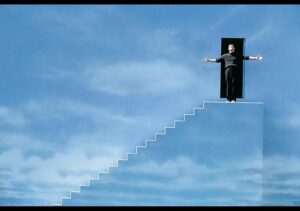
 The Truman ShowThe Truman Show presents Truman Burbank living unknowingly inside a constructed television environment whose town, relationships, routines, and physical conditions are organized by a production system around him. The film repeatedly exposes that system…
Showing 8 linked Index instances.
Follow the mechanism
Moves from
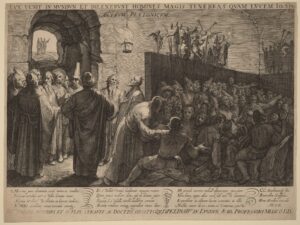 Conceptual CaptureConceptual capture occurs when naming, categorizing, measuring, or explaining stops serving relation and begins enclosing the living field inside fixed terms.
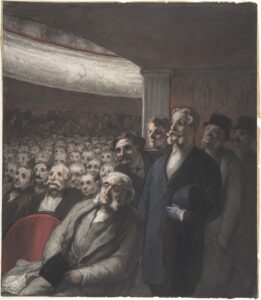 Image WorldImage World names a symbolic environment in which representation becomes the dominant medium through which reality, value, identity, and belonging are encountered.
See also
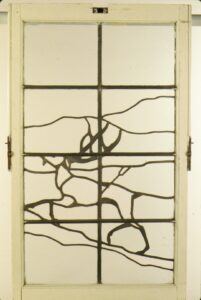 Transparent Form / Window, Not PossessionTransparent Form is a symbol, image, role, institution, or structure that remains usable precisely because it points beyond itself rather than demanding finality.
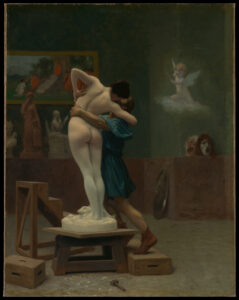 Living SymbolA living symbol is a form that continues to mediate depth, relation, and transformation rather than collapsing into a fixed shell or decorative sign.
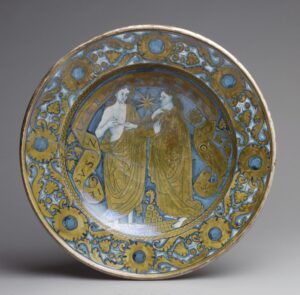 Direct SeeingDirect Seeing is contact with experience before immediate naming, interpretation, symbolic classification, or self-positioning takes over.