Most of what feels natural did not arrive that way.
You learn how to speak in one room and differently in another. You learn which expression gets rewarded, which emotion gets punished, what kind of confidence earns approval, what kind of silence keeps the peace. You learn a profession until the motions happen before you think about them. You learn a family role until everyone expects you to keep playing it. You learn the path home so completely that you can arrive with almost no memory of the drive.
None of this makes the learning false. That is the first distinction.
The problem begins when familiarity is mistaken for sourceIs — SourceIs names unclaimed being: awareness before possession, distinction, or identity.Read full entry →.
There is a reason the phrase second nature works so well. Repetition can make an acquired pattern feel native. What once required attention becomes automatic. What once felt like a choice begins to feel like character. Eventually the history of the pattern disappears behind the sentence: this is just who I am.
Geomytha places the pressure there. Not on nurture itself. On the claimI — ClaimI names claim: the interruption by which reflected presence is taken as mine.Read full entry →.
The World That Has Always Been There
The Truman ShowThe Truman ShowThe Truman Show presents Truman Burbank living unknowingly inside a constructed television environment whose town, relationships, routines, and physical conditions are organized by a production system around him. The film repeatedly exposes…Read full entry → gives the mechanism an almost perfect external form. Truman does not wake each morning consciously choosing Seahaven as his reality. Seahaven is simply the world that has always been there. Its streets, routines, relationships, fears, and permissions have become ordinary through continuity. The constructed environment does not need to announce itself as constructed. Its greatest strength is that it feels normal.
The MatrixThe MatrixThe Matrix presents Neo’s ordinary experienced world as a computer-generated or neural-interactive construct maintained by a machine system. The film repeatedly distinguishes the operative rules of that construct from whatever lies outside…Read full entry → pushes the same idea into a more violent register. The simulated world works because it is experienced as the baseline. The captive person does not compare the Matrix with reality every morning and choose the Matrix again. The comparison is unavailable until the frame itself becomes visible. AFI’s synopsis describes the captive humans as experiencing a simulation that presents itself as ordinary late-twentieth-century life. That is precisely why the metaphor endures: a constructed field can disappear by becoming familiar enough.
But Geomytha has to stop one step short of the movies.
The lesson cannot be that conditioning is the fake world and some untouched natural self is the real one. That simply replaces one identityThis — IdentityThis names the formed identity: the body, role, image, wound, belief, or story claimed as what the self is.Read full entry → with another. “I am conditioned” becomes “I am pure beneath conditioning.” The claimantSetIn Geomytha, Set names the claimant: I — the interruption by which reflection is taken as mine and converted toward ownership.Read full entry → survives; it has only changed costumes.
Nature is not automatically true. Nurture is not automatically false.
Nurture Is Content, Not a God
This matters because the Geomytha grammar cannot be reduced to a code in which every category of experience belongs to one figure. OsirisOsirisIn Geomytha, Osiris names reflected presence: Am — awareness reflected as living consciousness without yet becoming ownership.Read full entry → cannot simply mean nurture. HorusHorusIn Geomytha, Horus names the identity that forms after claim: This — the body, role, image, wound, belief, or story taken as what the self is.Read full entry → cannot simply mean whatever was learned. Set cannot simply mean culture. That would turn a relational grammar into a filing cabinet.
Within Geomytha, the more useful question is not what kind of content is this? but what is happening to the content?
A learned discipline can be reflected clearly. A habit can be useful. A tradition can preserve wisdom. A professional role can organize skill. A social rule can protect other people. The fact that something was acquired does not make it distortion.
The movement changes when the acquired thing becomes a claimant.
What was once “a way I learned to respond” becomes “the kind of person I am.” What was once “a role I perform” becomes “me.” What was once “a belief I inherited” becomes something that must be defended as if questioning it were an attack on existence itself.
This is where the old Geomytha mechanism of claim hardening into identityClaim Hardening into IdentityClaim hardens reflected presence into identity when I takes an appearance, role, body, wound, belief, story, insight, or other form and fixes it as This: the self-defining object in the sentence “I…Read full entry → becomes useful. The pattern is not the problem because it exists. The problem is that the pattern has acquired ownership language.
Second nature has been mistaken for first nature.
Horus Calls It “Me”
In Geomytha, Horus belongs to This: formed identity, the thing that can be pointed to, named, defended, carried into the world. That does not make Horus evil. Form is necessary. Identity is useful. A person who could never stabilize a role, promise, skill, boundary, or name would not be liberated; they would be unable to function.
The distortion is subtler.
Horus takes what has formed and says, “me.”
That sentence can be perfectly practical. It can also become a lock.
The difference appears when the form is challenged. Can the role change without the person experiencing the change as annihilation? Can the belief be revised without the entire self rushing to defend it? Can a habit be seen as a habit, or must it immediately become evidence of identity?
This is why the real axis is not nature versus nurture. It is relation versus possession.
The Heart and the Feather
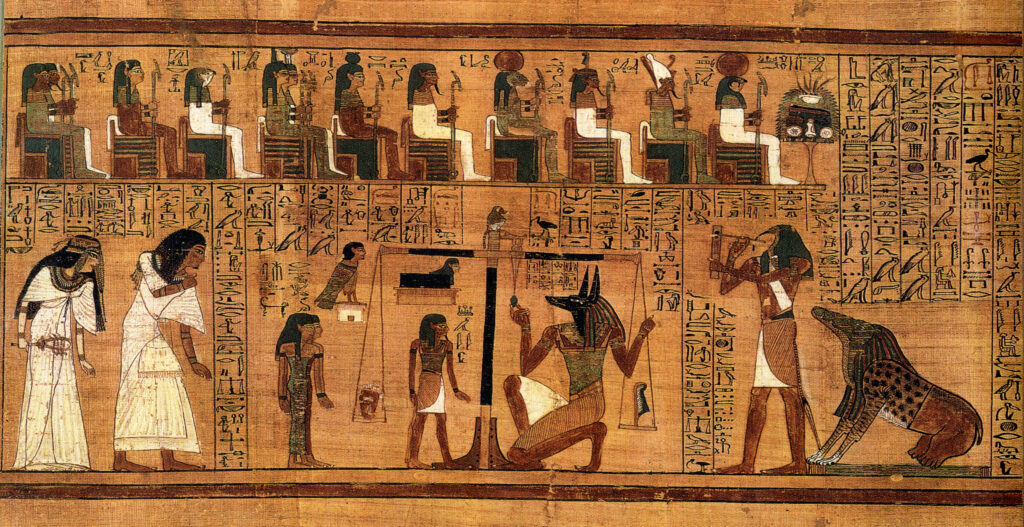
The strongest historical image for this article is not a modern diagram of conditioning. It is much older: the judgment scene in the Papyrus of AniPapyrus of Ani — Weighing of the HeartThe British Museum identifies the scene as Ani’s Judgment in the Hall of Judgment. Ani’s heart is weighed against a feather representing Ma’at, truth and order. The scene belongs to the ancient…Read full entry →.
The British Museum identifies frame 3, EA10470,3, as Ani’s judgment. Ani’s heart appears in one pan of a balance. In the other is a feather representing Ma’atMa’at — Truth, Balance, and OrderEgyptian principle/deity of truth, balance, and right order.Read full entry →, the divine personification of truth and order. AnubisAnubis — Egyptian Funerary DeityEgyptian deity associated with funerary rites and the weighing scene.Read full entry → attends the scale while ThothThoth — Egyptian Deity of Writing and ReckoningEgyptian deity shown recording the result in the weighing scene.Read full entry → stands ready to record the result. UCL places the weighing scene within the context of Book of the Dead Chapter 125, and a separate papyrus of Tiye at The Metropolitan Museum of Art preserves the same broader judgment tradition.
That is the documented Egyptian material.
Geomytha’s use of it begins only after that boundary is kept intact.
Geomytha does not claim that the Egyptians were secretly teaching a modern theory of conditioning, trauma, genetics, or nature and nurture. The scene is useful because it gives the modern symbolic question a disciplined image: what has become heavy enough to require weighing?
Not: is this learned?
Not: is this natural?
Not even: is this good or bad?
The sharper question is whether a formed pattern still serves relation, or whether it has become something that must be possessed and defended because it now owns the word me.
In that sense, the feather does not represent “nature.” Ma’at is not a shortcut back to some imaginary untouched personality. The Geomytha reading is better if the scale remains a scale: a test of proportion, order, and relation.
What happens when the identity is no longer allowed to grade itself?
Return Is Not Erasure
This is where “returnReturn — RemembranceReturn names remembrance and release: the loosening of possession so reflection can become transparent to source again.Read full entry → to baseline” can become misleading if the phrase is handled carelessly.
There may be no recoverable human personality that existed before all influence. Language is learned. Manners are learned. Skills are learned. Relationships change us. Pain changes us. Love changes us. Repetition changes us. Even the attempt to strip all of that away can become another identity project: the person who is now attached to being unconditioned.
Return therefore cannot mean deleting nurture.
It means seeing conditioning as conditioning.
That sounds smaller, but it is more demanding. Erasure lets the self declare an enemy and fight it. Recognition removes the drama. The habit can remain without being sovereign. The role can remain without becoming essence. The training can remain without becoming a prison. The story can remain available as history without demanding to become destiny.
Within the Geomytha grammar, that is the corrective movement from This back toward Am: from hardened identity into reflectionAm — ReflectionAm names reflected presence: awareness embodied or mirrored without yet becoming ownership.Read full entry →. The thing does not have to vanish. It has to become visible again.
The Stress Test
Consider a learned discipline that makes someone more dependable. They practice arriving on time, controlling an impulse, listening before speaking, or mastering a craft. ThoseThose — ProjectionThose names projection: enemies, outsiders, competitors, threats, and disowned qualities placed beyond the identity boundary.Read full entry → are acquired patterns. They may be deeply beneficial. Calling all nurture distortion would force Geomytha into the absurd position that improvement is corruption simply because it was learned.
Now reverse it. Consider an impulse that feels completely spontaneous and “natural.” Its naturalness does not make it wise. An urge can be immediate, familiar, embodied, and still destructive.
So neither side of the old binary can carry the moral weight.
The question has to move elsewhere.
Does the pattern remain available to reflection?
Can it be revised?
Can it be set down?
Can it serve without becoming the claimant?
If the answer is yes, then second nature can remain useful precisely because it is no longer pretending to be first nature.
Refine What Repetition Has Built
Waxing Gibbous builds. Virgo refines.
That combination gives this idea its practical pressure. Repetition has already done the building. It has already magnified the pattern. The work now is not to smash the structure and call the rubble freedom. The work is to refine the distinction that repetition blurred.
When a familiar reaction appears, ask what kind of thing it actually is. Is this something I use? Something I learned? Something I inherited? Something I practice? Or something I now defend because I have allowed it to own the word me?
The point is not to become a person with no second nature.
The point is to stop confusing second nature with source.
Nurture can become second nature.
Horus can call second nature “me.”
And the scale can still ask whether “me” needs to be carried as heavily as it is.